Banner with Tolkien Experience Logo

TEP #4 – James Tauber

Our next guest on the Tolkien Experience Podcast wears many, dare we say geeky, hats. He is the founder and CEO of Eldarion, he helps develop tools for the digital humanities, he loves ancient languages, and he is the creator of DigitalTolkien.com: James Tauber!

james-tauberAll of James’s projects are impressive, but perhaps the one that most of our listeners will be drawn to is his work at DigitalTolkien.com. There James has been working on analyzing textual variants in The Silmarillion. He has also been working to apply the tools used in other areas of digital humanities to Tolkien’s texts. You can visit his website, or listen to the episode, for more information about these projects. We are delighted that he could join us!

Please consider supporting the Podcast on Patreon!

Subscribe to the podcast via:

Comments or questions:

  • Visit us at Facebook or Twitter
  • Comment on this blog post
  • Send us an e-mail from the contact page
  • Email TolkienExperience (at) gmail (dot) com

You can see James’s Tolkien projects at DigitalTolkien.com and find links to his other work at his personal website.

He also mentioned the Elvish Linguistic Fellowship.

Catherine Warr’s Experience–Tolkien Experience Project (92)

This is one in a series of posts where the content is provided by a guest who has graciously answered five questions about their experience as a Tolkien reader. I am very humbled that anyone volunteers to spend time in this busy world to answer questions for my blog, and so I give my sincerest thanks to Catherine and the other participants for this.

To see the idea behind this project, check out this page

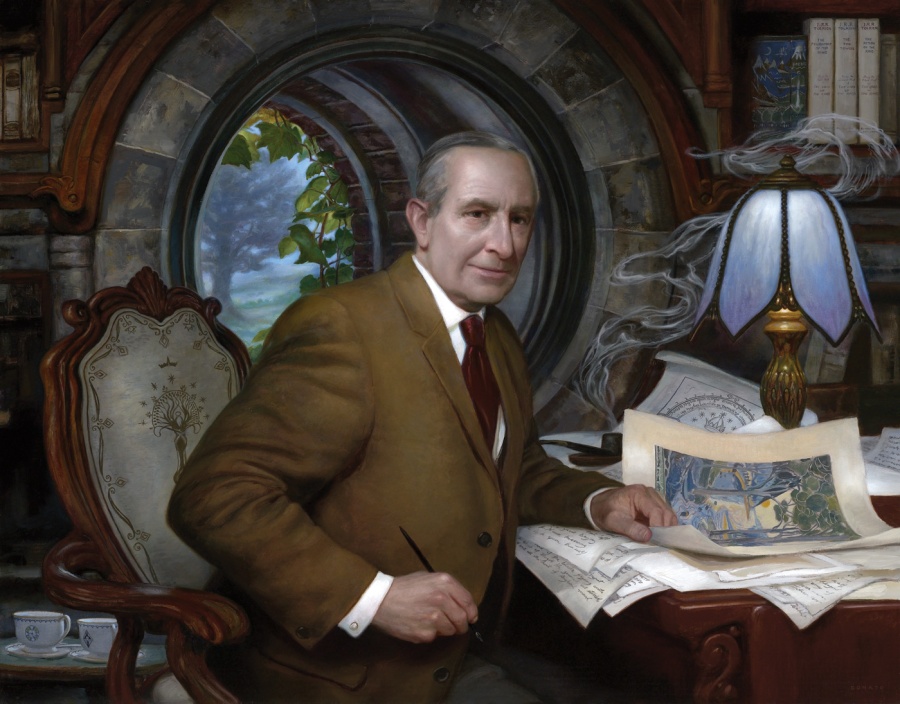
I want to thank Donato Giancola for allowing me to use his stunning portrait of J.R.R Tolkien as the featured image for this project. If you would like to purchase a print of this painting, they are available on his website!

If you would like to contribute your own experience, you can do so by using the form on the contact page, or by emailing me directly.

Now, on to Catherine Warr’s responses:


1. How were you introduced to Tolkien’s work?

I remember the moment very clearly. I hadn’t watched or read anything Tolkien when I was little, and the first time I experienced it was when I was walking round a car boot sale when I was very young, when out of the corner of my eye I spotted the DVD of The Fellowship of the Ring. I hadn’t a clue what it was, but, being interested in knights and castles and all things fantasy, I thought I’d give it a shot. I was hooked immediately.

2. What is your favorite part of Tolkien’s work?

I touch on this in a later question, but the depictions of the Shire and Rohan always were particularly powerful for me. The Shire was quintessential, picture-postcard England, a romanticised, pre-Industrial Arcadia which nevertheless touched on something real. The fight for survival of the Shire always struck me particularly powerfully as I view the same thing to be happening today. I’ve come to appreciate that latter aspect more nowadays, as I’m older. When I was younger, I was obsessed with Rohan – I just loved the aesthetic and how it mirrored the Anglo-Saxons.

Finally, growing up as a tomboy, I was always incredibly grateful for characters like Eowyn who weren’t typical girls, because I could finally relate to her. I hated dolls and dresses and makeup, and whereas most fantasy stories have their female princesses obsessed with exactly that, I was finally happy to have a fictional female character who legitimised my own interests – showing me it was okay for me to want to play with swords.

3. What is your fondest experience of Tolkien’s work?

Not an experience per se, but how it influenced me growing up. Every since I can remember, every week my parents took me out to visit a historic house, castle, museum, site of interest etc, and, as kids do, I would often project LOTR onto places I visited. Visiting a forest? I’d imagine epic battles between orcs and Aragorn. Visiting something Anglo-Saxon? That’s straight out of Rohan. LOTR was for a long time my obsession and informed, for a long time, my interpretation of the world. Tolkien’s Shire was the perfect, idealistic vision of the countryside I’d go for rides out in, and it still forms my mental image of perfect England – *my* England.

4. Has the way you approach Tolkien’s work changed over time?

I’ve found that, as I’ve got older, I’ve come to notice and understand the analogies and metaphors in The Lord of the Rings more than when I was a kid. When I was younger, it was just a jolly good fantasy romp. But now, I’ve come to appreciate the deeper meanings. For example, though not explicitly intended by Tolkien, the way characters describe the power of the Ring comes very close to descriptions of the power and effects of sin, and Tolkien’s Catholicism almost might have had something of a subconscious influence on this.

I’ve found his descriptions of the Shire particularly more powerful now, especially with the theme of the destruction of the countryside and ‘old ways’ of life for the purpose of advancements in technology and industry – it’s something I never grasped as a kid.

5. Would you ever recommend Tolkien’s work? Why/Why not?

Of course! It formed a huge obsession of mine as a kid and really shaped my interests and activities. LOTR often gets criticised for being too simplistic, too goodies-vs-baddies, in contrast to works like A Song of Ice and Fire. But I think that’s missing the point – we never, for example, say that Beauty and the Beast is unrealistic, because we understand that that was never the point or intention. LOTR is the most magnificent modern expression of the most fundamental theme in world storytelling – of the triumph of good over evil.


You can hear more from Catherine at her YouTube channel: Yorkshire’s Hidden History!

Publication: Review of Tolkien and the Classics (Open Access)

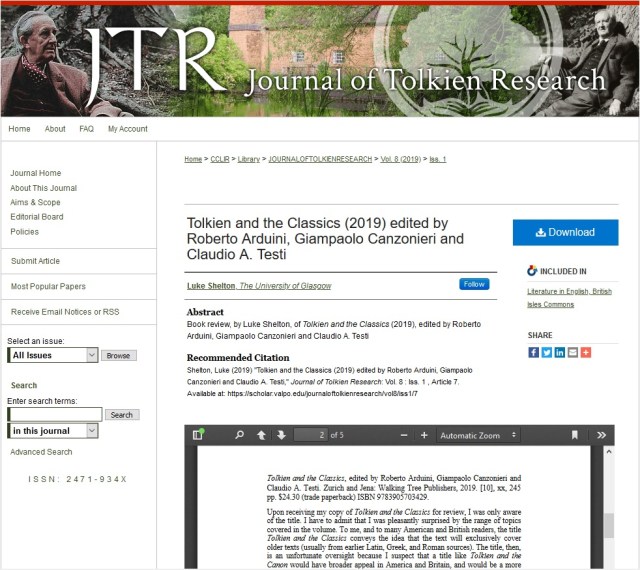
My review of Tolkien and the Classics edited by Roberto Arduini, Giampaolo Canzonieri and Claudio A. Testi has been published in the Journal of Tolkien Research!

Fortunately, this research is open access, so everyone can read the review on the journal website!

Their recommended citation is:

Shelton, Luke (2019) “Tolkien and the Classics (2019) edited by Roberto Arduini, Giampaolo Canzonieri and Claudio A. Testi,” Journal of Tolkien Research: Vol. 8 : Iss. 1 , Article 7.
Available at: https://scholar.valpo.edu/journaloftolkienresearch/vol8/iss1/7

If you are interested in purchasing the book, it is available from Amazon.

Tolkien and Classics on JTR

Phil Dean’s Experience–Tolkien Experience Project (91)

This is one in a series of posts where the content is provided by a guest who has graciously answered five questions about their experience as a Tolkien reader. I am very humbled that anyone volunteers to spend time in this busy world to answer questions for my blog, and so I give my sincerest thanks to Phil and the other participants for this.

To see the idea behind this project, check out this page

I want to thank Donato Giancola for allowing me to use his stunning portrait of J.R.R Tolkien as the featured image for this project. If you would like to purchase a print of this painting, they are available on his website!

If you would like to contribute your own experience, you can do so by using the form on the contact page, or by emailing me directly.

Now, on to Phil Dean‘s responses:


1. How were you introduced to Tolkien’s work?

Well it’s been the best part of forty years since I discovered Tolkien, so my recollection of this is slightly hazy. I do remember my parents buying me The Lord of the Rings as a gift, and I still have the rather battered and worn remains of these three books to this day – the 1981 Unwin editions, complete with the gorgeous cover art of Pauline Baynes. But I think prior to this I had been enthralled by a copy of The Hobbit I’d borrowed from the school library, attracted by Tolkien’s own marvelously evocative cover painting, which led to me spending an awful lot of time drawing mountain ranges of my own!

2. What is your favorite part of Tolkien’s work?

I’d have to say The Lord of the Rings. Because it’s such a lengthy tale, you get to immerse yourself in Middle-earth for such a long time, to the point where I find it really rather depressing to have to leave it at the end. I’ll try and find time to read it every year or two, and I never enjoy it any less for knowing it so well. But I find The Silmarillion to be a jaw-droppingly awesome piece of work, one which I’ve learnt to appreciate more and more the older I get. This is the real heart of Tolkien’s work, and it is a truly astonishing achievement. And I feel like it would be remiss of me not to mention “Leaf By Niggle,” a little work of genius which I think gives us a very insightful look at Tolkien himself.

3. What is your fondest experience of Tolkien’s work?

This is going to perhaps sound rather heretical to some, but spending a day at Hobbiton in New Zealand was amazing. I know that of course in reality it’s simply a movie set, but I loved Peter Jackson’s movies and – for good or bad – his superb visual representation of many of the locations in The Lord of the Rings have become embedded in my mind, and many others. Having an ale in The Green Dragon was brilliant, but standing outside Bag End brought a tear to my eye. “In a hole in the ground their lived a hobbit” – and there I was actually standing outside the front door of that hole. Sure, it’s not really that hole, but it felt like it was. I’ve travelled a lot and visited countless historical marvels, but this felt as real as any of them to me.

4. Has the way you approach Tolkien’s work changed over time?

Yes, very much so. First and foremost I love the stories for what they are – great stories, and that hasn’t changed at all. And I’ve always loved reading mythology and history, so I was able to appreciate what a great work The Silmarillion was outside of the stories themselves. But it wasn’t until I started listening to the podcasts of the Tolkien Professor (Corey Olsen) five or six years ago that I truly began to understand Tolkien’s work on a deeper level. Olsen revealed so many layers that I’d been hitherto unaware of, and it felt like I discovered the books all over again. Realising that Bombadil was actually speaking in a sort of accentual Anglo-Saxon verse blew my mind!

5. Would you ever recommend Tolkien’s work? Why/Why not?

Absolutely I would – at least to a certain type of person. Tolkien is one of the best writers at connecting us to something buried deep inside, to a world of faerie, of fantasy. To something other than everyday existence. I think the human mind needs this, and is much poorer when bereft of it. It is perhaps the one place we’re truly free. Of course many people are not going to read about elves or hobbits regardless of how good the story is, and that’s just fine – there are many other gateways to walk through!


You can find much more from Phil Dean on his website!

Excitement is Building for John Garth’s New Book!

John Garth’s new book The Worlds of J. R. R. Tolkien: The Places That Inspired Middle-earth is shaping up to be another must-own for Tolkien fans and scholars.

Worlds of JRRT cover Princeton smallIt is already rated the #1 New Release on Amazon in the Science Fiction History and Criticism genre, and it doesn’t release until June 2.

Garth gave a little bit of information about his book when he was on one of the live episodes of the Prancing Pony Podcast from Tolkien 2019 earlier this year.

Just this week, Tolkiendil (the French equivalent of the Tolkien Society) revealed a sneak peek inside the new book on Twitter:

In all, Garth is playing the publicity game very well right now, revealing enough detail to keep us very interested without giving the whole book away!

Given the success and acclaim of his first book, Tolkien and the Great War, expectations are high and I am confident that he will deliver!

Additionally, Garth published a shorter volume, Tolkien at Exeter College, in 2015 and you can purchase it on his website.

Banner with Tolkien Experience Logo

TEP #3-Andrew Higgins

Our next guest on the Tolkien Experience Podcast is a Tolkien scholar and linguist who has very quickly become influential in the field of Tolkien Studies: Dr. Andrew Higgins!

Hy9DGUAi_400x400Dr. Higgins completed his PhD on the evolution of J.R.R. Tolkien’s mythology in 2015. His doctoral research was a holistic examination of Tolkien’s earliest works in order to gain a new critical framework to examine Tolkien’s ‘early imaginative language invention’. He has also co-edited a critical edition of Tolkien’s A Secret Vice with Dimitra Fimi. This volume won the 2017 Tolkien Society Award for Best Book! We are delighted that he was able to be our guest for the podcast, and we hope you enjoy the interview!


Please consider supporting the Podcast on Patreon!

Subscribe to the podcast via:

Comments or questions:

  • Visit us at Facebook or Twitter
  • Comment on this blog post
  • Send us an e-mail from the contact page
  • Email TolkienExperience (at) gmail (dot) com

You can find the Elvish Linguistic Fellowship at elvish.org

Links to some of Dr. Higgins’s open-access articles are available at the Journal of Tolkien Research.

Tolkien Sessions at The International Medieval Conference at Kalamazoo 2020

The program preview for the 55th International Congress on Medieval Studies at Western Michigan University has been up for a little while now, and I thought I would share the Tolkien-themed panels that are a part of the program!

The conference takes place May 7- 10

Thanks to Tales after Tolkien, Tolkien at Kalamazoo, The Fantasy Research Hub at the University of Glasgow, William Fliss, and Elizabeth A. Terry-Roisin for organizing the panels!


On Thursday, May 7:

10:00am–“Medieval World-Building: Tolkien, His Precursors and Legacies”

The papers will be:• Tolkien, Robin Hood, and the Matter of the Greenwood,
Perry Neil Harrison, Fort Hays State Univ.
• Valinor in America: Faerian Drama and the Disenchantment of Middle-earth, John D. Rateliff, Independent Scholar
• Tolkien’s Golden Trees and Silver Leaves: Do Writers Build the Same World for Every Reader, Luke Shelton, Univ. of Glasgow
• Infinity War of the Ring: Parallels between the Conflict within Sauron and Thanos, Jeremy Byrum, Independent Scholar


On Friday, May 8:

1:30pm–“Deadscapes: Wastelands, Necropoli, and Other Tolkien-Inspired Places of Death, Decay, and Corruption (A Panel Discussion)”

The papers will be:• Sites of Memory in Robin Hobb’s Realm of the Elderlings,
Geoffrey B. Elliott
• Death and Politics in the Fourth World: Apocalypse and Recovery in the Earthdawn Roleplaying Games, Karol Rybaltowski, FASA Games, Inc.
• “Beorhtnoth we bear, not Beowulf”: Descriptive Restraint in The Homecoming of Beorthnoth, Beorhthelm’s Son, Brian McFadden, Texas Tech Univ.
• “Filled with Echoes”: Norse and Celtic Elements of Tolkien’s Early Realms of the Dead, Amy M. Amendt Raduege, Whatcom College

6:00pm–Tales after Tolkien Society Business Meeting


Saturday, May 9

10:00am–“Tolkien and Se Wyrm”

The papers will be:• A Womb of One’s Own: The Power of Feminine Spaces over the Mythical Phallus, Annie Brust, Kent State Univ.
• Signum Draco Magno Scilicet, or, Earendel and the Dragons: Heavenly Warfare in Medieval European and Tolkienian Annals, Kristine Larsen, Central Connecticut State Univ.
• Of Serpents and Sin, Michael A. Wodzak, Viterbo Univ.

12:00pm–Tolkien at Kalamazoo Business Meeting
1:30pm–“Tolkien’s Paratexts, Appendices, Annals, and Marginalia (A Roundtable)”
The papers will be:
• Materiality in Tolkien’s Medievalism: The Production of Secondary Manuscript Traditions, Brad Eden, Independent Scholar
• A Letter To a Friend: The “King’s Letter” as Para-text in The Lord of the Rings, Andrew Higgins, Independent Scholar
• Finding and Organizing Tolkien’s Invented Languages,
Eileen Marie Moore, Cleveland State Univ.
Do Young Readers Care What Authors, Editors, or Publishers Think? Young Readers’ Engagement with Paratext and Epitexts of Tolkien’s The Lord of the Rings, Luke Shelton, East Tennessee State Univ.
• The Things He Left Behind: Signatures, Marginalia, and Ephemera in Tolkien’s Irish Library, Kristine A. Swank, Univ. of Glasgow.


3:30pm–“Tolkien’s Chaucer”

The papers will be:
• Romance and Sexuality in Tolkien’s Lost Chaucer, Yvette Kisor, Ramapo College
• Tolkien, Chaucer, and the History of Ideas, Sharin F. Schroeder, National Taipei Univ. of Technology
• Travel, Redemption, and Pilgrimage Redux, Victoria Wodzak, Viterbo Univ.


Sunday, May 10:

8:30am–“Tolkien and Manuscript Studies”

The papers will be:
• Cotton MS Vitellius A.XII and Tolkien’s “Asterisk” History of the Lord’s Prayer, John R. Holmes, Franciscan Univ. of Steubenville
• Tolkien, Manuscripts, and Dialect, Edward L. Risden, St. Norbert College
• God and the Artist: Francis Thompson (1859–1907) and Sub-Creation, Brad Eden, Independent Scholar

10:30am–“The End of Game of Thrones in History and Literature”

The papers will be:
• The End of Game of Thrones: Contra-Lewis and Tolkien, Knighthood, Kingship, and the Realm, Elizabeth A. Terry-Roisin
• George R. R. Martin’s Muscular Medievalism: Masculinity, Violence, and Fantasy, Steven Bruso, Endicott College
• Waking the Dragon: Daenerys’s Mad Turn and the Politics of Colonialism in Game of Thrones, Thomas Blake, Austin College


You can find the entire sneak preview of the program, if you like!

(Also, there will be a Tolkien symposium the day before the conference. I will post more details about that when I have them!)

Online Congress registration opens in February, I would love to see you there!

Paul Wulfrun’s Experience–Tolkien Experience Project (90)

This is one in a series of posts where the content is provided by a guest who has graciously answered five questions about their experience as a Tolkien reader. I am very humbled that anyone volunteers to spend time in this busy world to answer questions for my blog, and so I give my sincerest thanks to Paul and the other participants for this.

To see the idea behind this project, check out this page

I want to thank Donato Giancola for allowing me to use his stunning portrait of J.R.R Tolkien as the featured image for this project. If you would like to purchase a print of this painting, they are available on his website!

If you would like to contribute your own experience, you can do so by using the form on the contact page, or by emailing me directly.

Now, on to Paul Wulfrun’s responses:


1. How were you introduced to Tolkien’s work?

My Father (who had also read Tolkien as a child) bought me a fourth edition copy of The Hobbit from a thrift shop in our local area when I was around 6 years of age. It was old, a little beaten up, but it was the first book I ever owned that smelled like an actual book!

On that note, I would like to thank Craig Holland from 7C (as it states on the first page of my copy) for donating your book and giving me years of good reading since. This very week I have begun reading it to my two children for the first time and I hope that they find it as magical and enthralling as I did.

2. What is your favorite part of Tolkien’s work?

His ability to weave a story that seems ageless and wide. Even in his smaller works such as ‘Smith of Wootton Major’, through a mere 16 pages he crafts a world you can visualise and immerse yourself within.

Then, to truly craft a universe, he builds history and bloodlines, ties characters from the past to those of present day, allowing their tales to be woven into a tapestry equal to the epics of Indo-European mythology.

One of his many goals was to make a universe that felt commonplace within the history of our own and I believe he achieved this better than any author to date.

3. What is your fondest experience of Tolkien’s work?

The first time I heard Tolkien recite elvish for the first time. Specifically, ‘Namárië’ (more commonly known as ‘Farewell to Lorien’) whose lines are given to Galadriel within the texts.

Any time I hear elvish recited properly (be it Sindarin, Quenyan, Noldorin, etc) it is truly a beautiful and profound experience. Howard Shore’s fantastic soundscape for the films brought it to a whole new level.

As an aside, visiting a Tolkien Moot and a trip to New Zealand are two experiences sitting readily on my Bucket list!

4. Has the way you approach Tolkien’s work changed over time?

Being young when I was first entrenched into the world of Tolkien, my first reads focussed on the drama, the quicker paced areas surrounding war and battle. Now that I am older, I love sitting within the words of each paragraph, delving into them to understand the knowledge, pretence and prophecy that they hold within the story. The minds of Hammond, Scull, Olsen, Shippey and many more have allowed me to acquire further meaning and I love diving ever deeper into his mythos. To the point where I almost love The Silmarillion more than the main work.

I also love to collect quotes, of which the one I have chosen to ponder this week is;

Do not love the bright sword for its sharpness, nor the arrow for its swiftness, nor the warrior for his glory. I love only that which they defend: the city of the Men of Numenor. – Faramir

5. Would you ever recommend Tolkien’s work? Why/Why not?

As a teacher and educator, I always find myself recommending Tolkien’s works for one reason or another.

The Hobbit is a fantastic introduction to greater fiction for primary readers, with many of his lesser works adding to the library of resources that can be utilised to study English and writing. His works are so wonderfully crafted that all of them can scale accordingly for any year level.

From a personal point of view, I want people to read his work so I can discuss it with them, to inspire and give a story of hope within a masterfully crafted fantasy setting the likes of which we more than likely will not ever see again.

Luke Shelton mentioned on Tor.com!

Thanks to David Urbach for bringing this to my attention through the Tolkien Experience Facebook page!

00CIoTGK_400x400-300x300Megan N Fontenot has been writing an excellent series on the characters of Middle-earth on TOR.com since early 2019. If you haven’t been reading them, you should be! Megan has an exceptional ability to communicate complex ideas through language that is engaging and approachable.
In her article on Gandalf, published yesterday, Megan graciously cited my work on young readers of LOTR! I am humbled that she remembers my work, and excited for the mention!

In return, I would like to use my own platform, small as it may be, to remind everyone that Megan is an award-winning scholar, having won the Alexei Kondratiex Award for best student paper at the 2018 Mythcon. Here paper was entitled “‘No Pagan ever loved his god’: Tolkien, Thompson, and the Beautification of the Gods” and is available to read online!

Megan and I met at the 2018 Mythcon in Atlanta, GA, and have communicated several times since. (We have even discussed working together on a couple of articles!) She is a remarkably kind and insightful scholar, writer, and person, and I really encourage you to follow her scholarship!

She maintains a profile on hcommons where you can see more of her work!

Publication: “Tehanu” in the Literary Encyclopedia

Hello everyone!

41MArMDkeHL._SY291_BO1,204,203,200_QL40_ML2_

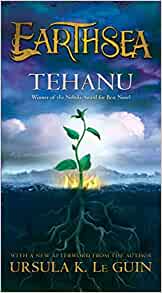
I am excited to share with you that my entry for Ursula K. LeGuin’s Tehanu has been published in the Literary Encyclopedia!

The article is available now, but unfortunately it is a subscription service. Check with your local institutions to see if they have access!

In summary, the entry gives an overview of the plot of the work, discusses the cultural climate around its publication, summarizes the critical response to the work, and then traces a few key themes.

This is one of my favorite series, so it was a joy to revisit the book. The whole process was a fun experience, and one that I hope to repeat soon!