Maria Helena Barrera-Agarwal’s Experience–Tolkien Experience Project (86)

This is one in a series of posts where the content is provided by a guest who has graciously answered five questions about their experience as a Tolkien reader. I am very humbled that anyone volunteers to spend time in this busy world to answer questions for my blog, and so I give my sincerest thanks to Maria and the other participants for this.

To see the idea behind this project, check out this page

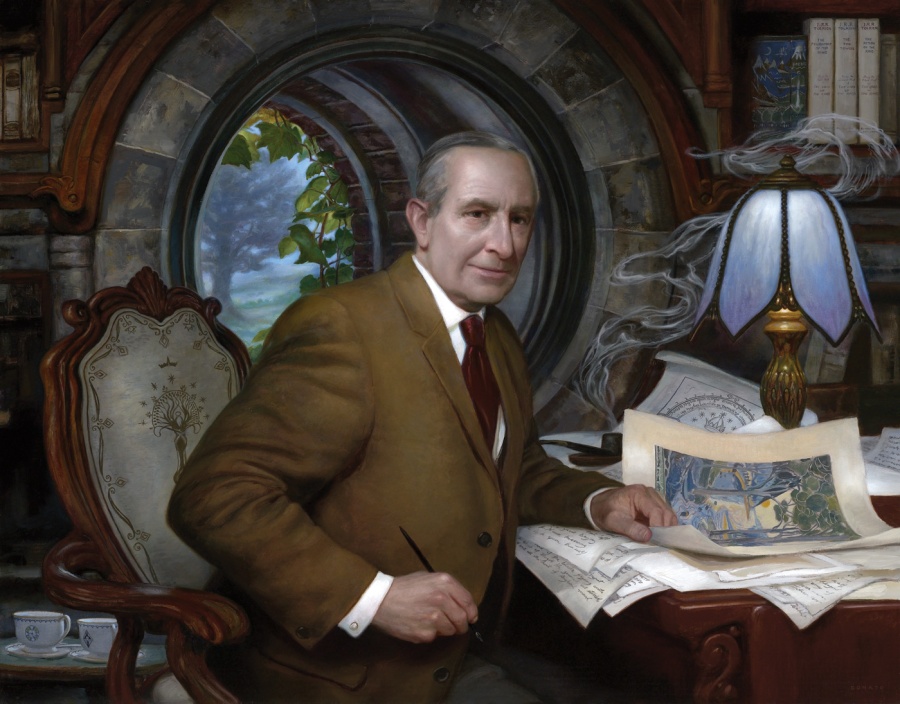
I want to thank Donato Giancola for allowing me to use his stunning portrait of J.R.R Tolkien as the featured image for this project. If you would like to purchase a print of this painting, they are available on his website!

If you would like to contribute your own experience, you can do so by using the form on the contact page, or by emailing me directly.

Now, on to Maria Helena Barrera-Agarwal’s responses:


1. How were you introduced to Tolkien’s work?

I was around nineteen years old, a law student in Quito, Ecuador. I had been a voracious reader since childhood. There were nice bookstores in the city, but none better than Librería Cima, at the time close to the La Alameda park. I had a good friend working there, Ecuadorian bibliophile and author Edgar Freire. I was visiting one day and, as usual, he allowed me to check the basement where they kept some of the books in stock. There I found the three-volume soft cover edition of Lord of the Rings, edited in Spanish by Minotauro, kept together with an elastic band. I had not heard of the author before but was immediately interested. I got the books upstairs and showed them to Edgar. He told me he had been keeping them for himself, but was happy to allow me to buy them. I did not have all the cash at that time – they were expensive – so I came back later in the week and purchased the books.

2. What is your favorite part of Tolkien’s work?

I think I never got over the first pages of The Fellowship of the Ring. I was about to reach the irresponsible tweens that are referred to in the very first page and had a rather nebulous wish to explore and to travel. The book spoke so clearly to my intentions. I still consider it a turning point in my life.

3. What is your fondest experience of Tolkien’s work?

My fondest experience was purchasing The Lord of the Rings for my nine-year-old son. I had spoken about Tolkien so much that he wanted to read his books. I was cautious – he was so young – but relented after some time. He read them and Tolkien became his favorite author.

4. Has the way you approach Tolkien’s work changed over time?

I reread The Lord of the Rings in my late thirties, in New York, after acquiring English as my fourth language. It was a rediscovery. I loved the translation into Spanish, made by Doménech, but reading the original later in life was a rather different experience. My early interest for change and travel had been fulfilled, and I could perceive, beyond the adventures, the undertones of Tolkien’s spiritual and philosophical ideas. I was also more attuned with the historical background of the books and the complexity of their linguistic content.

5. Would you ever recommend Tolkien’s work? Why/Why not?

Very few books can compare to Tolkien’s. I have recommended his works and will continue to do so, for I do believe it is a privilege and a joy to be able to inhabit these pages as a reader. It is an experience that enriches you in so many, unexpected ways.


You can follow Marie Bretagnolle on Facebook!

Marie Bretagnolle’s Experience–Tolkien Experience Project (85)

This is one in a series of posts where the content is provided by a guest who has graciously answered five questions about their experience as a Tolkien reader. I am very humbled that anyone volunteers to spend time in this busy world to answer questions for my blog, and so I give my sincerest thanks to Marie and the other participants for this.

To see the idea behind this project, check out this page

I want to thank Donato Giancola for allowing me to use his stunning portrait of J.R.R Tolkien as the featured image for this project. If you would like to purchase a print of this painting, they are available on his website!

If you would like to contribute your own experience, you can do so by using the form on the contact page, or by emailing me directly.

Now, on to Marie Bretagnolle’s responses:


1. How were you introduced to Tolkien’s work?

I discovered Tolkien thanks to Peter Jackson’s movie adaptations. I was too young to see the first two in the cinema, but my grand-parents took me to see The Return of the King, which felt like a quest of my own. I didn’t dive into the books right away. Instead, I found myself in a bookshop one day, and at the bottom of some shelves I spotted Alan Lee’s Sketchbook for The Lord of the Rings. To this day it is probably the book I’ve read and loved the most. Even more than the movies, I think it was Alan Lee who opened the door to Middle-earth for me.

2. What is your favorite part of Tolkien’s work?

What I love about Tolkien is the depth of his creation. There is always information to be found somewhere about an obscure reference made in passing in one of the stories.

I also love how he inspires other creatives, artists of all kinds, in endlessly different styles.

3. What is your fondest experience of Tolkien’s work?

Since I can’t remember reading The Lord of the Rings in French for the first time, I cling to the memory of reading it for the first time in English while on a language stay in England. While my friend frolicked in the (cold) waves after class, I stayed safely dry on the beach and read about the fellowship’s journey.

As for The Silmarillion, I remember my first experience (in French too) though I cannot date it. It mesmerized for three whole days, making me forget about meal-times, and baffling me with endless lists of characters. I was completely lost and couldn’t remember who was whom long enough to understand what was going on, but the story enthralled me and when it ended I closed the book as one wakes from a deep sleep.

More recently, attending my first Oxonmoot in 2018 and being given the opportunity to present my research at Tolkien2019 in Birmingham have been experiences which will stay with me for a long time.

4. Has the way you approach Tolkien’s work changed over time?

Definitely. I’ve been reading his works for pleasure for years, but at university I discovered they were a perfectly acceptable subject of research. I did a Master’s degree in contemporary Art for which I studied Alan Lee’s illustrations for the Centenary edition of The Lord of the Rings. In these two years, I only scratched the surface of a deep field of study, so I am now in the third year of my PhD, writing a thesis on interior illustrations for British and American editions of Tolkien’s Middle-earth narratives. I’m happy to report it has not diminished my reading pleasure!

5. Would you ever recommend Tolkien’s work? Why/Why not?

I would recommend Tolkien’s works, but maybe not for everyone, and I wouldn’t recommend the same stories for everyone. For people with an interest in fantasy, depending on their preferences or age I’d recommend to start either with The Hobbit or The Children of Húrin. For people not used to reading fantasy, I’d recommend Leaf by Niggle. It is one of my favourite piece of writing by him.


You can follow Marie Bretagnolle’s PhD work on her blog, or you can follow her on Twitter!

Prancing Pony Podcast Partners with Tolkien Experience

Last week, we told you that Sara Brown was joining Tolkien Experience. This week we are delighted to share another important partnership as we prepare for a big change (that we will announce next week)!

smaller ppp logoWe have partnered with The Prancing Pony Podcast to help us bring something new and exciting to The Tolkien Experience!

The Prancing Pony Podcast (PPP) is a weekly podcast hosted by Alan Sisto and Shawn E. Marchese. Each week, they discuss a part of Tolkien’s Middle-earth Legendarium, and they have been going strong for almost 150 episodes!

Luke has been an avid fan of their podcast from the beginning and would recommend their unique blend of research and quirky humor to any Tolkien fan!

We are delighted to partner with them to bring you a brand new way to interact with the Tolkien Experience. Want to see what that looks like? Come back again next Friday for our big reveal!

Casey Hilsee’s Experience–Tolkien Experience Project (84)

This is one in a series of posts where the content is provided by a guest who has graciously answered five questions about their experience as a Tolkien reader. I am very humbled that anyone volunteers to spend time in this busy world to answer questions for my blog, and so I give my sincerest thanks to Casey and the other participants for this.

To see the idea behind this project, check out this page

I want to thank Donato Giancola for allowing me to use his stunning portrait of J.R.R Tolkien as the featured image for this project. If you would like to purchase a print of this painting, they are available on his website!

If you would like to contribute your own experience, you can do so by using the form on the contact page, or by emailing me directly.

Now, on to Casey Hilsee‘s responses:


1. How were you introduced to Tolkien’s work?

I am one of those folk, perhaps more common these days, who grew up with the movies and not the books. When I was maybe 7 or 8 I was captivated by Jackson’s adaptation of Fellowship and spent my childhood watching the films regularly. I did give The Lord of the Rings book a shot but didn’t make it past the first chapter. When I got to college I began reading a lot of C.S. Lewis and began learning a bit about his life, with a particular focus on the Inklings. I knew he and Tolkien were friends, and since I loved the films, I decided to give Tolkien a go, reading The Hobbit aloud to my now-wife. We absolutely loved it. I promptly spent Christmas break reading The Lord of the Rings, The Silmarillion, and Carpenter’s biography. It has turned into a full-on obsession and I haven’t looked back.

2. What is your favorite part of Tolkien’s work?

My favorite part of his work is the way he’s able to weave what he believed and saw as ideal into his works and characters without it diminishing the quality and vastness of what he was doing. It’s a truly inspirational book, one that encourages me to strive to be a more noble man, a better husband and father, a more faithful Christian. He paints a beautiful portrait of what is good, true, and beautiful.

3. What is your fondest experience of Tolkien’s work?

It’s definitely reading The Hobbit out loud to my wife when we were engaged. It was a wonderful shared experience, one we still recall to this day. We still share many conversations about Middle-earth and Tolkien’s mythology.

4. Has the way you approach Tolkien’s work changed over time?

It absolutely has. I initially read it as just another fantasy novel, the grandfather of modern fantasy for sure, but not much more. After reading it and discovering The Silmarillion my view changed. I also discovered the academic side of Tolkien fandom, as well as the breadth of Tolkien’s work, such as his translation of Beowulf and “On Faerie Stories,” which has led me to analyze the texts in such a different way than I do any other novel I’ve read. Thank you especially to Shawn and Alan at the Prancing Pony Podcast for introducing me to the vast world of Tolkien fandom out here!

5. Would you ever recommend Tolkien’s work? Why/Why not?

Absolutely! I definitely think his works are worth at least trying out. He’s still hovering over every single conversation about the greatest books in the English language and over every discussion of fantasy novels. His influence is inescapable. I would definitely recommend different things to different people based on where they’re at and what they like, but I do recommend him every chance I get. If you know me in person and I haven’t recommended a Tolkien book to you yet, we just haven’t spent enough time together!


You can talk to Casey about all things Tolkien on Twitter or Reddit!

Dr. Sara Brown Joins Tolkien Experience

I told you this month would have a lot of exciting announcements for the Tolkien Experience!

bio-sara_brown-263x263The big reveal I have for you today is that Dr. Sara Brown has graciously agreed to join me so that, together, we can make the Tolkien Experience even better! I am thrilled to work with such an excellent scholar and an even better person!

I have known Sara for five years, since she was a preceptor in a course I took at Signum University. Since then, our research interests have overlapped several times, and I am excited for the chance to collaborate with her on a project that we are both enthusiastic about!

Sara Brown is an educator and Tolkien scholar. You can find a short bio of Sara in the Signum University directory, where she acts as both a professor and administrator.

To welcome Sara to the community, you can follow her on Twitter!

Roman’s Experience–Tolkien Experience Project (83)

This is one in a series of posts where the content is provided by a guest who has graciously answered five questions about their experience as a Tolkien reader. I am very humbled that anyone volunteers to spend time in this busy world to answer questions for my blog, and so I give my sincerest thanks to Roman and the other participants for this.

To see the idea behind this project, check out this page

I want to thank Donato Giancola for allowing me to use his stunning portrait of J.R.R Tolkien as the featured image for this project. If you would like to purchase a print of this painting, they are available on his website!

If you would like to contribute your own experience, you can do so by using the form on the contact page, or by emailing me directly.

Now, on to Roman’s responses:


1. How were you introduced to Tolkien’s work?

I’m from Russia, and Tolkien’s universe has been with me since I was a really little child. I remember when we lived with my parents in their old apartments, before I was 4 years old. And already at that time I was a fan! I had watched all of Peter Jackson’s trilogy! I don’t remember any moments of my life, in which I didn’t know about Middle-earth.

2. What is your favorite part of Tolkien’s work?

You remember Lurtz? The big orc who killed Boromir? He was the symbol of “Fellowship of the Ring” to me. When I wanted to watch the movie in childhood, I would just call my mom and say: “mom, I wanna watch “Lord of the Rings! With orcius!” (yea, I called him orcius.) The symbol of the second film was definitely Lorien’s elves. You remember their movements, when they entered Helm’s Deep? Yes, I liked to repeat them. It amused the parents very much! And the third film hasn’t a symbol, because my disk was very bad and the DVD-player wouldn’t play it, so I had to watch that film later.

3. What is your fondest experience of Tolkien’s work?

I was read a books when I was… Maybe 9-10 years old. We read it with my dad. It was very interesting to compare the film and books, and now I can accurately say what they do and do not do better. On one hand, Tom Bombadil was cut from films, on the other Peter Jackson’s films remain masterpieces for all times. So I guess I really like both 🙂

4. Has the way you approach Tolkien’s work changed over time?

You know, Luke, I’m telling you very personal thoughts. When I feel bad, I’m literally transported THERE. I imagine I’m a hobbit, and I walk down Hobbiton to my hole, with the garden in front of it. Watching the sunset, Smoking “Old Toby,” and it’s just an amazing feeling. Tolkien was able to create a world that helps me every moment of my life. Movies that have been with me since I was a child, the books came a little later, but anyway, “Two Towers” is my favorite book of all time. The desire to be transported from this world somewhere there, far away from here.

5. Would you ever recommend Tolkien’s work? Why/Why not?

Tolkien Experience Project Update!

Hello, dear readers!

I wanted to take the opportunity to let you know that something very exciting is happening to the Tolkien Experience Project!

I wanted to share the news here first. I appreciate the fact that you follow my blog and I wanted to let my dedicated readers know before anyone else! I will be sharing this same announcement on social media later today.

A big change is coming in January and I am so excited I can barely contain the news!


For now, I wanted to let you know that I have changed some of the social media accounts for the Tolkien Experience Project:

–On Facebook, you will now find it as @TolkienExperience (if you are already following, this name change will not affect you!)

–I have created a dedicated Tolkien Experience Twitter account: @TolkienExp

–And a dedicated email address for it: TolkienExperience@gmail.com


Keep watching here and on the social media accounts for exciting updates and announcements all month long!

Again, thank you so much for your readership! The support of this community has meant a great deal to me since I started the blog.

–Luke

M.L. Corbier’s Experience–Tolkien Experience (82)

This is one in a series of posts where the content is provided by a guest who has graciously answered five questions about their experience as a Tolkien reader. I am very humbled that anyone volunteers to spend time in this busy world to answer questions for my blog, and so I give my sincerest thanks to M.L. Corbier and the other participants for this.

To see the idea behind this project, check out this page

I want to thank Donato Giancola for allowing me to use his stunning portrait of J.R.R Tolkien as the featured image for this project. If you would like to purchase a print of this painting, they are available on his website!

If you would like to contribute your own experience, you can do so by using the form on the contact page, or by emailing me directly.

Now, on to M.L. Corbier’s responses:


1. How were you introduced to Tolkien’s work?

My introduction to Tolkien’s work was twofold actually, as there was an introduction and a re-introduction. The first was when a classmate of mine mentioned a book called In de Ban van de Ring, the Dutch translation of The Lord of the Rings. It translates along the lines of enthralled by the ring and I thought that sounded utterly stupid and ignored it completely as I wasn’t into jewellery at all. A couple of years later, my best friend asked whether I wanted to go to the Peter Jackson and company’s film adaptation of something called The Lord of the Rings and I agreed as the trailer looked rather neat and exciting, and he was my best friend after all. The film amused us but my friend was slightly disappointed as lots of things from the book weren’t in it. At this time I didn’t really read anything besides football magazines, but I agreed to give it a try nonetheless. I was blown away by the richness, so I quickly moved on to my friend’s copies of The Two Towers and The Return of the King. I didn’t really get why there were appendices in a novel but was intrigued enough to pick up The Silmarillion. That turned out to be a grave mistake. It is an incredibly rich and stunning story, but I don’t think a teenage, non-native speaker of English is the perfect audience for it. At the same time I was in my final year of high school and back then to graduate you had to read an impressive pile of books. First fifteen books in Dutch which was fine until my teacher complained that I read too many humour books and should move on to more serious literature – so the fun vanished immediately. I also had to read twelve English books but was forced to read Daniel Defoe’s Robinson Crusoe which is an interesting, important and valuable read but certainly not when you’re a teenager. To add insult to injury there were also eight books in German on the list to read… In the end, I was so put off by reading that I didn’t touch a book for five or six years. After those dark years, I went to study English Language and Culture and one of the texts we had to study was “Ancrene Wisse” and on the list of secondary sources I found an essay by a certain Tolkien, J.R.R. That name rang a bell and it came back when I was introduced to “Sir Gawayn and þe Grene Knyȝt” and again when an unreadable poem titled “Beowulf” showed up. It was then that my interest was rekindled and I have read Tolkien continuously and extensively from that point onwards.

2. What is your favorite part of Tolkien’s work?

I have two favourites these days but after long and careful deliberation, I will say “Sellic Spell.” What Tolkien did perhaps even better than writing fantasy is reconstructing things to show how they might have been. Due to an illegible word, one of the most problematic parts in the Anglo-Saxon epic “Beowulf” is a thief stealing a golden cup from a dragon. So it’s hardly a surprise when you find out Bilbo nicks a cup from Smaug’s heap in The Hobbit. Tolkien argued that before this epic poem there must have been a folktale that would have explained certain things that don’t make much sense at first glance. Tolkien explains the character by the name of Handshoe in the story and its introduction for example. I love this in Tolkien’s works as it combines the two reasons I have for enjoying them. The first is pure entertainment but the second is from a more academic point of view: thinking about “Beowulf” in a particular way interests me.

I have to mention my second favourite now of course but will do so shortly. It is The Father Christmas Letters. I believe every parent reading those letters is thinking about doing the same thing for her or his offspring (even when they know they can’t really pull it off).

3. What is your fondest experience of Tolkien’s work?

My master thesis was on Tolkien and linguistic relativity. In short, linguistic relativity means that a language affects the world view of the speakers of that language. I wasn’t all that impressed with my own research to be honest and need to do it again properly now that I know better what I should be doing, but locking myself in a room to surround myself with huge piles of books by and on Tolkien is indeed a fond memory. Also my professor deemed the research interesting enough to give me my Master’s degree which is a fond experience as well!

I do hope to replace this experience with a new one when my daughter is old enough to be read The Hobbit though…

4. Has the way you approach Tolkien’s work changed over time?

Definitely. I first read the Ring trilogy because of Peter Jackson and company’s film adaptations. That was nothing but entertainment. But then I went to university and focussed more and more on literary masters such as Geoffrey Chaucer (anyone excited for Tolkien’s Lost Chaucer) and Sir Thomas Malory. That meant, of course, that I started to enjoy reading the professor’s commentary on “Beowulf,” his translations of “Pearl,” “Sir Orfeo” and others, and his reworking of the “Völsungasaga” and the Arthurian legends. I’m reading Tolkien’s works in a different way now than before. That is in its own really rewarding though I wish of course I could go back to the day when I discovered the works for the first time and could dive in it without any idea what will be around the next corner.

5. Would you ever recommend Tolkien’s work? Why/Why not?

I take it a step further than recommending it actually. As a high school teacher of English I have to write a curriculum for my pupils and I can alter it as I see fit. I always include a little Tolkien in the curriculum – even the fiercely hated “Goblin Feet” has been part of it at a certain point!

However, I would never force a student to read a certain book as long as they can come up with a good alternative. As I recalled above, my high school teacher forced his pupils to read stuff they didn’t give a rat’s arse about and for me it meant I wouldn’t touch a book with a ten-foot pole for a long while afterwards. I’m a way more lenient teacher and believe there is a tremendous power in discovering your own reading taste. If I make a pupil read The Silmarillion and the result is that  she never wants to read Tolkien or any book for that matter again, I have failed as a teacher. If she wants to read Fifty Shades of Grey and enjoys it partly because I have encouraged her to keep on reading, and then she keeps on reading other works (and hopefully moving on to something less shady) I did a good job. I would only recommend Tolkien’s works to people who I think would enjoy it. There are many great books in the world and many different tastes after all! Though some tastes are greater than others of course…

Una McCormack’s Experience–Tolkien Experience Project (81)

This is one in a series of posts where the content is provided by a guest who has graciously answered five questions about their experience as a Tolkien reader. I am very humbled that anyone volunteers to spend time in this busy world to answer questions for my blog, and so I give my sincerest thanks to Una McCormack and the other participants for this.

To see the idea behind this project, check out this page

I want to thank Donato Giancola for allowing me to use his stunning portrait of J.R.R Tolkien as the featured image for this project. If you would like to purchase a print of this painting, they are available on his website!

If you would like to contribute your own experience, you can do so by using the form on the contact page, or by emailing me directly.

Now, on to Una McCormack’s responses:


1. How were you introduced to Tolkien’s work?

My first encounter with Tolkien’s work was with the cover of the single volume of The Lord of the Rings, illustrated by Pauline Baynes. It has a bright yellow spine – very distinctive – wild and wonderful landscapes, and strange and marvellous creatures. I can still remember looking at these images, not knowing anything about the book, wondering what the story might be, and making up my own stories about them.

I had The Hobbit read to me when I was small, and also it was a very memorable Jackanory in 1979 (when I was 7). I suspect I had it read to me about the same time. Then, in 1981, when I was 9, the BBC radio adaptation of The Lord of the Rings was transmitted. My dad, my siblings, and I would sit in front of the radio and listen to each part – it took twenty-six weeks! One of my siblings taped some of them (not all; tapes weren’t cheap!), and I had those tapes for years. I read The Lord of the Rings soon after, although I didn’t follow all of it. I read The Silmarillion for the first time when I was around 11 years old: again, I didn’t follow much, but I followed enough.

2. What is your favorite part of Tolkien’s work?

The earliest moments that imprinted on me remain the ones that come to mind first. Éowyn’s courageous stand against the Witch-king. Merry’s farewell to Théoden. Galadriel’s rejection of the Ring. A little later, I adored Unfinished Tales, particularly the Narn I Hin Hurin, the Quest for Erebor, and the minutiae of information about Istari and palantiri. In my thirties, I became greatly absorbed in the story of Denethor, Faramir, Boromir, and Finduilas, who seem to be the closest to ‘modern’ characters as we might know them; i.e. there is more emphasis on their psychology.

What has remained constant is that sense of coming home when I open The Lord of the Rings. I breathe the September air of the book, and I am back in Middle-earth, with the rain and the green smell.

3. What is your fondest experience of Tolkien’s work?

So many to choose. Sharing this delight with my dad (who died when I was 12). Consoling myself through my adolescence (Tolkien understood childhood bereavement). After the first Peter Jackson movie was released, I started to write fanfiction (quite a lot of it), and became very involved in online fanfiction groups: I set up a mailing list, and was involved in the creation of a fanfiction archive. This has given me some very happy memories, of writing with and for friends, and meeting people who love Tolkien as much as I do.

4. Has the way you approach Tolkien’s work changed over time?

Of course, it is more than forty years since I first encountered it, and I have changed hugely in that time! But I always come back to Tolkien.

5. Would you ever recommend Tolkien’s work? Why/Why not?

These days, not really. Surely everyone knows by now whether or not Tolkien is their thing?! If you like it, I’ll find out; if you don’t, I’m unlikely to persuade you!

I am, however, looking forward to my young daughter discovering The Lord of the Rings. I hope she likes it too.


You can follow Una McCormack on Twitter for more great Tolkien and other fantasy content!

Ed Strietelmeier’s Experience–Tolkien Experience Project (80)

This is one in a series of posts where the content is provided by a guest who has graciously answered five questions about their experience as a Tolkien reader. I am very humbled that anyone volunteers to spend time in this busy world to answer questions for my blog, and so I give my sincerest thanks to Ed Strietelmeier and the other participants for this.

To see the idea behind this project, check out this page

I want to thank Donato Giancola for allowing me to use his stunning portrait of J.R.R Tolkien as the featured image for this project. If you would like to purchase a print of this painting, they are available on his website!

If you would like to contribute your own experience, you can do so by using the form on the contact page, or by emailing me directly.

Now, on to Ed Strietelmeier’s responses:


1. How were you introduced to Tolkien’s work?

I was first introduced to Tolkien when my father read The Hobbit to me as a bedtime story while I was in elementary school in the 1980s. Along with The Chronicles of Narnia, The Hobbit became absolutely foundational in my psyche and worldview. It was as if I was both “walk[ing] in legends [and] on the green earth in the daylight” to paraphrase the Rider of Rohan as he speaks to Aragorn in The Two Towers.

I was also introduced to the Rankin Bass Hobbit and Lord of the Rings cartoons as well as the Ralph Bakshi Lord of the Rings while I was a kid. Looking back I cringe at so many aspects of those films, but at the time they really captured my imagination and made me love the stories even more. In a way they were like the silly figure of the Fairy Queen that Nokes put on the Great Cake in Smith of Wootton Major. To paraphrase the Fairy Queen, “Better a little [movie], maybe, than no memory of Faery at all. For some only a glimpse. For some an awakening…”

It was not until junior high that I read the Lord of the Rings myself, using my father’s old Ballantine paperback copies, which have since simply fallen apart! It was a long read for me at that age, but completely worth it.

2. What is your favorite part of Tolkien’s work?

There are so many to choose from! If forced to pick, I’d say the sequence in The Return of the King that begins with Chapter IV, “The Siege of Gondor” and ends with Chapter VI “The Battle of the Pelennor Fields.” These chapters have just about anything you could want.

All of the important parts connect to create a truly remarkable experience: The sense of impending doom that hangs over Minas Tirith jumps off the page and makes the moment when the cock crows and the horns of the Rohirrim call out so amazing. Reading about the Ride of the Rohirrim makes you feel like you are going along with them, on the way to Mundburg. The moment when Theoden sees the city under siege, slumps, but then gathers himself with the change of wind and the sound of the gate collapsing is Tolkien’s blending of providence and free will in microcosm. Eowyn and the Witch King.

Ultimately the moment when Eomer defies the Black Ships only to see the flag of Gondor and the arrival of Aragorn is the culmination of the entire experience. This moment is so powerful it’s hard to describe. But, even with all of that excitement and glory, you still are reminded of all those who fell and the loss that went into this miraculous victory. Simply amazing.

3. What is your fondest experience of Tolkien’s work?

My fondest experience has been reading The Hobbit to my oldest daughter (age 8 at the time). I watched her laugh out loud during the unexpected party, get scared at Gollum’s chapter, and wish she could live in Beorn’s house with his animals. She even drew her own version of Thror’s map and gave it to me.

At the end of the book we had a really thoughtful conversation about the “dragon sickness” and who really deserved the treasure in the Lonely Mountain. She could see how both the dwarves and the Lake Men had a claim but didn’t really see how the Elf King fit into the equation (which is a fair point!). In the end, she was just glad they found a way to work together. It has been one of my happiest experiences as a parent to date.

4. Has the way you approach Tolkien’s work changed over time?

Yes. I have been a Tolkien fan since childhood, but my interest rose to a whole new level in 2013 when I began listening to the Tolkien Professor Podcast. Corey Olsen’s lectures opened up a wider and deeper understanding in Tolkien’s works for me. His “Silmarillion Seminar” helped me to finally read The Silmarillion and understand it for the masterpiece that it is. Now I am able to see the wisdom, depth, and significance in Tolkien’s words in a new way.

I had read Tolkien’s various works sporadically over the years, but since listening to the Tolkien Professor as well as the Prancing Pony Podcast I’ve been reading the “Legendarium” annually. I’m a Lutheran pastor and my annual reading connects with the liturgical, or church, calendar. I read The Hobbit during the Christmas Season (12 days), The Silmarillion during the Season of Epiphany (January 6th to whenever Ash Wednesday arrives), and then The Lord of the Rings during Lent (40 days, plus Sundays). I’ve done this for the past 5 years: it’s been challenging but overwhelmingly rewarding.

5. Would you ever recommend Tolkien’s work? Why/Why not?

Would I?!?!? I’ve been handing used copies of Lord of the Rings to friends for a few years now! As a pastor and preacher, Tolkien quotes and themes find their way into my sermons regularly (although I try to no “over-do” it). His themes of escape, recovery, and the consolation of the happy-ending (eucatastrophy!) have crept into my way of seeing the world. Tolkien’s works have helped me recover a sense of wonder in our own world, which I have attempted to share with my two daughters. I hope they can carry that forward into their own lives.

I find that Tolkien’s works get at some of the central aspects of life and faith: providence, grace, the importance of mercy, the humbling of the strong and the rise of the weak, the sense of loss and sadness that so many people experience, bravery in the face of impossible challenges, and so much more. Tolkien’s works have helped so many people deal with their sadness and the losses they have suffered, I feel like his books can provide comfort and hope for people facing “the Shadow.”