David Hamblin’s Experience–Tolkien Experience Project (96)

This is one in a series of posts where the content is provided by a guest who has graciously answered five questions about their experience as a Tolkien reader. I am very humbled that anyone volunteers to spend time in this busy world to answer questions for my blog, and so I give my sincerest thanks to David and the other participants for this.

To see the idea behind this project, check out this page

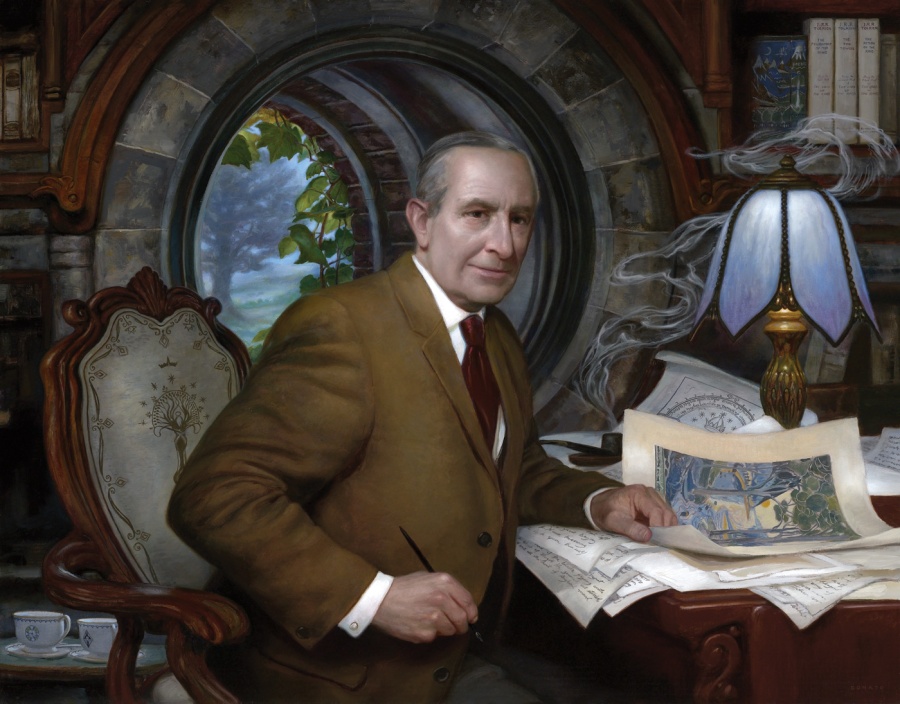
I want to thank Donato Giancola for allowing me to use his stunning portrait of J.R.R Tolkien as the featured image for this project. If you would like to purchase a print of this painting, they are available on his website!

If you would like to contribute your own experience, you can do so by using the form on the contact page, or by emailing me directly.

Now, on to David Hamblin’s responses:


1. How were you introduced to Tolkien’s work?

My father read The Hobbit and The Lord of the Rings to me when I was a child. I believe I’d have been about 6 with the latter. I can’t recall a time without The Lord of the Rings in my life. In my dad’s peerless logic reading TLOTR meant he didn’t have to choose another book for about a year.

I watched the Ralph Bakshi version as a child recorded off the TV. I listened to the Brian Sibley adaptation on 13 cassettes which my Dad had painstakingly recorded off the radio.

I used to carry around at least one of the books all the time (1 of 7 as Tolkien intended)

2. What is your favorite part of Tolkien’s work?

In terms of dramatic moments it would be Faramir’s rejection of the Ring.

In terms of comedy (an underrated aspect of Tolkien’s work) Gollum’s delicious reaction to being told that “The fish from this pool are dearly bought” *drops fish* “Don’t want fish.”

In terms of aspects the sheer volume and depth of the work in question. The fact that poetry is interwoven throughout the text. The fact that it is indeed the richest of worlds.

3. What is your fondest experience of Tolkien’s work?

Probably interacting with my Dad. We discuss the (excellent) Brian Sibley adaptation constantly (as a by the by I dropped an email to Brian Sibley just saying how much of an influence he had on me recently and was delighted to receive a response. He was lovely.) We play one of the board games (sumptuously illustrated) “Confrontation” regularly.

4. Has the way you approach Tolkien’s work changed over time?

I have become curiously tribal around fidelity of the text. Mostly in jest. Mostly. I was somewhat mercurial about TLOTR films but overall felt they captured the world. The Hobbit films are an affront to Eru and should be cast into Orodruin…

I follow Christopher Lee’s reported lead of reading in full annually.

John Howe, Alan Lee, Ted Nasmith remain the holy trinity of The Lord of the Rings illustrators. Others are great but they have their own niche carved at the top.

I have had the Balrog wings debate (I am in favour) but Nasmith’s depiction on the bridge of Khazad-dûm made me open to the alternative. John Howe’s resplendent Smaug remains my favourite Hobbit cover.

There is an unabashed sentimentality to The Lord of the Rings that I have always found to be deeply reassuring.

Also just a quick note to say that Tolkien inspired me to write poetry of my own. Tolkien was also a gateway to Games Workshop.

It is no accident that my profile pic on twitter shows me with key influences displayed. One of which is the Tolkien rune pendant bought for me by my wife.

5. Would you ever recommend Tolkien’s work? Why/Why not?

I do little else but recommend Tolkien’s work! The fact is Tolkien has informed my worldview significantly. While his disdain for allegory is well documented there are aspects of his principles that seep through. I too am Catholic and it is fair to say that Tolkien reinforced & articulated certain principles I hold dear. My stance on the death penalty (vigorous opposition) is in part based on faith & politics but informed and articulated by “It was pity that stayed his hand”, etc.

Speaking of politics – I am of a Socialist mien (and even my Catholoicism is Liberation Theology based) and fully au fait with the knowledge that Tolkien would not be enamoured with me. No matter. While speaking at a Trade Union conference I took the liberty of quoting Tolkien/Gandalf on the subject of the attacks on library services (and society as a whole as I see it). “He that breaks a thing to find out what it is has left the path of wisdom”. There is a power in his words. That alone is reason enough to recommend.


To talk with David Hamblin about Tolkie, you can find him on Twitter!

Terence Aries’s Experience–Tolkien Experience Project (95)

This is one in a series of posts where the content is provided by a guest who has graciously answered five questions about their experience as a Tolkien reader. I am very humbled that anyone volunteers to spend time in this busy world to answer questions for my blog, and so I give my sincerest thanks to Terence and the other participants for this.

To see the idea behind this project, check out this page

I want to thank Donato Giancola for allowing me to use his stunning portrait of J.R.R Tolkien as the featured image for this project. If you would like to purchase a print of this painting, they are available on his website!

If you would like to contribute your own experience, you can do so by using the form on the contact page, or by emailing me directly.

Now, on to Terence Aries’s responses:


1. How were you introduced to Tolkien’s work?

It began, as it so often does, with my mother handing me The Hobbit when I was looking for something to read. I must’ve been seven at the time and had just come off Watership Down. I was quickly taken by the book and fascinated by the runes on the map in the front. Even more so when my mother told me what those runes meant (she had translated them herself) and then showed me how it corresponded with the English words. A year later I began the first of many readings of The Lord of the Rings and it was that book, together with Watership Down, that drove me to start reading in English at a very early age and I’ve never stopped since. Between readings of The Lord of the Rings my mother also supplied me with copies of Tolkien’s other works such as Mr. Bliss and Leaf by Niggle (a story that I quickly dismissed and only very recently read for the second time, this time appreciating it far more than originally).

2. What is your favorite part of Tolkien’s work?

The little nooks and crannies. The sketched descriptions of places such as Brandybuck Hall that allows you to fill in the details using your own imagination. Where does the road in Ithilien lead, where the crossroads? But also the descriptions of the landscape and weather. Some people might find it too much, but I can feel the blanket of warmth and hear the lazy buzzing of insects when the Hobbits come to the Withywindle at the tail end of summer.

3. What is your fondest experience of Tolkien’s work?

There’s too many I think, it is always a sense of homecoming. But looking back, those times my mother said “Are you ready for more? Here’s LOTR. Want more? Here’s The Silmarillion. Want more? Here’s Unfinished Tales, sending me farther into this world than she herself had ever gone must take precedence.

4. Has the way you approach Tolkien’s work changed over time?

Of course it has, as a child I read it for the sense of wonder and adventure, as I grew older I found more layers; the similarities to WW1 for instance. And it was only recently that I noticed the perfect description of Frodo’s PTSD when they pass Weathertop or Bilbo’s instructions to Frodo to take all the notes and books and finish them, he wouldn’t be too critical of the results. Which exactly what Christopher ended up doing.

5. Would you ever recommend Tolkien’s work? Why/Why not?

We just gave the Hobbit to my 10 year old nephew with the promise that there is more…

TEP #5 – Shaun Gunner

Our next guest on the Tolkien Experience Podcast has been the chair of the Tolkien Society since 2013.

QoIoJQr6_400x400

According to the society’s website, Shaun “regularly speaks about adaptations of Tolkien’s works whilst passionately believing the Society needs to reach out to new audiences.” We are so happy he could make time to talk with us for this episode!

Please consider supporting the Podcast on Patreon!

Subscribe to the podcast via:

Comments or questions:

  • Visit us at Facebook or Twitter
  • Comment on this blog post
  • Send us an e-mail from the contact page
  • Email TolkienExperience (at) gmail (dot) com

The Tolkien Society has many publications to its credit. You can find a complete listing on the publications page of the TS website.

Josh Chaffin’s Experience–Tolkien Experience Project (94)

This is one in a series of posts where the content is provided by a guest who has graciously answered five questions about their experience as a Tolkien reader. I am very humbled that anyone volunteers to spend time in this busy world to answer questions for my blog, and so I give my sincerest thanks to Josh and the other participants for this.

To see the idea behind this project, check out this page

I want to thank Donato Giancola for allowing me to use his stunning portrait of J.R.R Tolkien as the featured image for this project. If you would like to purchase a print of this painting, they are available on his website!

If you would like to contribute your own experience, you can do so by using the form on the contact page, or by emailing me directly.

Now, on to Josh Chaffin’s responses:


1. How were you introduced to Tolkien’s work?

My mother showed me the Rankin Bass adaptation of The Hobbit, which I believe she checked out from our local library on VHS. She then would also read to us from the book as a bedtime story. As I understand it, one of her dates with my father was to see the Bakshi Lord of the Rings animated film, and that’s how she was introduced to Middle-earth. She in turn introduced me and my sister.

2. What is your favorite part of Tolkien’s work?

The fact that evil is never vanquished once and for all, it’s a constant battle, but it is a battle that will be won eventually. We must learn to find the light in the dark places.

3. What is your fondest experience of Tolkien’s work?

That would be a tie between listening to my mother read Tolkien’s works to me, and listening to my father narrate his own recollections of the events of Lord of the Rings at the dinner table.

4. Has the way you approach Tolkien’s work changed over time?

Yes. I used to read them just for lighthearted fun, but as I age, I find immersing myself in the Legendarium for escape from everyday life has become more a necessary aspect of survival. Instead of reading for mere entertainment, I read for encouragement and rejuvenation.

5. Would you ever recommend Tolkien’s work? Why/Why not?

Absolutely would recommend him. His works as a whole have helped solidify the way I view the world around me, and I believe everyone has something to learn from it, to help them grow and function as a human being.


If you want to connect with Josh Chaffin, you can do so on Twitter!

The Little-known Animated Hobbit Film from 1966

Today is my birthday, so here is a fun topic I want to talk about just because it is interesting to me!

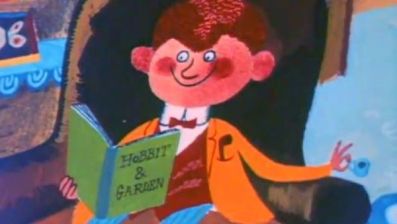
Many fans will point to the animated film by Jules Bass and Arthur Rankin Jr. as the first film adaptation of J.R.R. Tolkien’s work. This is understandable, because it received a wide audience when it first aired, and has remained a classic for many viewers. This version, however, is not the first film adaptation of Tolkien, nor the first adaptation of The Hobbit specifically!

Eleven years prior to the creation of the Rankin/Bass version, a much shorter, and admittedly less accurate, cartoon of the text was created by Gene Deitch. Deitch himself revealed this story in a blog post, but I have summarized it below.

Here is an overview of the story behind this unlikely little video:

hobbit_600
Image copyright Rembrandt Films

In 1964, William Snyder obtained the film rights to The Hobbit, and he approached Deitch with the proposal to turn it into a feature-length animated movie. Deitch read the book, and thought it sounded like a great idea! Unfortunately, everyone involved with the production was blissfully unaware of The Lord of the Rings, and so there were many liberties taken with the plot and characters. Once they learned about the larger text, they revised and updated their screenplay.

Unfortunately, part-way through the process, Snyder had asked for too much money from 20th Century-Fox, ruining their chances at an important bankroll for the movie. This meant that the project had to be scrapped because it lacked funding.

Months later, Snyder reached out to Deitch again, demanding a 12-minute film be completed and delivered to New York from Prague within 30 days. You see, Snyder’s contract stipulated that he had to “produce a full-color motion picture version” of the story by June 30th, 1966. The contract never stipulated how long the film had to be. If he was able to do so, then he would retain rights to both The Hobbit and The Lord of the Rings! The Lord of the Rings had exploded in popularity after Snyder had purchased filming rights, so retaining his contract became very important!

In order to deliver this film, Deitch had to destroy his longer screenplay, the one he spent more than a year editing, and write a short film that told the basic story from beginning to end. This also meant that Deitch had to draw, color, record sound, shoot, and edit the film then deliver it across the globe in under one month!

They managed to complete all of the work and ship the film in time. Snyder retained his rights. The film, though was just a ploy to make money off of his investment. Snyder sold the rights back to the Tolkien Estate shortly after they renewed for a large profit. Unfortunately Deitch didn’t receive anything for his work from this bit of business.

The resulting cartoon was something so slap-dash that it was never intended to be distributed. Furthermore, Deitch did not put his name on the film for 45 years. Part of the reason that Deitch burried his association with the film is because it didn’t live up to the vision he started the project with. It was not a feature-length movie with the best visual and voice-over artists that he had started the project hoping to create.

You can now watch the full video online:

SheilaMS’s Experience–Tolkien Experience Project (93)

This is one in a series of posts where the content is provided by a guest who has graciously answered five questions about their experience as a Tolkien reader. I am very humbled that anyone volunteers to spend time in this busy world to answer questions for my blog, and so I give my sincerest thanks to SheilaMS and the other participants for this.

To see the idea behind this project, check out this page

I want to thank Donato Giancola for allowing me to use his stunning portrait of J.R.R Tolkien as the featured image for this project. If you would like to purchase a print of this painting, they are available on his website!

If you would like to contribute your own experience, you can do so by using the form on the contact page, or by emailing me directly.

Now, on to SheilaMS’s responses:


1. How were you introduced to Tolkien’s work?

I first heard about Tolkien through a fella I was dating in the late months of 1971.  Having just graduated from high school, a private Catholic institution that provided me with what most people today might consider a college degree in liberal arts, I was a green teenager.  Working as a photo finisher because I had no money for college, I lived in a house with a group of girls from the photo shop and from high school. We had no TV. Books provided me with my only solitary entertainment.  Of course the fella and his friends, who included me in their little clique, loved to stay up all night on weekends drinking Mountain Dew and playing cards. The smoking of “pipe weed” would sometimes be added to enliven the atmosphere.  By and large, we were a harmless group who would retire at about 5 AM to the local Hasty Tasty Pancake House for bacon and eggs after a hard night of Euchre.

Not as studious as I but a graduate of the same high school, this fella surprised me one day by showing me a set of three books he had obtained from an old Army pal.  Entitled The Lord of the Rings, he called it fantasy.  As he finished each book, he loaned it to me.  While my relationship with the fella fizzled, my fascination with Tolkien did not.  In my twenties, I re-read LotR several more times.

But not until many years later did I read The Hobbit.  This peculiar reverse order of my introduction to Tolkien shaped my initial impressions of his work.  I didn’t understand the Ring’s influence on its bearer until I read The Hobbit, because of course, the Ring’s sway immediately prompted Bilbo to lie to Gandalf about his encounter with Gollum.  Only in the last 10 years did I read The Silmarillion.  And since my first encounter with The Lord of the Rings I’ve read it and The Hobbit many, many, times.  I now have electronic copies of the big five (Silmarillion, Hobbit, LotR) that I use for research.  The power of NOOK enables me to enjoy frequent lookups and cross indexing as never before. My library continues to grow thanks to the hard work of Christopher Tolkien who I understand has published the last of his father’s works.  I received the Histories of Middle-earth, 12 books in 3 volumes, for Christmas and reading The Fall of Gondolin currently winds me down at night.

2. What is your favorite part of Tolkien’s work?

Without a doubt, every word that Tolkien writes about Hobbits.

Through Hobbits (halflings, as he has other characters call them), Tolkien tells us that if we live up to even half of our potential, we can be heroic and courageous, simple and kind, and that the everyday things we do celebrate life.  I think Peter Jackson’s movies totally miss this very important point.

Jackson’s Boromir belittles Frodo, calling him “little one” and in one scene, brushes snow out of Frodo’s hair as if he is a small child when Frodo is undoubtedly older than Boromir.  By the Bruinen, Jackson gives Arwen a scene facing down the Ringwraiths that was given to Frodo by Tolkien. In The Fellowship of the Ring, Frodo defies the Nine himself riding alone on Asfaloth.  And Jackson omits “The Scouring of the Shire” from his film trilogy. Tolkien brings his trilogy full circle in this chapter of Return of the King.  Hobbits demonstrate their strength, resilience, leadership, and skill freeing the Shire of its captors.  (I omitted other examples for the sake of brevity but anyone who watches the movies with me understands that Jackson’s short shrift of Hobbits is a sore point with me.)

3. What is your fondest experience of Tolkien’s work?

Although I love the movies and can, by no means, match my knowledge of Tolkien’s many works with any true scholar, my love and my ultimate pleasure lies in re-reading Tolkien’s stories.  Tolkien created a dangerous world where good, after much toil, overcomes evil and realized hopes triumph over bleak despairs. But I think my real enjoyment derives from the many beautiful words Tolkien created to tell his tales.  One cannot turn a page without discovering some unique name, poem, or phrase in Quenya or Sindarin – names like Lύthien Tinύviel, Mithrandir, Lothlórien, and Arwen Undómiel – that sing without music. Even Lobelia Sackville-Baggins possesses a certain charm.  Oddly, people who say they cannot ‘wade through’ The Lord of the Rings complain most often about the many proper names Tolkien uses.  To me, they provide the magic.

In that spirit, most of what I study focuses on Sindarin.  As a retired software engineer who no longer studies computer languages or anything else full time, my interests include needlework and grandchildren to whom I write letters using the Anglo-Saxon runes.  They each have a card made by me that gives them the key using the standard ‘The quick brown fox jumps over the lazy dog.’

unnamed And my approach has become much broader than Tolkien’s original published fantasy. The Children of Hύrin, The Fall of Arthur, The Fall of Gondolin, The History of Middle-earth, The History of The Lord of The Rings, Unfinished Tales Vol I-II, and about 8 different versions of The Hobbit live on my bookshelves.  I even purchased the Latin translation.

4. Has the way you approach Tolkien’s work changed over time?

My most recent acquisition, J.R.R. Tolkien A Biography by Humphrey Carpenter, arrived today and adds to other titles about the Master, himself, including The Inklings and The Letters of J.R.R. Tolkien.  I could go on and on having acquired books of maps, books of illustrations, books on the movies, companion books, books on Sindarin, books on how to write Tolkien’s invented languages, and so many collectibles that in every corner of my home, I can see some part of Tolkien’s fantasy world but I should probably stop here.  In short, my first casual approach to Tolkien has intensified over the years and my husband, good man that he is, surprises me every year with figures and jewelry from the Weta Workshop in New Zealand. I even have the full-scale Sting, made in Spain, hanging on the wall in my office.

5. Would you ever recommend Tolkien’s work? Why/Why not?

I think everyone could get something good from Tolkien’s work.  The man was a genius. And who doesn’t need to take a trip away from the very real problems plaguing the world today?  But my kids, who love the Jackson movies, just won’t sit down and read the books. My oldest granddaughter has the books and all three grandkids have read The Hobbit.  They probably read it because when they were younger and came to my house every weekend, I read one chapter to them every night before they went to bed.  I did all the characters in different voices – I still do a respectable Gollum – and they loved it. Having that exposure at such a young age got them interested in Middle-earth.  As they get older, I hope they read The Lord of the Rings.  Once they do that, they will want to read The Silmarillion.  I’ve told them parts of that story when the movies reference it.  At least they know where to get it!

Since I only recently discovered podcasts, my current project involves listening to all the past episodes of  “The Prancing Pony Podcast” and since Microsoft took it upon themselves to change the format of True Type fonts to something that doesn’t support Dan Smith’s Fantasy Fonts, I may try to contact him about redoing his fonts in the new format.  Mostly, I intend to read Tolkien until my eyes are too tired to see. His stories fascinate me, his characters engage me, and his world draws me in as no other story teller ever has or ever will.


You can find SheilaMS on Twitter, where she talks about Tolkien and other topics!

Banner with Tolkien Experience Logo

TEP #4 – James Tauber

Our next guest on the Tolkien Experience Podcast wears many, dare we say geeky, hats. He is the founder and CEO of Eldarion, he helps develop tools for the digital humanities, he loves ancient languages, and he is the creator of DigitalTolkien.com: James Tauber!

james-tauberAll of James’s projects are impressive, but perhaps the one that most of our listeners will be drawn to is his work at DigitalTolkien.com. There James has been working on analyzing textual variants in The Silmarillion. He has also been working to apply the tools used in other areas of digital humanities to Tolkien’s texts. You can visit his website, or listen to the episode, for more information about these projects. We are delighted that he could join us!

Please consider supporting the Podcast on Patreon!

Subscribe to the podcast via:

Comments or questions:

  • Visit us at Facebook or Twitter
  • Comment on this blog post
  • Send us an e-mail from the contact page
  • Email TolkienExperience (at) gmail (dot) com

You can see James’s Tolkien projects at DigitalTolkien.com and find links to his other work at his personal website.

He also mentioned the Elvish Linguistic Fellowship.

Catherine Warr’s Experience–Tolkien Experience Project (92)

This is one in a series of posts where the content is provided by a guest who has graciously answered five questions about their experience as a Tolkien reader. I am very humbled that anyone volunteers to spend time in this busy world to answer questions for my blog, and so I give my sincerest thanks to Catherine and the other participants for this.

To see the idea behind this project, check out this page

I want to thank Donato Giancola for allowing me to use his stunning portrait of J.R.R Tolkien as the featured image for this project. If you would like to purchase a print of this painting, they are available on his website!

If you would like to contribute your own experience, you can do so by using the form on the contact page, or by emailing me directly.

Now, on to Catherine Warr’s responses:


1. How were you introduced to Tolkien’s work?

I remember the moment very clearly. I hadn’t watched or read anything Tolkien when I was little, and the first time I experienced it was when I was walking round a car boot sale when I was very young, when out of the corner of my eye I spotted the DVD of The Fellowship of the Ring. I hadn’t a clue what it was, but, being interested in knights and castles and all things fantasy, I thought I’d give it a shot. I was hooked immediately.

2. What is your favorite part of Tolkien’s work?

I touch on this in a later question, but the depictions of the Shire and Rohan always were particularly powerful for me. The Shire was quintessential, picture-postcard England, a romanticised, pre-Industrial Arcadia which nevertheless touched on something real. The fight for survival of the Shire always struck me particularly powerfully as I view the same thing to be happening today. I’ve come to appreciate that latter aspect more nowadays, as I’m older. When I was younger, I was obsessed with Rohan – I just loved the aesthetic and how it mirrored the Anglo-Saxons.

Finally, growing up as a tomboy, I was always incredibly grateful for characters like Eowyn who weren’t typical girls, because I could finally relate to her. I hated dolls and dresses and makeup, and whereas most fantasy stories have their female princesses obsessed with exactly that, I was finally happy to have a fictional female character who legitimised my own interests – showing me it was okay for me to want to play with swords.

3. What is your fondest experience of Tolkien’s work?

Not an experience per se, but how it influenced me growing up. Every since I can remember, every week my parents took me out to visit a historic house, castle, museum, site of interest etc, and, as kids do, I would often project LOTR onto places I visited. Visiting a forest? I’d imagine epic battles between orcs and Aragorn. Visiting something Anglo-Saxon? That’s straight out of Rohan. LOTR was for a long time my obsession and informed, for a long time, my interpretation of the world. Tolkien’s Shire was the perfect, idealistic vision of the countryside I’d go for rides out in, and it still forms my mental image of perfect England – *my* England.

4. Has the way you approach Tolkien’s work changed over time?

I’ve found that, as I’ve got older, I’ve come to notice and understand the analogies and metaphors in The Lord of the Rings more than when I was a kid. When I was younger, it was just a jolly good fantasy romp. But now, I’ve come to appreciate the deeper meanings. For example, though not explicitly intended by Tolkien, the way characters describe the power of the Ring comes very close to descriptions of the power and effects of sin, and Tolkien’s Catholicism almost might have had something of a subconscious influence on this.

I’ve found his descriptions of the Shire particularly more powerful now, especially with the theme of the destruction of the countryside and ‘old ways’ of life for the purpose of advancements in technology and industry – it’s something I never grasped as a kid.

5. Would you ever recommend Tolkien’s work? Why/Why not?

Of course! It formed a huge obsession of mine as a kid and really shaped my interests and activities. LOTR often gets criticised for being too simplistic, too goodies-vs-baddies, in contrast to works like A Song of Ice and Fire. But I think that’s missing the point – we never, for example, say that Beauty and the Beast is unrealistic, because we understand that that was never the point or intention. LOTR is the most magnificent modern expression of the most fundamental theme in world storytelling – of the triumph of good over evil.


You can hear more from Catherine at her YouTube channel: Yorkshire’s Hidden History!

Publication: Review of Tolkien and the Classics (Open Access)

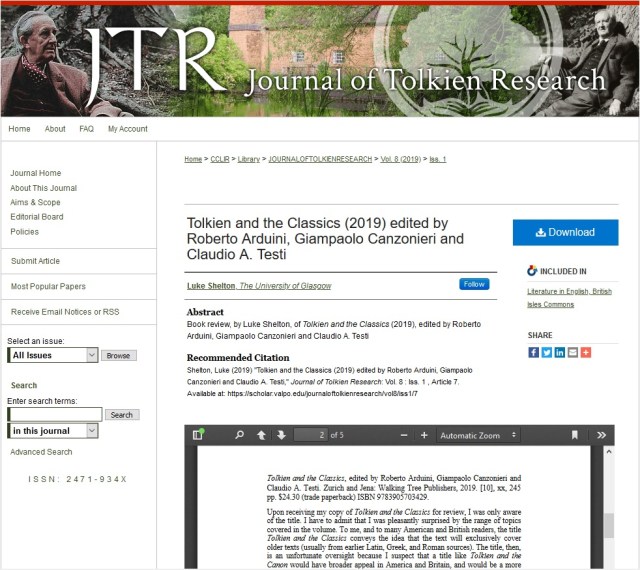
My review of Tolkien and the Classics edited by Roberto Arduini, Giampaolo Canzonieri and Claudio A. Testi has been published in the Journal of Tolkien Research!

Fortunately, this research is open access, so everyone can read the review on the journal website!

Their recommended citation is:

Shelton, Luke (2019) “Tolkien and the Classics (2019) edited by Roberto Arduini, Giampaolo Canzonieri and Claudio A. Testi,” Journal of Tolkien Research: Vol. 8 : Iss. 1 , Article 7.
Available at: https://scholar.valpo.edu/journaloftolkienresearch/vol8/iss1/7

If you are interested in purchasing the book, it is available from Amazon.

Tolkien and Classics on JTR

Phil Dean’s Experience–Tolkien Experience Project (91)

This is one in a series of posts where the content is provided by a guest who has graciously answered five questions about their experience as a Tolkien reader. I am very humbled that anyone volunteers to spend time in this busy world to answer questions for my blog, and so I give my sincerest thanks to Phil and the other participants for this.

To see the idea behind this project, check out this page

I want to thank Donato Giancola for allowing me to use his stunning portrait of J.R.R Tolkien as the featured image for this project. If you would like to purchase a print of this painting, they are available on his website!

If you would like to contribute your own experience, you can do so by using the form on the contact page, or by emailing me directly.

Now, on to Phil Dean‘s responses:


1. How were you introduced to Tolkien’s work?

Well it’s been the best part of forty years since I discovered Tolkien, so my recollection of this is slightly hazy. I do remember my parents buying me The Lord of the Rings as a gift, and I still have the rather battered and worn remains of these three books to this day – the 1981 Unwin editions, complete with the gorgeous cover art of Pauline Baynes. But I think prior to this I had been enthralled by a copy of The Hobbit I’d borrowed from the school library, attracted by Tolkien’s own marvelously evocative cover painting, which led to me spending an awful lot of time drawing mountain ranges of my own!

2. What is your favorite part of Tolkien’s work?

I’d have to say The Lord of the Rings. Because it’s such a lengthy tale, you get to immerse yourself in Middle-earth for such a long time, to the point where I find it really rather depressing to have to leave it at the end. I’ll try and find time to read it every year or two, and I never enjoy it any less for knowing it so well. But I find The Silmarillion to be a jaw-droppingly awesome piece of work, one which I’ve learnt to appreciate more and more the older I get. This is the real heart of Tolkien’s work, and it is a truly astonishing achievement. And I feel like it would be remiss of me not to mention “Leaf By Niggle,” a little work of genius which I think gives us a very insightful look at Tolkien himself.

3. What is your fondest experience of Tolkien’s work?

This is going to perhaps sound rather heretical to some, but spending a day at Hobbiton in New Zealand was amazing. I know that of course in reality it’s simply a movie set, but I loved Peter Jackson’s movies and – for good or bad – his superb visual representation of many of the locations in The Lord of the Rings have become embedded in my mind, and many others. Having an ale in The Green Dragon was brilliant, but standing outside Bag End brought a tear to my eye. “In a hole in the ground their lived a hobbit” – and there I was actually standing outside the front door of that hole. Sure, it’s not really that hole, but it felt like it was. I’ve travelled a lot and visited countless historical marvels, but this felt as real as any of them to me.

4. Has the way you approach Tolkien’s work changed over time?

Yes, very much so. First and foremost I love the stories for what they are – great stories, and that hasn’t changed at all. And I’ve always loved reading mythology and history, so I was able to appreciate what a great work The Silmarillion was outside of the stories themselves. But it wasn’t until I started listening to the podcasts of the Tolkien Professor (Corey Olsen) five or six years ago that I truly began to understand Tolkien’s work on a deeper level. Olsen revealed so many layers that I’d been hitherto unaware of, and it felt like I discovered the books all over again. Realising that Bombadil was actually speaking in a sort of accentual Anglo-Saxon verse blew my mind!

5. Would you ever recommend Tolkien’s work? Why/Why not?

Absolutely I would – at least to a certain type of person. Tolkien is one of the best writers at connecting us to something buried deep inside, to a world of faerie, of fantasy. To something other than everyday existence. I think the human mind needs this, and is much poorer when bereft of it. It is perhaps the one place we’re truly free. Of course many people are not going to read about elves or hobbits regardless of how good the story is, and that’s just fine – there are many other gateways to walk through!


You can find much more from Phil Dean on his website!