Chad Bornholdt’s Experience — Tolkien Experience Project (196)

This is one in a series of posts where the content is provided by a guest who has graciously answered five questions about their experience as a Tolkien fan.

To see the idea behind this project, or if you are interested in sharing your own, visit the project homepage. If you enjoy this series, please consider helping us fund the project using the support page.

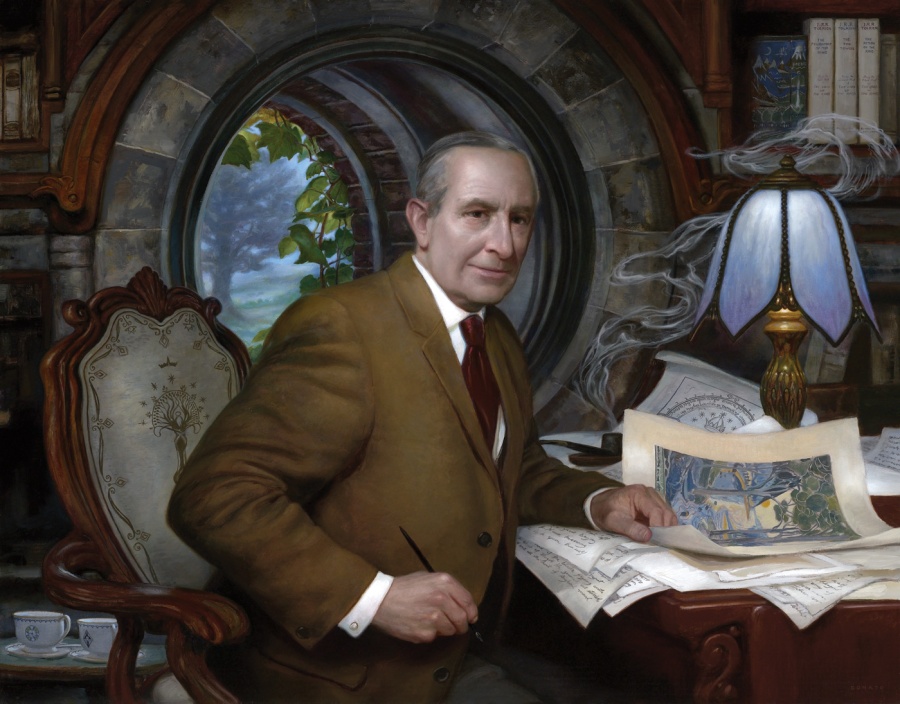
I want to thank Donato Giancola for allowing me to use his artwork for this project. Prints are available on his website!

Now, on to  Chad Bornholdt’s responses:


1. How were you introduced to Tolkien’s work?

I did not realize it at the time, but in my cartoon-filled pre-teen days I saw the Rankin/Bass The Hobbit and The Return of the King along with Ralph Bakshi’s The Lord of the Rings. Back then I believed them to be just any other cartoon and it was not until a coworker told me that Peter Jackson was filming a movie that I would love that I investigated, devoured, and repeated the books for the past 20-plus years.

2. What is your favorite part of Tolkien’s work?

I love the immense magnitude of the Legendarium, the complexity of the work, and every aspect within that world. As I learn more, I add more to this answer (but never remove.)

3. What is your fondest experience of Tolkien’s work?

Every time I see someone grasp a part of the Legendarium with which they have been having trouble, I feel a sense of accomplishment. (This is still ongoing!) Also, getting to personally interact with everyone is very high on the list.

4. Has the way you approach Tolkien’s work changed over time?

Definitely so: I get a lot of satisfaction from teaching Tolkien. As my comprehension improves and new media comes along to help in my teaching, I am constantly improving my approach. Every time I think of a new way to teach a phase of the Legendarium, I make a tool so others can learn from it at their own pacing. In the very beginning of my own journey I was warned to keep notes. I went overboard then and nothing has changed since.

5. Would you ever recommend Tolkien’s work? Why/Why not?

I am so confident that others will enjoy some aspect of the Legendarium that I always recommend it. When someone is confident that they will not enjoy it, I evaluate whether the reasoning is sound and go from there. I have come to the conclusion before that someone really would not enjoy it (rarely.)


You can connect with Chad Bornholdt on the Texas Tolkien website!

G. Connor Salter’s Experience — Tolkien Experience Project (195)

This is one in a series of posts where the content is provided by a guest who has graciously answered five questions about their experience as a Tolkien fan.

To see the idea behind this project, or if you are interested in sharing your own, visit the project homepage. If you enjoy this series, please consider helping us fund the project using the support page.

I want to thank Donato Giancola for allowing me to use his artwork for this project. Prints are available on his website!

Now, on to  G. Connor Salter’s responses:


1. How were you introduced to Tolkien’s work?

I was just over 5 years old when Fellowship of the Ring came out, so my early childhood was full of Burger King toys and Lord of the Rings movie tie-in games. Since my father was a diehard fan of the books and enjoyed many of these games, I grew up knowing the characters for as long as I could remember. By age 11 I had read The Hobbit multiple times, and by age 15 I had read The Lord of the Rings trilogy in full. Shortly after reading The Lord of the Rings trilogy, I saw the movies.

2. What is your favorite part of Tolkien’s work?

I enjoy the wide range of his work. Whether it’s the quaint Father Christmas Letters he wrote for his children, the more complex children’s literature of The Hobbit, or the tragic stories for adults in The Silmarillion, Tolkien always told the story well.

3. What is your fondest experience of Tolkien’s work?

I often think of the moment in The Fellowship of the Ring where the group is attempting to get through a snowy mountain pass, and Legolas pokes fun at the others as he treads lightly on it. It’s a lighthearted moment that shows how the characters have bonded during the quest, learned to joke with each other.

4. Has the way you approach Tolkien’s work changed over time?

As I have read more fantasy literature from Tolkien’s period (from Robert E. Howard’s Conan stories to T.H. White’s The Once and Future King), I have noticed how much the genre dialogues about whether might equals right. It’s interesting to me that Tolkien gives complex answers to that question – Faramir’s comment about not loving the sword, loving what it protects. I particularly find that position interesting in light of Tolkien’s World War I service.

5. Would you ever recommend Tolkien’s work? Why/Why not?

I would definitely recommend Tolkien’s work to readers who want an introduction to fantasy. The Hobbit provides a great way to enter the genre without feeling too challenged, and transitioning from that into The Lord of the Rings gives a gradual dive into more complex work. I also love how Tolkien’s work is enjoyable but can never be accused of “juvenile escapism,” a label that gets thrown around a lot when dismissing fantasy literature.


You can find more from G. Connor Salter on his blog!

Carl W. Brown Jr’s Experience– Tolkien Experience Project (194)

This is one in a series of posts where the content is provided by a guest who has graciously answered five questions about their experience as a Tolkien fan.

To see the idea behind this project, or if you are interested in sharing your own, visit the project homepage. If you enjoy this series, please consider helping us fund the project using the support page.

I want to thank Donato Giancola for allowing me to use his artwork for this project. Prints are available on his website!

Now, on to  Carl W. Brown Jr’s responses:


1. How were you introduced to Tolkien’s work?

I came upon it on my own, the summer between 5th and 6th grade, age 10 in 1972. I also saw 2001: A Space Odyssey that summer, and generally say that I was never the same after those two things. Unlike perhaps most fans I read LotR first and then The Hobbit, which has given me an odd relationship to the first book because while I loved the story I wasn’t keen on the old-fashioned telling-the-story-to-children style. (I was greatly relieved when reading in Tolkien’s letters that he came to regret that tone himself lol). I was a senior in high school when Silmarillion came out, which was easily the greatest book-publishing event of my life… my local bookstore saved the first copy they took out of the box for me.

2. What is your favorite part of Tolkien’s work?

I’ll answer this in both the meanings of “part”: in the broader sense the breadth and depth of his creation and the sweep of the narrative from the Elder Days to the end of the Third Age… very few authors have built worlds and peoples that live and breathe the way he did. In the what part of his works aspect, my single favorite moment is Gandalf and Shadowfax facing off against the Morgul-Lord as Grond shatters the gates of Minas Tirith and the horns of the Rohirrim echo off the mountain.

3. What is your fondest experience of Tolkien’s work?

The sheer delight of reading Silmarillion for the first time, having new Tolkien to read, and not just new but the core of the story really for the first time, and the experience of rereading LotR after reading Silmarillion for the first time, and the added depth of truly understanding the references to the Elder Days… closely followed by seeing Jackson’s version of Fellowship in the theater for the first time and marveling at how well it all was done.

4. Has the way you approach Tolkien’s work changed over time?

I still consider LotR my “favorite book”, and as an adult and an historian I am both more aware of his work’s limitations in terms of gender and racial issues but also able to analyze it in the context of both the time it was created in and the reasons for which it was made. His work has all the power and all the problems of most of the classic canon, which I think should be used but carefully examined to make their issues clear.

5. Would you ever recommend Tolkien’s work? Why/Why not?

The power and resonance of the quest story is undeniable, and in LotR there is little doubt that Tolkien did it as well as anyone ever has. For those fond of detailed world-building, the entire corpus would seem to be required reading. The continuing success of both the books and the 2 movie trilogies shows that it has an appeal even in the 21st century, and I would recommend it to those who like those things, perhaps with a caution that they might find it old-fashioned in several ways.


You can find more from Carl on Twitter!

Victoria Willey’s Experience — Tolkien Experience Project (193)

This is one in a series of posts where the content is provided by a guest who has graciously answered five questions about their experience as a Tolkien fan.

To see the idea behind this project, or if you are interested in sharing your own, visit the project homepage. If you enjoy this series, please consider helping us fund the project using the support page.

I want to thank Donato Giancola for allowing me to use his artwork for this project. Prints are available on his website!

Now, on to  Victoria Willey’s responses:


1. How were you introduced to Tolkien’s work?

My older brothers saw the Fellowship in theaters and that got them into the books. They would tell me about parts of it, sometimes showing me scenes or large portions of the films. Little did they know then, our mom was already somewhat familiar with Tolkien through her favorite author, C.S. Lewis, and later read The Hobbit aloud to my younger brother and me. One of my brothers gifted me the 50th anniversary single-volume edition for my birthday, then later, a copy of The Silmarillion.

2. What is your favorite part of Tolkien’s work?

Oh goodness.

My favorite book is The Silmarillion. I love all of them, but I’ve actually read The Silmarillion more recently and more times than the trilogy. I love how large scale the stories are and how they can suddenly zoom in and give so much detail like in “The Children of Hurin” or “Of Beren and Luthien”. I love the image of the two trees and the stars, characters like Finrod Felagund and Beleg Cuthalion, and the intense, palpable solitude of Eärendil searching the empty streets of Tirion. I could go on about The Silmarillion forever.

My favorite scene, aside from Eärendil, is where Aragorn heals Faramir and Faramir wakes and immediately knows who Aragorn is- better than almost everyone around him, despite having never met him before. That’s also the scene where it dawns on you what Kingsfoil actually means. And Faramir and Eowyn’s whole story in the Houses of Healing.

My favorite element or theme in all the works is probably just the acknowledgment of how an experience can change you so much that you don’t quite fit in your normal home anymore. You start longing for somewhere that’s more “home” than home. And that never leaves. Sometimes it’s a traumatic experience that does it, like bonding with a company of dwarves and then watching some of them die, or carrying a cursed object all the way across the world. But other times, it happens by experiencing something good. Or just other. The forest of Lothlorien or Fangorn, the caverns of Helm’s Deep, or The Sea. People joke about how much Tolkien goes on about trees, but the way he talks about the Sea always hit me hardest and stuck with me the most.

3. What is your fondest experience of Tolkien’s work?

In 2012, a theater in our town did a showing of all the extended LOTR films, back to back and I got to go see them with my older brother and cousin. It was my first time seeing all of them together, seeing the Extendeds, and the first time seeing The Return of the King.

Much later, my mom- the one who read me The Hobbit– decided to read The Silmarillion aloud to my younger brother and I. I had already read it and probably talked her ear off about it. When it was describing the different Valar, she kept pausing to say “Oh, he’s just borrowing” about how some of them resemble classical deities, implying his work was less original for it. When we got to “Of Beren and Luthien” we stopped in the middle of the chapter and decided to finish it the next day. (She read them to us right before bedtime.) She then took the book to bed with her and finished that chapter herself and when we gathered to hear the rest, she actually said “Ok, pay attention, this story is really good…”

Mainly, though, I think my fondest experience is using it as a kind of shorthand language to communicate with other fans- friends and family. It gives me a vocabulary with which to express things that we don’t talk about much in everyday life, but definitely experience in some form or another. I can reference a scene with a very specific and hard to describe tone and others immediately know what I mean. Once, after turning in my last assignment of the semester in college, I sent a GIF of Frodo saying “It’s over, Sam!” to my siblings and one of them quickly texted back “Breathe the free air again, my friend!” Really, just sharing the experience of it all with others who love it as much as I do is the best part. 

4. Has the way you approach Tolkien’s work changed over time?

I used to be so annoyed when people would joke that Frodo and Sam were gay. And when it’s meant as an insult, or to imply that their relationship was anything other than wholesome, I still do. But as I’ve gotten to hear more from queer Tolkien fans who ship them and others, I think they mainly appreciate the portrayal of open and very genuine affection that is so rare even in literature and especially in films. I think how we categorize that affection, be it platonic friendship, loyalty, romantic love, or something else, matters less than the fact that it’s displayed in such a positive way. To me, at least. I’m not queer and I don’t personally read Frodo and Sam as a romantic couple, but I think I understand why so many do a little better.

5. Would you ever recommend Tolkien’s work? Why/Why not?

Absolutely. I understand that it can be hard to get through, even though I devoured it, so I don’t always recommend it to anyone. But I hope more and more people keep reading it. I love getting to share it with others.


You can find more from Victoria on her blog or on Twitter!

Quincy Wheeler– Tolkien Experience Project (192)

This is one in a series of posts where the content is provided by a guest who has graciously answered five questions about their experience as a Tolkien fan.

To see the idea behind this project, or if you are interested in sharing your own, visit the project homepage. If you enjoy this series, please consider helping us fund the project using the support page.

I want to thank Donato Giancola for allowing me to use his artwork for this project. Prints are available on his website!

Now, on to  Quincy Wheeler’s responses:


1. How were you introduced to Tolkien’s work?

When I was 10 years old, I was given a copy of The Hobbit by our dad. (Our dad had received a copy from his oldest brother when he was around that same age). I was immediately hooked and spent days just reading through all of The Hobbit and The Lord of the Rings and talking to my dad about every new event in the books. I then immediately shared it with my siblings, eventually encouraging my 5 younger sisters and 1 younger brother to love them in turn.

2. What is your favorite part of Tolkien’s work?

I love the ability of Tolkien to create characters that both delight and inspire, or both horrify and challenge me. His carefully-crafted world-building leads to endless fodder for the imagination, and I deeply appreciate his ability to share wisdom and humor in the midst of telling an epic story.

3. What is your fondest experience of Tolkien’s work?

From the days I spent devouring every page to first finish The Lord of the Rings in book form, to attending the midnight showing of The Fellowship of the Ring film the night of its release, Tolkien’s work always reminds me of family and a shared adventure to stand up for what is good in this world.

4. Has the way you approach Tolkien’s work changed over time?

I have been challenged to see how Tolkien’s work is perceived by people from different cultural, racial and life-experience backgrounds, and I have learned to appreciate deeply the needed efforts by so many talented artists, scholars and fans to make Tolkien more accessible to everyone.

5. Would you ever recommend Tolkien’s work? Why/Why not?

Yes, of course! While not everyone likes the kind of literature Tolkien writes, I want everyone to at least try to engage with his world because it is a place where we have found love, hope, and encouragement – and everyone needs a little more of that in their lives!

If you would enjoy hearing seven siblings talk about Tolkien’s work, you can check out our monthly podcast, “Seven Stars, Seven Siblings, and One White Tree” on whatever podcast service you prefer, and find our Twitter page at @7stars7siblings


You can find more from Quincy on his podcast’s Twitter or Facebook accounts!

Nadia Wheeler’s Experience — Tolkien Experience Project (191)

This is one in a series of posts where the content is provided by a guest who has graciously answered five questions about their experience as a Tolkien fan.

To see the idea behind this project, or if you are interested in sharing your own, visit the project homepage. If you enjoy this series, please consider helping us fund the project using the support page.

I want to thank Donato Giancola for allowing me to use his artwork for this project. Prints are available on his website!

Now, on to  Nadia Wheeler’s responses:


1. How were you introduced to Tolkien’s work?

My Dad and older brother read the books and talked about them to me as their favorite books. We also watched the animated Hobbit movie and Return of the King. When I was 10 I was allowed to read the books myself, which I did, and they became my favorite fiction books.

2. What is your favorite part of Tolkien’s work?

I love the epic and hopeful tone of the work as well as the hilarious and true to life characters. I appreciate the challenges it offers to me to live better and seek for more truth and justice.

3. What is your fondest experience of Tolkien’s work?

I have a memory of finishing “The Fields of Cormallen,” the chapter where they are celebrating the ring being destroyed, and closing the book because I didn’t want it to end. The words in that chapter still make me cry and feel as real as anything in life to me.

4. Has the way you approach Tolkien’s work changed over time?

Seeing the films as they came out and having the rest of the world enjoy something which had been more of a niche and a “test” for kindred spirits who also liked them has changed my perspective a bit. I love that Gollum is in everyone’s lexicon now and that people appreciate the brilliance of Tolkien, it’s been fun to share it with the world.

5. Would you ever recommend Tolkien’s work? Why/Why not?

Absolutely, and I would also recommend reading over watching it if you can. I also do a podcast with my seven siblings about Tolkien and our perspectives on the works having grown up in a Tolkien loving family and been part of the excitement as the films came out. You can find “Seven Stars, Seven Siblings, and One White Tree” on podbean, or whatever podcast service you prefer, and find our Twitter page at @7stars7siblings.


You can find more from Nadia on her podcast or her Amazon author page!

Elizabeth H.M. Wheeler’s Experience — Tolkien Experience Project (190)

This is one in a series of posts where the content is provided by a guest who has graciously answered five questions about their experience as a Tolkien fan.

To see the idea behind this project, or if you are interested in sharing your own, visit the project homepage. If you enjoy this series, please consider helping us fund the project using the support page.

I want to thank Donato Giancola for allowing me to use his artwork for this project. Prints are available on his website!

Now, on to  Elizabeth H.M. Wheeler’s responses:


1. How were you introduced to Tolkien’s work?

My father was a huge fan, and had already introduced all four of my older siblings to the books, so I knew the story and all the characters before I was ever old enough to read it. I was so excited to finally be able to read well enough to get through the books (albeit slowly) and I finished reading them alongside the movies coming out, so it was just peak Tolkien time.

2. What is your favorite part of Tolkien’s work?

I love that every character is important and given attention. And for individual part, the Houses of Healing in the Return of the King. “The hands of a king are the hands of a healer”, and the culmination of Éowyn, Faramir, and Merry’s character arcs, all during a very important break in the action before the end of the book.

3. What is your fondest experience of Tolkien’s work?

I know it’s controversial, but for me it was The Hobbit movies coming out. As I said, I grew up with the books and alongside the movies coming out but I was too young to see the movies in theaters. When The Hobbit movies came out, I got to experience seeing Tolkien characters come to life alongside other fans and celebrate that with them.

4. Has the way you approach Tolkien’s work changed over time?

I’ve learned to accept that everyone appreciates it differently. When I was younger I was all about everyone having to read the book first, because I wanted them to have all of the world before seeing the movies. But everyone takes in and appreciates fiction differently and however they learn to love the stories, they’re still such a great thing to experience.

5. Would you ever recommend Tolkien’s work? Why/Why not?

I always recommend Tolkien’s work when I have a chance, I’ve just learned to be understanding and recommend it in a way that people can appreciate on an individual level, rather than hardcore enforcing “You HAVE to experience Tolkien and you HAVE to experience it the same way I did.”

If you would like to hear more about how all six of my siblings and I continue to analyze Tolkien’s works, you can find our podcast, “Seven Stars, Seven Siblings, and One White Tree” on whatever podcast service you prefer, and find our Twitter page at @7stars7siblings.

Zachary Schmoll’s Experience — Tolkien Experience Project (189)

This is one in a series of posts where the content is provided by a guest who has graciously answered five questions about their experience as a Tolkien fan.

To see the idea behind this project, or if you are interested in sharing your own, visit the project homepage. If you enjoy this series, please consider helping us fund the project using the support page.

I want to thank Donato Giancola for allowing me to use his artwork for this project. Prints are available on his website!

Now, on to Zachary Schmoll’s responses:


1. How were you introduced to Tolkien’s work?

I was introduced to Tolkien’s work by my fourth grade teacher. She would read The Hobbit to her classes every year, and after I heard it read out loud, I fell in love with it. She then gave me The Lord of the Rings, and the rest is history.

2. What is your favorite part of Tolkien’s work?

My favorite part of Tolkien’s work is actually its conclusion. The hobbits have embarked on this quest, several primary objectives have been completed, but they come home to find trouble in their own neighborhood. They have to overcome one more obstacle on their own, and we get to see them come full circle. They were ill-equipped to go on an adventure at the beginning of the story, but they return as heroes capable of saving their home.

3. What is your fondest experience of Tolkien’s work?

My fondest experience of Tolkien’s work is probably having the opportunity to teach it. It is one thing to read Tolkien’s work by myself, but being able to lead students into stories that they may have never read before is particularly special.

4. Has the way you approach Tolkien’s work changed over time?

I don’t know that my approach to Tolkien’s work has necessarily changed, but my appreciation of its depth certainly has. Like many people, I thought it was a fun story when I first encountered it. It was full of adventure, bravery, and great deeds. I still appreciate that element of it, but as I have matured, I certainly have a greater appreciation for the deeper themes embedded within Tolkien’s sub-creation.

5. Would you ever recommend Tolkien’s work? Why/Why not?

I actually just recommended Tolkien’s work to a coworker the other day. I think the reason I recommend it so much is because of its depth. Different parts of his work will resonate more strongly with different people, but because he crafted such a magnificent world, we can identify with it on a very authentic, human level.


You can find out more about Zachary on his website!

John’s Experience — Tolkien Experience Project (188)

This is one in a series of posts where the content is provided by a guest who has graciously answered five questions about their experience as a Tolkien fan.

To see the idea behind this project, or if you are interested in sharing your own, visit the project homepage. If you enjoy this series, please consider helping us fund the project using the support page.

I want to thank Donato Giancola for allowing me to use his artwork for this project. Prints are available on his website!

Now, on to John’s responses:


1. How were you introduced to Tolkien’s work?

My mother read The Hobbit to my bother and me as a bedtime story. I was about seven, he was five. I have been smitten ever since.

2. What is your favorite part of Tolkien’s work?

The beautiful language. There is nothing quite like it in the English language.

3. What is your fondest experience of Tolkien’s work?

Those early memories of my mother reading late into the night.

4. Has the way you approach Tolkien’s work changed over time?

Yes. As a child I was particularly interested, of course, in the adventure aspect of the story. First in The Hobbit, and then especially with The Lord of the Rings, which I read aged about 10. As an adult I’ve become much more enamored with the writing, as I mentioned before, which is beautiful and in my opinion peerless. I also am significantly less interested now in The Hobbit and The Lord of the Rings (though I still read them regularly), and have gravitated towards the great tales, particularly The Fall of Gondolin and Beren and Lúthien. Honestly, The Silmarillion has become perhaps my favorite of Tolkien’s published works.

5. Would you ever recommend Tolkien’s work? Why/Why not?

Yes I would, but not to everyone. I don’t want it to seem as though I’m gatekeeping, but there are some people who can appreciate the films just fine but struggle with the books. I typically don’t recommend that they pick them up because, to someone that is a slow reader or has reading difficulties, they can seem impossible. However, I have found success in helping my younger brother get through them by reading aloud/using audiobooks.


You can read about John’s poetic exploits on Facebook!

Dustin Savage’s Experience — Tolkien Experience Project (187)

This is one in a series of posts where the content is provided by a guest who has graciously answered five questions about their experience as a Tolkien fan.

To see the idea behind this project, or if you are interested in sharing your own, visit the project homepage. If you enjoy this series, please consider helping us fund the project using the support page.

I want to thank Donato Giancola for allowing me to use his artwork for this project. Prints are available on his website!

Now, on to Dustin Savage’s responses:


1. How were you introduced to Tolkien’s work?

My introduction to Tolkien was actually a two-pronged approach. The first introduction was through the Rankin-Bass animated Hobbit. I recall coming home (I was probably 7 or 8 years old) and my older sisters were watching it (I came in right when Bilbo was separated from the dwarves in the goblin tunnels). Though I didn’t immediately read The Hobbit, there was a copy of it on our bookshelf and my older sister and I would memorize all the riddles.

The second introduction came within a year after that – I discovered the old 1991 Interplay computer game The Lord of the Rings. At first I didn’t realize that it was based in the same universe as The Hobbit, though the names sounded familiar. My dad filled me in that there was a sequel to The Hobbit, and we went to the local library and found copies of the 3 parts.

However, being 8/9 years old I didn’t get very far through the book (got stuck in Tom Bombadil’s house) and had to return the books to the library. The next year I was in Grade 5, and it was the year that The Lord of the Rings was named book of the century. A new kid at our school brought in a very nice copy of the complete volume for show and tell and it was a catalyst in us becoming friends. We both started reading it.

Sadly, I really rushed myself, and my friend (who was the faster reader) spoiled some major things (Boromir’s death, Gandalf’s return, Gollum dying). I was more interested in the Sam & Frodo story, so I found a lot of Books 3 & 5 boring and skimmed large chunks. A lot of the story didn’t stick, but I still labelled myself a Lord of the Rings nerd, and my friend and I played the heck outta that computer game. As such, Book 1 is still my favourite part of The Lord of the Rings as the game made it so familiar to me.

A couple years later the movies were announced. I think I fit in a reread or two of the trilogy in that time. I know for a fact I would reread “Shelob’s Lair”, “The Choices of Master Samwise”, and “The Scouring of the Shire” over and over.

In my 20s I grew out of Tolkien – just a part of going off to university and growing up – but when I was nearly 30 I started diving back in (I think this was due to gaining a greater appreciation of CS Lewis). I was amazed at how immersive Tolkien’s work was, and would keep it by my bed-side. I ended up reading The Lord of the Rings yearly for about 4 years, and branched out and finally tackled The Silmarillion, Children of Húrin, Tree and Leaf, The Fall of Gondolin, and most of The Unfinished Tales. I discovered The Tolkien Professor and Mythgard and was a regular listener for quite a while – I still pop in now and then.

2. What is your favorite part of Tolkien’s work?

An easy answer would be the heroics and virtues displayed by the characters. You see classical virtues exemplified such as courage, sacrifice, love, friendship, repentance, the whole gamut.

However, at this time of my life I’d have to say it’s the important spot that language plays in Tolkien’s legendarium. Middle-earth was birthed out of language, or, to reference St. John, Middle-earth is Tolkien’s logos putting on flesh and dwelling amongst us. I believe Tolkien (and Lewis with him) are recent examples of the power of Medieval Philosophical Realism, and his work – as well as being a treasure of this worldview – also points backwards to many other

3. What is your fondest experience of Tolkien’s work?

Honestly, it would be the several times seeing The Fellowship of the Ring movie in the theatres. I was a bit of an outcast in high school (nerd culture wasn’t mainstream yet) and this big blockbuster movie brought such validation to who I was at the time. Plus, my dad was battling cancer at the time (he won). In order for my mom to go visit him (we lived well out of town) she would bring me and my younger brother to the theatre, buy us tickets to Fellowship, then go spend time alone with my dad. I don’t know if I could attribute it to the movie, but that whole season I just had a sense that everything was going to be okay.

4. Has the way you approach Tolkien’s work changed over time?

Absolutely. Before it was just about fantasy, swords and shields, and escapism. Now, it’s linguistics, philology, world-building, Old Western Culture, and metaphysics.

5. Would you ever recommend Tolkien’s work? Why/Why not?

Always. I know several people who’ve tried and given up, and I’m quick to encourage them to give it another go. It’s essentially great art – a purer and greater Khazad-dum that has no shortage of riches to better the soul.