Chandler’s Experience–Tolkien Experience Project (105)

This is one in a series of posts where the content is provided by a guest who has graciously answered five questions about their experience as a Tolkien reader. I am very humbled that anyone volunteers to spend time in this busy world to answer questions for my blog, and so I give my sincerest thanks to Pauline and the other participants for this.

To see the idea behind this project, check out this page

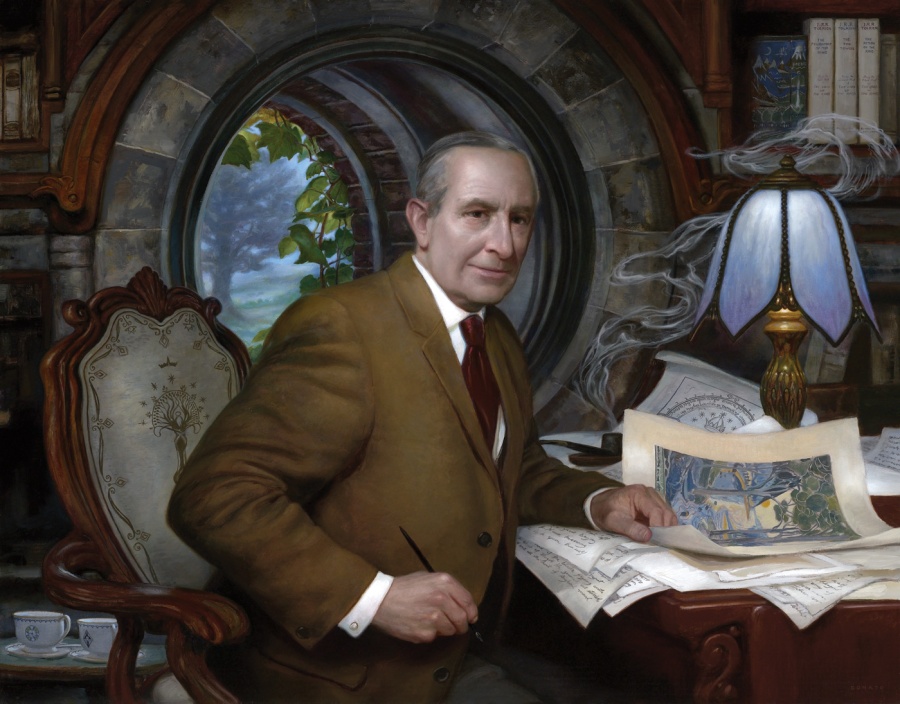
I want to thank Donato Giancola for allowing me to use his stunning portrait of J.R.R Tolkien as the featured image for this project. If you would like to purchase a print of this painting, they are available on his website!

If you would like to contribute your own experience, you can do so by using the form on the contact page, or by emailing me directly.

Now, on to Pauline’s responses:


1. How were you introduced to Tolkien’s work?

I had to read The Hobbit in high school in the late 1980’s.

2. What is your favorite part of Tolkien’s work?

That he didn’t just tell a story, he built a world and apparently inspired/set the stage for people like George R.R. Martin to do the same.

3. What is your fondest experience of Tolkien’s work?

My late son and I watched Jackson’s LotR movies repeatedly and just before his death (at age 11) had begun discussing LotR on a level deeper than “just a cool story”.  It was the Good vs. Evil struggle and Campbell’s idea of The Reluctant Hero and his Mentor like Skywalker/Kenobi. As well as Chaotic vs Lawful.  (I had also introduced him to Dungeons and Dragons Online.)

4. Has the way you approach Tolkien’s work changed over time?

  • Didn’t care for it in HS when I was forced to read it.
  • It became s connection point w/ my son, and I have since gone back and re-read it numerous times.
  • I now feel it is so monumental in our culture that I chose to read it aloud as part of my English/Language Arts curriculum while teaching Graduate Equivalency classes at a Medium Security Men’s Prison here in Georgia.

5. Would you ever recommend Tolkien’s work? Why/Why not?

Always. It is unlike so many other ‘High Fantasy’ works and like Jimi Hendrix or Nirvana, it was the first of its kind; the flag bearer; the harbinger of Fantasy for All…or at least a large percentage of ‘All’.

Pauline’s Experience–Tolkien Experience (104)

This is one in a series of posts where the content is provided by a guest who has graciously answered five questions about their experience as a Tolkien reader. I am very humbled that anyone volunteers to spend time in this busy world to answer questions for my blog, and so I give my sincerest thanks to Pauline and the other participants for this.

To see the idea behind this project, check out this page

I want to thank Donato Giancola for allowing me to use his stunning portrait of J.R.R Tolkien as the featured image for this project. If you would like to purchase a print of this painting, they are available on his website!

If you would like to contribute your own experience, you can do so by using the form on the contact page, or by emailing me directly.

Now, on to Pauline’s responses:


1. How were you introduced to Tolkien’s work?

Quite honestly, I’ve been rather lucky. It all happened 20 years ago (!) : When I was 11, one of my teachers told us about The Hobbit; she really wanted us to read, to become readers, to discover the wonderful worlds hidden behind book covers, and it’s crazy how I perfectly remember her presenting The Hobbit to our class (an illustrated edition). And I perfectly remember how I told myself that ‘Yes I SHOULD read this book’! I didn’t immediately though… but a few weeks later, Peter Jackson’s Fellowship of the Ring was opening in French theatres, and my father (who had read The Lord of the Rings as a teenager), took me to the cinema. I remember my amazement accompanying those first steps into Middle-earth ; I knew I wanted to be part of it, although I didn’t really catch everything about the plot!

It’s only a few months later, when my dad came back home with the VHS (!!!) of The Fellowship of the Ring, that I finally understood what I was watching and I loved it ; I then read the books, first The Hobbit, then the LotR. And little by little, I discovered the hidden part of the iceberg: The Silmarillion, The Unfinished Tales, and the whole History of Middle-earth, followed by Tolkien’s scholarly writings, and other scholarly works about Tolkien, in both French and English

2. What is your favorite part of Tolkien’s work?

I’m what I call “an elder-days-lover”. I obviously love the LotR, I read and reread it passionately, but the Noldorin part of me always returns to Beleriand, or even farther! To Tirion, or even Cuiviénen! The discovery of The Silmarillion and HoMe changed everything in my life, both personal and professional. I have a deep affection of the last volumes of HoMe ; “The Athrabeth Finrod ah Andreth” is one of my favourite texts, but I’m also fascinated by the “Laws and Customs of the Eldar” and “Myths Transformed.” I read “The Shibboleth of Fëanor” way too many times, along with the chapter about Maeglin that we find in The War of the Jewels (those are just a few examples of my favourite parts).

3. What is your fondest experience of Tolkien’s work?

Ah, that’s a tough question!

I should mention here that my first attempt at translation happened with one of his texts ; long story short, I was part of Tolkien fan group on Facebook, and I wanted to discuss a part of HoMe that hadn’t yet been translated into French, but most of the members didn’t speak/read English; so I translated excerpts of those texts for them. That’s how I realized how much I loved translating, and that’s why now I’m studying to become a professional literary translator!

Working on my own on Tolkien’s texts also made me realized how much I loved studying: It might seem weird, but I had left university for a couple of years when I started digging deeper into his works and related works: it made me understand how important it was for me. That’s why I returned to university to complete a second degree, and that’s how I was finally able to follow a training in translation!

4. Has the way you approach Tolkien’s work changed over time?

Oooh yes! Remember, I mostly encountered Tolkien through PJ’s first trilogy! After I read and reread all of Tolkien’s texts about Middle-earth, my perspective greatly evolved ; not only about the first trilogy (which I somehow judge more severely now, but which will always be special to me because they represent the window through which I discovered Arda), but also about the texts! After all, I grew up with those texts, and my interpretation of them, my approach to the characters and to the events evolved with me; partly because I don’t see the world today as I did when I was 20, but also because of my increasing knowledge about Tolkien not only as a writer, but also as professor and as a man. Besides, I said, I enjoy reading scholarly works about Tolkien precisely because they help me look at Arda through other perspectives; I don’t always agree, but at least it allows me to take some distance with my own vision of Tolkien’s world – and I love that!

5. Would you ever recommend Tolkien’s work? Why/Why not?

I always do recommend it, but not always with the same arguments! It depends on who I’m talking to 😉

A quick example: I live in Paris, so I had the magical opportunities to go and return (9 times, up to now) to the wonderful Tolkien exhibition at the Bibliothèque Nationale de France. I took a lot of people there: friends, parents or aunts, people who didn’t know ANYTHING about Tolkien. None of them had read the books, only some of them had watched the Peter Jackson’s movies… But they were all fascinated by the exhibition and asked me where they should start if they wanted to read Tolkien’s texts. For my friends still in their 20s, I recommended starting with The Hobbit and, if they enjoy it, LOTR. As for my parents and aunts I mostly recommended starting with The Children of Hurin, which, even though it is related to the whole Silmarillion material, stands very well as a story in itself, and is maybe more appealing to people who don’t usually read fantasy. Mr Bliss and Revorandom I will soon offer to my young niece, both in French and English, and I also plan to record myself reading them so that she can listen to those stories as soon as possible!… then, I hope she’ll ask for more.😉

The (hi)stories of Arda can appeal to anyone because the themes treated are universal; but not everyone would have the time/patience to read The Lord of The Rings, or The Silmarillion. But Tolkien treated so many genres, so many literatures, that I believe anyone can find something, a book or a story, which will delight them.


You can find Pauline on Twitter!
Peg Powler’s Experience–Tolkien Experience Project (103)

This is one in a series of posts where the content is provided by a guest who has graciously answered five questions about their experience as a Tolkien reader. I am very humbled that anyone volunteers to spend time in this busy world to answer questions for my blog, and so I give my sincerest thanks to Peg and the other participants for this.

To see the idea behind this project, check out this page

I want to thank Donato Giancola for allowing me to use his stunning portrait of J.R.R Tolkien as the featured image for this project. If you would like to purchase a print of this painting, they are available on his website!

If you would like to contribute your own experience, you can do so by using the form on the contact page, or by emailing me directly.

Now, on to Peg Powler’s responses:


1. How were you introduced to Tolkien’s work?

The first reference I remember came in a novel I read in early childhood, though I don’t recall either title or author. In it the characters read The Lord of the Rings together in the evenings to give them sustenance through a time of difficulty. The way LotR was described, the richness of its contents, intrigued me, but I never came across any Tolkien in my local library. I loved fantasy and I devoured the work of authors like Alan Garner, George MacDonald, Alison Uttley, Peter Dickinson and Rosemary Sutcliff.

I didn’t actually read LotR until I was 16 or 17, when a close friend urged me to buy the books. Back then, the cost represented a significant outlay, but once I’d begun to read Fellowship I couldn’t relax until I had the other volumes lined up ready. Subsequently I read Humphrey Carpenter’s biography (feeling rather sorry for Edith’s lot) and toyed briefly with the idea of studying philology at Leeds – in which case I would have been taught by Tom Shippey!

By my mid-twenties, I’d re-read LotR several times, and The Silmarillion once, but by then I’d been coping with severe health problems for some years, so I set Tolkien aside. Admittedly, my reading of him then was rather superficial, given my physical and cognitive debility

2. What is your favorite part of Tolkien’s work?

Being close to the natural world has been essential to me my whole life. Tolkien’s evocations of weather, sky, hills, trees, scents and sounds, the seasons and times of day and night still have the power to enchant. All this, together with the sense of mystery and otherness has meant certain parts of LotR, The Silmarillion and Unfinished Tales have stayed with me vividly since my first reading: the journey to Rivendell; the departure from Lothlorien; travels through Ithilien (I’m retiring there); the long, quiet return journey through the lands of Middle-earth back to the Shire, parting with friends along the way; the progress of Ungoliant and Melkor through Aman; the Helcaraxë; Tuor’s journey along the Rainbow Cleft and down into Beleriand.

The themes of persistence in the face of certain loss, eventual consolation, questions of death and the implications of immortality, the mythic atmosphere, the transmission of memory and the evocation of passing ages are all aspects of Tolkien’s work that I find endlessly absorbing.

3. What is your fondest experience of Tolkien’s work?

Coming back to reading Tolkien after a gap of 25-30 years, while sitting in my rural garden over a long bright summer, I felt as though The Lord of the Rings and The Silmarillion were completely different books to the ones I had read in my youth. I thought I knew them.

4. Has the way you approach Tolkien’s work changed over time?

Coming back to Tolkien after so long, I can appreciate much more now the depth and complexity of his themes, and the subtle psychological portraits of certain characters. The Silmarillion, which I’d found a beautiful but baffling slog at 20, I now find an engrossing story cycle of creation and fate.

Over the past couple of years I’ve been reading works of Tolkien criticism for the first time. Verlyn Flieger’s work in particular has been a revelation to me.

5. Would you ever recommend Tolkien’s work? Why/Why not?

No. I think about my schoolfriend (a friend to this day) who encouraged me to buy Fellowship all those years ago. When we were studying for our A Levels, she tried to write about LotR for one of her Eng. Lit. dissertations, but the department treated the idea with derision. I encountered a similar attitude later from friends I made at university. Even my own husband believes fantasy and science fiction are for kids, or for adults who don’t want to grow up! For a large part of my life Tolkien has not been considered worthy of serious attention by intelligent people. Too many people still regard him, and readers of fantasy, myth, legend and folktale, as atavistic and childish. That’s completely wrong of course, but at this stage I’m happy to keep my love of all things Tolkien to myself.

Samantha Y’s Experience–Tolkien Experience Project (102)

This is one in a series of posts where the content is provided by a guest who has graciously answered five questions about their experience as a Tolkien reader. I am very humbled that anyone volunteers to spend time in this busy world to answer questions for my blog, and so I give my sincerest thanks to Samantha and the other participants for this.

To see the idea behind this project, check out this page

I want to thank Donato Giancola for allowing me to use his stunning portrait of J.R.R Tolkien as the featured image for this project. If you would like to purchase a print of this painting, they are available on his website!

If you would like to contribute your own experience, you can do so by using the form on the contact page, or by emailing me directly.

Now, on to Samantha Y’s responses:


1. How were you introduced to Tolkien’s work?

When I was 7 years old, I had a babysitter named Becky. She is half-Korean like me, and she was an incredibly exciting and charming person. I was totally enthralled with her. She loved The Lord of the Rings, and so I wanted to be a fan as well. She took me to the first movie when it came out, and she took me to a “hobbit party” that many years later has inspired me to host my own every year.

2. What is your favorite part of Tolkien’s work?

It’s so hard to choose! Generally, I love the message that even the smallest, most insignificant being can make the difference in turning the world from dark to light. For that reason, I think the moment the One Ring is destroyed and you recognize all of the moments and choices that led to that outcome is my favorite part of his work. However I also really love his essay On Fairy-stories!

3. What is your fondest experience of Tolkien’s work?

I spent a summer in high school studying children’s literature at Oxford. I met a couple other Tolkien fans in my class, and the three of us went to the Eagle and Child pub. Discussing his and C.S. Lewis’s works in that room was such a magical experience, it felt like the Professor could have been just around the corner.

4. Has the way you approach Tolkien’s work changed over time?

Yes! I was such a big fan from an early age, so it was really disappointing and sad to read Junot Diaz’s book The Brief Wondrous Life of Oscar Wao, and realize that some young readers may have had such a negative reaction to Tolkien’s work. However that inspired me to investigate further the racial implications and impact of the Orcs for example. I have had conversations about these issues with a professor of critical race theory, read Tolkien, Race and Cultural History, and even corresponded with podcast hosts of The Prancing Pony Podcast on the issue. I don’t think there’s anything “wrong” with Tolkien’s works. Rather, I see it as my responsibility as an avid fan and member of a 21st century society to wrestle with these issues and self-educate.

5. Would you ever recommend Tolkien’s work? Why/Why not?

Absolutely! I love these stories for so many reasons. They are foundational for anyone interested in fantasy fiction. There is likely no other example of a canon so meticulously and beautifully detailed. Regardless of a person’s interest in fairy stories, it is a true masterpiece, an objectively significant work of art that made a huge mark on our culture.

Liam H’s Experience–Tolkien Experience Project (101)

This is one in a series of posts where the content is provided by a guest who has graciously answered five questions about their experience as a Tolkien reader. I am very humbled that anyone volunteers to spend time in this busy world to answer questions for my blog, and so I give my sincerest thanks to Liam and the other participants for this.

To see the idea behind this project, check out this page

I want to thank Donato Giancola for allowing me to use his stunning portrait of J.R.R Tolkien as the featured image for this project. If you would like to purchase a print of this painting, they are available on his website!

If you would like to contribute your own experience, you can do so by using the form on the contact page, or by emailing me directly.

Now, on to Liam H’s responses:


1. How were you introduced to Tolkien’s work?

I was first exposed to Tolkien’s work through the Peter Jackson films. I was very young but I can remember vividly watching the Battle of the Pelennor Fields on my couch in my childhood home. I have watched those movies scores of times.

Later, while in eighth grade I was simultaneously introduced to Tolkien’s literature through the copy of The Children of Hurin my mother kept and a sweet Valentine’s Day gift I received from my Mother; a copy of The Hobbit.

2. What is your favorite part of Tolkien’s work?

His detail, more specifically with his invented languages. Tolkien brought a love for understanding in me. Directly as a result of his works I love English etymology and the meaning of words!

3. What is your fondest experience of Tolkien’s work?

Reading. Always, reading. I find that I go to a magical world when I open the pages of one of his works. So if I were to be specific it would be sitting on the loveseat in my parents room when we lived in Florida. A book on the shelf had caught my eye; a warrior, standing on a high point with his helmet reminiscent of a great worm. I picked it up, read a few words, looked at the stunning pictures and fell into a magical pool that has transformed my life since.

4. Has the way you approach Tolkien’s work changed over time?

Of course! About a year after I read The Lord of the Rings for the first time I dove in, but without very much thought. I bought The Silmarillion and the first few books in The History of Middle-earth. Those can be heavy books, particularly the Histories. I put off reading The Silmarillion for a few years but I tried to read the histories like normal books, which doesn’t really work, at least not for me. Now I have more of a study approach when reading the incomplete, fragmented works.

5. Would you ever recommend Tolkien’s work? Why/Why not?

Absolutely, I love fantasy and Tolkien is the granddad of the genre. Tolkien is very readable, though many feel he is not. His writing is so alive and a bizarrely fantastic mix of fairy-tale and epic. He really was a scholar, and his books are scholarly works. I think they have the potential of making scholars out of your simple, every-day folk.

Just the other day at work a coworker was listening to Shakespeare and he liked tragedy, so naturally I recommended The Children of Hurin. I have even managed to get my wife passively interested in Tolkien’s work and I got my in-laws hooked with the movies. When my children are older I plan to read Tolkien’s works to them until they hopefully pick them up on their own


To talk to Liam H about Tolkien, find him on Twitter!

Charis Loke’s Experience–Tolkien Experience Project (100)

This is one in a series of posts where the content is provided by a guest who has graciously answered five questions about their experience as a Tolkien reader. I am very humbled that anyone volunteers to spend time in this busy world to answer questions for my blog, and so I give my sincerest thanks to Charis and the other participants for this.

To see the idea behind this project, check out this page

I want to thank Donato Giancola for allowing me to use his stunning portrait of J.R.R Tolkien as the featured image for this project. If you would like to purchase a print of this painting, they are available on his website!

If you would like to contribute your own experience, you can do so by using the form on the contact page, or by emailing me directly.

Now, on to Charis Loke’s responses:


1. How were you introduced to Tolkien’s work?

When I was about ten or eleven years old, my father brought home a set of LOTR paperbacks which he’d purchased when he was pursuing his PhD in the UK (books were much cheaper there than in Malaysia, where I lived). It was fortunate that I was introduced to LOTR then and had about a year or so to devour it + the appendices + learn to write Tengwar before Jackson’s films came out.

2. What is your favorite part of Tolkien’s work?

Gandalf is my favourite literary character. It takes a bit of digging in the LOTR appendices and Unfinished Tales to find scenes that flesh out his personality further, but he can be as sassy and witty as he is wise and compassionate. The idea of being committed to a mission for thousands of years–far from home–without straying away from one’s principles is inspiring, and something which I began to better appreciate as I got older and started being involved in non-profit education work.

3. What is your fondest experience of Tolkien’s work?

Getting to see his original drawings and manuscripts when they were exhibited at the BnF – I don’t think anything else can compare to that experience. I spent a lot of time marvelling over the fine ink lines in his various depictions of Bilbo and the three trolls and had chills reading the handwritten page where the Riders of Rohan reach the Pelennor Fields.

4. Has the way you approach Tolkien’s work changed over time?

Over the years different parts of his work (and the fandom) have appealed to me; first, it was the layered worldbuilding, then the characters, then fanfiction which expanded and engaged with the canon in critical ways, and right now it’s the idea of a slower-paced, decades-long approach to being a writer and artist. I am now a full-time illustrator working in publishing; reading Tolkien’s work as a child set me on that path. He was brilliant at providing enough description to evoke vivid imagery, but not so much that it dictated how his world should be portrayed. Hence the myriad of illustrators who have plowed that fertile soil since; John Howe and Donato Giancola’s work, in particular, are inspirations to me.

5. Would you ever recommend Tolkien’s work? Why/Why not?

Yes – there’s a reason why it’s enduring and continues to appeal to readers. The value of Hope that’s espoused in the stories feels very timely in today’s circumstances, even as the issues that we face seem insurmountable. I think a lot about the ‘what weather they shall have is not ours to rule’ passage these days


You can find Tolkien-inspired illustrations by Charis Loke on her website, or follow her on Instagram or Twitter!

Annie’s Experience–Tolkien Experience Project (99)

This is one in a series of posts where the content is provided by a guest who has graciously answered five questions about their experience as a Tolkien reader. I am very humbled that anyone volunteers to spend time in this busy world to answer questions for my blog, and so I give my sincerest thanks to Annie and the other participants for this.

To see the idea behind this project, check out this page

I want to thank Donato Giancola for allowing me to use his stunning portrait of J.R.R Tolkien as the featured image for this project. If you would like to purchase a print of this painting, they are available on his website!

If you would like to contribute your own experience, you can do so by using the form on the contact page, or by emailing me directly.

Now, on to Annie’s responses:


1. How were you introduced to Tolkien’s work?

My mother was a fan and lent me her copy of The Hobbit and LOTR. I was 10. My teacher wrote home and said these works were inappropriate reading for a young lady. In response to this, my mother gave me The Silmarillion.

2. What is your favorite part of Tolkien’s work?

TBH I don’t know yet? Every year I find new material and my favourites keep changing. But I’ve always had a soft spot for Smith of Wootton Major.

3. What is your fondest experience of Tolkien’s work?

Discovering that every new reading uncovers new information and insight, not only into Middle-earth and it’s inhabitants, but also into the mind of Tolkien.

4. Has the way you approach Tolkien’s work changed over time?

Yes. I’ve started reading a lot more academic work in recent years and am enjoying exploring the depths of his work.

I’ve also become a shameless collector of first editions. 😂

5. Would you ever recommend Tolkien’s work? Why/Why not?

Is the Pope Catholic? Tolkien changed the way I view the world. His works were one of my first forays into language and created worlds and set the scene for the development of my own future writing. There is so much to be discovered and learnt from these texts and from Tolkien himself. My only regret is that I didn’t start reading his works earlier.

Br. Pius, Norbertine friar’s Experience–Tolkien Experience Project (98)

This is one in a series of posts where the content is provided by a guest who has graciously answered five questions about their experience as a Tolkien reader. I am very humbled that anyone volunteers to spend time in this busy world to answer questions for my blog, and so I give my sincerest thanks to Br. Pius, Norbertine friar, and the other participants for this.

To see the idea behind this project, check out this page

I want to thank Donato Giancola for allowing me to use his stunning portrait of J.R.R Tolkien as the featured image for this project. If you would like to purchase a print of this painting, they are available on his website!

If you would like to contribute your own experience, you can do so by using the form on the contact page, or by emailing me directly.

Now, on to Br. Pius, Norbertine friar’s responses:


1. How were you introduced to Tolkien’s work?

I was introduced to Tolkien’s works by the wonderful films of Peter Jackson. Back in my childhood, I really enjoyed watching them, especially with my father who’s also a little bit addicted to the story (at least I made him interested in it). He thinks that everyone knows something about Tolkien’s breath-taking universe. Of course, after watching the films, I felt a hole inside me. I mean, they weren’t enough for my always-working imagination, so I wanted to know much more about Middle-earth. I immediately searched for The Lord of the Rings books in a bookstore’s online page and I bought my first ones by the beloved Professor. I was so happy when I received them and I read them as soon as it was possible during my vacation at my granny’s garden. I imagined that I was sitting on Bilbo’s bench, looking at his wonderful flowers and admiring Gandalf’s fireworks upon the sky.

2. What is your favorite part of Tolkien’s work?

Naturally, my favourite parts are my first reading experience, The Hobbit and The Lord of the Rings, but I also really venerate the whole of the universe which was made by Tolkien. I have to tell you that I’m not really into man-created worlds. I mean, I never saw Star Wars, Star Trek and several adaptations like these, but I was fulfilled by Tolkien’s work after reading just the first and the smallest part of it. The best part of all for me are the first sentences of the Hobbit, as I always feel so delightful and comfortable while reading: “In a hole under the ground…”

It lasted till my twenties,  as now I can look from another perspective at my Tolkien readings, as I’m older and I manage to understand the fond meaning of these works. I mean the real meaning of them. I like to think about the sequences and wise sayings of Tolkien, which can be suitable for every situation in our life.

3. What is your fondest experience of Tolkien’s work?

I have to tell that I’m a Norbertine friar, so my fondest experience was that I realised the religious side of Tolkien’s work. Even during reading, I stopped and I thought about where I’ve met with a situation or story like that in my philosophical or theological studies, or even in the Holy Scripture. Sometimes, if I start to talk about it to others, they look at me as one might look at something which is strange, as if they’ve never heard that the world made by Tolkien can also be seen as a religious or philosophical work. But yeah, he was a dedicated and conservative catholic, which makes him more sympathetic to me.
As I’m still studying philosophy and theology this year, I’ve decided to research the philosophical, especially metaphysical, relations of The Lord of the Rings for my annual exam.

4. Has the way you approach Tolkien’s work changed over time?

Indeed! Of course, as my first reading experience was in the beginning of my teenage period and the last was after entering the Norbertine convent. As I had time to spend reading during my formation, I mean the period of postulancy, I decided to extend a little bit my collection of Tolkien’s works. So I bought some studies about him, some language books of Quenya and Sindarin, and even a Hungarian-Quenya dictionary. That is not because I wanted to be fluent in elvish, as I have much more studies to do, even in Latin or Greek, it was just to have a closer look into this eye-catching universe. After that, I read The Silmarillon, Children of Hurin, The Lost Tales, and the History of Middle-earth… I’m so addicted to it all. They’re so deep, so fond, I managed not to see Tolkien’s work as a fairy tale as I did in my teenage years. I really understand now the idea of sub-creation

5. Would you ever recommend Tolkien’s work? Why/Why not?

I would recommend Tolkien’s work, but divided into age-levels. I mean, The Hobbit and The Father Christmas Letters are suitable for children as they’re written for them. To deeply understand the whole universe, we should be a little bit older. I mean, to find the real things behind the fairy tale, which I explained in my other answers. By the way, I think we should recommend the reading of Tolkien’s work for everyone as it has a meaning, maybe a different meaning for everyone. It could be a fairy tale or something to read before going to bed, but it can be someone’s fondest reading experience or even a subject to do research on or to find the real meaning of. I also really recommend it to religious people who know about Holy Scripture and have theological and philosophical knowledge, as they also can have a nice experience in finding these meanings of the novels.


If you want to talk to Br. Pius, Norbertine friar, you can find him on Facebook!

Steffan O’Sullivan’s Experience–Tolkien Experience (97)

This is one in a series of posts where the content is provided by a guest who has graciously answered five questions about their experience as a Tolkien reader. I am very humbled that anyone volunteers to spend time in this busy world to answer questions for my blog, and so I give my sincerest thanks to Steffan and the other participants for this.

To see the idea behind this project, check out this page

I want to thank Donato Giancola for allowing me to use his stunning portrait of J.R.R Tolkien as the featured image for this project. If you would like to purchase a print of this painting, they are available on his website!

If you would like to contribute your own experience, you can do so by using the form on the contact page, or by emailing me directly.

Now, on to Steffan O’Sullivan’s responses:


1. How were you introduced to Tolkien’s work?

While browsing in a book store, I stumbled across the first US paperback publication of The Hobbit in 1965, when it had just been released. I was in high school, and a science fiction and fantasy reader since the late 1950s, so frequently checked the shelves for anything new.

2. What is your favorite part of Tolkien’s work?

The Hobbit, closely followed by the tale of Beren and Lúthien as found in The Silmarillion.

3. What is your fondest experience of Tolkien’s work?

Reading The Hobbit out loud to various people, both children and adults, over the years. They’ve all loved it.

4. Has the way you approach Tolkien’s work changed over time?

Well, sometimes I skip right to my favorite parts, but mostly my approach is the same. That is, I settle down to immerse myself in Tolkien’s worlds.

5. Would you ever recommend Tolkien’s work? Why/Why not?

I have, and do, and will continue to do so. Because it’s unique, and simply the best at what it does. I tell people The Hobbit is the best book written in the last hundred years, though I confess I haven’t read *all* the competition. I say it anyway.

David Hamblin’s Experience–Tolkien Experience Project (96)

This is one in a series of posts where the content is provided by a guest who has graciously answered five questions about their experience as a Tolkien reader. I am very humbled that anyone volunteers to spend time in this busy world to answer questions for my blog, and so I give my sincerest thanks to David and the other participants for this.

To see the idea behind this project, check out this page

I want to thank Donato Giancola for allowing me to use his stunning portrait of J.R.R Tolkien as the featured image for this project. If you would like to purchase a print of this painting, they are available on his website!

If you would like to contribute your own experience, you can do so by using the form on the contact page, or by emailing me directly.

Now, on to David Hamblin’s responses:


1. How were you introduced to Tolkien’s work?

My father read The Hobbit and The Lord of the Rings to me when I was a child. I believe I’d have been about 6 with the latter. I can’t recall a time without The Lord of the Rings in my life. In my dad’s peerless logic reading TLOTR meant he didn’t have to choose another book for about a year.

I watched the Ralph Bakshi version as a child recorded off the TV. I listened to the Brian Sibley adaptation on 13 cassettes which my Dad had painstakingly recorded off the radio.

I used to carry around at least one of the books all the time (1 of 7 as Tolkien intended)

2. What is your favorite part of Tolkien’s work?

In terms of dramatic moments it would be Faramir’s rejection of the Ring.

In terms of comedy (an underrated aspect of Tolkien’s work) Gollum’s delicious reaction to being told that “The fish from this pool are dearly bought” *drops fish* “Don’t want fish.”

In terms of aspects the sheer volume and depth of the work in question. The fact that poetry is interwoven throughout the text. The fact that it is indeed the richest of worlds.

3. What is your fondest experience of Tolkien’s work?

Probably interacting with my Dad. We discuss the (excellent) Brian Sibley adaptation constantly (as a by the by I dropped an email to Brian Sibley just saying how much of an influence he had on me recently and was delighted to receive a response. He was lovely.) We play one of the board games (sumptuously illustrated) “Confrontation” regularly.

4. Has the way you approach Tolkien’s work changed over time?

I have become curiously tribal around fidelity of the text. Mostly in jest. Mostly. I was somewhat mercurial about TLOTR films but overall felt they captured the world. The Hobbit films are an affront to Eru and should be cast into Orodruin…

I follow Christopher Lee’s reported lead of reading in full annually.

John Howe, Alan Lee, Ted Nasmith remain the holy trinity of The Lord of the Rings illustrators. Others are great but they have their own niche carved at the top.

I have had the Balrog wings debate (I am in favour) but Nasmith’s depiction on the bridge of Khazad-dûm made me open to the alternative. John Howe’s resplendent Smaug remains my favourite Hobbit cover.

There is an unabashed sentimentality to The Lord of the Rings that I have always found to be deeply reassuring.

Also just a quick note to say that Tolkien inspired me to write poetry of my own. Tolkien was also a gateway to Games Workshop.

It is no accident that my profile pic on twitter shows me with key influences displayed. One of which is the Tolkien rune pendant bought for me by my wife.

5. Would you ever recommend Tolkien’s work? Why/Why not?

I do little else but recommend Tolkien’s work! The fact is Tolkien has informed my worldview significantly. While his disdain for allegory is well documented there are aspects of his principles that seep through. I too am Catholic and it is fair to say that Tolkien reinforced & articulated certain principles I hold dear. My stance on the death penalty (vigorous opposition) is in part based on faith & politics but informed and articulated by “It was pity that stayed his hand”, etc.

Speaking of politics – I am of a Socialist mien (and even my Catholoicism is Liberation Theology based) and fully au fait with the knowledge that Tolkien would not be enamoured with me. No matter. While speaking at a Trade Union conference I took the liberty of quoting Tolkien/Gandalf on the subject of the attacks on library services (and society as a whole as I see it). “He that breaks a thing to find out what it is has left the path of wisdom”. There is a power in his words. That alone is reason enough to recommend.


To talk with David Hamblin about Tolkie, you can find him on Twitter!