Promoting a Scholarly Tolkien Event or Book? First, Do Your Homework!

There has been a trend over the past year in which small conferences promote their registration or their call for submissions by claiming that they are seeking to reinvigorate or reanimate a field of scholarship that is on the wane. For instance, one such conference claimed that:

2023 is a significant turning point in Tolkien studies because the generation of scholars that truly knew him is entering retirement. It’s not yet clear what sort of scholarship will fill the void they are leaving.

This claim is odd for several reasons. First, what is meant by the phrase “truly knew him”? If the idea is scholars who had a personal relationship with Tolkien, then it should be noted that none off the scholars who have retired in the past twenty years had a personal relationship with Tolkien. Tom Shippey met Tolkien in 1972 at a dinner party, but they were not friends. If the phrase is meant to suggest that there is a generation of scholars who have offered valuable insights into Tolkien’s work, in other words scholars who ‘get it’ in a different parlance, then how does the conference organizer support the assertion? Why do the scholars that follow this generation fall short?

Another odd thing about this claim is that, if we assume that the creator of this promotional material DID mean to reference Shippey and his generation of scholars, then this call for a conference is about ten to fifteen years too late; for example, Shippey retired in 2008, Jane Chance retired in 2011, and Verlyn Flieger retired in 2012.

Perhaps the most egregious oversight of this claim, however, is that the author of the piece seems unaware of the fact that Tolkien scholarship has thrived, and indeed expanded, over the past decade. Not only does the claim ignore the work of well-established scholars like Dimitra Fimi, Janet Brennan Croft, Kristine Larsen, and a whole host of scholars whose publications overlap those of the previously mentioned group and who are still active participants in the field, it completely ignores the fact that we have more early-career and independent scholars in the field than we have ever had before!

From my vantage point, writers of pieces like this must frame their argument this way for one of two reasons: either they are ignorant about the field at-large, and so have made an honest mistake, or they have decided that the kind of work currently available in Tolkien scholarship “just isn’t real scholarship.” In either case, I would challenge them to read more modern scholarship on Tolkien.

I understand how fans and non-academics who are not engaged in the field can make claims that contradict current scholarship. I do not fault them for this, because I don’t personally believe that one needs to be invested in scholarship to be a Tolkien fan. When one proposes to conduct an academic conference, however, I would hope that the minimum due diligence would be to have a working knowledge of the field. This is how academics typically work.

Another instance of this kind of positioning was Holly Ordway’s book Tolkien’s Modern Reading. Setting aside the quality of the book itself, as there have been numerous reviews written at this point and I would encourage readers to peruse those for a fuller assessment of the text, the promotional material surrounding the book were unnecessarily provoking. The first paragraph of the blurb still posted on the publisher’s page is:

Tolkien’s Modern Reading addresses the claim that Tolkien “read very little modern fiction, and took no serious notice of it.” This claim, made by one of his first biographers, has led to the widely accepted view that Tolkien was dismissive of modern culture, and that The Hobbit and The Lord of the Rings are fundamentally medieval and nostalgic in their inspiration.

This is intentionally misleading in a way that heightens the significance of the book and undermines the work of other scholars. While it is true that early scholarship focused on Tolkien’s medieval sources, this has not been the sole focus of Tolkien scholarship for the past thirty years. I suspect that Ordway herself did not have a hand in writing the blurb, and she would not have been so disingenuous if she had been involved. Usually someone from the publisher ends up writing most of these promotional blurbs.

I must admit that I do not understand the need for event organizers and publishers to position what they are offering as counter-cultural or revolutionary when, in fact, they are not. I have found such a posturing to be particularly employed by events and publications adopting a Christian perspective recently, so to show you my meaning I will use them as a case study.

I went to the Modern Language Association’s International Bibliography and searched for “Tolkien” and “war” occurring in any text field for a work. The results indicated 2,046 results, which would include books, reviews, articles, or dissertations written between 1961 and 2002. It is not an exact science, but it gives us a place to start comparisons. Repeating the search with “Tolkien” and “religion” yields 1,261 results, and searching for “Tolkien” and “race” yields 1,009 results. While “religion” is not as common as “war,” it is more common than many words like “race” or “gender.” These searches are, of course, an imperfect measure, but it does help to demonstrate that, when it comes to discussions of Tolkien, religion is not a marginalized topic.

These promotional materials are being dishonest. One has to suspect that such a positioning is intentional. After all, the point of promotional materials is to generate interest for a book, for an event, etc. They are tapping into a sentiment that they feel will draw people to whatever they are marketing. I think it is a disservice to Tolkien scholars and to Tolkien fans to misrepresent scholarship in this way.

If you want to write about or host an event concerning Tolkien and religion, excellent. Please don’t, however, ignore the other scholars who have been diligently working on this topic for decades in order to make your work seem more important. To broaden this out, it does not apply to only religious studies of Tolkien, of course. I said I was using this as a case study because I have seen multiple examples of it recently in this area. This tactic, claiming marginalized status for a mainstream idea, has been used in other areas of our field.

Therefore, to anyone promoting events, publications, etc. I would like to issue a challenge: do your homework. Know the field you are talking about, and try to honestly represent it in your materials. Situate it in conversation with scholarship, not in contrast to it. Just like Tolkien, we are all influenced by and are influencers of our scholarly area and culture more generally, though not to the same degree. We should hold that in our minds as a responsibility. We are not here to make money; we are here to further understanding and create meaningful dialogue.

Last-Minute Tips For Making Hobbit Day Memorable!

Hobbit Day comes but once a year, so why not make it a party of special magnificence by adding some book-related frivolity to the festivities?

For those of you who don’t know: Hobbit Day is on September 22 each year, and is the observation of Bilbo and Frodo’s birthday party! Tolkien fans around the world gather together in large parties or small groups to celebrate the joyous occasion! (It is also the day after the original publication date of The Hobbit!)

Now, on to the Tolkien-themed silliness!


You can try greeting each other using this simple formula from The Hobbit!

Greeter: _[Greeter’s name]_, at your service!

Respondent: __[Respondent’s name]__, at yours and your family’s.


As the host or hostess, you can always excuse the tardiness of a meal (or course) by reassuring your guest with a quick paraphrase of Gandalf from The Lord of the Rings (*a word of caution, this one might not go over as well if you are around book purists!*):

“[food that the group is waiting on] is never late, Frodo Baggins! Nor is it early, it arrives precisely when it means to”


Don’t forget to make some memorable toasts!

  • The easiest one is the simple “May the hair on [your/his/her/their] toes never fall out!” from The Hobbit.alcoholic-beverage-ale-beer-1464825
  • If anyone is feeling particularly verbose, they can give Bilbo’s birthday toast from the first chapter of The Lord of the Rings! This could be especially entertaining if someone has a party popper for just the right moment, or if it leads to murmuring about what is meant by the compliment “I don’t know half of you half as well as I should like; and I like less than half of you half as well as you deserve.”
  • On a more somber tone, you could use Thorin’s final words from The Hobbit: “If more of us valued food and cheer and song above hoarded gold, it would be a merrier world.” Although, this might cause more introspection than you want at your Middle-earth themed party!

Whatever you do, don’t upset your host by performing your own rendition of “Chip the Glasses and Crack the Plates!”


I would recommend, even if you don’t want to do all of the silliness above, that at some point when everyone has a glass of their favorite beverage, just take a moment to raise a glass with the simple toast “The Professor!” It is a nice way to honor the memory of the creator whose work brings us all together!

If you want to make it a really memorable day, you could take it in turns to share the story of how you came to Middle-earth, and maybe something about what you have found there. I would be elated if anyone used my basic questions from the Tolkien Experience Project to get to know their fellow celebrants better! After all, that is the whole point of the project!

However you celebrate, and whoever you do it with, just know that there are many others celebrating with you on this day! May it be a joyous occasion indeed!

Tolkien 2019 Announcement

Hello friends, I wanted to share some exciting news with you.

I will be attending the Tolkien 2019 conference in Birmingham, England this August!Tolkien-2019-logo

I will be presenting a paper entitled “The Lord of the Rings, Young Readers, and Questions of Genre”. I would love for anyone interested in my research to attend!

I am very much looking forward to meeting up with friends and colleagues, as well as participating in the largest event ever hosted by the Tolkien Society!

If you would like more information, the event staff have posted a full schedule of events!

Happy Birthday to Luke-Shelton.com!

Hello everyone!

This website has just passed the one-year mark, and I just wanted to write a post to celebrate the past year..and what a year!

I have been absolutely blow away by the support and interaction with readers and contributors! I wanted to share a few of the milestones with you all, as I try to stay as transparent as possible:

In the first year, the website has seen:

  • 114 published posts (more than 66,000 words!)
  • 62 contributors
  • nearly 15,000 visitors
  • over 20,000 views
  • almost a comment per post on average
  • more than one ‘like’ per post on average
  • a nomination for the Tolkien Society Awards 2019

None of these things would have been possible without the support and contributions of readers and fans. I rely on readers and contributors much more than a typical blog because of the design and aim of the Tolkien Experience Project! So I thank each and every one of you for your support in making this website a success! Keep spreading the word and we can make the Tolkien Experience Project an excellent repository for fan experience!

I also wanted to share with you that the URL tolkienexperience.com now forwards to my website! So feel free to share that with friends if it is easier to remember!

The Tolkien Birthday Toast–A Reflection on Reflection

For a few years now, I have followed the tradition of the Tolkien Birthday Toast that I was first introduced to through the Tolkien Society.

You can visit the Tolkien Society’s page explaining the toast for more information or for the basic procedures.

Today I wanted to take a moment to laud the simple traditions that fandom inspires. It is easy to look at something like the Tolkien Birthday Toast from the outside and assume it is nothing more than an exercise performed by a group of over-enthusiastic nerds.

I think there is something a bit more, though.

alcoholic-beverage-ale-beer-1464825

At this point, the toast is a shared, communal tradition that lends itself to something that our everyday lives increasingly push out: reflection.

I call it a communal experience because, whether one celebrates it alone or in the company of others, there is an understanding that this act is something shared. Different fans and groups of fans across the world will do this same act, and participating in something that large gives a sense of unity and belonging.

It is more than that, though. This sense of community is nice, but what is the community about? Why does it matter?

Having the toast focus on the author rather than a specific text or event makes this activity a very special kind of reflection. It is a moment to pause and appreciate the achievements of an author and the life he lived. Tolkien was not a writer by trade, he was an academic. While many people were drawn to him because of his creative endeavors, those are only part of Tolkien’s influence. The toast allows people with varying degrees and experiences with Tolkien and his work to participate, and this is important!

This is the point that intersects the most with my interests as a researcher into the reception of Tolkien’s writings: The Toast invariably calls participants to reflect on the ways that Tolkien’s writings have produced meaning in their lives.

Often, participants will share stories of how they first read Tolkien or how Tolkien changed the way they saw the world. These stories are the kind of reflection that are increasingly pushed aside in a fast-paced culture.

A tradition that practices taking a moment and recalling these stories of connection and inspiration is well worth participating in! So tonight, at 9pm, consider raising a glass to The Professor!

Baymoot Approaches

As many of you already know, I have been responsible for organizing Baymoot for Signum University this year.

The event takes place at Mills College in Oakland, California on Saturday, August 18, 2018. The theme is “breaking boundaries and crossing borders.” It is a one-day literature symposium. It is $40 to attend, and a light breakfast and lunch are provided.

I am very excited about the schedule we have been able to pull together, including our plenary speaker: Corey Olsen, a.k.a The Tolkien Professor!

The Baymoot organizational team has already been an invaluable help in making sure the event runs smoothly!

I just wanted to post here that there is only one week left to register for the event, where you can meet me and the other excellent speakers and share your ideas with other Tolkien and speculative fiction fans!

For more information about the event, and to register, see the Signum page for the event!

Kalamazoo Report (2018)

I have recently returned from the 54th International Congress on Medieval Studies, where I attended several wonderful paper presentations and had the opportunity to network and promote my PhD Research!

Highlights:

There were so many great papers and resources shared that I do not have enough time or space to recount them all, so here are a few that are easier to share quickly:

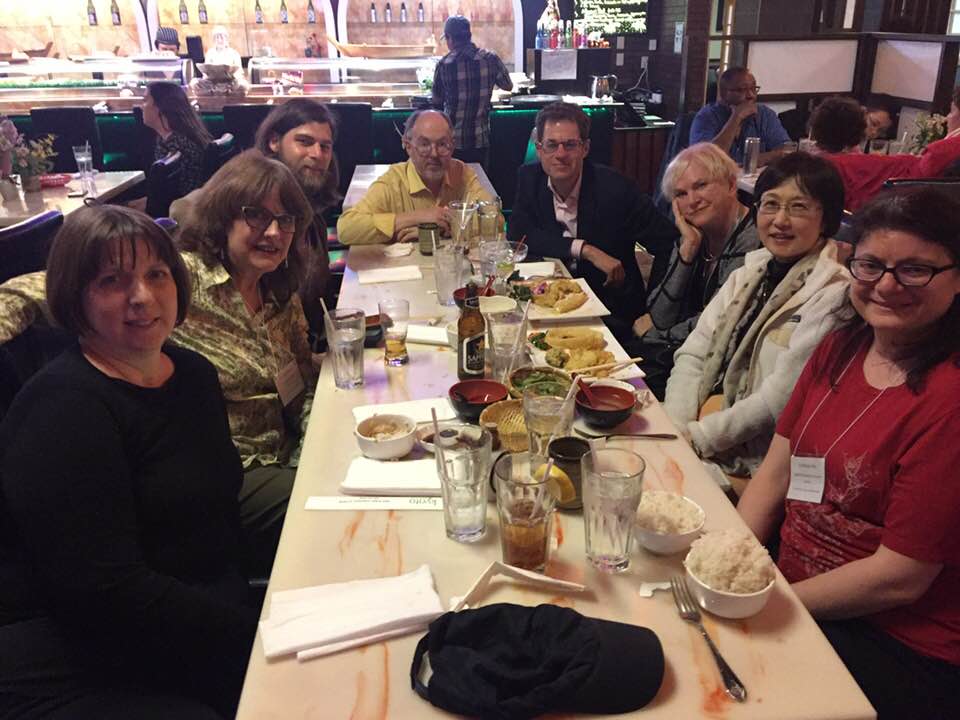
Tolkien fellowship at dinner

I was fortunate enough to have great company each evening at dinner. Here is a picture of one such gathering:

32253652_10156503589572386_8384827101634625536_n
Pictured (left to right): Kris Swank, Diedre Dawson, me, John Rateliff, Andrew Higgins, Jane Chance, Yoko Hemmi, and my PhD chair Dimitra Fimi. Photo taken by Douglas Anderson.

Tolkien Art Index

Erik Mueller-Harder shared this phenomenal resource that he has been working diligently to compile. It is a standardized list of Tolkien’s images. The usefulness and descriptiveness of the index makes it practical and influential. It should become the standard reference for Tolkien’s images.

Find the index here: http://tai.vermontsoftworks.com/

Tales After Tolkien Society

I was elected a Vice-President of the society, an honor that I hope to live up to!

Many Meeting

I had several meaningful interactions and can’t wait to get to work on some of the ideas I brought home from the conference! The encouragement and insight of scholars whose work I admire is truly one of the greatest assets of a conference like this. I hope everyone made it home safe!


2018 Summer Activities, Presentations, and Workshops

May 9-13

Paper for the Tolkien Symposium: “Eomer Gets Poetic: Tolkien’s Alliterative Versecraft” and attending International Congress on Medieval Studies

June 21-24

Paper for MythMoot V: “Tolkien’s Young Readers”

July 20-23

Workshop for Mythcon: “Young Readers’ Receptions of Tolkien: An Interactive Session with Survey and Interview”

August 18

Organizing BayMoot, a one-day symposium on speculative fiction in Oakland, CA.