LotRFI Pt. 9–Strider Again

On the journey between Bree and Rivendell, Strider’s character becomes more complex, especially when the group arrives at Weathertop. The first suggestion that Strider is more than a roaming do-gooder is the fact that he has earned Gandalf’s respect. According to Gandalf’s letter, and Strider’s subsequent ruminations on how Gandalf would likely proceed, we understand that the two of them have often worked together and that they understand one another well. Just before they reach Weathertop, however, Strider’s learning is on full display. It is here that the ranger of the north divulges his knowledge of history. He answers the hobbits’ questions about Weathertop by sharing his historical knowledge of the area, then he relates some of the tale of Gil-galad.

To the surprise of all, Sam goes on to recite a bit of Gil-galad’s tale! This was a marvelous occurrence to me, as I did not expect it from Sam at all. He was listening to Bilbo closer than I ever gave him credit for! Unfortunately, Sam’s knowledge does not extend past this excerpt and he is unaware of its significance. Later, the hobbits request that Strider tell them the full story and he declines, saying that now is not the time. Instead,

“I will tell you the tale of Tinúviel” said Strider, “in brief—for it is a long tale of which the end is not known” (FR, I, xi, 191).

Then follows a lengthy poem that recounts the story of the meeting of Beren and Lúthien.
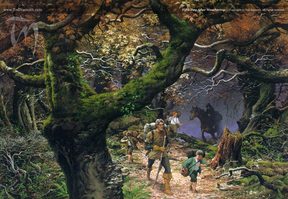
Fifth Day After Weathertop, by Ted Nasmith
Image copyright Ted Nasmith

This poem is significant for several reasons. First, it allows for exposition of Aragorn’s character and of the history of Middle-earth. This incident shows Aragorn to be knowledgeable of the lore of men and elves. Additionally, this sharing of lore seems to have the side-effect of forestalling the encounter with the Black Riders. They seem to lurk in the shadows until the tale is told and silence falls again. Finally, Corey Olsen posits that this is the moment in the drafting process where Tolkien decides to have LotR and The Silmarillion (not italicize because here it refers to the entire legendarium and not the published text) inhabit the same imaginative world. While this may be the case, when I first read the text, all I garnered from this episode is that Strider has much more wisdom than simply the skills of a tracker and forester. This sense is underlined after the events on Weathertop when Strider reveals that he has been to, and in fact lived in Rivendell for a time.

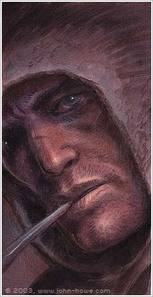
On Weathertop we see Strider’s real fighting skills for the first time. Contrary to how the movie adaptation depicts the scene, Strider does not use a sword in his combat against the Riders. Instead he uses fire brands to hold them off. This was significant to me in a couple of ways. First, it demonstrates that he is a formidable warrior in that he can adapt and use different weaponry when the situation dictates. Also, the imagery of Aragorn wielding the fire, a source of light, against the dark, shadowy Riders was symbolically important to me as a young reader.

The final insight I wanted to discuss about Strider is his use of Athelas on Frodo’s wound before Glorfindel arrives. This episode underscores Strider’s learning again, but it is not strange that a forester would have a bit of herb lore. The scene, however, demonstrates more about Strider than just his knowledge base. It demonstrates his emotional investment in the hobbits. Strider seems to genuinely care for the hobbits and he wants to ease Frodo’s suffering and delay the poison of the blade as much as he can. This care becomes more evident as this leg of the journey continues and he becomes increasingly worried about Frodo.

Where Do We Go From Here?

Glorfindel and the elves (pre-Rivendell) are next! Then we will cross the Ford and enter Rivendell.

What Do You Think?

What Aspects of Strider’s initial characterization change for you in this section? When?
​Did you picture Aragorn with a sword on Weathertop or not?

BlueberryMuffins76’s Experience–Tolkien Experience Project (7)

This is one in a series of posts where the content is provided by a guest who has graciously answered five questions about their experience as a Tolkien reader. I am very humbled that anyone volunteers to spend time in this busy world to answer questions for my blog, and so I give my sincerest thanks to BlueberryMuffins76 and the other participants for this.

To see the idea behind this project, check out this page

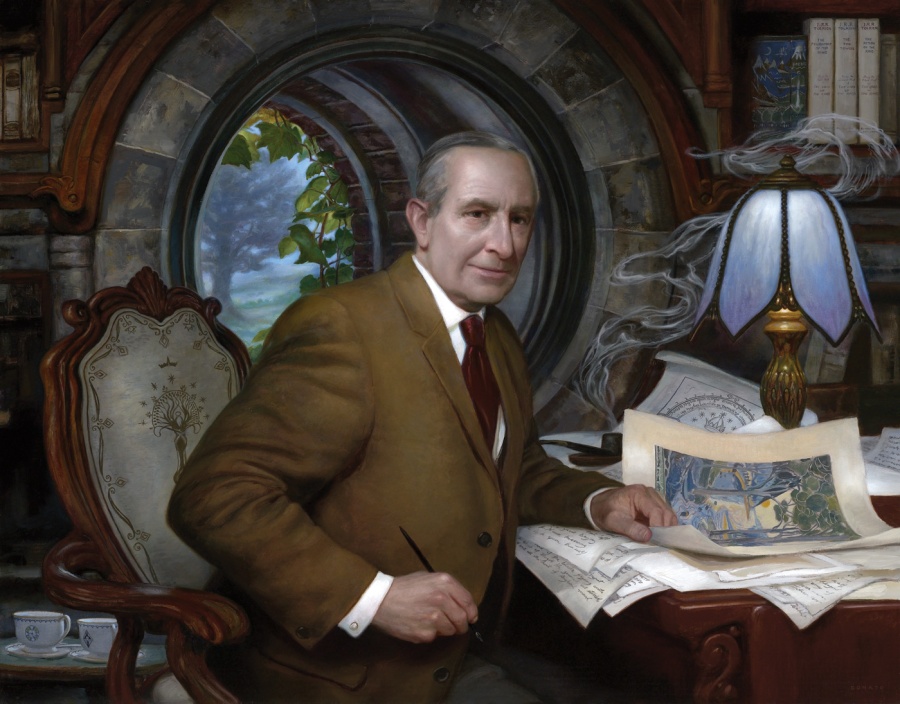
I want to thank Donato Giancola for allowing me to use his stunning portrait of J.R.R Tolkien as the featured image for this project. If you would like to purchase print of this painting, they are available on his website!

If you would like to contribute your own experience, you can do so by using the form on the contact page, or by emailing me directly.

Now, on to BlueberryMuffins76’s responses:


How were you introduced to Tolkien’s work?

My mother has owned the [LotR] trilogy, The Hobbit, and The Silmarillion ever since her teenage years and has always been fond of the latter four. In fact, I had to check out The Fellowship of the Ring from the library before I finally obtained my own copy because her copy (a paperback) had been loved and read so much it was missing the first fifty pages! So I became interested in them when I was in my early to mid teen years and have enjoyed most things Tolkien ever since!

What is your favorite part of Tolkien’s work?

Choose just one favorite part?!? As far as an entire book goes, I must say The Two Towers is my absolute favorite. However, my top two favorite stories are The Adventures of Tom Bombadil (one of my favorite characters) and Beren and Luthien as found in The Silmarillion, not The Lost Tales. I really enjoyed finally buying the book Beren and Luthien; having the various versions in one place is awesome!

What is your fondest experience of Tolkien’s work?

Again, that is a tough question! My favorite memories are writing fanfictions with my best friend, particularly about Dirhael and Ivorwen.(Their story is the third installment of our Legends of Love short series).

Has the way you approach Tolkien’s work changed over time?

I think my approach changed a little when I started writing fanfictions in college. I began researching more, finding I needed to learn more in order to make my stories accurate (although I will say I take a lot of license with some of them!). As I learned more about Tolkien’s life, it helped me to understand his writing a little more, especially why he seems to kill off so many people. He was certainly a gifted author and a very brilliant man!

Would you ever recommend Tolkien’s work? Why/Why not?

Yes! I quite frequently suggest people read the books since the films are so popular. While I do enjoy the movies, the books are ever so much better and contain a depth that the films do not and cannot accurately portray. The films even changed some of the characters’ personalities, so seeing the deviations from Tolkien’s written works are interesting. As I said before, Tolkien was quite a gifted author and certainly deserves his place in the classics!


For more great insights from BlueberryMuffins76, you can find her on The Council of Elrond and on FanFiction.net

LotRFI Pt. 8–About Strider

You can probably anticipate what my initial approach to Strider was. As with almost everything in the story, I was untrusting or even outright skeptical about him at first. Who was this shadowed figure trying to wheedle himself into the confidence of the hobbits? Unlike previous encounters where I held on to my preconceived notions longer than other readers might or where, however, I imagine that I changed my opinion around the same time as most other readers. I decided to trust Strider the same time that the hobbits did: after they see Gandalf’s letter and he proves that he is Aragorn by showing his broken blade.

I think part of the reason that I decided to like Strider is because the rest of the Breelanders did not like him. Frodo claims that


“You have frightened me several times tonight, but never in the way the servants of the Enemy would, or so I imagine. I think one of his spies would – well, seem fairer and feel fouler, if you understand.”

strider

I think that this passage helps to explain my own approach. Throughout the early parts of LotR, I had an innate mistrust of any characters that seemed fair, because their aspect is unbelievable (the elves are excluded from this, but we will talk more about that as we enter Rivendell). Therefore, my approach to this unknown world of Middle-earth was similar to Frodo’s own. I had reservations, often verging on misgivings, about people who seemed to be better than they were. Hobbits I innately trusted because they were familiar; for example, even though Maggot is daunting, he was still a hobbit, and so was not a source of fear so much as tension or conflict. Once the hobbits leave the Shire, however, most of their encounters were cause for alarm to me because each was an encounter with the unknown.

Strider is the exception to this rule so far. He mirrors the trajectory of Maggot in that he seems gruff and unlikable, but eventually grows into an ally for the hobbits. This is the first character that the hobbits meet outside the Shire who is not as he appears. The foreboding caused by Old Man Willow and the fear of the Barrow wights were appropriate responses and Bombadil really was a merry, if frighteningly powerful, fellow (even though I had my doubts). For the first time, a character who is not a hobbit presents some real complexity of character and does not fit in to his surroundings. This makes him intriguing to the reader and we want to know more about him. In fact, we, like Frodo, want all of our questions answered on the spot there in Bree. It is the artistry of Tolkien, however, to prolong the mystery and only unravel Aragorn’s true significance bit by bit.

I will go a bit more into Aragorn’s lore and medicinal skills in my next post, as we approach and then descend Weathertop, but I did want to say a bit more about his character on the road, as it were, with the hobbits. I came to like Strider very quickly because he is direct in his guidance, but does not take himself so seriously that he does not have fun while with the hobbits. I think Jackson’s characterization of Aragorn strays quite a bit here. The hobbits are the characters that readers are supposed to identify with, that is why the tale is told from their vantage point. This elevates Aragorn to be above the station of the reader. The reader does not like Aragorn as an equal, but appreciates the burden of his responsibility and his condescension in being a ranger and protecting the hobbits. This makes his character much more complex and interesting. Aragorn is not the character whose history we can understand or whose purpose we can see ourselves mirrored in, but the fact that he is willing to come alongside the hobbits and help them in their quest demonstrates a quality of character well beyond what is expected of individuals with power and station.

Where Do We Go From Here?

Next stop: Weathertop. Then I want to pause and talk about Glorfindel and elves before we head into Rivendell

What Do You Think?

What was your first impression of Strider?
Do you relate more to the hobbits or the men depicted in LotR​? Why?

Joe Hoffman’s Experience–Tolkien Experience Project (6)

This is one in a series of posts where the content is provided by a guest who has graciously answered five questions about their experience as a Tolkien reader. I am very humbled that anyone volunteers to spend time in this busy world to answer questions for my blog, and so I give my sincerest thanks to Joe and the other participants for this.

To see the idea behind this project, check out this page

I want to thank Donato Giancola for allowing me to use his stunning portrait of J.R.R Tolkien as the featured image for this project. If you would like to purchase print of this painting, they are available on his website!

If you would like to contribute your own experience, you can do so by using the form on the contact page, or by emailing me directly.

Now, on to Joe Hoffman’s responses:


How were you introduced to Tolkien’s work?

A classmate showed up with the Tolkien Calendar (Tim Kirk, 1975). I was curious, so he lent me the books on a Tuesday. I read The Hobbit in a couple of evenings, and inhaled the entire Lord of the Rings over the weekend.

What is your favorite part of Tolkien’s work?

It changes every time my life enters a new stage. At the moment, I enjoy imagining how Bilbo lived in the Shire in the years between The Hobbit and The Unexpected Party. I too am a sort of old man, happy with his books and his gardens. When I find likely youngsters, I make sure they‘re made aware of a wider world than the one about which their schools tell them. I too get occasional sidelong looks from my more respectable neighbors.

What is your fondest experience of Tolkien’s work?

In college, I loved to talk about books. But I’m a scientist, so my views about them were idiosyncratic and ignorant. I met an English major who thought my ideas were amusing, and who showed me there were other, much better ways to read books. Tolkien was the only author we both enjoyed. She married me.

Has the way you approach Tolkien’s work changed over time?

Of course! You can’t step into the same river twice, and you can’t read The Lord of the Rings the same way twice.

Would you ever recommend Tolkien’s work? Why/Why not?

I would recommend his books to anyone. Different ones first, depending on the person. Some people don’t like them; they are not of our Fellowship; no harm done. It would be a tragedy, though, if someone were a lover of Tolkien who never read him.


You can see regular blog posts about Tolkien and many other subject from Joe on his website: www.idiosophy.com

LotRFI Pt. 7–Signs in the Prancing Pony

We have finally arrived at Bree! As the first non-Shire settlement, there is much for the hobbits to adapt to and many new avenues of experience for them. Perhaps the plethora of innovations that the hobbits experience impacts the way that this scene can be interpreted in different ways.

In his Exploring the Lord of the Rings podcast, Dr. Corey Olsen suggested that Peter Jackson did not accurately portray the Prancing Pony in his film. According to Olsen, the great peril of the Pony is that it was so warm and inviting that it would put the hobbits off their guard, which could trick them into revealing more about their errand than they should. He denounced Jackson’s interpretation as far too scary and dark.

ba91a841b992bb1b6e1677f5bb14e45b
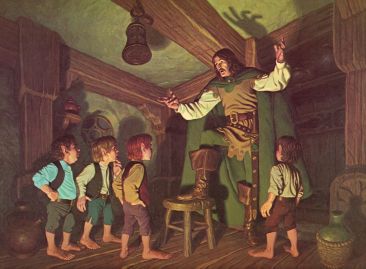
Image copyright Greg and Tim Hildebrandt

Personally, my own experience echoes Jackson’s interpretation more than Olsen’s, although I do see parts of the hobbits’ experience at the Pony as pleasant. While I can appreciate Olsen’s perspective, I always saw the common room at the Pony as in intimidating place because it is the first time that the hobbits encounter the Big People, if you will. Reading the scene as child, it resembled my own experience of entering a room of adults. The feelings of uncertainty and unease that occur to anyone who enters a room where they can assume that they are the least knowledgeable about the world and other people. This connection is obviously an extension of my reading of the hobbits as children.

While the common room unsettled me, I understood that the hobbits were at ease for part of their time there and relaxed for most of their time before going to the common room. Perhaps a more accurate assessment of my response would be that I thought the Pony was, to paraphrase Aragorn, both fair and perilous. The warmth of the caretaker and his staff were more than enough to allow any weary travelers to rest and be at peace. The inclusion of hobbit rooms at the Pony was certainly an unlooked-for balm for the hobbits as they relaxed from their travels. Once the hobbits are refreshed, they confront the world of the Bog People without being properly prepared. While the hobbits felt ease in the beginning of their encounter in the common room, it quickly became a source of intimidation and fear. Just as Frodo was aware of the danger before his fellow hobbits, so I, as the reader, was aware of the danger upon entering the common room.

This is partly because of the warnings that Merry and Pippin bandy back and forth before going to the common room. In Olsen’s opinion, most of these warnings are friendly ribbing among the hobbits. As a young reader, though I took them all very seriously. This put me on guard as they entered the common room, and Frodo’s misgivings only acted as a confirmation of my presuppositions. I do not think that the disagreement in interpretation here changes much of the characterization of important people moving forward. Therefore, it seems to me that this episode supports either of these two interpretations because later developments do not necessitate one interpretation over the other.

Where Do we Go From Here?

I would like to take a post to reflect on Aragorn-as-Strider and then probably move on to Weathertop and the lore that breaks in there.

What do you think?

What were your first impressions of the Prancing Pony or of Bree?
When, if ever, did you begin to mistrust the Big People?
What were your impressions of Butterbur, Hob, and Nob?

Geoffrey B. Elliott’s Experience–Tolkien Experience Project (5)

This is one in a series of posts where the content is provided by a guest who has graciously answered five questions about their experience as a Tolkien reader. I am very humbled that anyone volunteers to spend time in this busy world to answer questions for my blog, and so I give my sincerest thanks to Geoffrey and the other participants for this.

To see the idea behind this project, check out this page

I want to thank Donato Giancola for allowing me to use his stunning portrait of J.R.R Tolkien as the featured image for this project. If you would like to purchase print of this painting, they are available on his website!

If you would like to contribute your own experience, you can do so by using the form on the contact page, or by emailing me directly.

Now, on to Geoffrey B. Elliott’s responses:


How were you introduced to Tolkien’s work?

There’s not so much one watershed moment as a slow realization of and acclimation to the work. My local bookstore, Books to Share in Kerrville, more or less introduced me to the genre, and the shop’s owner, Gloria, made several suggestions that slowly spurred me to pick up Tolkien–beginning a series of re/readings that has continued for more than twenty years, now. (And which reminds me: I need to do the re-read again.)

What is your favorite part of Tolkien’s work?

Hm. Really hard to say with that one. I suppose the easy answer would be to cite some passage in Lord of the Rings, but, in truth, I’ve gotten more use out of “On Fairy-Stories” than just about anything else he wrote. While incomplete in itself, the essay forms a useful starting point for criticism of fantasy literature, one I’ve deployed on several occasions.

What is your fondest experience of Tolkien’s work?

Reading The Hobbit to my daughter. It was the first book I read to her (and I need to do so again), and having her infant self contentedly cooing and gurgling at me as I did…yeah. Good times.

Has the way you approach Tolkien’s work changed over time?

It could scarcely not. I went from being a passive consumer of the work to an avid devourer of it as I came up through high school. In college, Tolkien was a source of comfort, something of a cultural touchstone and a springboard for undergraduate research. In graduate school, it undergirded my early efforts and led to my MA project on Robin Hobb; as I have moved into and through my PhD and onward, it has fostered the Tales after Tolkien Society, which remains my primary engagement with the better parts of academe. Even now, Tolkien’s corpus continues to be a reference point for how I read fantasy as a genre.

Would you ever recommend Tolkien’s work? Why/Why not?

Clearly, there are problems with the writing. That the Middle-earth corpus arises from Tolkien’s linguistic project is clear, and the man’s poetry is not the best. Too, there are time- and place-of-composition-specific concerns that end to make modern readers cringe. But Tolkien’s work in fantasy is pivotal to the genre, and his work on older Germanic languages remains useful, so he still needs reading–with eyes open, of course.


You can see regular blog posts from Geoffrey on Tolkien, as well as other writers and education topics, on his fantastic blog: https://elliottrwi.com/

Full disclosure, I also work on the leadership team of the Tales After Tolkien Society with Geoffrey!

LotRFI Pt. 6–The Barrow Wights

For some reason, I always equated the Barrow wights with the Black Riders chasing our band of hobbits through the Shire. I imagined that they were somehow related or in collusion. Perhaps it was just my way of simplifying the danger that the company faced, thinking that evil was a single, combined force instead of a multi-faceted and diverse set of challenges or opponents. It was not until much later, probably around a decade, that I began to realize that there were some textual reasons why I made this assumption as a first-time reader.

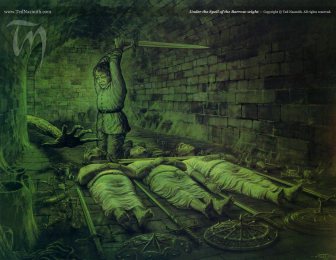
Under the Spell of the Barrow-wight, by Ted Nasmith
Image copyright Ted Nasmith

As a twenty-something, I wrote a word study focusing on Tolkien’s use of   glimmer throughout LotR. This project led me to Shadow, which displays the development of the wights and Riders through several drafts. In a prior version of this text, J.R.R. Tolkien describes how Tom Bombadil “seemed to think that the Riders and Barrow wights had some kind of kinship or understanding.”

Perhaps this assumption which is present in the previous iterations of the text still lingers in some of the creative decisions in the published text. While the two dangers are not in collusion as-published, the characterization of the Riders and the wights is very similar, down to the word choice (as I argued, somewhat, in that earlier paper).

I am not naïve enough to suggest that I was able to detect Tolkien’s earlier intent as a young child. What I would assert, however, is that Tolkien revised his text in such a way as to leave this connection between the Riders and the Barrow wights as a possibility for readers to interpret into the text, even if he does not suggest the link outright.

Where Do We Go From Here?

I hope to be in Bree next week!

What Do You Think?

Did you ever think that the Barrow wights were related to the Black Riders?

Olga Polomoshnova’s Experience–Tolkien Experience Project (4)

This is one in a series of posts where the content is provided by a guest who has graciously answered five questions about their experience as a Tolkien reader. I am very humbled that anyone volunteers to spend time in this busy world to answer questions for my blog, and so I give my sincerest thanks to Olga and the other participants for this.

To see the idea behind this project, check out this page

I want to thank Donato Giancola for allowing me to use his stunning portrait of J.R.R Tolkien as the featured image for this project. If you would like to purchase print of this painting, they are available on his website!

If you would like to contribute your own experience, you can do so by using the form on the contact page, or by emailing me directly.

Now, on to Olga Polomoshnova’s responses:


How were you introduced to Tolkien’s work?

Looking back, it now seems that Tolkien’s books found me, rather than I was introduced to them by someone. In my second year at university, studying English philology, I bought three volumes of The Lord of the Rings at a book sale in the main hall. I cannot explain now what made me pick up these books: I was aware of Tolkien’s work, of course, but did not consider reading it at that time. But when I saw these volumes in the box I just took them and that was it.
I did not read the books at that time, though. It was only many years later, long after my graduation from university, when I finally took them from the shelf and was able to enjoy the beautiful language and the story created by the author. However, I do not consider those years as lost (I could have read so much Tolkien so much earlier!) because I am sure his mythology entered my life exactly when it was meant to.

2. What is your favorite part of Tolkien’s work?

I love how many-layered and dimensional Tolkien’s stories are. You can re-read his books every year and still find a lot of things you did not notice before. There is great depth in his works that shows in shorter stories and poems, too. Tolkien’s world feels and appears real due to how greatly detailed, worked out and thought out everything about it is.

3. What is your fondest experience of Tolkien’s work?

Reading The Silmarillion for the first time. It was at the very beginning of January 2013, right after the New Year’s celebration. I had ten days off work and spent them all reading The Silmarillion non-stop while the world outside was quiet and covered with snow. I still remember the feeling of awe, enchantment and excitement on gradually discovering the tales while curling up on the sofa.

4. Has the way you approach Tolkien’s work changed over time?

I think it has, in a way. Now I like looking closely into the tales, legends and verse that Tolkien loved alongside reading and re-reading his own books. Learning more about Anglo-Saxon, Old Norse or Finnish ancient literature helps me understand Tolkien’s work better, adds a new dimension to my appreciation of his stories.

5. Would you ever recommend Tolkien’s work? Why/Why not?

I would recommend it gladly. In my opinion, his work is the finest example of fantasy literature written with great depth, in exquisite language, with love and care that few books can rival.


You can see regular blog posts about Tolkien from Olga on her fantastic blog: http://www.middleearthreflections.com/

LotRFI Pt. 5–Farmer Maggot

I feel like my first impression of Farmer Maggot was typical. At first, I did not like Maggot because I took Frodo’s account as accurate. I believed that he and Maggot had a history of clashing and were at odds with one another. This made Frodo’s reaction to being on his land seem logical.

“One trouble after another!” said Frodo, looking nearly as much alarmed as if Pippin had declared the lane was the slot leading to a dragon’s den. (FR, I, iv, 91)

It was not until Maggot offered food and shelter to the young hobbits that I began to trust him. So far, I think that most readers would agree with this impression, though some of them may have tempered their opinion of Maggot earlier, when Pippin began to push back against Frodo’s characterization.

Interestingly, I was recently listening to a podcast (Corey Olsen’s Exploring The Lord of the Rings, episode seventeen) which highlighted a disagreement that my perspective may have with others. In this podcast, Corey Olsen presents his belief that Maggot’s account of his interaction with the Black Rider is a rather objective recounting. Here is the passage in question:

“Good-day to you!” I says, going out to him. “This lane don’t lead anywhere, and wherever you may be going, your quickest way will be back to the road.” I didn’t like the looks of him; and when Grip came out, he took one sniff and let out a yelp as if he had been stung: he put down his tail and bolted off howling. The black fellow sat quite still.

‘“I come from yonder,” he said, slow and stiff-like, pointing back west, over my fields, if you please. “Have you seen Baggins?” he asked in a queer voice, and bent down towards me. I could not see any face, for his hood fell down so low; and I felt a sort of shiver down my back. But I did not see why he should come writing over my land so bold.” (FR, I, iv, 94)

Olson contends that, because Maggot’s account is objective, the Rider’s use of “yonder” is an attempt for him to blend in to the local dialect to collect information. My interpretation, however, has always been to treat this passage as reported speech. That is, Maggot is conveying the general sense of the interaction using his own idiomatic way of speaking. I never considered, then, that the Rider actually uses “yonder.” Instead, I always thought, and still believe, that Maggot is putting that word into the Rider’s mouth instead of trying to recount the interaction verbatim. This approach to the dialogue seems probable to me because it is a way of retaining the established characterization of both the Black Rider and Maggot. In that the Black Rider is not going to demean himself to try and fit into the dialect of the hobbits, and Maggot has no qualms about paraphrasing other people in his own dialect when it suits him. Also, I think that had Tolkien meant for readers to treat this scene has objective dialogue then he would have embedded the interaction into the text in a different way. As it stands in the published text, however, the entire episode is intended to be reported speech from Maggot’s perspective.

A second manner in which my approach to Maggot was very different from the norm is that he served as a proto-Bombadil encounter to me. My experience of Bombadil was very similar to the pattern that most people adopt with Maggot. It began with distrust but gradually evolved into respect and amiability. I know that this is very different from the opinion of others (as I recounted in my first post), but the pattern established by the Maggot encounter served as a template for many of the meetings that followed it in LOTR.

Where do we Go From Here?

Next we will visit the Barrow Downs, and then on to Bree!

What Do You Think?

How do you approach this passage which recounts dialogue between Maggot and the Black Rider?
Did the Maggot episode serve as a template of encounter for you as a reader?


Old Badger-brock’s Experience–Tolkien Experience Project (3)

This is the third in a series of posts where the content is provided by a guest who has graciously answered five questions about their experience as a Tolkien reader. I am very humbled that anyone volunteers to spend time in this busy world to answer questions for my blog, and so I give my sincerest thanks to Old Badger-brock and the other participants for this.

To see the idea behind this project, or if you are interested in sharing your own, visit the project homepage. If you enjoy this series, please consider helping us fund the project using the support page.

I want to thank Donato Giancola for allowing me to use his artwork for this project. Prints are available on his website!

Now, on to Old Badger-brock’s responses:


How were you introduced to Tolkien’s work?

My mother introduced my brothers and me to The Hobbit and The Lord of the Rings with a set of paperbacks when I was age 11. I recall her reading portions of The Hobbit to us.

What is your favorite part of Tolkien’s work?

I’m not certain how to interpret “part”. Do you mean which work, what particular scene in that work, or what aspect or attribute of Tolkien’s works? I’ll answer the first two.

My favorite work is The Lord of the Rings. It’s a wonderful work from beginning to end, but my very favorite scenes are “The Bridge of Khazad-dûm” (especially Tolkien’s use of the drums to build and diminish tension) and Éowyn’s encounter with the Lord of the Nazgûl in “The Battle of Pelennor Fields” (especially Éowyn’s speech to him). If I had to choose between the two, I’d pick the latter.

What is your fondest experience of Tolkien’s work?

That’s a difficult question to answer. I love all my experiences with his work! Perhaps my fondest experience is reading portions of it aloud to my wife. Although I’ve read his works many times, I find I still get emotional during certain passages. Tolkien’s words are so beautiful, as are the scenes they describe. C.S. Lewis wonderfully described LotR when he stated “here are beauties which pierce like swords or burn like cold iron”. Being able to share Tolkien’s words with the one dearest to me, and to communicate how meaningful they are to me, is particularly gratifying.

Has the way you approach Tolkien’s work changed over time?

Yes and no. (How’s that for an Elven response!) “Yes” because I first read them as a youth, and now that I am in my mid-50s my understanding of both Tolkien’s works and the world we live in has greatly increased. “No” because Tolkien’s words and what they express are timeless. There should be no change in interpretation from when they were published in the ’50s to when I first read them in the ’70s to now in the 2010s. The only change would be the greater understanding now possible due to the publication of The Silmarillion, Unfinished Tales, Letters, HoME, etc.

Would you ever recommend Tolkien’s work? Why/Why not?

An easy question! Yes, of course I would recommend them, and have. Tolkien’s works have great appeal simply as an adventure story, but the more mature reader finds applicability to their lives and the lives of others. His words stir both the emotions and the intellect. I would not recommend LotR and similar works, e.g., The Silmarillion, to younger readers, but The Hobbit was written with children in mind and should be enjoyed by them.


You can see regular comments about Tolkien and other subjects from Old Badger-brock by following his Twitter account: @oldbadgerbrock