Always1957’s Experience–Tolkien Experience Project (26)

This is one in a series of posts where the content is provided by a guest who has graciously answered five questions about their experience as a Tolkien reader. I am very humbled that anyone volunteers to spend time in this busy world to answer questions for my blog, and so I give my sincerest thanks to Always1957 and the other participants for this.

To see the idea behind this project, check out this page

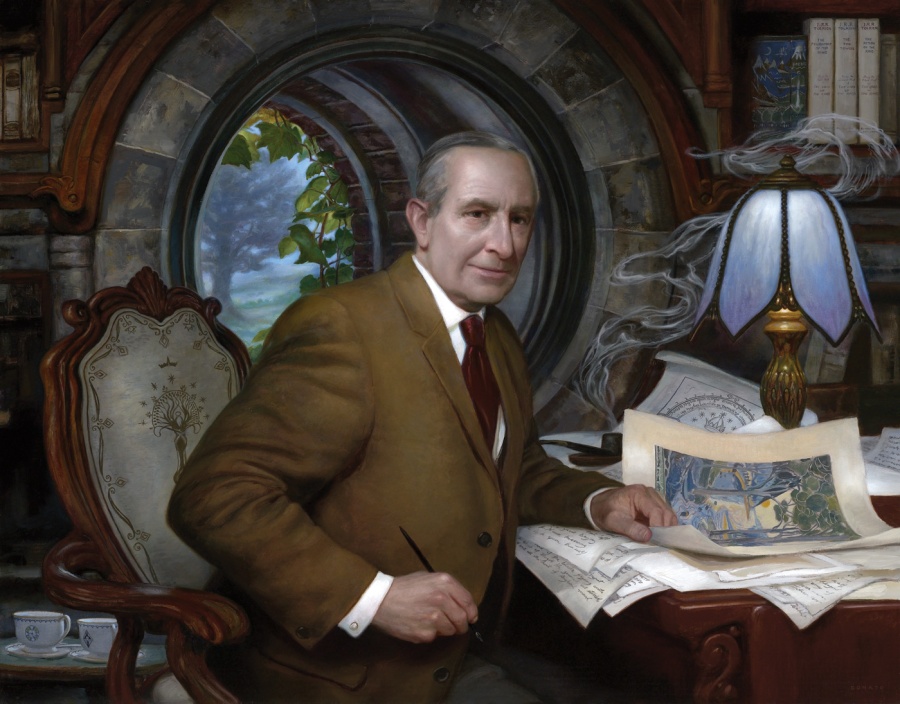
I want to thank Donato Giancola for allowing me to use his stunning portrait of J.R.R Tolkien as the featured image for this project. If you would like to purchase a print of this painting, they are available on his website!

If you would like to contribute your own experience, you can do so by using the form on the contact page, or by emailing me directly.

Now, on to Always1957’s responses:


How were you introduced to Tolkien’s work?

Apparently, my father had heard of the books through Princeton University and got them in his study. I was not supposed to read them, but I did, between the ages of 10-16, perhaps.

What is your favorite part of Tolkien’s work?

Certain chapters stand out: the Council of Elrond, the Mines of Moria, the Pellenor Fields, the Grey Havens.

What is your fondest experience of Tolkien’s work?

The movies were good, but I persist in liking the reading of the books, and I reread them all the time.

Has the way you approach Tolkien’s work changed over time?

Yes, indeed! By now, I’ve read most of the History of Middle Earth plus other things that Christopher has printed. We know a lot more of how Tolkien’s mind worked, and how he thought of things.

Would you ever recommend Tolkien’s work? Why/Why not?

Yes. I might, however, warn the potential reader of some politically incorrect or dubious things in Tolkien beforehand.

LotRFI Pt. 27–Concerning Théoden

When I first came across Théoden, I thought he was a withered old king and that Éomer would soon replace him. This made sense as a means to establish a leader in Rohan sympathetic to the Fellowship. His transformation into a true king was quite a marvel to me, and I found his reinvigorated personality to be magnetic.

672px-michael-kaluta-theoden-espies-the-serpent-banner
Image copyright Michael Kaluta

Théoden’s persona as the protector of his people made him a kind of father figure to me in my first reading. I loved his courage in the face of adversity and his determination to defend others. He is the kind of leader who has always inspired me: one who leads by example, not by command. I have such a hard time expressing my response to Théoden. This is one of those rare instances where something seems too important for words. The thoughts and feelings are there, but the words fail.

Whenever I revisit the text, I am shocked at how small Théoden’s role actually is. I always conflate his importance to me personally with his prominence in the text.

His role as the stalwart leader who comes to the aid of Gondor in the last moment foreshadows Aragorn’s arrival in similar circumstances. Unlike Aragorn, however, Théoden is not destined to keep his kingship. The fateful events surrounding the House of Eorl at the Pelennor Fields make me cry every time. I always want to save Théoden, so I can watch he and Merry settle in to have a long talk about herb-lore.

Where Do We Go From Here?

I want to talk specifically about Théoden’s transformation, then move on to address Wormtongue and Saruman.

What Do You Think

What was your very first impression of Théoden?
How did you react to his demise?
Did I miss anything? Let me know!

Timothy “Timdalf” Fisher’s Experience–Tolkien Experience Project (25)

This is one in a series of posts where the content is provided by a guest who has graciously answered five questions about their experience as a Tolkien reader. I am very humbled that anyone volunteers to spend time in this busy world to answer questions for my blog, and so I give my sincerest thanks to Tim and the other participants for this.

To see the idea behind this project, check out this page

I want to thank Donato Giancola for allowing me to use his stunning portrait of J.R.R Tolkien as the featured image for this project. If you would like to purchase a print of this painting, they are available on his website!

If you would like to contribute your own experience, you can do so by using the form on the contact page, or by emailing me directly.

Now, on to Timothy “Timdalf” Fisher’s responses:


How were you introduced to Tolkien’s work?

I was 19 or 20 and someone knew of my interests and recommended it, But I did not initially take it up. However at a summer job at a beach restaurant that year I guess I happened upon the pb books and began reading…

What is your favorite part of Tolkien’s work?

That is a hard one to answer. As the decades have passed and I have read more and more often, I find that each work enhances the others. Obviously, LotR is the best realized and most suggestive work. And it stands out. But within it there are those high intensity moments which I could never choose one over another, but the low intensity descriptions of nature are also essential to the sense of reality he build up.

What is your fondest experience of Tolkien’s work?

Simply rediscovering it with each re-reading. And the visuals and score of the films sent me back to the book. And recently coming upon a dramatic reading that combines all that is my latest happy discovery.

Has the way you approach Tolkien’s work changed over time?

Yes. My initial read, coming soon after discovering Wagner’s Ring Cycle, left me unimpressed. I found the style flat compared with the intensity of the music dramas. I could not have been more wrong. Each reading increases my appreciation and admiration for what Tolkien achieved in LotR in particular. But the interplay between the Wagner music dramas (not just his Ring) and Tolkien has become a major focus for me.

Would you ever recommend Tolkien’s work? Why/Why not?

Absolutely! The vividness of the LotR characterizations and the interplay between the characters and their situations is inspiring. I find “The Silmarillion” still quite problematic especially for being unfinished. Given Tolkien’s penchant for drastic revisions I find the various versions interesting, but also frustrating…

LotRFI Pt. 26–The White Rider

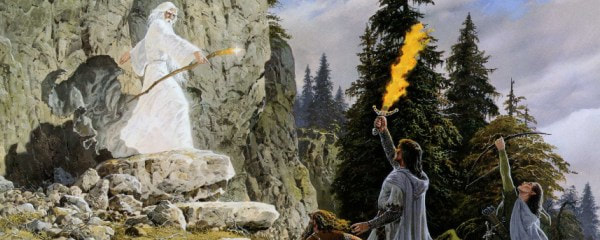
When the Three Hunters encounter a mysterious old man in Fangorn, I immediately assumed it was Saruman. His way of speaking was so obvious an attempt to avoid revealing his identity from them. There is no reason for anyone else to wish to conceal who they are so completely. The confrontation between the Hunters and the old man is so tense and the stakes so high, unexpectedly, that I thought for a moment that the Hunters would be executed in quick succession.

05-nas-02_orig
Image copyright Ted Nasmith

When this is revealed to be Gandalf, I still had a hard time understanding why he did not reveal himself straight away. Was he testing the Three Hunters? This would be similar to what Aragorn does back at the Prancing Pony with the hobbits. Surely, the powers of evil have set traps for Gandalf before!

It took me a long time to accept that Gandalf has memory issues here, and I still doubt it sometimes. He remembers so much, and is not newly revived, so I did not understand why he should have forgotten who he is when he can remember who Galadriel and Gwaihir are. All this nit picking aside, the return of Gandalf was a complete shock to me.

Of all the miraculous things that happen in books, one that I certainly never expected was the return of Gandalf. The warmth and joviality that the Three Hunters express is as nothing compared to the elation of my little eleven-year-old heart. Especially with the tidings which he brings with him. He tells the others:

Indeed my friends, none of you have any weapon that could hurt me. Be merry! We meet again. At the turn of the tide. That great storm is coming, but the tide has turned. (TT, III, v, 495)

Not only is Gandalf returned, he has returned stronger than he was. He also prophesizes that he and the others are now a part of the side which is gaining in strength, a stark contrast from the waning which characterized their forces earlier. It was a very long time before I would understand what happened to Gandalf. In my first reading, I just knew that he had died and that Something sent him back. Undoubtedly, my Christian upbringing made me assume a particular spiritual connotation to the whole event.

Where Do We Go From Here?

Onward, to King Théoden and the Golden Hall

What Do You Think?

What was your reaction to Gandalf’s reappearance?
​What did you make of his premonition?
​Did I miss anything? Let me know!

Tanya P’s Experience–Tolkien Experience Project (24)

This is one in a series of posts where the content is provided by a guest who has graciously answered five questions about their experience as a Tolkien reader. I am very humbled that anyone volunteers to spend time in this busy world to answer questions for my blog, and so I give my sincerest thanks to Tanya and the other participants for this.

To see the idea behind this project, check out this page

I want to thank Donato Giancola for allowing me to use his stunning portrait of J.R.R Tolkien as the featured image for this project. If you would like to purchase a print of this painting, they are available on his website!

If you would like to contribute your own experience, you can do so by using the form on the contact page, or by emailing me directly.

Now, on to Tanya P’s responses:


How were you introduced to Tolkien’s work?

By chance, if chance you call it. When I was 14, a few months after my family and I came to US, I went with my mother and sister to the local library to pick out a book to read together, for the purposes of learning English. We were really at a loss what book to pick. So we wandered to a random shelf. There my mother pointed to some books and said “Look, there’s Tolkien.” My sister and I never heard the name before and were puzzled, so my mother, who like us never read Tolkien either, said that she heard that “this Tolkien was sought after” by more enthusiastic book lovers in Russia. That was good enough for us. So we plucked a random book by this Tolkien from the shelf and check it out. It was called The Hobbit. We began reading it together, but my mom and sister got bored very quickly and quit. I devoured the book and been reading and enjoying Tolkien’s works ever since.

What is your favorite part of Tolkien’s work?

My favorite Tolkien’s book is The Silmarillion, but I’m having trouble pinpointing a single favorite passage or chapter in it. On the other hand, in The Lord of the Rings, I have several favorite passages. I like them for different reasons. But the one describing Gandalf’s flash of real light in Moria stands out even among them. Moria is one of my favorite locations in Middle-earth. Its perpetual darkness conceals secrets that I long to uncover. And I love the moment when Gandalf lifts this veil of mystery and gives his companions, and readers, a tiny glimpse of what they are missing.

What is your fondest experience of Tolkien’s work?

Being part of the Tolkien community and being able to share the love for the works of my most favorite author with like-minded people through discussion, speculation and humor. I was a solitary and lonely fan for twenty years. When I joined the Tolkien Society Facebook group, I was overjoyed to finally find someone to talk to about all things Tolkien.

Has the way you approach Tolkien’s work changed over time?

Yes and no. It was really natural progression over time, fueled by age and exposure to the Tolkien’s fandom. This is how it went: This is such a great story, can’t wait to find out what happens next. —> Arda is such a rich world, must know every detail. —> These books are great works of literature, must think of all the different themes that the author included and tried to explore in his works. —> There are so many influences, references and allusions to external sources both literary and historical, must find all these hidden gems and thoroughly analyze them. But my greatest interest always was and still remains Arda itself – it’s history, metaphysical structure and internal workings.

Would you ever recommend Tolkien’s work? Why/Why not?

Yes I would if I ever get a chance because I think that a person of almost any age will find something interesting in Tolkien’s books. But unlike many other fans, I generally like to talk Tolkien only to the people whom I already know to be fans. And though I recommended the “next Tolkien book” many times, I almost never get an opportunity to recommend it to someone who never read Tolkien before.


Interview on The Tolkien Heads

I wanted to share that I recently recorded an interview with The Tolkien Heads!

We were able to talk about my PhD Research looking at young readers of The Lord of the Rings, Beowulf, and some proverbs from the text I had always been curious about!

If you are interested in hearing the latest about my PhD research and some other fun Tolkien bits, you can find the episode on their website!

The Tolkien Heads is also available on iTunes and Stitcher, my interview is episode #55.

LotRFI Pt. 25–Uruk-Hai

The third chapter of book three was an odd experience for me as a reader. I have to admit that it took me a little while to find my bearings and understand that the narrative had jumped to a different perspective than the previous chapter.

Once I found my legs, though, I was intrigued to walk among the Uruk-Hai in their camp and to watch their march through Rohan. I was not quite sure what to make of these characters because, up to this point, they had been nameless, faceless sources of dread. Now, I had to confront their being in a completely different way.

alan-lee-orc-hunting-2
Image copyright Alan Lee

The chapter was effective in making me understand how the Orcs interacted with one another with malice without making me question whether or not they had a sense of humanity. I understood that these characters were mean, ruthless, and cruel, but did not question their motivations or whether or not they could be redeemed. My claim is not that Tolkien wrote the Uruk-Hai simply, but that I read them simply when I was a child. The kind of in-fighting and bickering portrayed among the disparate bands on the march was something I could relate to. The contrast between the milieu of this terse, selfish group and the rather unselfish, supportive climate of the Fellowship made a solid impression on me.  I think that I somehow unintentionally internalized these groups as exemplars to apply to my life: good groups (that is, groups that function well and where everyone is appreciated, not morally just groups) look like the Fellowship, bad groups look like the Uruk-Hai.

Pippin and Merry evolve a lot over this passage, but I want to side-step that conversation for now and come back to it when I do a character analysis of each of them, probably in book V.

Where Do We Go From Here?

The White Rider, of course!

What Do You Think?

What impression did chapter three make on your reading?
Did it change the way you perceived the Orcs and Uruk-Hai?
Did I miss anything? Let me know!

Ina’s Experience–Tolkien Experience Project (23)

This is one in a series of posts where the content is provided by a guest who has graciously answered five questions about their experience as a Tolkien reader. I am very humbled that anyone volunteers to spend time in this busy world to answer questions for my blog, and so I give my sincerest thanks to Ina the other participants for this.

To see the idea behind this project, check out this page

I want to thank Donato Giancola for allowing me to use his stunning portrait of J.R.R Tolkien as the featured image for this project. If you would like to purchase a print of this painting, they are available on his website!

If you would like to contribute your own experience, you can do so by using the form on the contact page, or by emailing me directly.

Now, on to Ina’s responses:


How were you introduced to Tolkien’s work?

I was introduced by my German/philosophy teacher at the German grammar school I was attending at the time. I was 17.
He gave me the three-volume German edition of The Lord of the Rings, published by Klett-Cotta. When I handed it back to him, he asked me if I had liked it, and I told him I hadn’t.
I also didn’t understand what the hype was all about. At the time, I didn’t understand why I hadn’t liked it.
Several years later, my English had improved, so I decided to read the original version (since I had been lucky enough to find an affordable one-volume edition with the appendices; English books used to be very expensive in Germany before the advent of Amazon).
I devoured the book within a few days and loved it!
I also realised why I hadn’t liked the German translation:

a) All the songs and poems were translated with rhyme and meter, which is commendable; however, the meaning/content went out the window, so I hadn’t understood the backstory of the ring and the history of Middle-Earth.

b) The prose of the German translation is by no means on a par with Tolkien’s use of language. Also, the translator had changed a number of the names to what he probably thought was easier for German readers. I only found it confusing.
I‘ve read it several times since then and love it more each time.

2. What is your favorite part of Tolkien’s work?

My favourite work by Tolkien is still The Lord oft he Rings, although I have also read The Hobbit and The Silmarillion.

3. What is your fondest experience of Tolkien’s work?

My fondest experiences are:

a) Reading such a magical, beautiful book in the original language.

b) Watching The Lord of the Rings Trilogy (the extended version). One thing I like about the films in particular is that the female characters are portrayed more strongly – and as stronger.

4. Has the way you approach Tolkien’s work changed over time?

Well, I’m 50 now and have a somewhat more mature approach (I hope). As a young adult, I read novels mostly for entertainment. Then I went to university to study English and learned much about literature, so I came to appreciate it more. Nowadays, I also want to know about the author’s and the story’s backgrounds.

5. Would you ever recommend Tolkien’s work? Why/Why not?

I definitely recommend Tolkien’s work to others – if at all possible, in English. The Lord of the Rings is a milestone of unprecedented genius. You can read it on many levels, starting from reading it simply for pleasure all the way to writing your thesis on it. It’s a marvel of world-building, which makes the reader see something new every time they read it. For me, it’s the best book of the 20th century.


LotRFI Pt. 24–Legolas

I always found Legolas’s character arc to be one that begins in haughtiness and becomes more approachable as he engages in the hardships of the Fellowship. Looking back with a wider literary reference frame than I had in my first reading, I would almost say that my first interpretation of his transformation would not raise any eyebrows if it were set in a Jane Austen novel, though his bow skills might.

lotr-19
Image copyright Alan Lee

He is always quick-witted, especially when engaging in repartee with Gimli; however, this arguing transforms into a light-hearted badinage by the end of their time together in Rohan. I always enjoyed watching these two become friends over the course of the tale and appreciated the note about their friendship in the appendices.

As an individual, Legolas is a formidable bowman, he does not defy the law of gravity mind you. He is always a reliable aid to his companions and he shows up when he is needed. For all of these elements, though, I never really felt drawn to Legolas as a character. I think his oft-mentioned ethereal nature made him seem remote from me as a young reader. He was a character to be marveled at, when he walks on the snow of Caradhras, for instance, but not related to.

I think this was underscored for me in Lothlórien when the elves are grieving for Gandalf. Legolas refuses to translate their song for the Fellowship and, by extension, the reader. This always made me feel as though Legolas wanted to be an outsider in some ways. Surely my interpretation of Legolas was, and is, a projection of a part of myself, in that I am reading what I would desire if I were to act as Legolas. To me, though, it is not until later when he volunteers to follow Aragorn on the Paths of the Dead that his desire for attachment is demonstrated.

Where Do We Go From Here?

I suppose we should talk about being ‘Orc dragged’ across Rohan.

What Do You Think?

What was your initial reaction to Legolas?
Did you like Jackson’s super-elf?
​Have I missed anything? Let me know!

Beth H’s Experience–Tolkien Experience Project (22)

This is one in a series of posts where the content is provided by a guest who has graciously answered five questions about their experience as a Tolkien reader. I am very humbled that anyone volunteers to spend time in this busy world to answer questions for my blog, and so I give my sincerest thanks to Beth and the other participants for this.

To see the idea behind this project, check out this page

I want to thank Donato Giancola for allowing me to use his stunning portrait of J.R.R Tolkien as the featured image for this project. If you would like to purchase a print of this painting, they are available on his website!

If you would like to contribute your own experience, you can do so by using the form on the contact page, or by emailing me directly.

Now, on to Beth H’s responses:


How were you introduced to Tolkien’s work?

I was first introduced to Tolkien’s work in late junior high or freshman year of high school when my sister brought home a library copy of The Hobbit. I may be remembering this wrong—what year of my life it happened. It had to have been before freshman year of high school. Then I think the Rankin Bass cartoon of The Hobbit was shown on TV and I liked it, so I read the book, and liked the parts about yearning for cupboard comforts the best, the Gollum scene second best, and the troll scene next best.

What is your favorite part of Tolkien’s work?

My favorite part of Tolkien’s work is The Lord of the Rings—and my favorite part of that is the hobbitry. Really the mixture of country bumpkins yearning for adventure, loving the comfortable life, but wanting to see more interesting things. It was the story of my life growing up in a small farm town before the Internet, feeling that there must be SO MUCH MORE out there. At first read through the Black Rider scare and intrigue hooked me so that I could not put the book down, and I fell in love with Glorfindel—as small a part as that was. He seemed to me to most clearly evoke what was beautiful—promisingly possible about elves. Makes you want to learn more about what life in his world would be like—but we never really get it, do we? We are always left wanting more.

What is your fondest experience of Tolkien’s work?

When I first read the LOTR I was all about the Englishness of it and cared the most about the hobbit story lines. I studied in England for a year in college and I blame the LOTR for planting a romantic idea in my head about what England would be. This was before I read The Wind in the Willows. Same kind of love, though. Love of nature and simple pleasures and yearning for adventure.

My experience changed most after finally being able to digest The Silmarillion—ONLY possible with the help of Corey Olsen and The Silmarillion Seminar podcasts. It was like being given the LOTR all over again, and this time the parts that I had previously found to be tedious (long descriptions of landscapes and chapters having to do with Gondor and Rohan) became the more interesting parts.

Has the way you approach Tolkien’s work changed over time?

Post Silmarillion Tolkien has become an extension of my spiritual life—in the sense that it provides another “in” to a sense of gratitude for beauty, the importance of sorrow and pity. As a writer I am always amazed by Tolkien’s skill. He is much loved but underrated, and many who try to copy him suggest that they miss most of what is great in his writing. By that I mean that the charm has less to do with the variety of creatures/sentient beings. Writing a story that has dragons and elves does not give you Tolkien, so the value lies elsewhere.

Would you ever recommend Tolkien’s work? Why/Why not?

I always try to get people to read Tolkien and try to keep Little Free Libraries near me always stocked, hoping to give that experience to another person. The first biggest value is in an appreciation of beauty in a biblical sense—“…and God saw that it was good,” and so do we.