Richard Rohlin’s Experience—Tolkien Experience Project (31)

This is one in a series of posts where the content is provided by a guest who has graciously answered five questions about their experience as a Tolkien reader. I am very humbled that anyone volunteers to spend time in this busy world to answer questions for my blog, and so I give my sincerest thanks to Richard and the other participants for this.

To see the idea behind this project, check out this page

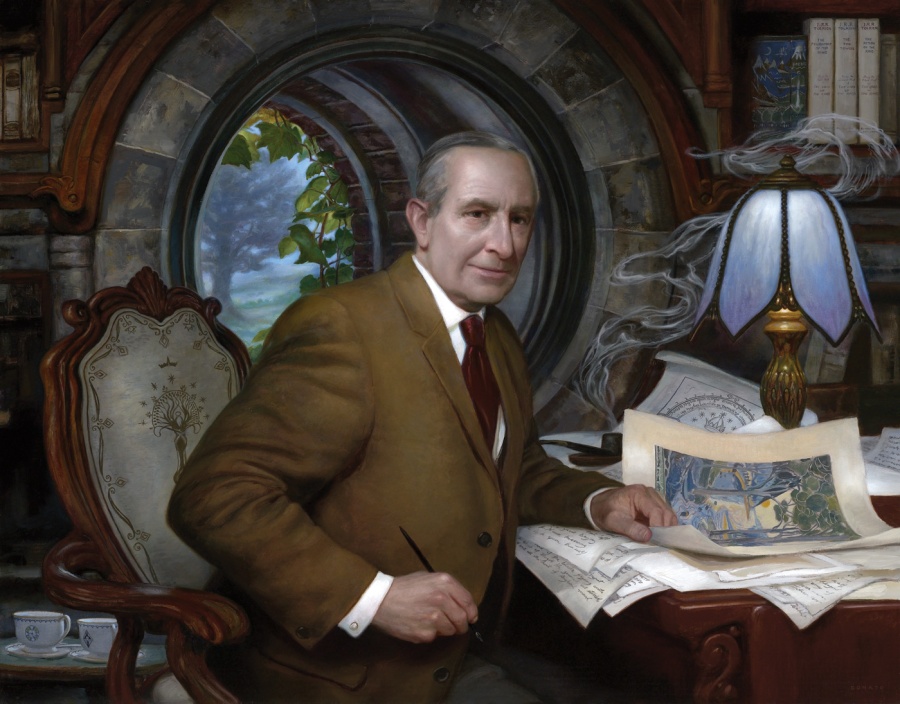
I want to thank Donato Giancola for allowing me to use his stunning portrait of J.R.R Tolkien as the featured image for this project. If you would like to purchase a print of this painting, they are available on his website!

If you would like to contribute your own experience, you can do so by using the form on the contact page, or by emailing me directly.

Now, on to Richard Rohlin’s responses:


How were you introduced to Tolkien’s work?

I read The Hobbit and The Lord of the Rings a couple of years before the Peter Jackson films came out. I actually found a couple of old yellowed Del Rey paperbacks (of The Hobbit and The Fellowship of the Ring; I’ve always assumed they must have been left there by the previous owners) in the attic of the house we were living in at the time. I was nine or ten years old, and although I was a big Narnia fan at the time I’d never heard of these books. I took them downstairs to my mother, and she looked at them and said, “yeah, those are good.” Over the course of a summer family road trip from Texas to Tennessee, I read through both volumes. It was only when I came to the end of The Fellowship of the Ring that I realized there were at least two more volumes!

What is your favorite part of Tolkien’s work?

I think Tolkien was vastly underappreciated as a poet, by which I mean specifically a versifier. I didn’t really get the poetry my first, second, or third time through, but that’s been one of the many ways I’ve “grown into” the books. And of course elves. I can’t get enough of elves.

What is your fondest experience of Tolkien’s work?

One of the great moments in my life came when I was twelve years old and learned of the existence of The Silmarillion. My mom took me to the library to find a copy, and I ended up coming up with a copy of Unfinished Tales as well. There are certain books you read that set your tastes for the rest of your life, books that cause your imagination to turn a corner. The Silmarillion is one of those books for me.

Has the way you approach Tolkien’s work changed over time?

I am (thanks to Tolkien) a Germanic philologist, currently finishing my thesis on Eddic poetry and specifically an Eddic poem known as “The Waking of Angantýr.” My interest in philology began as an attempt to see Tolkien’s sub-creation through his eyes, and then discovering that I actually enjoyed this sort of work. I think there are lots of linguists and medievalists with similar stories. That experience, following in his academic footsteps as it were (or at least trying to – they’re rather large footprints), has certainly enriched my reading of his works. On the other hand, it’s freed me up to really read them again. There’s this phase that I think many Tolkien fans go through, usually right after they read The Silmarillion, where they are sure that they’ve got Middle-earth completely “figured out.” They know what categories and boxes to fit everyone into, they know what all of the allusions in The Lord of the Rings mean, etc. In that way the illusion that the Silmarillion creates is almost too effective. It’s only when you dig deeper into the complexity and the richness of Tolkien’s language creation, his mythmaking, his poetry, and the long and complicated textual history of the legendarium as it’s presented to us in The History of Middle-earth that you get a sense for how much there is. With that realization comes a certain freedom. I can relax. I can sit back and enjoy the story, the rich prose, the humor, the fullness that is there to be enjoyed. And I can know that I don’t have to get to the bottom of it all today. I probably never will. I don’t have to deconstruct it. I can set my mind free to rove “over hill and under tree.”

Would you ever recommend Tolkien’s work? Why/Why not?

Tolkien’s books are among the most life-changing works I have ever encountered. They set the trajectory for what my life, work, study, and faith have become. That said, I’ve found that it doesn’t always pay to recommend them too strongly to your friends. The sheer amount of investment which Tolkien “superfans” put into Middle-earth can be off-putting, even intimidating, to people considering their first casual read. Tolkien’s prose, which I find rich and lovely, does intimidate some readers of the “Harry Potter” generation (my generation)—no slander to Harry Potter intended! Oddly, I have found that the Generation Z kids (many of whom did not grow up with the films) are often much more excited and receptive about reading Tolkien. I wonder if his works are undergoing a “rediscovery” in a small way? I hope so. To children or adults, I would say simply this: Read these books. They may not change your life. They may not be your favorite thing in the world. But at the very least, you will leave Middle-earth richer than when you arrived.


To see more of Richard Rohlin’s thoughts on Tolkien, head over to his blog: http://blogonthebarrowdowns.blogspot.com/

LotRFI Pt.32–Saruman

Saruman was very mysterious to me as a young reader. I loved many of the passages surrounding him because I could understand their deeper significance or symbolism (a rarity for me when I was younger), but I had a very difficult time visualizing Saruman.

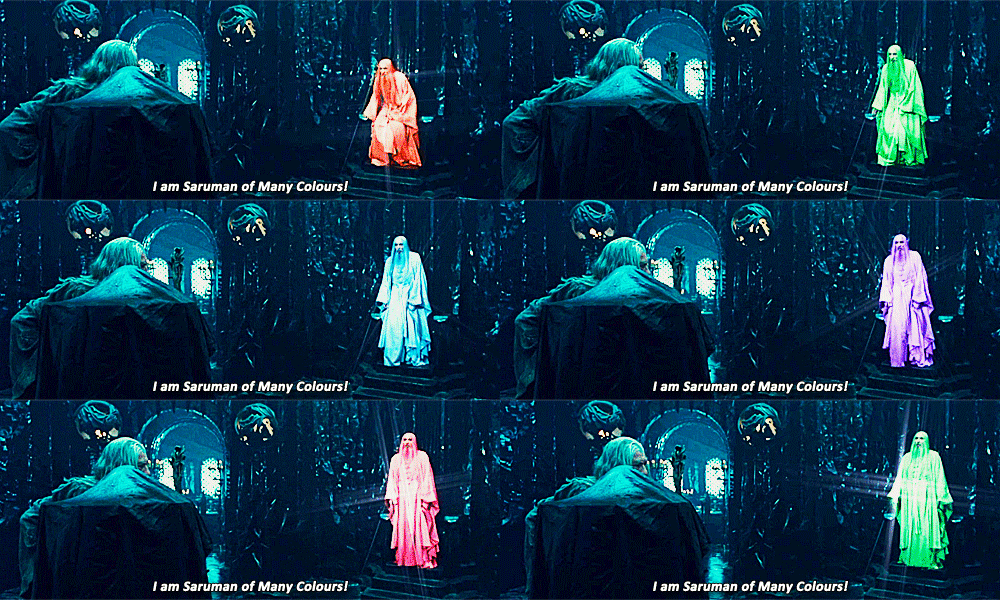
This confusion about Saruman began at the Council of Elrond, with Gandalf’s description of their interaction as his explanation of why he was late. During their interaction, Saruman proclaims himself Saruman of Many Colours, and Gandalf describes his garments as follows:

‘I looked then and saw that his robes, which had seemed white, were not so, but were woven of all colours, and if he moved they shimmered and changed hue so that the eye was bewildered’ (FR, II, ii, 259).

As a young child, I tried my best to picture this, but could not. Each time I tried, I ended up with an image something akin to the titular piece of clothing from a version of Joseph and the Amazing Technicolor Dream Coat. I deeply enjoyed the symbolism of this description and Gandal’s commentary, but I could not visualize it.

tumblr-inline-nkevtpfabl1r1werk_orig
I was not alone in my preposterous imaginings. This image taken from https://catotheyoungerdotblog.wordpress.com/2017/04/29/saruman-a-tragedy-of-pettiness/

This same difficulty in imagining aspects of Saruman was true about his voice. Gandalf warns his companions that Saruman’’s voice is a great weapon and that it could daunt, soothe, coerce, and persuade very effectively. I must admit that I lacked this skill as a child, so it was very hard for me to make Saruman’s voice seem as convincing as it should, or as I thought it should, in my mind. In all, this made Saruman a very illusive figure to me. I still find him difficult to picture in my mind with as much clarity as the other characters.

Two quick side-notes:

Here again we revisit the theme of the staff, and this was the pay-off of my observation of this theme earlier.

Joseph Conrad’s Heart of Darkness, rather unbelievably, has shaped many of my later opinions about Saruman. Perhaps there is a paper here at some point.

Where Do We Go From Here?

To the Dead Marshes…where else?

What Do You Think?

How did you picture Saruman’s robes?
Did you struggle to find a voice to fit him?
Did I miss anything? Let me know!

grys03’s Experience –Tolkien Experience Project (30)

This is one in a series of posts where the content is provided by a guest who has graciously answered five questions about their experience as a Tolkien reader. I am very humbled that anyone volunteers to spend time in this busy world to answer questions for my blog, and so I give my sincerest thanks to grys03 and the other participants for this.

To see the idea behind this project, check out this page

I want to thank Donato Giancola for allowing me to use his stunning portrait of J.R.R Tolkien as the featured image for this project. If you would like to purchase a print of this painting, they are available on his website!

If you would like to contribute your own experience, you can do so by using the form on the contact page, or by emailing me directly.

Now, on to grys03’s responses:


How were you introduced to Tolkien’s work?

This one was easy – 1971
I was a comic book collector & had made friends with a guy who ran a bookshop
He was an ex-literature/English teacher/private tutor in his 70’s
We had come to an arrangement whereby he would let me know when something interesting came in &
I would grade & value the comics
On one of these occasions I spotted a silly paperback in a box in the back room
It looked like fun & had even sillier name: Bored of the Rings by the Harvard Lampoon

About an hour later (I was a quick reader) I was hooked.

What is your favorite part of Tolkien’s work?

I was always fond of books/stories that filled in details via background data (e.g. Dune)
So Tolkien’s appendixes, family trees was a fascination for me
& eventually The Silmarillion, in particular, almost became far more important than LoTR
providing a rich history
inconsistencies I ignored – stories grow over time & the details can change
even in a well researched/laid out world such as Middle-Earth

What is your fondest experience of Tolkien’s work?

Reading LotR to my kids 4 & 5 as bedtime a series of bedtime stories
I would paraphrase a section of a chapter
We would talk about unfamiliar concepts etc
This led to many games of HeroQuest, Talisman (board games) &
eventually Dungeon & Dragons when they had matured at ages 5 & 6

Has the way you approach Tolkien’s work changed over time?

I always considered LoTR a grand adventure
It was the adventures of Hercules & Thor & other great tales all rolled into one
It was populated with heroes, ‘magicians’, evil demons, elves, dwarves, etc.
What more could you want

Except, as time went on I realized that the journey to Mordor, the reinstatement of Aragorn as king of Gondor
the travels through Middle-Earth, the destruction of the Ring etc were actually the back story

The real story was the ‘coming of age’ of the Hobbits – their growing confidence & their ability to decide their own future

Which is why, though I loved the movies, I was disappointed that the Homecoming was not handled properly
To me that was the most important chapter in the book

Not the most exciting or grandiose or epic but certainly most important

Would you ever recommend Tolkien’s work? Why/Why not?

It took me several attempts to get past the first 33 pages
Once I did I read the next 70 odd pages in the next day
But the rest of the book simply flowed very quickly

So, depends on the person. LoTR is a great book but to me it always felt like a book that thought it was a movie
Descriptive passages were almost written as if Tolkien was one of the Fellowship & described what he saw
similarly, Tolkien wrote as if he was an eavesdropper

Not everyone is interested in reading that style of book

LotRFI Pt.31–Gimli

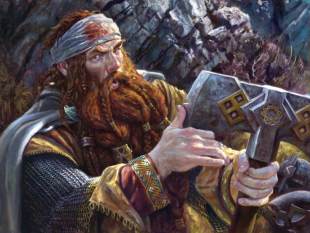
My fondness for Gimli grew very much over the course of book III. Since the passages in and around Moria were the highlight of my prior experience with Gimli, there was not a lot of character development to him other than his obstinacy and tendency to argue against everything Legolas mentions. Basically, I did not read him as a well-defined character until book III.

matt-20stewart-20gimli-20forty-20two_orig
Image copyright Matt Stewart

I believe that this started in the passages of the Three Hunters. The fact that the Fellowship has shrunk to three characters allows for each of them to have more meaningful interaction, and I felt like Gimli’s character really benefitted the most from it.

I loved his indomitable spirit as the three run after the Uruk-Hai to rescue their abducted companions. He is not the punch line of every joke, as Jackson makes him out to be. He shores up the spirits of his companions. At the outset he proclaims:

‘Dwarves too can go swiftly, and they do not tire sooner than Orcs’ (TT, III, I, 420).

Even more, he is not as simple as Jackson would have us believe. He offers good counsel to Aragorn at a crucial decision:

‘Only by day can we see if any tracks lead away…even I, Dwarf of many journeys, and not the least hardy of my folk, cannot run all the way to Isengard without any pause…and if we rest, then the blind of night is the time to do so’ (TT, III, ii, 425).

So from this section on I always saw Gimli as a fully-formed character. What really made me like Gimli, however is his interaction with Merry and Pippin upon catching up with them at Isengard. His exasperation with the hobbits and his amicability after tobacco is offered as a means of amends endeared him to me. Gimli became a character that I truly enjoyed over this section.

Where Do We Go From Here?

A visit with Saruman, then on to the Dead Marshes.

What Do You Think?

Did you like Gimli’s character?
When did you develop your opinion of Gimli?
Did I miss anything? Let me know!


RossRN’s–Tolkien Experience Project (29)

This is one in a series of posts where the content is provided by a guest who has graciously answered five questions about their experience as a Tolkien reader. I am very humbled that anyone volunteers to spend time in this busy world to answer questions for my blog, and so I give my sincerest thanks to RossRN and the other participants for this.

To see the idea behind this project, check out this page

I want to thank Donato Giancola for allowing me to use his stunning portrait of J.R.R Tolkien as the featured image for this project. If you would like to purchase a print of this painting, they are available on his website!

If you would like to contribute your own experience, you can do so by using the form on the contact page, or by emailing me directly.

Now, on to RossRN’s responses:


How were you introduced to Tolkien’s work?

My parents were not Tolkien fans, nor were any friends growing up. I first learned of The Hobbit by seeing the animated Hobbit on TV when I was in elementary school. In 6th grade, I got The Hobbit video game for my Commodore 64 and while I struggled with getting through the portcullis in the barrels, I was already falling in love with the world of Tolkien. It was then that I bought a copy of The Hobbit and a box set of The Lord of the Rings and read them for the first time.

What is your favorite part of Tolkien’s work?

My favorite part of Tolkien’s work is what I’ve come to consider the depth of it. By that, I mean at each stage of my life as I’ve reread The Hobbit and LoTR, I’ve taken away more from it based on my own life experience. Even more depth was granted with the History of Middle Earth. Being able to see the development of the story, the different ideas and considerations that were made is something I find unique. Finally, the publication of his Letters, Essays, and Translations opens your thinking even further as to the influences and decisions he made in this writing. It is truly unique.

What is your fondest experience of Tolkien’s work?

Hands down reading The Hobbit and LoTR to my daughter when she was five years old. She had seen the first Harry Potter and wanted me to read that to her as her bedtime story. I told her we would do that once we read The Hobbit and LoTR. She agreed. Each night I read to her and each morning while walking to school we talked about it. I saw the stories in such a new light and it was fun to discuss influences of Tolkien on the world of Harry Potter when we read those.

The experience re-awakened my love of Tolkien and over the past 15 years I’ve greatly expanded my collection and reading of many more of his works.

Has the way you approach Tolkien’s work changed over time?

To the comments made above, once I recognized the depth, I couldn’t get enough. I not only re-read works, but read all of HoME and many other works by and about him. In between, I’d reread The Hobbit and LoTR with a new appreciation and context. I think it is mostly my own experience in life opening my eyes a bit more as I get older, but each time I reread these books I find previously missed gems and concepts. I don’t look for them, I just notice them and more readily identify them. Each read gives me food for thought.

Would you ever recommend Tolkien’s work? Why/Why not?

I respect Tolkien is not for everyone. I find it hard to recommend to an adult who hasn’t read it already as it seems many people have predetermined notions of the books based on the movies.

People who haven’t read his works are often shocked that I would have read the books to my daughter at such a young age, mostly because of the movies. Honestly, when I read it to her, she understood it based on her age and experience. To her it was a wonderful, fantastical journey of good vs. evil. It had very ‘basic’ messages of temptation, which as you get older you start to view as being much more complex, none-the-less, she enjoyed it and I think any child would. If you are reading it to your child and discussing it, you can choose what is right to discuss with them and how to do it in the right way for them.

LotRFI Pt. 30–Helm’s Deep

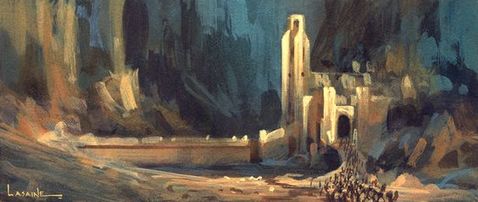
It seems that everyone remembers Éomer’s act of courage at the Battle of the Pelennor Fields as the high point of Rohirric culture. Théoden’s stand at Helm’s Deep, however, foreshadows that brave stand. This battle has always had a unique place in my understanding of Tolkien’s world. It is the place where I really understood for the first time what I would later understand to be ‘northern courage.’ The bravery to understand that defeat is certain, but not to cower and to fight on against overwhelming odds. This is one of the few major themes of Tolkien (e.g. ‘the machine’) that I perceived in my first reading.

78c61d66d6c7d520e5d675cb505a3d90-ring-sketch-matte-painting
Image copyright Paul Lesaine

Aragorn’s act of looking out from the gate and confronting the Uruk-Hai is an essential preface to this kind of bravery. My first reading of this scene, I thought that perhaps Aragorn was fay and reckless (although I would not have used these terms at the time, instead probably opting for the less-specific crazy, stupid, brave, until I learned better words to describe the action). This also bolstered the themes of honor and duty that I began to perceive starting with Frodo’s decision to carry the Ring in Rivendell.

I did not really understand the courage behind Aragorn’s words until the scene where he and Théoden lay their plans to ride out:

‘The end will not be long…but I will not end here, taken like a badger in a trap…When dawn comes, I will bid men sound Helm’s horn, and I will ride forth. Will you ride with me then, son of Arathorn? Maybe we shall cleave a road, or make such an end as will be worth a song—if any be left to sing of us hereafter” (TT, III, vii, 539).

This brave face assumed at a time when hope seems lost always shocked me as a child and resonated with something inside of me. I could not describe it the, and I cannot describe it well now. It stirs in me a desire to be as brave and noble as these characters and to not fear death. This is, of course, a bizarre feeling for someone so privileged as I have been and it is nonsensical, but it is true. The riding out of the king and Aragorn with the horns blowing has always given me chills and stirred my sympathies.

Other important notes about my first read through of Helm’s Deep are:

This is the first time that I felt the eucatastrophic moment in LotR in the same way that I felt it in H.

I enjoyed the fighting game of Gimli and Legolas far more than I ought at such a young age. Perhaps this was because of my naivete as a child, and this game was reminiscent of the light treatment that authors frequently use of difficult ideas when writing for children. Tolkien himself used this same kind of technique in H.

As an interesting bit of ‘misreading,’ I always envisioned the causeway from the keep to lead into the part of the stronghold behind the battlements, not out from the battlements. I suppose I assumed this because it would make the keep a stronger fortress. I imagined that Aragorn and Théoden rode out into the host who had flooded past the battlements after the hole was blown open. This made more sense to me as to how they were cut off from the caves. Though I admit that it makes the pincer maneuver with the reinforcements harder to imagine later on.

As a side note: the description immediately following Aragorn’s words has been variously interpreted:

‘Even as they spoke there came a blare of trumpets. Then there was a crash and a flash of flame and smoke…’ (TT, III, vii, 537).

Jackson showed a runner with a torch igniting a stack of bombs. Others have suggested that this passage describes a projective weapon, like a missile. For my own part, I have always agreed that this was a bomb and not a projectile weapon. I feel certain that Tolkien would have described a projectile weapon in greater detail.

Where Do We Go From Here?

I want to talk about Gimli and Saruman before I head into book four.

What Do You Think?

How did you first interpret the bravery of Aragorn and Théoden?
​Is this moment as impact as Éomer’s ?
​Did I miss anything? Let me know!

Alan Sisto’s Experience–Tolkien Experience Project (28)

This is one in a series of posts where the content is provided by a guest who has graciously answered five questions about their experience as a Tolkien reader. I am very humbled that anyone volunteers to spend time in this busy world to answer questions for my blog, and so I give my sincerest thanks to Alan and the other participants for this.

To see the idea behind this project, check out this page

I want to thank Donato Giancola for allowing me to use his stunning portrait of J.R.R Tolkien as the featured image for this project. If you would like to purchase a print of this painting, they are available on his website!

If you would like to contribute your own experience, you can do so by using the form on the contact page, or by emailing me directly.

Now, on to Alan Sisto’s responses:


How were you introduced to Tolkien’s work?

The answer to this question will, unfortunately, necessitate my admitting to being older than I’d prefer to acknowledge. In November of 1977, I was 9 years old and, apparently, watched the Rankin & Bass animated TV presentation of The Hobbit. Admittedly, I no longer remember that experience with any degree of specificity. What I do remember — and what I still have on my bookshelf — is the first Tolkien book I ever owned, a copy of The Hobbit that I received that Christmas: the book as illustrated with art from the film. I recall reading that story over and over and simply being enthralled.

Sadly, it would be another five years before I would even learn of the existence of The Lord of the Rings — the Rankin & Bass book didn’t include the usual list of “other books by the author”, and the internet was just a sparkle in Al Gore’s eye at the time. But as a freshman in high school, I distinctly remember coming across the set of paperbacks from Ballantine Books (the Silver Jubilee set, as it turns out, with art by Darrell Sweet). I spent nearly all my paper-route money on that set and began to read them; though ‘devour’ might be a more accurate word, as I read the set at least three times in my first year of high school

What is your favorite part of Tolkien’s work?

I’m sure my answer won’t be the only one along these lines, but my favorite element of Tolkien’s work is how they feel grounded in reality, despite their fantastic nature. It wouldn’t be until much later — as an adult, studying his works — that I would realize the importance of ‘the inner consistency of reality’ and the resultant Secondary Belief in the sub-created world. Still, identifying and understanding these elements does not detract from the impact they have when I read Tolkien: no other author I’ve found seems as able to sub-create a world as utterly believable and internally-consistent as the world that Tolkien made

What is your fondest experience of Tolkien’s work?

To be honest, I’m not sure I can narrow it down to just one. I’ve had an incredibly wonderful time (so far!) in walking through the legendarium for The Prancing Pony Podcast — I’ve learned so much, and it’s brought me closer connections to the Tolkien community than I ever would have imagined. And then there was the four or five year ‘drought’ where I didn’t read Tolkien (out of lack of time, not lack of interest), and the first time reading the books after that was like a desert wanderer stumbling upon the sweetest water.

But if I have to pick just one ‘fondest experience’, it would have been in the summer of 2001 — a few months before Peter Jackson’s film adaptations would come to theaters around the world. My wife had never read The Lord of the Rings but had shown some interest in the movie trailers and previews that we’d seen. I suggested she read the books before the films released so that she could experience them properly; her response was for us to read them together. So I bought a second set of paperbacks (my Ballantine set was nearing 20 years old, and was held together by tape and a very inadequate spell of binding) and we read together. Not just ‘together’ in the sense that we would each read a chapter every couple of days and stay mostly on track, no… by ‘together’, I mean we would find time and I would read aloud from the books while she followed along in her copy. Not only was it the first time I’d read the entirety of The Lord of the Rings aloud (an experience I highly recommend to anyone!), but I got to experience the story as a first-time reader vicariously through my wife. That first-time experience is something that, by definition, we can only experience once… but watching someone else have that first-time experience comes close, and is definitely my fondest experience of Tolkien’s work.

Has the way you approach Tolkien’s work changed over time?

Without a doubt. Like most young people, the richness of Tolkien’s world was something that I enjoyed without being able to properly identify it. So my approach was merely to enjoy the story — I say ‘merely’, but there’s nothing wrong with this approach at all and, I suspect, Professor Tolkien would approve of those who approach his works exclusively in this manner.

Over time, though, I began to develop a deeper appreciation for the craft of the story… for the recurring themes… for the worldview that (I believe) Tolkien espoused. And these interests made me dig deeper — into biographical material, the Letters, essays, studies, and more.

Now, of course, I approach Tolkien’s work with even more attention to detail than ever before. As the co-host of The Prancing Pony Podcast, I have to approach Tolkien’s work with several thousand listeners in mind! This means being more thorough in my research, more complete in my comprehension, more open in discussion with my co-host, and more careful in leaping to conclusions. It’s been an extraordinarily rewarding experience, and I’m thrilled we have so much more material to cover.

Would you ever recommend Tolkien’s work? Why/Why not?

At first, this seems like an odd question. Why would anyone who is willing to take the time to answer these questions not be willing to recommend Tolkien’s work? But as I considered it, I realized that there are some people to whom I wouldn’t bother recommending Tolkien — they are already set in their (orcish, perhaps) ways, sadly content in their myopia, pleased to focus on only the Primary World and not even the truths about that Primary World that they might learn from Tolkien’s secondary one.

But aside from those few, sad people, the answer is an unconditional ‘yes’, I would whole-heartedly recommend Tolkien’s work! As for why, the answers may be found in On Fairy-Stories, the seminal essay on fantasy written by Tolkien and printed in Tree and Leaf, among other volumes. The reasons are threefold: recovery, escape, and consolation. Each provides an important (in my view, perhaps essential) element in enjoying our brief span on this earth, but to understand and experience all three is a wonderful gift. Tolkien’s works provide each in unavoidable quantity and rich quality; reading his works can only improve one’s life correspondingly.


You can hear more of Alan’s thoughts on all things Tolkien in the wonderful podcast that he co-hosts: The Prancing Pony Podcast!

LotRFI Pt. 29–Wormtongue

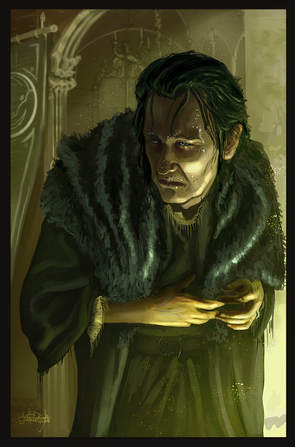
As you have no doubt gathered, I was not a very trusting child. Each time members of the Fellowship come across a character whose motives could be questioned, or where there was any vagueness whatsoever, I was quick to ascribe the worst to them. Finally, I found the kind of character I was waiting for in Wormtongue. He was deceitful, treacherous, and calculating: exactly what I expected from Maggot, Bombadil, and Aragorn when I first encountered them.

grima-wormtongue-by-suzanne-helmigh-d57tgmh
Image copyright Suzanne Helmigh

The way that Wormtongue manipulates the interaction between Théoden and Gandalf from the very beginning made me mistrustful of him. I always felt that the way Théoden stands to deliver his opening volley at Gandalf and then quickly sits again was reminiscent of someone reciting something from memory. In fact, I was reminded sharply of Sam, standing up to recite verse when he was amongst the trolls.

The fact that Wormtongue took over immediately after this speech and was the true opponent of Gandalf in dialogue made me wonder if he had written this speech for Théoden. I assumed that this was the typical modus operandi for Wormtongue. He would feed an opening monologue to Théoden, who would exclaim it from rote, and then Wormtongue would actually deal with conversations. This would lend him the king’s credibility and make it seem that they were in agreement on everything. Additionally, this process would allow Wormtongue to further his brainwashing of Théoden with every interaction, as he attempts to do when talking with Gandalf.

I think Gandalf’s power in dealing with Wormtongue is that he is quick to identify this technique and challenges it from the beginning. He ignores Wormtongue initially, and directly addresses Théoden around him. After Wormtongue’s tirade against Gandalf, Gandalf disregards the abuse, instead saying:

‘The courtesy of your hall is somewhat lessened of late, Théoden son of Thengel…[we] have passed through the shadow of great perils to your hall’ (TT, III, vi, 139).

Wormtongue tries to reassert himself into the conversation, disparaging that the traveler’s road took them through the Golden Wood. To this, Gandalf sings, and then castigates Wormtongue for speaking ill of things he has no knowledge of.

The interaction where Gandalf dismisses Wormtongue is interesting. As he cowers away from Gandalf, Wormtongue says:

‘Did I not counsel you, lord, to forbid his staff? That fool, Háma, has betrayed us!’ (TT, III, vi, 140).

This is the clearest indication so far that the power of the wizards is bound up in their staff. I think this is the point when the observation finally sunk in for me in my first reading. I did not know whether the power itself was in the staff, or if the staff was simply the most effective tool for channeling a wizard’s power. Perhaps I thought of the staff in the same way I thought of lightsabers in the Star Wars universe, something which I was incredibly familiar with. They were implements which harnessed the innate powers of the individual to a greater extent than could otherwise be achieved.

Where Do We Go From Here?

I think we will stop by Helm’s Deep, then take a look at Saruman!

What Do You Think?

What was your initial impression of Wormtongue?
What did you make of the importance placed on Gandalf’s staff?
Have I missed anything? Let me know!

Shawn E. Marchese’s Experience–Tolkien Experience Project (27)

This is one in a series of posts where the content is provided by a guest who has graciously answered five questions about their experience as a Tolkien reader. I am very humbled that anyone volunteers to spend time in this busy world to answer questions for my blog, and so I give my sincerest thanks to Shawn and the other participants for this.

To see the idea behind this project, check out this page

I want to thank Donato Giancola for allowing me to use his stunning portrait of J.R.R Tolkien as the featured image for this project. If you would like to purchase a print of this painting, they are available on his website!

If you would like to contribute your own experience, you can do so by using the form on the contact page, or by emailing me directly.

Now, on to Shawn E. Marchese’s responses:


How were you introduced to Tolkien’s work?

My first awareness of Tolkien’s work was as a child in the 1980s, when I saw a commercial on TV for Rankin and Bass’ The Hobbit on VHS. It must have included a clip of Bilbo in the cave with Gollum, because I got the idea that all of Middle-earth was underground: i.e., in the “middle” of the “earth.” I never cared much for the subterranean, so I didn’t give it a second thought. As I got older, I discovered Dungeons & Dragons, and before long I had a bookshelf full of middling fantasy paperbacks. I would occasionally hear about The Hobbit and The Lord of the Rings as I roamed this literary wilderness, but the titles just hovered on the edge of my awareness for many years.

I didn’t actually make up my mind to read Tolkien until I was fifteen. I was reading a book about a well-known rock group that originated in London in the 1960s, and on page 11 the author inserted an alluring story about how, decades earlier, a distracted college professor had written the words “In a hole in the ground there lived a hobbit” on an empty page of a student’s examination. That little act of creative rebellion greatly impressed me as a teenager, so I made up my mind to find out what this “hobbit” was, and what kind of mind it came from. On my next trip to the local Waldenbooks, I bought a box set of The Hobbit and The Lord of the Rings in paperback and read them right away.

What is your favorite part of Tolkien’s work?

I’m quite fond of the myth of Eärendil, as anyone who’s heard me talk about The Silmarillion for more than about seven minutes probably knows. Maybe it’s because Eärendil’s name was the start of it all for Tolkien, when he read that famous line of Old English poetry: “Eala earendel engla beorhtast.” Maybe it’s because of Eärendil’s central position in the legendarium, a nexus point between the Elder Days and the later stories. Maybe I just think flying star-boats are cool (who doesn’t?). But I think the real reason is because the myth of Eärendil allows me to connect the stories in the legendarium to my own life. Every time I see the evening star in the sky (I rarely wake up early enough to see it when it appears in the east as the morning star), I feel hope and wonder, as I imagine the people in Middle-earth did when they first saw the Star of High Hope rise in the sky. I feel a part of the story, and I sense my own birthright to the lessons it offers us.

And there’s so much there to learn: The importance of language and story, and their effect on how we view the world. The appreciation of nature. The need for enchantment and Faërie in our lives. The strength, hope, wisdom — and sometimes defiance — of Tolkien’s characters. And that’s what really keeps me coming back, more than the languages and history. It’s the strength of Éowyn, the wisdom of Faramir, the warmth of Gandalf, the insight of Samwise; the valor of Tuor, the loyalty of Beleg, the love of Beren and Lúthien, that makes me want to read it all again and again.

What is your fondest experience of Tolkien’s work?

My son was a cranky newborn, and nothing would get him to sleep at night except the sound of my voice or my wife’s voice. We’d spend an hour or two singing to him every night until he fell asleep, usually to find him awake again twenty minutes later! Hour after hour we’d go through this, night after night, for months.

Well, there’s only so many times you can sing the same songs over and over again before you get tired of singing. For me, that happened when he was three months old. As I looked down at the screaming baby in my arms, I realized it would be much easier for me to keep my voice going for hours on end if I was reading instead of singing. So, I picked up The Hobbit and started reading from the beginning. It was the first time I had ever read Tolkien’s work aloud, and I was struck by how much it changed my experience of the story. I could hear the music inherent in the words. I could feel the alliteration, the rhythm, the power of it all. I could keep this up all night if I had to! And the boy slept quite well.

I finished The Hobbit before he grew out of this phase, so I continued on to The Lord of the Rings. Then when my daughter was born a year or so later, I started reading The Hobbit to her at three months (she was a much better sleeper, but I wanted an excuse to read it aloud again), and continued the tradition with The Lord of the Rings after that. I’m proud to say both of my children technically were introduced to Tolkien before they were a year old, though they don’t remember it. I even read The Silmarillion aloud at bedtime to each of them when they were closer to two. I skipped some parts of “Of Túrin Turambar,” of course.

Has the way you approach Tolkien’s work changed over time?

Absolutely. As a teenager reading it for the first time, I approached it with curiosity and wonder. Despite having read many fantasy novels, I noticed immediately that Tolkien’s work was unlike anything I’d read before. By my mid-20s (right around when Peter Jackson’s Fellowship of the Ring came out), the mainstreaming of geek culture in general and the availability of movie tie-in memorabilia led me to a sense of Tolkien “fandom” as a personal identity. Now that I’m older, such labels don’t matter much to me anymore, and I just appreciate Tolkien’s work for what it is: a literary work like no other in the world, an entire mythology from the mind of one man. It’s so rich and deep that I can discover something new in it every time I go back to it, and that’s very exciting. I suppose that brings me back to an approach similar to when I read it for the first time, when everything was new; but now I have the good fortune to co-host a podcast exploring Tolkien’s work, and I get to share what I’ve found with others while participating in a conversation about these stories and this world with other Tolkien readers all over the world. That’s a fantastic feeling!

Would you ever recommend Tolkien’s work? Why/Why not?

Yes. I do it all the time. There’s something there for everyone. One reason why I spend so much time talking about Tolkien, and also why I wanted to podcast about Tolkien, is to share my love and knowledge of Tolkien with others who haven’t fully explored Middle-earth, or who think it’s all just too intimidating. There is a lot there, I realize; and I don’t expect everyone to muddle through every word of The History of Middle-earth. I even understand if someone says they can’t make it through The Silmarillion (though I’ll do what I can to help them make sense of it). But I recommend The Hobbit to everyone. Everyone should read The Hobbit at least once, and I think everyone should at least try to read The Lord of the Rings as well.


You can hear more of Shawn’s thoughts on all things Tolkien in the wonderful podcast that he co-hosts: The Prancing Pony Podcast!

LotRFI Pt.28–Théoden’s Transformation

My interpretation of the passage where Théoden shakes off the depression which has paralyzed him has changed greatly over the years. Initially, I thought that Gandalf was responsible for dispelling some effect that was placed on Théoden. I thought that Théoden’s malaise was some sort of enchantment that was placed on him by Wormtongue.  That Gandalf was a strong enough sorcerer to ward off the spell and return Théoden to his proper state.

goldenhall3-3-theodenbyjohnstone
Image copyright Jay Johnstone

Many fans will notice that this interpretation is very close to Jackson’s portrayal of the event. Interestingly, when I saw Jackson’s interpretation of this scene, which agreed with my own, but made more explicit the conflict, I realized that I was wrong.

Instead of confronting some spell placed on Théoden by Wormtongue, Gandalf’s approach is a bit more nuanced. It is true that he initially uses his magic as a means of daunting: Gandalf cows Wormtongue before he addresses Théoden. When he talks to Théoden, however, the atmospheric changes that take place are the result of Théoden’s actions, not their cause. This becomes obvious in the passage where Théoden descends from his throne:

‘Slowly Théoden left his chair. A faint light grew in the hall again’ (TT, III, vi, 515).

Notice that the atmosphere does not respond to Gandalf here, but to Théoden. Gandalf is responsible for taking away Grima, who has restricted Théoden’s actions for a while, but only Théoden can throw of the burden which is placed upon him. This harkens back to Gandalf’s role as a kindler of spirit, not as the conquering hero. His task is to allow Théoden to show forth his true courage in overcoming the malaise himself.

Once the two men are outside and Gandalf is able to whisper to Théoden, there is no magic. Gandalf simply tells Théoden of deeds that may bring hope and fortify his mind against the gathering darkness. The movies overplay Gandalf’s use of magic here quite considerably. It is true that he manipulates the weather, but after this first show of strength, his main focus is on fermenting Théoden’s will, not destroying Saruman or Wormtongue.

Where Do We Go From Here?

To Wormtongue and Saruman!

What Do You Think?

How did you perceive Theoden’s transformation?
Did you like Jackson’s vision of the transformation?
​Did I miss anything? Let me know!