Xenia M’s–Tolkien Experience Project (40)

This is one in a series of posts where the content is provided by a guest who has graciously answered five questions about their experience as a Tolkien reader. I am very humbled that anyone volunteers to spend time in this busy world to answer questions for my blog, and so I give my sincerest thanks to Xenia and the other participants for this.

To see the idea behind this project, check out this page

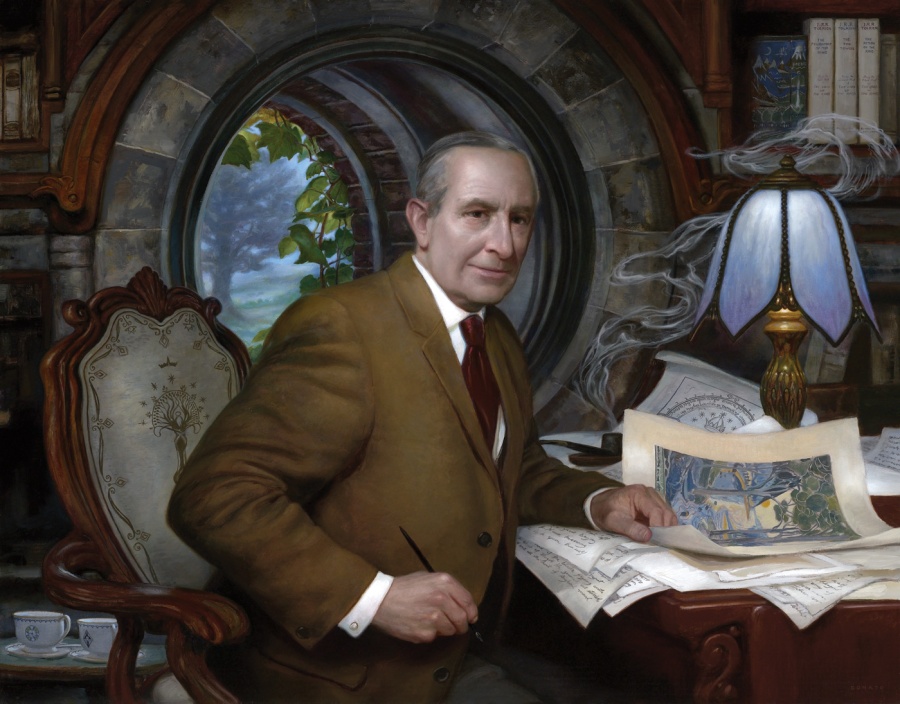
I want to thank Donato Giancola for allowing me to use his stunning portrait of J.R.R Tolkien as the featured image for this project. If you would like to purchase a print of this painting, they are available on his website!

If you would like to contribute your own experience, you can do so by using the form on the contact page, or by emailing me directly.

Now, on to Xenia M’s responses:


How were you introduced to Tolkien’s work?

I was a wannabe hippie at a very small high school in rural Ohio in the late 1960’s. There was a girl named Joyce who was further advanced in hippie-dom than I was so I looked to her for guidance. She was reading a book with a very psychedelic cover so naturally I had to get a copy. It was The Fellowship of the Ring. I don’t think Joyce ever finished the book; she mostly carried it around for effect. But I devoured it and saved my allowance money (some hippie!) for the next two volumes. I read them over and over.

2. What is your favorite part of Tolkien’s work?

I liked the travel sections the best when the Fellowship is traveling through woods, mountains, and Moria.

3. What is your fondest experience of Tolkien’s work?

I used to hike a lot as a young person and imagine I was part of a Fellowship traveling through Middle-earth.

4. Has the way you approach Tolkien’s work changed over time?

Yes, I have been affected by two things:

1. The Tolkien Professor’s podcasts, which led to participating live in the Tuesday and Wednesday night Mythgard classes, which led to enrolling in Signum University as a graduate student. The course work has caused me to take a more scholarly look at Tolkien’s writing. Happily, this has not been dry but actually has enhanced my enjoyment. I notice subtleties that I had previously overlooked.

2. The Peter Jackson movies, for better or for worse. Previously, I didn’t pay much attention to the battle scenes and JRRT didn’t elaborate on them too much either but the movies made the battles extremely, possibly overly, exciting. Also the monsters, such as the cave troll and the oliphants were very exciting in the movies. Also, when I read the books now I have an actor’s face for every character which I suppose is OK but not something I would have wished for.

5. Would you ever recommend Tolkien’s work? Why/Why not?

Yes! Especially to people who are overly involved with politics, accounting, databases, etc. I suggest they start with The Lord of the Rings, then The Hobbit, and then The Silmarillion, in that order.

LotRFI Pt.41–Pippin

Pippin has always been my favorite hobbit. I was first interested in him because of how funny he is in the first book, especially in “Three is company” and “Shortcut to Mushrooms.” He remained my favorite because I appreciated his process of maturation as the story progresses.

welling
Image copyright Greg and Tim Hildebrandt


His cheerful spirit serves as a comedic relief during many of the less active passages in the text. From his snarky comment in Rivendell,


‘”Gandalf has been saying many cheerful things like that”’ (FR, II, i, 226)

to his curiosity in Moria, which lands the Fellowship in some trouble, Pippin remains fairly charming and lighthearted. It is not until Gandalf grows angry and berates Pippin

‘”Fool of a Took…This is a serious journey, not a hobbit walking party. Throw yourself in next time, and you will be no further nuisance. Now be quiet!”’ (FR, II, iv, 313)

that he starts to transform into a more serious and responsible character. This interaction in Moria, reminded me of a parent scolding a child. Pippin did something which was outside the normal expectations and it could have, and ultimately has, dire consequences. Gandalf chides him in the way that a concerned mother or father might express exasperation at a child who touches a stove or runs into the street. This confrontation seemed to me to be the starting point for Pippin’s transformation.

The two places where Pippin’s character shows real growth are in his actions to escape the Uruk-Hai in Rohan, and in his time spent in Gondor. When he is with the Uruk-Hai, Pippin is not a passive observer of events. Instead, he keeps his wits and not only manages to escape, but also leaves a clue for the Three Hunters to follow.

Pippin’s largest step toward becoming a responsible adult is his time spent in Gondor. Here he volunteers his service to the steward of Gondor to repay his debt to Boromir:

‘”Little service, no doubt, will so great a lord of Men think to find in a hobbit, a halfling from the northern Shire; yet such as it is, I will offer it, in payment of my debt.”’ (RK, V, I, 754/5).

He feels accountable for Boromir’s death and seeks to make amends. Not only does this act show Pippin becoming more mature, but it puts him in a role of responsibility. A role which he performs very well. His next show of responsibility is that he chaperones Bergil, Beregond’s son, around Minas Tirith. Pippin no longer interacts with Bergil as his equal, though he cannot resist an occasional joke, but he sets restrictions on Bergil and enforces them. Finally, Pippin’s decision to disobey Denethor’s wishes and save Faramir shows the kind of complex reasoning and questioning of authority that is typically associated with maturity. He is not simply rebelling against authority because it is authoritative, nor is he blindly following it. He weighs consequences and decides to act in the way he think is best. Though I could not have expressed ,many of these concepts in this way when I was a kid, I certainly respected Pippin’s growth as an individual, and understood that he had earned responsibility and was using his judgement wisely.

Pippin’s story is a bildungsroman. This greatly impacted me in my first several readings of LotR. I will talk about the Scouring of the Shire in a later post, but I think the arc of Pippin’s character is clear already. He stays jovial throughout the text, I love his interaction with the Three Hunters in “Flotsam and Jetsam,” but he matures over the course of his journey. This is why Pippin was, and still is, my favorite hobbit from LotR.

Where Do We Go From Here?

We will look at Merry next, then explore the Battle of Pelennor Fields.

What Do You Think?

What did you think of Pippin in the early parts of the text?

Did your impression of him change as he developed over the course of the story?

Did I miss anything? Let me know!

Patricia Minger’s Experience–Tolkien Experience Project (39)

This is one in a series of posts where the content is provided by a guest who has graciously answered five questions about their experience as a Tolkien reader. I am very humbled that anyone volunteers to spend time in this busy world to answer questions for my blog, and so I give my sincerest thanks to Patricia and the other participants for this.

To see the idea behind this project, check out this page

I want to thank Donato Giancola for allowing me to use his stunning portrait of J.R.R Tolkien as the featured image for this project. If you would like to purchase a print of this painting, they are available on his website!

If you would like to contribute your own experience, you can do so by using the form on the contact page, or by emailing me directly.

Now, on to Patricia Minger’s responses:


How were you introduced to Tolkien’s work?

I found The Hobbit in the school library when I was about ten years old. I immediately loved it, although I don’t remember that first reading very clearly. I was one of those kids who stayed up late reading by the light of the 15-watt bulb in the hall outside my room. (Which may explain why I needed glasses by the time I was twelve.) I devoured the whole thing in about two nights running.

I did not start reading The Lord of the Rings until I was about thirteen. I dimly recall my mother saying the book was ‘too old’ for me. She never read it, so I don’t know why she thought that. Once I did start, I read it continuously about three times. The descriptions of the places enthralled me, and the adventure of it all. The maps fascinated me. I would have followed Aragorn into battle. I took Sam to my heart. I wept when Frodo left the Grey Havens.  I loved fantasy of any kind, but without knowing it, I grokked that this was the ‘deep magic’ version of the genre. To this day when I start to re-read it, I eagerly anticipate it like a new experience.

2. What is your favorite part of Tolkien’s work?

My favorite part of Tolkien’s work shifts with time and experience, but I have always had a great appreciation for the landscapes he paints, particularly certain breathless, stunning moments. Certainly, the environment functions as a character, one that occasionally comes to life and speaks. It was no surprise to learn that Tolkien saw with the eye of an artist. Some of his paintings express elemental visions, and are as striking as his prose.

I think the strengths of the PJ films were the visuals, and Howard Shore’s exquisite score. There are those who take exception to some of the adaptation, but those two features outweighed any possible flaws of the script. Surprisingly, my imagination limited the magnitude of scenes like the Ride of the Rohirrim, or the Mines of Moria, and the movies fully fleshed these out for me without dislodging my own impressions. And the music: the music of the Ainur! A worthy sub-creation.

3. What is your fondest experience of Tolkien’s work?

My fondest experience of Tolkien’s work has to be the bond it has created between my sister and me. When we were growing up, it was our job to wash the dishes after dinner. For many years we took turns reading aloud, one of us working while the other read. We went through many books in those years, but my favorite was The Lord of the Rings. It has led us on many adventures together, from Mythgard and Signum University, to the A Long Expected Party (ALEP) community based in Kentucky, to midnight premieres of the movies, to Oxford and the recent Bodleian Library exhibit.

4. Has the way you approach Tolkien’s work changed over time?

Naturally my approach to Tolkien has changed over the years. In my original readings, where all I had was the story in front of me, I took it at face value. In more recent times I have absorbed the scholarship of people like Verlyn Flieger, Michael Drout, Tom Shippey, Corey Olsen, and so many more, and I have experienced more depth to my readings, more questions, more attention to details. His essays, his shorter works, and Christopher Tolkien’s extensive exploration found in The History of Middle Earth of course inform my understanding and curiosity. Getting my BA in English also gave me a better idea of context.

5. Would you ever recommend Tolkien’s work? Why/Why not?

Would I recommend Tolkien’s work? Yes. With the caveat that his work is certainly not everyone’s cup of tea. The Lord of the Rings is magnificent. It rises above genre in the way that all truly great works of fiction do. But I will also admit that if someone asks me ‘Would I like it?’ I do not give a quick answer. I sort of feel a protectiveness about it. I don’t want someone to read it who will not like it, or who might even hate it. I usually qualify a recommendation with the caveat that while I found it a revelation of what literature could be, I do not expect that will be everyone’s experience.


For more thoughts from Patricia Minger, see her Facebook page!

LotRFI Pt.40–Minas Tirith

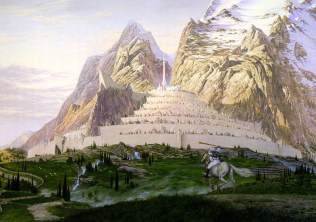
Minas Tirith was an altogether novel experience in my first read of LotR. It holds an interesting place in my memory because it is so different from the rest of LotR, but is more like other fantasy stories that I read before LotR.

ted-nasmith-the-complete-guide-to-middle-earth-minas-tirith-at-dawn_orig
Image copyright Ted Nasmith

Here is what I mean: Most of LotR felt original and new to me in the settings and many of the interactions, but Minas Tirith was like an allusion to stories with which I was familiar. Minas Tirith was the first ‘castle’ in the book, which automatically brought up associations with knights, damsels, jousting and quests for adventure. Most notable among these tales, I was aware of Camelot and Arthurian legends (which ones particularly, I cannot recall). For better or worse, I started to think about knights errant and chivalric tales.

This made the setting seem more remote and ancient to me than the rest of the text. I do not mean that it felt like it had a long history, several parts of the text feel like that. I mean that it felt like part of an older story to me. While most of LotR was a novel experience, I thought Minas Tirith was going to revisit fantasy of the medieval court variety. This was probably because, unlike with most of the other characters, events, and settings in the story, my only reference frame for Minas Tirith was other fantasy books. I had not living thing to equate Minas Tirith to. These other fantasy text were always set in distant lands or in earlier times (or ‘long ago’ and ‘far away’ if that were not banished as a cliché at this point).

In a sense, Minas Tirith was more storied for me as a location, but also more remote. I have often wondered how Europeans and Brits might feel about this point, since they grew up in places where they could have visited castles as a kid. To me, a castle was an element of make-believe, I wonder if it was just an element of history to them.

Where Do We Go From Here?

I would like to take a breath and talk about Merry and Pippin before we move on to the larger picture.

What Do You Think?

Did you think of Minas Tirith as a castle?
How did this influence the way you perceive(d) the events in Minas Tirith?
​Did I miss anything? Let me know!

Miles S’s Experience–Tolkien Experience Project (38)

This is one in a series of posts where the content is provided by a guest who has graciously answered five questions about their experience as a Tolkien reader. I am very humbled that anyone volunteers to spend time in this busy world to answer questions for my blog, and so I give my sincerest thanks to Miles and the other participants for this.

To see the idea behind this project, check out this page

I want to thank Donato Giancola for allowing me to use his stunning portrait of J.R.R Tolkien as the featured image for this project. If you would like to purchase a print of this painting, they are available on his website!

If you would like to contribute your own experience, you can do so by using the form on the contact page, or by emailing me directly.

Now, on to Miles S‘s responses:


How were you introduced to Tolkien’s work?

I was first introduced to The Lord of the Rings when I was nine years old. I had been reading The Lion, the Witch and the Wardrobe by C.S. Lewis and had enjoyed it immensely. My father had a Brilliantine paperback edition of The Fellowship of the Ring (with the wonderful Barbara Remington cover art) and gave it to me, telling me, “there is a very scary part where they make a journey underground and encounter a dreadful spirit of the underworld!” I was so intrigued that I began to read it almost immediately and was soon completely engrossed in the story. Of course, The Bridge of Khazad-dum had me enthralled and I was devastated when Gandalf the Grey fell into darkness.

What is your favorite part of Tolkien’s work?

It really is difficult for me to define what I feel is my favorite part of Tolkien’s work. I was absolutely enthralled with Middle-earth after my first (of many) readings of The Lord of the Rings, and that was not diminished by subsequent, multiple readings of The Hobbit and The Silmarillion. If anything I would have to say that perhaps those three works are my favorites of the Tolkien catalogue. I have not been quite as big a fan of most of his posthumously published material (with the exception of The Silmarillion of course which he was working on prior to his death) because I am not sure whether Professor Tolkien would have wanted this material published.

What is your fondest experience of Tolkien’s work?

One of my fondest experiences associated with Tolkien’s work is perhaps my first reading of The Silmarillion when I was 16 years of age. I had pre-ordered my copy from the local bookstore and taken the bus to pick it up the day it arrived. At first I found the narrative odd and disjointed, but being a lover of Tolkien and possessing the dogged determination that comes with young adulthood, I soldiered on and very quickly fell under the spell of the incredibly vast and complex universe that Professor Tolkien wove around me.  I found the history of the Elves to be incredibly noble and tragic, and the story of Feanor, the Silmarils and the flight of the Noldor to Middle Earth reminded me of the legends and myths I had read in books on ancient Greek/Roman and Norse mythology. I keenly remember reading of the Dagor Bragollach and the madness of Fingolfin; of his riding forth alone to Angband to challenge Morgoth to single combat. When I read the line “and Morgoth came” the hairs rose on the back of my neck and a shock of fearful anticipation coursed through me like an electric current. There have been very few times, before or since when the written word has been able to elicit that kind of a response in me.

Has the way you approach Tolkien’s work changed over time?

Of course my approach to Tolkien’s work has changed over time. After multiple readings of his work, and vastly more experience gained through reading the works of other authors, my appreciation of Tolkien has been modified and placed in the context of a greater appreciation of literature in general.

Would you ever recommend Tolkien’s work? Why/Why not?

As for recommending Tolkien, I have been doing so ever since I first experienced his work. I think part of the genius of Tolkien’s work is that it is approachable by readers of any calibre. One only has to look at the popularity of the very simplistic, commercial movie versions of his work to see how it can appeal across a large demographic.


LotRFI Pt.39–Sam’s “Meta” Moments

One of the inspirational aspects of Tolkien’s work which really stuck with me in my first reading was Sam’s perceptive moments where he talks about how the adventure he is in is like the adventure he learned as a child. A great example of this tendency occurs of the Stairs of Cirith Ungol Chapter. Sam recounts part of the tale of Beren and Luthien and then falls into reflection, saying:

‘But that’s a long tale, of course, and goes on past the happiness and into grief and beyond it…and why, sir, I never thought of that before! We’ve goy – you ‘ve got some of the light of it in that star-glass that the Lady gave you! Why, to think of it, we’re in the same tale still! It’s going on. Don’t the great tales never end?’ (TT, IV, viii, 712)

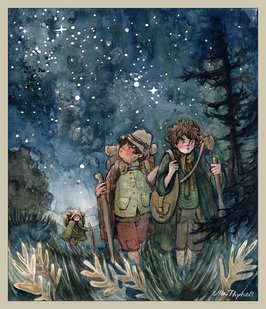
leaving-hobbiton-by-ullakko-d55jdvr
Image copyright Ulla Thynell

Then Frodo and Sam talk about the nature of stories and the part that characters play in them. This was important to me because it gave me a connection to the characters I was reading about. I wanted to believe that these stories were real, that they mattered. This vision of how a story could impact the life of the listener/reader was very inspiring to me. I think that, had it not been for the several moments like this in TT and RK, perhaps LotR would not have been as impactful on me. Not only did these passages make this story more meaningful, they made reading as an activity more important. I really internalized these observations a lot in my first reading.

Where Do We Go From Here?

I believe we will start RK with a visit to Minas Tirith. That seems fitting!

What Do You Think?

What is your impression of these moments with Sam?
Have these episodes ever impacted your reading outside of Tolkien?
Did I miss anything? Let me know!

Wesley Schantz’s Experience–Tolkien Experience Project (37)

This is one in a series of posts where the content is provided by a guest who has graciously answered five questions about their experience as a Tolkien reader. I am very humbled that anyone volunteers to spend time in this busy world to answer questions for my blog, and so I give my sincerest thanks to Wesley and the other participants for this.

To see the idea behind this project, check out this page

I want to thank Donato Giancola for allowing me to use his stunning portrait of J.R.R Tolkien as the featured image for this project. If you would like to purchase a print of this painting, they are available on his website!

If you would like to contribute your own experience, you can do so by using the form on the contact page, or by emailing me directly.

Now, on to Wesley Schantz’s responses:


How were you introduced to Tolkien’s work?

As a kid, I read an illustrated Hobbit with pictures from the Rankin-Bass movie. I think it was my dad’s. I would read and look at the pictures about equally. Then in middle school I read The Hobbit and Lord of the Rings in plain paperback editions at least a couple of times through, before the Peter Jackson movies came out.

2. What is your favorite part of Tolkien’s work?

The sense of an individual crafting something which also aspires to be universal, a mythic whole, and that we’re being invited to imaginatively participate in the endeavor.

3. What is your fondest experience of Tolkien’s work?

Reading The Hobbit for the first time at summer camp, when Bilbo comes to Gollum’s lake, to the spiders in Mirkwood, to Smaug, and finally makes it back home again.

4. Has the way you approach Tolkien’s work changed over time?

Listening to The Tolkien Professor courses on The Silmarillion, Leaf by Niggle, Smith, etc. and studying Tolkien’s scholarly work, starting with the two big essays and his translations, I’ve become interested in his cultural impact, beyond just his stories.

5. Would you ever recommend Tolkien’s work? Why/Why not?

I highly recommend it. A great way for new readers to encounter him is in the company of Narnia, Harry Potter, and A Wrinkle in Time, through Signum Academy’s summer camps!


For more from Wesley Schantz, check out his blog!

LotRFI Pt.38–Gollum

I have already indicated two things which greatly impact the way that I viewed Sméagol in my initial reading. First, I was very concrete in my thinking of good and bad at the time (hence my largely negative opinion of Boromir). Second, I was very mistrustful in general. These two attributes conspired to make me dislike Gollum from the moment I knew he would be in this story. He had, after all, betrayed sweet Bilbo in H and was as treacherous as any other character.

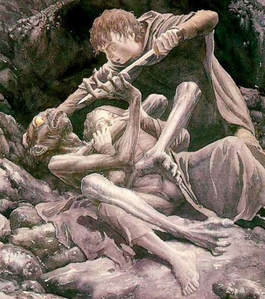
wbvvlnp
Image copyright Alan Lee

This utter dislike for Gollum continued pretty much undaunted until the trio reaches Ithilien. In this phase of the adventure, I started to think of Gollum more as a pet than an enemy. This may not make me seem like the most gracious child, but his overly-expressive gesticulations and extreme attitude shifts reminded me of a dog. Gollum became a character who could amuse me, but he still had to be watched very carefully because he might try to get away with something at any moment.

I did not really understand that Gollum was pitiable until the Stairs. At one point the narrator makes more explicit here what Gandalf hinted at earlier in FR. The narrator describes Gollum coming back to find the hobbits sleeping and

‘slowly putting out a trembling hand, very cautiously he touched Frodo’s knee – but almost the touch was a caress. For a fleeting moment, could one of the sleepers have seen him, they would have thought that they beheld an old weary hobbit, shrunken by the years that had carried him far beyond his time, beyond friends and kin, and the fields and streams of youth, an old staved pitiable thing’ (TT, IV, viii, 714).

I need to clarify here that I did not see Gollum as regretful here. For all I knew, Gollum was reaching to see if Frodo was asleep enough for him to steal the Ring. What I did understand, though, was that others could pity him even if his motivations or intentions were bad. This passage did not show regret in Gollum, but the magnanimity that thee hobbits were capable of. I did not arrive at an understanding of Gollum’s motivations until a few years later in my reading experience.

Gollum to me was complicated in the way that he could be viewed by others, but not complicated in his own character. While I understood some of his internal tension, Tolkien was too overt with Gollum for me to ignore it, it registered as uncertainty to me and not real conflict.

Where Do We Go From Here?

Sam gets meta, then onward to RK​!

What Do You Think?

What was your first interpretation of Gollum?
Did you ever take true pity on him?
Did I miss anything? Let me know!

Abner de Souza’s Experience–Tolkien Experience Project (36)

This is one in a series of posts where the content is provided by a guest who has graciously answered five questions about their experience as a Tolkien reader. I am very humbled that anyone volunteers to spend time in this busy world to answer questions for my blog, and so I give my sincerest thanks to Abner and the other participants for this.

To see the idea behind this project, check out this page

I want to thank Donato Giancola for allowing me to use his stunning portrait of J.R.R Tolkien as the featured image for this project. If you would like to purchase a print of this painting, they are available on his website!

If you would like to contribute your own experience, you can do so by using the form on the contact page, or by emailing me directly.

Now, on to Abner de Souza’s responses:


How were you introduced to Tolkien’s work?

Though familiar with Tolkien’s name, being a C.S Lewis’s reader, it was all because of the LOTR movies. Which I just came to watch in the year of the second part of The Hobbit trilogy , for, until then I only had seen the scene of the Hobbits in Fangorn, which in my memories were totally different. Well, though it was a bad quality, illegal copy, it was enough to take me out of my world and so I became, or, more accurately, I found out I was thirsty for that fantastic beauty I found in Middle-earth. So, by the time of the third part of The Hobbit, I’d already read the four books and considered myself his biggest fan, and abandoned, because I had no idea by the time, that The Silmarilion existed.

What is your favorite part of Tolkien’s work?

If you asked a book, I would say with no doubt The Silmarilion. Because of it’s majestic beauty, incomparable. But, the “part” of his work I can’t say. Maybe the linguistic, that, like the gift of the elves, it was his magic of writing, of making men have dreams of that intangible fairness. Like only the words he created could give you the description of what it means without spoil.

What is your fondest experience of Tolkien’s work?

That is something I discovered suddenly. Walking to school, back in those days I was reading The Lord of The Rings, I caught myself gazing upon the trees. In a moment I just knew that I was changed forever by a book I was reading. I can still see the tree, the street I was in, like I’m right in front of it. This moment is in my mind and heart. Unremovable.

Has the way you approach Tolkien’s work changed over time?

Never. Since I read The Lord of The Rings, to read a new work, to watch or to listen to an interview or record he made, or anything related to him, it’s like a ceremony for me. I have the highest respect for all of his legacy and so I care about not giving it the recognition of it’s worth. By now, I’ve read or listened to a lot by Tolkien and about Tolkien, though I have this way that might seem strange. I do not consume the work of someone I like and that has already passed in the same way I do for the work of the living. So I go slow, as slow as I can. It’s reasonable actually. For I fear the day I will know all that there is to be known. But for Tolkien, being who he is, it’s different. I always make sure to have something new to pass Christmas day or my birthday.

Would you ever recommend Tolkien’s work? Why/Why not?

If I would? What can a man do in the name of love if not share all that is good?


If you want more of Abner’s thoughts on Tolkien and other topics, you can find him on Twitter!

The Tolkien Birthday Toast–A Reflection on Reflection

For a few years now, I have followed the tradition of the Tolkien Birthday Toast that I was first introduced to through the Tolkien Society.

You can visit the Tolkien Society’s page explaining the toast for more information or for the basic procedures.

Today I wanted to take a moment to laud the simple traditions that fandom inspires. It is easy to look at something like the Tolkien Birthday Toast from the outside and assume it is nothing more than an exercise performed by a group of over-enthusiastic nerds.

I think there is something a bit more, though.

alcoholic-beverage-ale-beer-1464825

At this point, the toast is a shared, communal tradition that lends itself to something that our everyday lives increasingly push out: reflection.

I call it a communal experience because, whether one celebrates it alone or in the company of others, there is an understanding that this act is something shared. Different fans and groups of fans across the world will do this same act, and participating in something that large gives a sense of unity and belonging.

It is more than that, though. This sense of community is nice, but what is the community about? Why does it matter?

Having the toast focus on the author rather than a specific text or event makes this activity a very special kind of reflection. It is a moment to pause and appreciate the achievements of an author and the life he lived. Tolkien was not a writer by trade, he was an academic. While many people were drawn to him because of his creative endeavors, those are only part of Tolkien’s influence. The toast allows people with varying degrees and experiences with Tolkien and his work to participate, and this is important!

This is the point that intersects the most with my interests as a researcher into the reception of Tolkien’s writings: The Toast invariably calls participants to reflect on the ways that Tolkien’s writings have produced meaning in their lives.

Often, participants will share stories of how they first read Tolkien or how Tolkien changed the way they saw the world. These stories are the kind of reflection that are increasingly pushed aside in a fast-paced culture.

A tradition that practices taking a moment and recalling these stories of connection and inspiration is well worth participating in! So tonight, at 9pm, consider raising a glass to The Professor!