The Best (and Worst) Books for Tolkien Biography

I have seen several news stories along the lines of “books to read before seeing Tolkien” around the internet recently. While I applaud news outlets for encouraging reading tied to movies, several of these posts, though certainly not all, recommend reading Tolkien’s fantasy works instead of reading works about Tolkien. In my experience, biographical material is far more interesting to read before a biopic, so I have compiled a list of recommended (and not recommended) readings that appeal more to that aspect. Enjoy!

Recommended
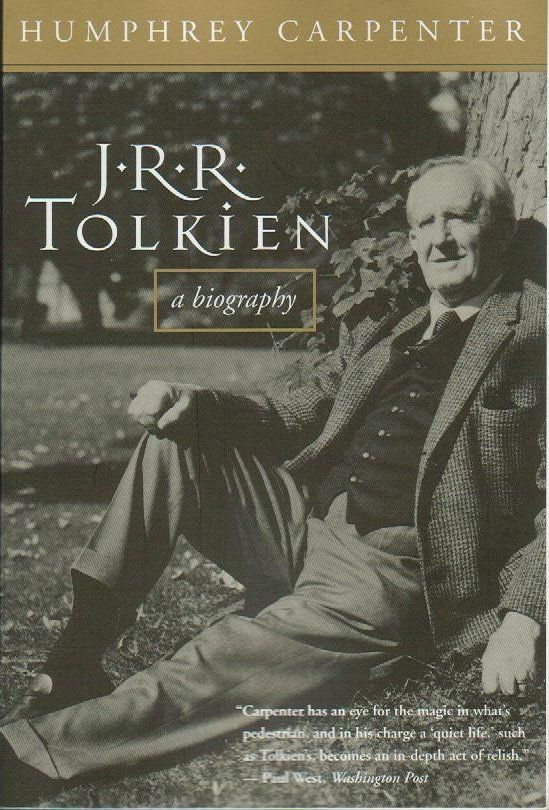
J.R.R. Tolkien: A Biography by Humphrey Carpenter

Put simply, this book is regarded as the essential Tolkien biography by many scholars and fans.
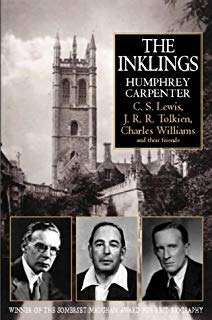
The Inklings: C.S. Lewis, J.R.R. Tolkien, Charles Williams and Their Friends by Humphrey Carpenter

This book focuses more specifically on the group that came together to share readings and community in Oxford that included Tolkien and Lewis.

Winner of the 1982 Mythopoeic Award for Inklings Studies!
Bandersnatch: C.S. Lewis, J.R.R. Tolkien, and the Creative Collaboration of the Inklings by Diana Pavlac Glyer

This is another well-respected and informative book looking at the creative group in Oxford!

I believe this is somehow related to her other text The Company They Keep, but as I have not read it I can provide no commentary. (Winner of the 2008 Mythopoeic Award for Inklings Studies.)
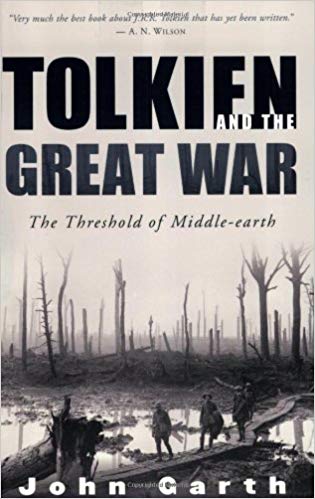
Tolkien and the Great War: The Threshold of Middle-earth by John Garth

This excellent book looks at Tolkien’s war experience during World War I and how his friendships and experience could have shaped his life and literature.

Winner of the 2004 Mythopoeic Award for Inklings Studies!
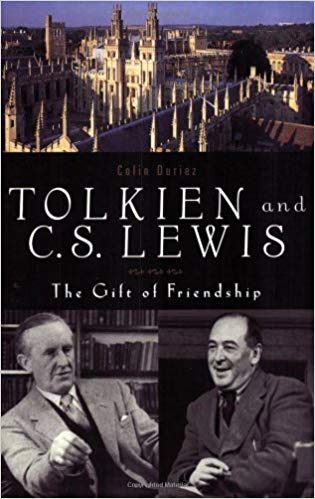
Tolkien and C.S. Lewis: The gift of Friendship by Colin Duriez

This is an even closer portrait of the friendship between Lewis and Tolkien, as the title implies.
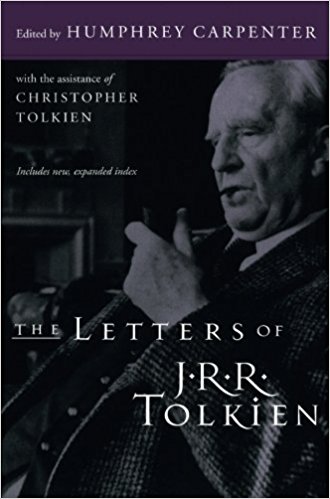
The Letters of J.R.R. Tolkien edited by Humphrey Carpenter

This is an invaluable resource for readers who want a little insight into Tolkien’s exchanges with friends, family, publishers, and fans.
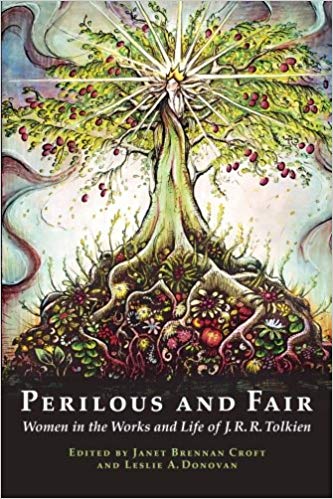
Perilous and Fair: Women in the Works and Life of J.R.R. Tolkien edited by Janet Brennan Croft and Leslie Donovan

Even though this is a collection of essays rather than a book-length investigation, it is absolutely worth mentioning because it is perhaps the best resource available discussing the way that Tolkien worked with and supported women in his life.

Tolkien, Race and Cultural History by Dimitra Fimi

While not a biography, per se, this volume contains an insightful cultural history of Tolkien which is helpful when trying to understand how Tolkien’s views and opinions compared to the culture in which he lived.

Winner of the 2010 Mythopoeic Award for Inklings Studies!
The J.R.R. Tolkien Companion and Guide: Boxed Set

I added this after Jason Fisher and others pointed out that the Chronology is a fantastic insight into Tolkien’s biography.
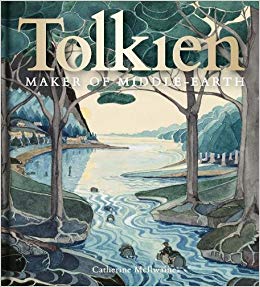
Tolkien: Maker of Middle-earth by Catherine McIlwaine

Released in conjunction with the recent (2018) Tolkien exhibition in Oxford, this serves as both the catalogue for that exhibition and a remarkable text full of insight into the life of Tolkien.

Have Not Read

For each of these, I welcome comments from other readers!
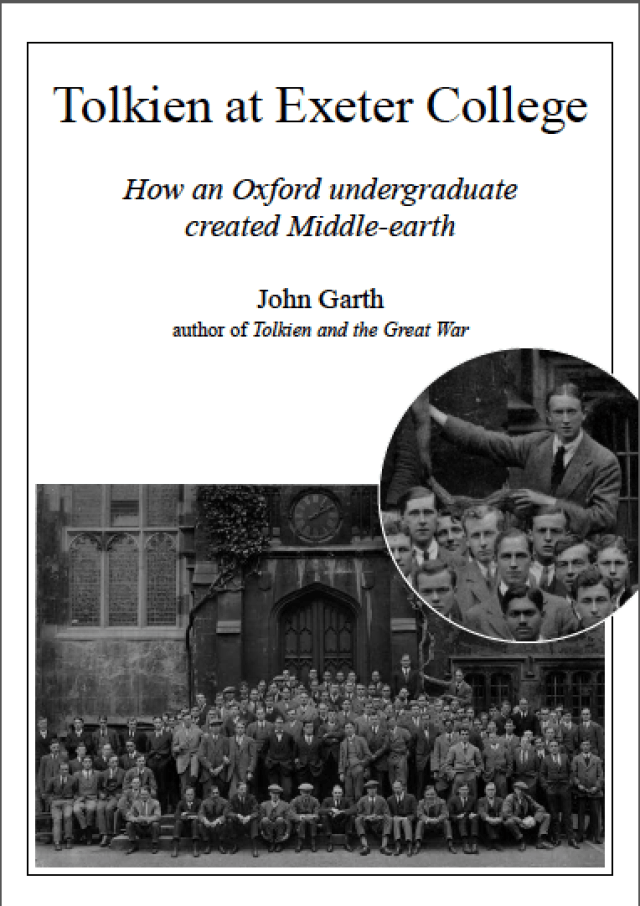
Tolkien at Exeter College by John Garth

The Fellowship: The Literary Lives of the Inklings: J.R.R. Tolkien, C.S. Lewis, Owen Barfield, and Charles Williams

Winner of the 2017 Mythopoeic Award for Inklings Studies!
Tolkien by Raymond Edwards

  A Hobbit, a Wardrobe, and a Great War by Joseph Loconte

Not Recommended
The Biography of J.R.R. Tolkien: Architect of Middle-earth by Daniel Grotta

Grotta has been exposed for, shall we say, taking liberties?
J.R.R. Tolkien (Just the Facts Biographies or Learner Biographies) by David R. Collins

Not well circulated, this book is intended as an introduction to the author for children. Unfortunately it suffers from two faults: it contextualizes the author using the movies, and at times it seems to take facts from Grotta.

Honorable Mentions

I have not included these in the list because I did not think them either bibliographic enough, or far-ranging enough in their bibliographic content. However, I wanted to mention some other works of great scholarship that touch on bibliography:

The several volumes produced by Hammond and Scull about Tolkien’s artistic output!

Shippey’s first and second books on Tolkien have less biography, but demonstrate overlap between biography and his creative output (credit to commenters for convincing me to add this).

Ring of Words: Tolkien and the Oxford English Dictionary by Peter Gilliver et al.

Tolkien in East Yorkshire 1917-1918: An Illustrated Tour by Phil Mathison

Tolkien and Wales: Language, Literature and Identity by Carl Phelpstead

There are several works by authors like Richard Purtill, Joseph Pearce, or Bradley Birzer which focus specifically on the religious aspects of Tolkien’s life and elevate it above all others. I have not included such works in this list, but a couple are worth hunting down if these are of interest to you.

What other books would you recommend for biographical information? Do you agree or disagree with anything on this list? Let me know!

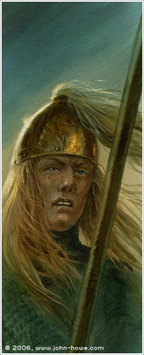
LotRFI Pt.46–​Éomer

I mentioned Éomer’s first encounter with the protagonists in Pt. 22. Like many other characters, I mistrusted him at first, but then came to respect his demeanor and his bravery. The reader is reintroduced to Éomer at Edoras. Here he is reinstated as one of Théoden’s top commanders. From this point on, Éomer plays the part of a stout warrior, and steadfast advisor on military matters. He is impressive in this role, and takes after his uncle with his tenacious spirit.

wotr-eomer-port
Image copyright John Howe

As I read through LotR for the first time, I really liked Éomer. He struck me as a kind of balance between Strider as he appears in the beginning of the book and Aragorn as he is revealed as king in the end. He was unapologetically of high birth in his society, but was unpolished and even plain in his manner. This allowed him to be very likable, but to command respect, similar to what I saw in Théoden.

A large distinction that I made between Éomer and Théoden is that Théoden becomes close to the Fellowship through being an equal in stature to Gandalf and a fatherly figure to the hobbits. Éomer, on the other hand, seemed to establish a brotherly relationship with Aragorn and a playful rivalry with Gimli. While both of these relationships elevated the characters above the hobbits, and therefore above the reader, they were different in that Théoden seemed much more interested in the hobbits than did Éomer.

Shifting focus, this elevated stature of Éomer allowed him to be a heroic figure to me. His cares and worries seemed to be larger than those of the hobbits. Where the halflings are often concerned with a sense of belonging, Éomer knows his place, and is concerned more with how to lead his people correctly.

His position of authority makes his valiant stand on the battlefield even more impactful. While I am presenting my current thoughts on Éomer’s alliterative exclamations at a conference in 2018, I do want to cover my initial reaction to his heroic feats during the Battle of the Pelennor Fields.

Just as Théoden’s call to charge gave rise to some mad fire inside my little eleven-year-old frame, so too did Éomer’s despair at seeing his uncle and sister dead on the battlefield. At the time of my first reading, I was fortunate enough to have never lost someone close to me. Even still, I could find a sense of pain and loss something similar to what Éomer must have felt. His heartrending cry chilled me to the bones:

“‘Éowyn, Éowyn!’ he cried at last. ‘Éowyn, how come you here? What madness or devilry is this? Death, death, death! Death take us all’” (RK, V, vi, 844).

It was through these passages that I learned what it meant to be fey. Éomer’s complete abandonment of strategy in favor of making his death meaningful was utterly beyond my experience. His laughter in the face of battle was terrible and terrific. He was awe-inspiring in two ways: one of the most courageous and stupid things I had ever read. I was so grateful when Aragorn swooped in and saved Éomer, because I had given up hope that this courageous man would ever see another day.

Where Do We Go From Here?

To take a look at Denethor and see what his problem is.

What Do You Think?

How did you react to Eomer’s reckless abandon in battle?
What did you think of his relationship to the fellowship?
Did I miss anything? Let me know!

Becky Dillon’s Experience–Tolkien Experience Project (43)

This is one in a series of posts where the content is provided by a guest who has graciously answered five questions about their experience as a Tolkien reader. I am very humbled that anyone volunteers to spend time in this busy world to answer questions for my blog, and so I give my sincerest thanks to Becky and the other participants for this.

To see the idea behind this project, check out this page

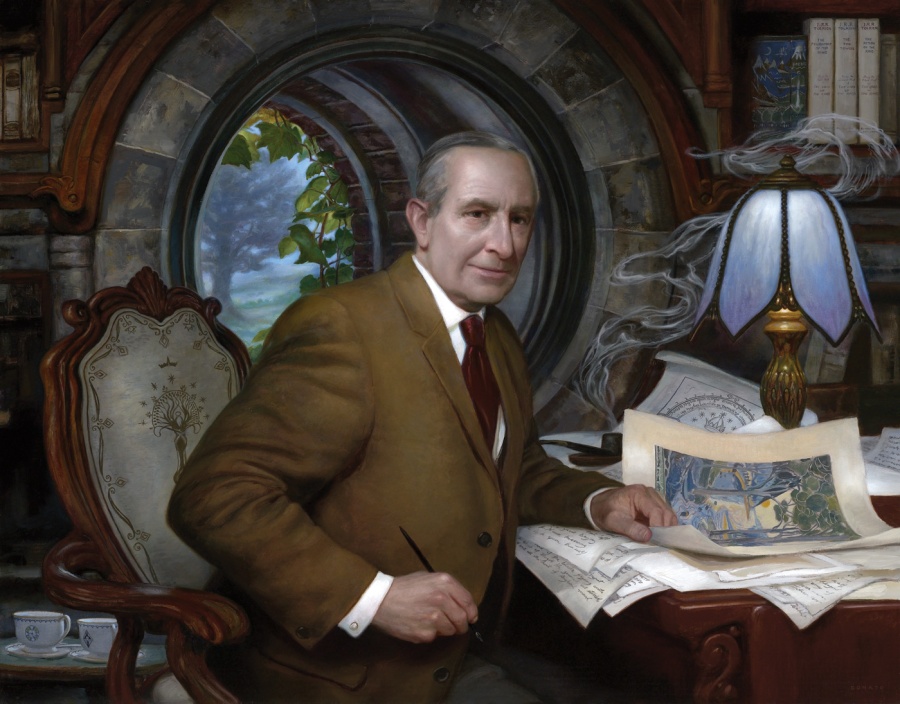
I want to thank Donato Giancola for allowing me to use his stunning portrait of J.R.R Tolkien as the featured image for this project. If you would like to purchase a print of this painting, they are available on his website!

If you would like to contribute your own experience, you can do so by using the form on the contact page, or by emailing me directly.

Now, on to Becky Dillon’s responses:


1. How were you introduced to Tolkien’s work?

“Read this,” she said as we brushed shoulder-to-shoulder in the exchange of classes back in 1965, and she pushed a strangely covered book under my nose.
“What? More unicorns and dragons and fairies? Please, Kathy, no!”
“This is different. Trust me!” I was sceptical, but I took the book from her anyway as she turned on her heel and sped away to her next class.
“Hmmm. The Two Towers. It doesn’t sound promising; more like Rapunzel…”

Of course, I was wrong.

It seemed that Kathy’s boyfriend had stumbled on this series of three books that he thought were cool and insisted that Kathy read them so they could discuss them. Kathy, in her need for support, was sharing the set with others, including me, and I got the second book because the first one was already lent out to a mutual friend who was keen to read this ‘new’ view of fantasy. Kathy, herself, was finishing the third.

Yes, I eventually got to read them in the correct order, and have been doing so every couple of years since then – albeit in one volume!

2. What is your favorite part of Tolkien’s work?

 My favourite part of Tolkien’s work is the imaginative children’s works; specifically Smith of Wootton Major, with Roverandom a close second. Tolkien’s love of story for the sake of story shows in his attention to detail and great sense of humour. Who else but Tolkien would invest so much time in the creation of the ‘Father Christmas Letters’ or the Girabbit in Mr Bliss’ garden? And, all of it is tied together with his own artwork. Although much of the published titles use the work of others (ie.:Pauline Baynes), Tolkien still had his own sense of art communicating the story as much as the words, and for a children’s book, pictures were a necessity.

3. What is your fondest experience of Tolkien’s work?

As existential as it may sound, the first time I got off the train in Oxford and walked up the street to the Magdalen Martyr’s Memorial and onto St. Giles and the Eagle and Child. I knew then that I would never have a better experience with Tolkien as my reference; almost as if I was ‘reading’ Oxford for the first time.

4. Has the way you approach Tolkien’s work changed over time?

Absolutely. Even after some 20+ reads of ‘Lord of the Rings,’ I have found that the more I read and discuss the more depth I find.
I am a member of an on-line reader’s group called the Grey Havens Palantír, and we are again reading LotR; being on Chapter VII, ‘In the House of Tom Bombadil.’ The previous chapter has opened up new insights, as re-reads always do, and I am always excited about new finds and new perceptions. The Story, for sake of the Story, will always intrigue me, but finding new details and new direction in the well-read text is always exciting.

5. Would you ever recommend Tolkien’s work? Why/Why not?

It would depend on the person involved. There are some who would not enjoy/appreciate Tolkien, and I would like to think that I should be able to discern those characters. I have found that it takes a special character to enjoy the work and the ideals put forth, and it is that which I would need to consider before any recommendation.


For more Tolkien, follow the page that Becky Dillon contributes to on Facebook: International Tolkien Fellowship-News & Publications!

LotRFI Pt.45–Éowyn

A Bit of Background

I must admit that Éowyn was a very difficult character for me to understand the first time I read LotR, and I am still not sure that I understand her entire character arc. I am sure that there are scholars and critics better able, and in a more appropriate place, to comment on her portrayal as a woman and to her motivations and resolution. Let me clarify, then, that what I am trying to convey here is the understanding that I had of Éowyn as an eleven-year-old boy, whose life experiences did not include putting myself in other people’s shoes very often except through literature.

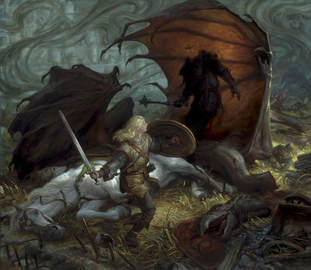
eowynandnazgul-donatob
Image copyright Donato Giancola

Since I was still an immature reader, though I was probably advanced in ability for my age, I would say that I lacked the kind of empathy that comes through life experience. I tried to understand everything I read through my own frame of reference. I literally thought about each character’s actions and tried to understand how I would have to feel in order to act the way they did. As we grow up, this kind of reading, I believe, becomes less necessary, as we can relate characters’ actions to other people’s actions and feelings easier because we have experienced more. Regardless, this means that I was attempting to understand how an eleven-year-old boy from the southern US would have to feel to act the way that Éowyn does…I am sure you can see how this was a flawless interpretation technique.

My Reading

From this vantage point, I was able to understand many of Éowyn’s early actions. She was proud, and she wanted to help her king and people through action. This was not difficult for me to understand. Pride is something I relate to very easily, having had an abundant share of it myself. I understood entirely why Éowyn wants to, and ultimately does, ride into battle with her kin. The difficulty for me came about when I tried to understand Éowyn’s very complex interpersonal relationships.

I should perhaps remind everyone that in my first reading I did not read any introductory material or any of the appendices. This means that I was completely unaware of the relationship between Aragorn and Arwen until much later. This influenced my interpretation of Éowyn because it means that I was completely unaware that Aragorn’s comment about Rivendell was a romantic refusal.

‘“Were I to go where my heart dwells, far to the North I would now be wandering in the fair valley of Rivendell”

For a while she was silent, as if pondering what this might mean’ (RK, V, ii, 784).

To me, this was simply a statement that people do not always get what they desire. Aragorn would rather be at peace in a place that he loved than leading men into battle.

The most resonant statement for me was that Éowyn feared ‘a cage’ more than anything else (RK, V, ii, 784). This statement resonated with me on the same level as Merry’s experience during his time in Rohan. They both wanted to be helpful, but were being stereotyped as lesser and ignored.

Finally, I want to talk about Éowyn’s epic stand (I will talk about her relationship with Faramir and the Houses of Healing in a later post). While Éowyn was a complicated character to me, I had no difficulty appreciating her courage and valor in standing up to the leader of the Nazgûl. She becomes enraged after her uncle is mortally wounded and, in her bravery, she challenges and defeats the fearsome foe. She delivers one of the most marvelous lines of prose I have ever read:

‘But no living man am I! You look upon a woman. Éowyn I am, Eómund’s daughter. You stand between me and my lord and kin. Begone if you be not deathless! For living or dark undead, I will smite you, if you touch him’ (RK, V, vi, 841).

The dramatic tension leading up to this moment was so powerful, and I remember cheering out loud when she stands up to him and reveals herself. This was truly a remarkable passage to me as a first-time reader.

As a side note: perhaps the strong impact of this moment, the strength in Éowyn’s identification as a woman in the midst of the largest battle in the text, is what blinded me for so long to the valid claims that Tolkien does not include enough women in his narrative. I held on to this one climactic instant and made it a pinnacle of the story, which it is, but I allowed it to obfuscate shortcomings which were related to it.

Where Do We Go From Here?

Let’s talk about her brother Eomer, then talk about Denethor.

What Do You Think?

How did you approach Eowyn’s character in your first reading?
How did you react to her stand against the Nazgul?
​Did I miss anything? Let me know!

William J. Meyer’s Experience–Tolkien Experience Project (42)

This is one in a series of posts where the content is provided by a guest who has graciously answered five questions about their experience as a Tolkien reader. I am very humbled that anyone volunteers to spend time in this busy world to answer questions for my blog, and so I give my sincerest thanks to William and the other participants for this.

To see the idea behind this project, check out this page

I want to thank Donato Giancola for allowing me to use his stunning portrait of J.R.R Tolkien as the featured image for this project. If you would like to purchase a print of this painting, they are available on his website!

If you would like to contribute your own experience, you can do so by using the form on the contact page, or by emailing me directly.

Now, on to William J. Meyer’s responses:


1. How were you introduced to Tolkien’s work?

I was first introduced to Tolkien’s work when my older brother-in-law Brendon gave me a box set of paperbacks which included The Hobbit and The Lord of the Rings. These editions were the ones with the Darrell K. Sweet covers. The cardboard box was just as much a part of the reading experience as Tolkien’s words, and I would look at that art for hours. In particular, the giant eagle in its nest on the cover of The Hobbit held my rapt attention.

2. What is your favorite part of Tolkien’s work?

My favorite part would be the sense of one age ending and another one beginning. Especially in the final pages of Return of the King. But my favorite single moment would have to be Éowyn slaying the Witch-King.

3. What is your fondest experience of Tolkien’s work?

I was re-reading The Lord of the Rings in college and happened to be visiting my parents. I stopped at Appendix B, where, we are told, Legolas and Gimli sail over the sea and leave Middle-earth together after the deaths of Aragorn, Merry, and Pippin. The final line is, “And when that ship passed an end was come in Middle-earth of the Fellowship of the Ring.” I felt this wave of emotion and burst into tears. Can’t really articulate why, though I reckon it felt like a dissolution of friendship, and the end of an heroic age, sure. Anyway, I was crying and my step-dad asked me to explain why. I tried to explain, but he didn’t like fantasy or sci-fi, and had no idea about Tolkien, so it was kind of a funny moment in retrospect because he was like, “What is happening?”

4. Has the way you approach Tolkien’s work changed over time?

I’m sure it has, but I’m not self-aware enough to describe how.

5. Would you ever recommend Tolkien’s work? Why/Why not?

Yes, I would recommend it, because I feel like a lot of classic literature, it transcends the pop culture image we have of it. And beyond all the resonant themes of mythology, it’s just plain fun!


To hear more from William J. Meyer, you can follow him on Twitter!

LotRFI Pt.44–The Horns of the Rohirrim

This pivotal moment in the battle for Minas Tirith was like a lightning bolt in my young reading experience. For a bright and shining moment, the forces of good asserted itself over all of the battle and shouted aloud that it would not be vanquished. I still get chills every time I read the end of “The Ride of the Rohirrim” (RK, V, v). The blaring of the horn, which signals the steadfast defiance of the Rohirrim in the sight of overwhelming odds was (and still is) enrapturing.

angus-mcbride
Image copyright Angus McBride

I do not know why or how an eleven-year-old who knows nothing of medieval warfare or modern warfare or even of true difficulty and hardship, should become so enthralled with the kind of bravery put forth by Théoden and the Rohirrim in this moment. Whatever the cause, I was ready to leap from my seat and charge into battle, whatever that might have meant to me at the time.


Perhaps a relatable metaphor here would be the hobbits’ incredulity on parting from Tom Bombadil:

‘They took a deep draught of the air, and felt that a skip and a few stout strides would bear them wherever they wished. It seemed fainthearted to go jogging aside over the crumpled skirts of the downs towards the road, when they should be leaping, as lusty as Tom, over the stepping stones of the hills straight towards the Mountains’ (FR, I, viii, 136).

The hobbits are so enraptured by their experience with Tom and Goldberry that they feel capable of performing feats on-par with Tom himself. In much the same way, the sounding of the horns of Rohan intoxicated me and made me feel as if I could perform feats of courage akin to those of the riders. An important note, though, is that neither the hobbits, nor I, are truly capable of emulating the actions we were so inspired by. In the case of the hobbits, they are naive and became foolhardy. In my case, however, reality checked my emotions, and I simply kept reading, although perhaps more voraciously than before.

Where Do We Go From Here?

Let’s take a closer look at Eomer and Eowyn!

What Do You Think?

What was your first reaction to the horns of the Rohirrim?
Has your reaction changed over time?
​Did I miss anything? Let me know!

Putri Prihatini’s Experience–Tolkien Experience Project (41)

This is one in a series of posts where the content is provided by a guest who has graciously answered five questions about their experience as a Tolkien reader. I am very humbled that anyone volunteers to spend time in this busy world to answer questions for my blog, and so I give my sincerest thanks to Putri and the other participants for this.

To see the idea behind this project, check out this page

I want to thank Donato Giancola for allowing me to use his stunning portrait of J.R.R Tolkien as the featured image for this project. If you would like to purchase a print of this painting, they are available on his website!

If you would like to contribute your own experience, you can do so by using the form on the contact page, or by emailing me directly.

Now, on to Putri Prihatini’s responses:


1. How were you introduced to Tolkien’s work?

In 2002. That year, the hype for LOTR movies was high, and I went to the book store after finding out that they had been adapted from books. The Indonesian editions of The Fellowship of the Ring, The Two Towers, The Return of the King, and The Hobbit had just hit the shelves. I purchased FOTR without thinking. Later, I remember laying still on my bed late at night, thinking “Wow, what did I just read?” I later went back to the store and purchased the others. The rest is history.

2. What is your favorite part of Tolkien’s work?

Lots of things, but mainly how layered and sophisticated his world-building aspects are. When I was still a beginner reader, I felt like his stories were not something that happened in a fantasy world, but could have happened at some points in the past. I also love how nuanced his characters and stories are. They are not as “black and white” as some people might accuse.

Finally, I love the way Tolkien obscured many references when his characters mention history, characters, and stories from the past. He was supposedly the “know it all” in his world, but he restrained himself from revealing too much to the readers. This makes me feel the sense of mystery and wonder for the past, which results in some serious digging if I want to know more. When reading LOTR, for example, I only know as much as what the characters know, which makes me feel connected to them.

3. What is your fondest experience of Tolkien’s work?

Reading The Silmarillion for the first time in 2005. I felt like everything that was mentioned vaguely in LOTR finally came to life, with all the tragedies, conflicts, and larger-than-life characters. Also, it was the first Tolkien’s book that I read in English. My English reading skill was still below average at that time, and it took me one year to finish the book. It was so rewarding, and my reading skill improved greatly.

More recent example was when my paper was presented at Tolkien Society Seminar 2018, by none other than Nelson Goering. While I was unable to visit due to financial reasons, I was touched because people whom I never met went out of their way to help my paper to be presented. As a person who did not have literature, Classic, linguistic, or other Tolkien-related academic backgrounds, it felt like an acknowledgment from the community.

4. Has the way you approach Tolkien’s work changed over time?

Yes. The first time I read Tolkien, I was intrigued by the stories and adventures, and how it was connected with the movies I had watched, nothing more. Later, I started to notice new layers and understanding when rereading the books. When my experiences and knowledge grew, I saw more nuanced insight and new understanding about many aspects of the stories. These things prompted me to start buying more books that could help me see more behind these new layers, even outside the recommended biographies, History of Middle-earth, and Tolkien’s letter collections. In short, I grew with his books, and his books “grew” with me.

5. Would you ever recommend Tolkien’s work? Why/Why not?

Yes! I will always recommend it when someone asks me about good fantasy fiction books. Tolkien’s work provides good examples of detailed world-building, powerful characters, and nuanced stories that require you to look deeper, even into the words his characters use when speaking. I would also recommend Tolkien’s non Middle-earth books, especially for new readers who just found out about Tolkien from movies.


For more thoughts on Tolkien’s life and works from Putri Prihatini, visit The Lore Master: Blog Tolkien Indonesia!

LotRFI Pt.43–The Battle of The Pelennor Fields

That I can recall, the massive battles that take place at Helm’s Deep and on the fields in front of Gondor were the second and third large scale incursion I ever read in fiction. The first was from H, and was an incomplete telling at best. I believe my next exposure to battlefield narratives would have been Esther Forbes’s Johnny Tremain. My whole family listened to that story on audiobook in the car while on vacation one summer because it was a required text for school. I would not read Homer, C.S. Lewis, or any other such battle for several years after this experience. Of course, I had read the brief descriptions of amassing forces and battle strategies presented in the history books for school, but those very rarely gave an account of fighting, they were distant overviews.

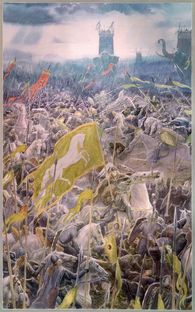
alan-lee-battle-of-the-pelennor-fields
Image copyright Alan Lee

This is not to say that I was naive of brutality: once again, The Call of the Wild was one of my favorite books starting around the age of eight or nine. The scale of the violence was a significant change from my prior reading experience. This means that two elements were very different for me to adjust to. The first is how the story told of the battles, especially Pelennor Fields, from multiple perspectives. This is a trick that Tolkien uses to show more of the battle, and it was a new approach to me. Also, the ebb and flow of the battle was also unique. Of course, I was used to plots where the protagonist came up against an obstacle, or experienced a setback, only to overcome the difficulty in the end. This was one of my first experiences with this kind of story arc encapsulated in a single struggle that didn’t extend for the entire length of the narrative.

This type of battle broke the mold of my previous experience with courtly tales. These were mostly centered on popular culture and not literature (I would not read White’s Once and Future King until two or three years later), and so massive battles were not very bloody nor very lengthy, I was only watching things deemed appropriate for a child, after all. It brought a grim kind of realism into these stories, but it preserved the epic moments of climax and eucatastrophe that I will talk about in my following posts.

Where do We Go From Here?

I want to address the horns of the Rohirrim, then take a moment to think about Eomer and Eowyn in some more depth.

What Do You Think?

How did the Pelennor Fields fit into your previous reading experience?
Did it change your view of Minas Tirith?
​Did I miss anything? Let me know!

Onthetrail’s Experience –Tolkien Experience Project (40)

This is one in a series of posts where the content is provided by a guest who has graciously answered five questions about their experience as a Tolkien reader. I am very humbled that anyone volunteers to spend time in this busy world to answer questions for my blog, and so I give my sincerest thanks to Onthetrail and the other participants for this.

To see the idea behind this project, check out this page

I want to thank Donato Giancola for allowing me to use his stunning portrait of J.R.R Tolkien as the featured image for this project. If you would like to purchase a print of this painting, they are available on his website!

If you would like to contribute your own experience, you can do so by using the form on the contact page, or by emailing me directly.

Now, on to Onthetrail’s responses:


How were you introduced to Tolkien’s work?

Tolkien books were on our shelves from as early as I can remember and when I was 7 my father and I read The Hobbit together over the Christmas holidays. I then read The Lord of the Rings shortly after. I quickly picked up The Silmarillion which was somewhat of a blur during the first read and like The Lord of the Rings took months to finish but I was already hooked.

2. What is your favorite part of Tolkien’s work?

As a child I would have said reading anything set in or around the Shire but now I am far more interested in Tolkien’s early forming of his imagined world, I am especially fond of The Book of Lost Tales. The Cottage of Lost Play is my favorite Tolkien work.

3. What is your fondest experience of Tolkien’s work?

Probably reading The Hobbit, The Lord of the Rings, The Silmarillion, and volume one of The Book of Lost Tales during a hike around North Wales.

4. Has the way you approach Tolkien’s work changed over time?

I have two modes of approaching Tolkien now, so I would say yes. I read for enjoyment and also for study (which of course I enjoy but I try to focus differently). I study at the desk and I curl up on the sofa when I just sit and read for the joy of it.

5. Would you ever recommend Tolkien’s work? Why/Why not?

Absolutely. If I meet people who show an interest but don’t own a copy then they always go home with a copy. Mostly a copy I picked up second hand for that purpose.

LotRFI Pt.42–Merry

While I saw Pippin’s lightheartedness as a very relatable trait, I was also able to identify with Merry during certain points of the epic. Unlike my adulation of Pippin’s jovial nature and individual growth, my identification with Merry was from a negative perspective.


Merry’s time alone in Rohan was perhaps the most affective part of his story for me. His time with Théoden begins in happiness. He is honored and sits next to the king and regales him with stories (RK, V, iii, 796). When word comes that the Rohirrim must go aid Gondor, Théoden telld Merry that he cannot go with them.

‘You shall abide here, and if you will, you shall serve the Lady Éowyn, who will govern the folk in my stead’ (RK, V, iii, 803).

Merry becomes indignant because he does not wish to be left out:

‘But, but, lord,’ Merry stammered, ‘I offered you my sword. I do not want to be parted from you like this, Théoden King. And as all of my friends have gone to battle, I should be ashamed to stay behind…tie me to the back of [a horse], or let me hang on a stirrup, or something.’

250px-john-howe-merry
Image copyright John Howe

This kind of useless bargaining and pleading between someone lower in position and a figure in authority reminded me very much of interactions I had had with my parent not many years before reading LotR (and perhaps some interactions even at the time of reading, if I am honest with myself). In a sense, Merry’s subordinate role in Rohan as a figure of entertainment one moment and as a burden the next mirrors a lot of the childhood experience.

The next chapter set in Rohan (RK, V, v) opens with Merry reflecting on his isolation. To make matters worse, the first interaction Merry has is with Elfhelm the Marshal who trips over him and curses him as a tree root. Merry stands up for himself, saying:

‘I am not a tree-root Sir…nor a bag, but a bruised hobbit’ (RK, V, v, 831).

Although his daring is not rewarded very kindly, as Elfhelm still calls him ‘Master Bag’ at the close of their conversation (RK, V, v, 831). Then Merry is overlooked as he ‘crept’ close enough to the conversation between Théoden and Ghân-buri-Ghân to narrate the scene for the reader (RK, V, v, 832).

The Rohirrim constantly ignore and/or disregard Merry. Perhaps this is a kind of othering. While it can, of course, be interpreted in many ways, this othering always reminded me of those times when adults would tell me to settle down, be quiet, and stop getting in the way. This really resonated with me as a child. Though I had what I would consider a happy childhood, I certainly experienced this kind of reprimand on occasion. The kind of loneliness and isolation that can accompany such an encounter feels on-par with what Merry experiences in Rohan. I could easily relate to the feeling of dejection that Merry feels.

My reflection on Merry’s part at the Battle of the Pelennor Fields and the Scouring of the Shire will come later.

Where Do We Go From Here?

Onward, to battle!

What Do You Think?

How did you read Merry’s experience in these chapters?
Do you think this reading is feasible or insane?
​Did I miss anything? Let me know!