Paul Mitchener’s Experience–Tolkien Experience Project (47)

This is one in a series of posts where the content is provided by a guest who has graciously answered five questions about their experience as a Tolkien reader. I am very humbled that anyone volunteers to spend time in this busy world to answer questions for my blog, and so I give my sincerest thanks to Paul and the other participants for this.

To see the idea behind this project, check out this page

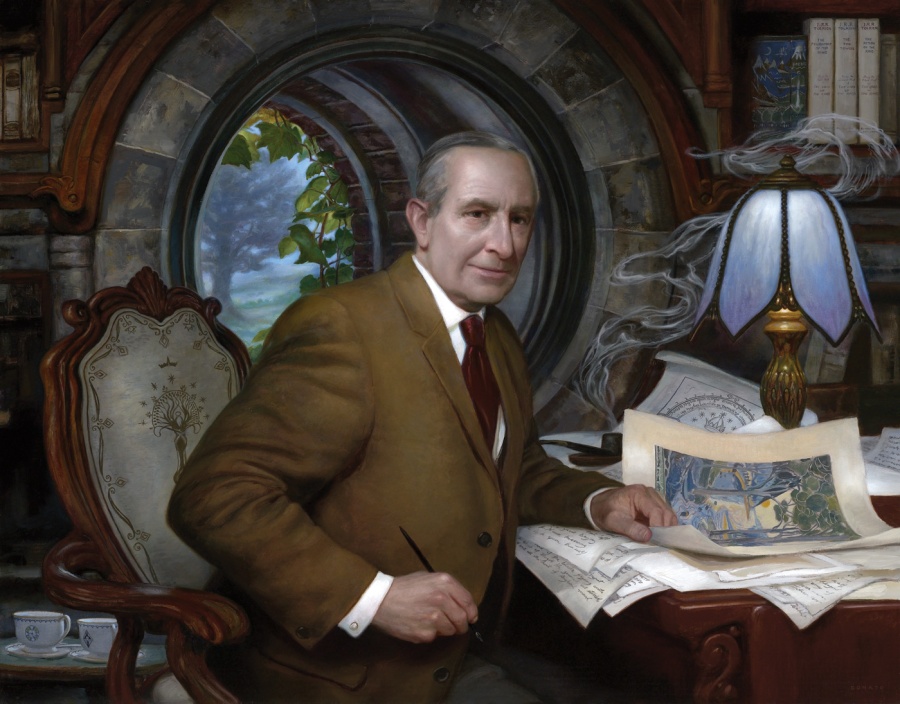
I want to thank Donato Giancola for allowing me to use his stunning portrait of J.R.R Tolkien as the featured image for this project. If you would like to purchase print of this painting, they are available on his website!

If you would like to contribute your own experience, you can do so by using the form on the contact page, or by emailing me directly.

Now, on to Paul Mitchener’s responses:


1. How were you introduced to Tolkien’s work?

There were two, maybe three stages. The first stage was The Hobbit being read to me when I was 8 or so at school, back in the early 1980s. About a year later, my grandfather recommended him to me, and I read The Hobbit on my own and The Fellowship of the Ring. For some reason, he only had the first volume of Lord of the Rings, though I reread Fellowship several times. When I was first at a new school when I was 11, almost the very first thing I did was go to the library, and notice they had the rest of the Lord of the Rings. I devoured them over the next few evenings.

2. What is your favorite part of Tolkien’s work?

Who’s your favourite child? More seriously, this is one of those answers which changes over time, and with each reading. I love Bilbo’s growth in The Hobbit from bumbling fish out of water to being a crafty hero, the way the world is revealed to the readers at the same time it is to the hobbits in Lord of the Rings, and the tragic grandeur of The Silmarillon.

And there are so many good individual moments. In Lord of the Rings for example, the charge of the Rohirrim on the Pelennor Fields, and Treebeard’s interactions with Merry and Pippin stannd out for me at the moment. If I’m going to answer just one thing, I’ll choose the sheer depth of Tolkein’s work, the way every piece of the landscape has character and history. There’s nothing else like it in fiction.

3. What is your fondest experience of Tolkien’s work?

I moved a little away from Tolkien in my early twenties, but seriously reconnected later. There were the movies, but in the wake of the movies I listened to the BBC radio play of Lord of the Rings for the first time, and of course reread the books. And I was struck anew by the great depths, and the sheer mythic reality of Middle-earth. In particular, I seriously appreciated The Silmarillion more than I ever had when I was younger, but it was not only The Silmarillion which felt new to me again.

And there have been other periods of rediscovery. In particular, I recently really enjoyed a group slow read of Lord of the Rings, with a mix of people very familiar with Tolkien and those with less experience.

4. Has the way you approach Tolkien’s work changed over time?

Definitely. Even after the first reading, on subsequent rereads I tended to rush through everything, enjoying the technicolour movie playing out in my brain. Later I started to dwell on the imagined world, drawing out connections between different parts of Middle-earth, and pondering questions such as “what happened to Radagast?” and “where did the Entwives go?” looking for clues in the text.

Most lately, I’m trying to go more slowly, dwelling on each part of the narrative as it comes, not rushing ahead to what comes next, and trying not to use my knowledge of what comes next to inform the present. I’m also engaging more with some of the thematic elements. Tolkien warned us against allegory, but also emphasised that applicability is something different.

5. Would you ever recommend Tolkien’s work? Why/Why not?

Certainly! Tolkien’s work is the deepest work of fantasy out there, and there’s nothing else like it.

It’s hard to find someone who doesn’t have biases about what Tolkien is and is not, informed by popular culture. I’d urge them to forget their biases, especially when it comes to what they think of as “Tolkienesque fantasy”, a term which misleads us about Tolkien’s depth, and engage with the original. It’s fun and something to lose oneself in. One can go as deep as one desires, or just enjoy the world, the story, and the characters.


If you want more thoughts from Paul Mitchener, you can find him on G+!

LotRFI Pt.49–At The Houses of Healing

I really enjoyed the passages which take place among the members of the Fellowship in the Houses of Healing because they are like the chapter “Many Meetings.” There are many old friends who come together and catch up on what the others have been doing since they were last in each other’s company. The humor that arises here is reminiscent of the joviality that overtakes them sitting in the rubble at Isengard.

One of the most memorable passages for me comes from these sections. Merry apologizes for speaking to Aragorn in the wrong tone, saying:

‘it is the way of my people to use light words at such times and say less than they mean. We fear to say too much. It robs us of the right words when a jest is out of place’ (RK, V, viii, 870).

Merry’s words struck home in this reader, and this is one of the phrases that I stored away to use when necessary. To keep a long story short, I was quite tactless as a child, more so than other children, and I frequently said the wrong thing or diverted attention with an awkward or untimely joke. My sense of social awkwardness found expression here.

508-eissmann-healing-faramir_orig
Image copyright Anke Eissmann

Another interesting observation to make of these passages is that I made a rather meaningful thematic observation, but I am unsure how. I will have to do a bit of digging to find out why, but I somehow knew the fact that Aragorn could heal people was a very good sign. I had a sense, albeit not a well-formed sense, that rulers being healers was a metaphor for something. I, of course, had no concept of the trope of the king who heals the land until much later.

A final consideration from the Houses of Healing is the relationship that forms here between Éowyn and Faramir. To be completely honest, this relationship baffled me for many years. It seemed to me that the relationship developed too quickly and I did not understand how these characters could be drawn together from such opposing perspectives. Again, reading Éowyn as an extension of myself, I thought that I would be mad at Faramir for presuming to know how I felt about anything, much less another person. This may largely be because one of the things I hated most as a child was being ‘talked down’ to. Perhaps I interpreted Faramir’s explanation of Éowyn’s feelings as condescending (and not in the good, medieval sense).

Where Do We Go From Here?

The Last Stand, then on to Book VI!

What Do You Think?

Which part of the Houses of Healing was your favorite? why?
How did you, or do you, interpret the relationship between Éowyn and Faramir?
​Did I miss anything? Let me know!

Marie Prosser’s Experience–Tolkien Experience Project (46)

This is one in a series of posts where the content is provided by a guest who has graciously answered five questions about their experience as a Tolkien reader. I am very humbled that anyone volunteers to spend time in this busy world to answer questions for my blog, and so I give my sincerest thanks to Marie and the other participants for this.

To see the idea behind this project, check out this page

I want to thank Donato Giancola for allowing me to use his stunning portrait of J.R.R Tolkien as the featured image for this project. If you would like to purchase print of this painting, they are available on his website!

If you would like to contribute your own experience, you can do so by using the form on the contact page, or by emailing me directly.

Now, on to Marie Prosser’s responses:


1. How were you introduced to Tolkien’s work?

Honestly, my first introduction to Tolkien’s work was the Rankin/Bass Hobbit and Return of the King films, which my family had copies of on VHS, and I did read The Hobbit as a middle school student. None of this was particularly memorable, though, and I have to say that the Rankin/Bass Return of the King barely spoiled the books at all ;). I read The Lord of the Rings when I was 12, and that was what began a lifelong love of Tolkien’s work.

How it happened was like this: The summer before seventh grade, I wanted to read Jules Verne’s Journey to the Center of the Earth, but for whatever reason, could not find a copy of it at the library. So, I was going through the bookshelf in my parent’s office (the one that had their old college textbooks on it), and was quite pleased to find a selection of novels that included the Jules Verne book. Next to it was the Ballantine paperback copies of Lord of the Rings, which I was not overly excited about at the time. But after I finished the book I wanted, I did eventually pick them up. The covers were…not encouraging, to say the least, but I remembered liking The Hobbit, so. I of course enjoyed them immensely. I had reached Return of the King by Christmas break, and I remember I was supposed to be finishing an art project (a grid drawing of a bird). I sat at the bookshelf in my bedroom, and I would read a chapter, then work on the drawing, read a chapter…. I still have that drawing, and it reminds me of the first time I read the books. My mother got it framed for me, because she knew I liked it so much. I re-read the books for the first time in 9th grade, and then again in 10th grade. I don’t really re-read them any more, but that’s mostly because at this point I know them so well I don’t need to; I just look up passages when I want to.

2. What is your favorite part of Tolkien’s work?

I am most partial to The Silmarillion. I love that story, and what he did with creating such a poignant story where everyone fails but there’s still a hopeful ending. The Silmarillion hurts sometimes, but it is so beautiful and I love it.

The part of Tolkien’s writing I love the most is his love of trees and stars. I too love trees and stars, and at this point, it’s difficult for me to say whether I love these things because I read Tolkien, or if I love Tolkien because he shares my love of these things. It is not unusual for me to greet Orion (I mean Menelmacar) when I go outside at night, just as the elves Frodo met in the Shire do.

3. What is your fondest experience of Tolkien’s work?

Oh, that’s an easy one! ALEP. A Long Expected Party is a Tolkien-themed event in the Shaker Village outside Lexington, Kentucky every three years. It is AMAZING and I love it very much. The people I’ve met there have become good friends. What kinds of friends? Well, I live with one of them; that’s where I met my roommate. I went on vacation with a bunch of them in June. And I’ve visited Banff and Calgary’s Stampede because one of them invited me to her place. I dated someone who also attends the event, which involved explaining to immigration how we met. So, yeah. It is dear to my heart and important to me and just amazing from so many points of view – hiking in the woods in costume, hanging out at a bonfire, recreating Bilbo’s birthday party, music and dancing, singing ‘Rolling Down the Hole’ at the top of my voice at 2 AM – you know, a good time! Oh, and I teach a Tengwar class there.

Second choice would be visiting Tolkien’s grave in Oxford. I sat next to it and had a nice long conversation, and then left a green stone that I’d brought with me.

4. Has the way you approach Tolkien’s work changed over time?

Certainly. When I first read the book, I mostly just thought about it. I would close my eyes and picture the forests of Middle-earth, and my teacher would ask me if I was meditating. I did make some sketches, I suppose, but I didn’t really know how to engage with a book yet.

When I was in high school, I tackled the Appendices more seriously. I taught myself how to write in runes, and I would often doodle on my schoolwork in them. I would make copies of the runic alphabet for my friends, so they could read the messages I wrote. My boyfriend even wrote a font program so I could type in runes; the first thing I typed was ‘bright blue my jacket is and my boots are yellow.’ I wrote ‘A Elbereth Gilthoniel’ on the wall in the set room during the school musical. I checked Humphrey Carpenter’s biography out of the school library, and was saddened to learn that Tolkien died before I was born – I called a friend and told her that we weren’t even alive at the same time! [The Balantine books I’d read were printed in 1972 and had the ‘respect for living authors’ disclaimer on the back, so it was news to me.] I read The Silmarillion and disliked it. I told my sister about it, though, and she said she wanted to marry Finrod (or Ulmo). A friend lent me Bakshi’s Lord of the Rings after we’d wandered around talking about Tolkien’s work for hours. I also came across the artwork of the Brothers Hildebrandt; I liked Galadriel’s Mirror the best.

When I was in college, I took a slightly more academic approach. My geography class required me to go to the library every week to view videos, and while I was there, I would go up to the Tolkien section and check out a different book of literary criticism on him each week. I was largely disappointed. Tom Shippey’s The Road to Middle-earth was the only one that actually taught me something new. I also read Letters and discovered what Tolkien’s opinion of a young American engineer was (that’s what I was at the time, so.) Luckily for me, I went on to take a few medieval history classes, so I likely wouldn’t have made the faux pas about feudalism. Whew! My college roommate (and best friend) learned Tengwar with me, and we wrote on each other’s notes during the classes we took together.

Then, the summer of ’99 was consumed by ‘So, did you hear they’re making a movie of Lord of the Rings?’ and I discovered online messageboards (my home was TORc, TheOneRing.com) Conveniently, Tolkien’s books were on my bookshelf, within reach of my computer, so I learned the ‘look it up!’ rule of answering questions in online discussions. My time there discussing Tolkien’s books in detail with other fans is most of the reason why I know Tolkien’s writing so well. I also decided to read the books aloud to my brothers in 2000. My youngest brother had requested The Hobbit when he was five, mostly because he liked Rankin/Bass’ Gollum, but now he was ten, so I thought he was ready for it. Each evening that summer, I would come home from work, swordfight with my brothers in the backyard using sticks, and then read Lord of the Rings to them after dinner. I drew them a sketch of Helm’s Deep (with labels!) so they could understand the battle and answered their questions as we went. It was a lot of fun, for me and them! I went on to recount most of the stories in The Silmarillion to my youngest brother while I was painting our parents’ living room. He would ask me questions, and I would tell him about First Age elves. I should not be terribly surprised that his middle school reading included Hamlet and The Silmarillion. He is still an avid reader to this day and loves fantasy; he’s currently trying to get me to read The Name of the Wind.

After college, my best friend made me a fleece cloak. It was a revelation to me that if the clothes you wanted to wear didn’t exist in the store to buy, you could make them yourself! I learned how to sew with my mother’s help, and made a dress with lacing on the back and a bodice. The bodice became part of my Hobbit costume and I still wear it. In 2004, I wrote my first fanfiction. It was about hobbits, and mostly nothing happened :P. I went on to write about Maedhros trapped in the Halls of Mandos and a young Elrond at the end of the First Age. I also read a lot of other people’s fanfiction and discovered another way to engage with Tolkien’s work. In fanfic, the whole point was to expand the story, to make your own choices and decisions about what these characters would do, what these places were like, how events unfold. Tolkien’s ‘unexplored vistas’ call out for that! I also discovered the artists Anke Eissmann, Jenny Dolfen, and Catherine Karina Chmiel who imagined Tolkien’s world visually in a way I found very appealing. Their love for The Silmarillion (and certain Sons of Fëanor!) likely keep me coming back to them as my favorite Tolkien artists.

As a teacher, I had opportunities to work Tolkien into my classroom. Did you know that there are examples of all the various types of erosion in The Hobbit? My earth science students found that out when they had to match the passage to the vocab word. Did you know that blond hair travels in hobbit families the same way it does in human families? My biology students got to study inheritance patterns in hobbit family trees. And of course I could always write what was happening in Middle-earth under the date. On October 6th, it was dark in the dell under Weathertop….

I discovered conventions and costuming, starting in 2006 at the Gathering of the Fellowship in Toronto. (Oh, I also had the opportunity to see the Lord of the Rings musical in both Toronto and London; it was very interesting, but not necessarily good. I liked it!) I’ve already mentioned ALEP, so you know where this goes, and I’ve also attended DragonCon three times. My costumes include: an orc, an ent, Varda, Elwing, Curufin, random wood elves and hobbits. Oh, and I made a costume for Finduilas of Dol Amroth specifically so I could make the starry mantle but not wear a blond wig for Eowyn 😛 The costumes from Peter Jackson’s film are very lovely, but I’ve never made a recreation of one. I did get to see them up close at the exhibit in Boston, which was fun.

Most recently, my efforts have been directed towards the Silmarillion Film Project, contributing to a collaborative group effort to adapt The Silmarillion to a television series, spearheaded by Corey Olsen with the help of Trish Lambert and Dave Kale. I mostly help with script outlining, but it’s been great to work with artists – we have maps, we have costumes, we have location scouting, we have artwork…everything you would need to create for this adaptation is fair game to tackle. So there’s been all sorts of fun conversations, like how do the Light of the Trees influence the architecture of Tirion (do all the windows face west?) and what visual changes does Melkor undergo when he is transitioning from fair-seeming to tyrant of Angband, and how do you handle first contact between the elves and the dwarves?

The short answer: I have transitioned from being a passive reader to engaging the text academically, and then later creatively, and I feel that this last is the most fruitful and rewarding, so I intend to keep doing it. I also very much enjoy reading Tolkien’s work aloud.

5. Would you ever recommend Tolkien’s work? Why/Why not?

Yes, of course. It’s very good. I would say that The Lord of the Rings is one of the best books ever written, and that it has surprisingly few flaws. People love it for a reason. But I take a strict ‘no pushing’ policy. I have friends and family members who have never read Tolkien’s work, and I do not push them to do so. I recognize that it is not to everyone’s taste, so if someone tells me that they prefer nonfiction to fiction, I’m not going to say, “You know what you should read? Lord of the Rings!” But at the same time, everyone knows I love it. It’s one of the first five things you learn about me, typically – you either find out that I’ve lived in Ethiopia, I’m Catholic, I used to teach high school, I grew up as the oldest of five kids on an apple orchard…or that I love Tolkien.


If you want to hear more from Marie Prosser, check out his great SFF blog: https://domnardireviews.wordpress.com or follow him on twitter: @Nardiviews
Tolkien Reading Day 2019!

The Tolkien Society has dubbed March 25th Tolkien Reading Day! This year, the Society has selected the topic ‘Tolkien and the Mysterious‘! In celebration of this topic, I thought I would make a what I am calling a Reading Day Roundup! I am pulling together bits and pieces of my First Impressions series and Tolkien Experience Project contributions that have to do with mystery! I hope you enjoy!


Tolkien Experience Contributions:

Only two contributes (to this point) have mentioned “mystery” in their responses: Tanya P. and Putri Prihatini. Interestingly, both of them mention mystery when they are describing their favorite parts of Tolkien!

Putri Prihatini says

I love the way Tolkien obscured many references when his characters mention history, characters, and stories from the past. He was supposedly the “know it all” in his world, but he restrained himself from revealing too much to the readers. This makes me feel the sense of mystery and wonder for the past, which results in some serious digging if I want to know more. When reading LOTR, for example, I only know as much as what the characters know, which makes me feel connected to them.

Tanya P. notes

Moria is one of my favorite locations in Middle-earth. Its perpetual darkness conceals secrets that I long to uncover. And I love the moment when Gandalf lifts this veil of mystery and gives his companions, and readers, a tiny glimpse of what they are missing.

It is interesting that one talks about preserving mystery while the other talks about unveiling or revealing mystery. Read more from Tanya P. and Putri Prihatini in their full Tolkien Experience Project contributions!


First Impressions series:

In my First Impressions series, I am reconstructing my first reading of The Lord of the Rings. I have mentioned mystery on three occasions over the course of the series so far. The first is when the hobbits meet Strider in Bree:

It is the artistry of Tolkien, however, to prolong the mystery and only unravel Aragorn’s true significance bit by bit.

I really enjoyed not knowing who this character really was and getting to know him slowly! I also mentioned mystery when I talked about The Watcher in the Water! I disliked the movie adaptation because Tolkien was very careful not to reveal too much about this  creature:

Despite how the movie interprets this event, Tolkien’s characterization of the action leaves more mystery surrounding the nature of the Watcher.

Finally, I mentioned mystery in my entry on the Mirror of Galadriel! I was speaking of elf magic and how the way that the elves perceive ‘magic’ convinced me of its reality in Middle-earth:

[Their] rational approach to magic was so verisimilitudinous with the way that people who understand a concept dispel the mystery of those who do not that I was completely sold on the existence of ‘magic’ in Tolkien’s world.

Wow, these very disparate observations all touch on mystery in interesting ways!

What are you reading to celebrate Tolkien and the mysterious on this Tolkien Reading Day?

LotRFI Pt.48 The Grey Company

The Grey Company was one of the most unexpected occurrences in all LotR to me. They show up in Rohan completely unheralded and change the course of the narrative entirely. As I said before, I did not read any contextual material in my first reading, so my entire experience with the sons of Elrond up to this point was their small roles in Rivendell. Therefore, it was completely unexpected that this troop of brave men that were not really introduced earlier should come into the story and completely alter Aragorn’s plans.

inger-edelfelt
Image copyright Inger Eledfelt

While this may seem like a coincidental intrusion by the writer, it is explained well enough by the characters that it did not detract from my enjoyment of the story. It made sense to me that Galadriel would send what aid she could to Aragorn, and that the sons of Elrond would be the ones entrusted with such an important message (RK, V, ii, 775).

I will be honest and admit that I did not understand who ‘the Lady of Rivendell’ was or what she could have made for Aragorn (RK, V, ii, 775). I assumed that this was a reference to Elrond’s previously unmentioned wife and she was sending some gift to Aragorn as a source of comfort like the way that Mrs. Maggot send mushrooms with Farmer Maggot.

I followed Aragorn’s decision to use the Palantir and to ride on through the Paths of the Dead. I loved the description of the Paths and the other-worldly feel of these passages.

‘Signs and figures were carved above its wide arch too dim to read, and fear flowed from it like a grey vapor…Aragorn led the way, and such was the strength of his will in that hour that all the Dúnedain and their horses followed him’ (RK, V, ii, 786).

The Paths were different from the rest of the places that the company visits, except perhaps the elvish cities. These passages convey a sense of ineffability even as they try to describe most of the mundane actions throughout the sequence. In other words, I enjoyed how the narration mainly focuses on tangible facts, but still hints at something more. This reinforces both the ethereal feel of the pass, but also Aragorn’s strength of character.

The way that the Grey Company delivers the eucatastrophe at the Battle of the Pelennor Fields gives me chills every time I read it. Their unexpected arrival is foreshadowed well by their abrupt entrance to the narrative in Rohan. This kind of surprise meeting is now expected from the Dúnedain. The first time I read it, however, I was flabbergasted. I felt like Sam when he wonders if

‘everything sad [is] going to come untrue’ (RK, VI, iv, 951).

Their arrival just in time to ensure victory for the Gondorians was completely unexpected and drained me emotionally.

On a side note: Jackson gets the Ride of the Grey Company completely wrong. He establishes a king of the dead that Aragorn talks to and negotiates with, which is not accurate. I knew on my first reading that Aragorn was the king of the dead. This is why they follow him, they owe their allegiance to him.

Where Do We Go From Here?

To the Houses of Healing, then to examine the last stand

What Do You Think?

How did you first interpret the ride of the Grey Company?

Did you see Aragorn as the King of the Dead?

Did I miss something? Let me know!

Marcel Aubron-Bülles’s Experience–Tolkien Experience Project (45)

This is one in a series of posts where the content is provided by a guest who has graciously answered five questions about their experience as a Tolkien reader. I am very humbled that anyone volunteers to spend time in this busy world to answer questions for my blog, and so I give my sincerest thanks to Marcel and the other participants for this.

To see the idea behind this project, check out this page

I want to thank Donato Giancola for allowing me to use his stunning portrait of J.R.R Tolkien as the featured image for this project. If you would like to purchase a print of this painting, they are available on his website!

If you would like to contribute your own experience, you can do so by using the form on the contact page, or by emailing me directly.

Now, on to Marcel Aubron-Bülles’s responses:


How were you introduced to Tolkien’s work?

A really bad sunburn on the first day of our family’s holidays beside the Adriatic Sea in then Yugoslavia confined me to our quarters – and there was that horribly green German three volume edition of The Lord of the Rings.

For the next two days and nights I barely slept and only rarely left the room I was reading the books in. Returning home to Cologne I became one of the youngest members ever of a British Council library and found The Hobbit, The Silmarillion, Unfinished Tales, Pictures, Journeys of Frodo by Barbara Strachey and The Book of Lost Tales I + II and The Lays of Beleriand.

When I had finished those I started reading historical fiction, introductions into Welsh and Old English, and asked the local English bookshop whether they had “something like Tolkien.”

They gave me The Colour of Magic by Terry Pratchett.

The rest is, as they say, history.

What is your favorite part of Tolkien’s work?

I have to say that in the course of years with different interests shaping and/ or changing my imagination (including the study of British and American History as well as English Literature and Linguistics) I have come to appreciate different things at different times. The Lord of the Rings is, of course, to this day the single most important book in my life; however, I have come to adore and appreciate and respect other titles not generally considered ‘Middle-earth’, that is, his scholarly or Non-Middle-earth works.

Finn and Hengest, for example, I have reasons to assume to be a manuscript for a modern ‘CSI: Linguistics’ TV series; On Fairy-Stories is to me – even if the wording or the argument itself may not sound as polished as one might wish – on the same level as E.M. Forster expounding qualities of the novel as such; Letters from Father Christmas is such a whimsical, lovingly illustrated quasi-autobiography of the writer and father that you can either simply read them out to a rapt audience or mine them for background information on the development of the ‘Legendarium’; and the list continues …

What is your fondest experience of Tolkien’s work?

The fact I had the privilege and honour to found a literary society promoting interest in the life and works of J.R.R. Tolkien which in its twenty year existence has grown to an incredible source of community activities, scholarly publications and events, and the fellowship such societies offer around the world.

Plus: I met my wife Sauronita thanks to the Professor.
Nota bene: The nickname was given by Melkor. No pun intended.

Has the way you approach Tolkien’s work changed over time?

Yes, certainly – in the sense of a wider range of approaches to Tolkien’s life and works. It is obvious that theology, medievalist studies and any linguistic efforts are at the forefront of scholarly work in terms of JRRT. However, there are many other fields of interest which can shed light on many still undiscovered aspects of Tolkien’s imagination.

I am particularly interested in the reception of Tolkien’s works in the public eye and the fandom they have spawned, its past, present and future. As I have been a Tolkien activist and volunteer for 25+ years now (and a ‘fan’ myself for more than thirty) I am very much looking forward to be part of this outstanding group of people everywhere in the world, whatever the individual focus may be.

Would you ever recommend Tolkien’s work? Why/Why not?

Yes, I would.

As the long-time chairman to a Tolkien society it was, of course, my job to convince people to become members of our society and I am very proud to this day that at one fantasy festival of about 150 people which took place in an old medieval castle I managed to convince five people to join us in one evening – the last one demanding I would offer my back so he could sign the application form on it – as it happened in Schwarzenegger’s rendition of “Running Man.” And no, I was spared the pain … he simply signed 😉

But aside from such anecdotes of which there are many I would always ask the person in question first what they do like – is it drama, is it tragedy, is it light-hearted comedy, is it high epic fantasy? – and then I would chose from the wide range of options available a title that person will probably never have heard of as many do not know about Tolkien’s ‘minor works.’ They offer such different approaches there’s always something out there to suggest.

If I needed to supply catch words they would possibly be: heroic romance, epic fantasy, fellowship, literary classics, fandom (always depending on the individual sales pitch!) But again, I would work from what I was being offered by the person asking me for suggestions and then decide what needed to be said or suggested.

I incidentally coined the slogan “Literature. Fantasy. Fandom” for the German Tolkien Society to quickly explain at fairs and conventions what we do as a society – and it has helped people to better understand how we see ourselves and what we do provide as a community of Arda Activists [another term I coined just now. It’s a term-in-development but I think there is potential in this.]

And that is how I would recommend Tolkien to anyone appreciative of (fantasy) literature – there is so much to explore on so many different levels you’ll have quite a few books to read.

There is nobody like him. You might as well read books.

Why not?


For more Tolkien- related material from Marcel Aubron-Bülles, you can find him on Twitter or Instagram, or follow his blog: The Tolkienist.

Luke-shelton.com Shortlisted for Tolkien Society Awards 2019!

The Tolkien Society has released their shortlist for their 2019 awards, and I am truly humbled that this website has made the shortlist for the Best Website category!

I have tried to make the website a space for honest and open discussion, a place where people can share their experiences with Tolkien. It is only because people have responded to that idea with warmth, generosity, and insight that the Tolkien Experience Project and the larger website are still here at all!

So I wanted to sincerely thank all of the, now almost sixty, contributors to the project and also thank the readers who follow the project and the First Impressions series!

If you want to see the complete shortlists, they are available here: Tolkien Society Awards 2019

I am honored just to be nominated, and every nominee, in every category, has indeed made the Tolkien community a better place this year!

Thank you,

-Luke

LotRFI Pt.47–Concerning Denethor

Denethor was another character that was very difficult for me to understand when I was a child. He seemed very one-dimensional like his son Boromir, and I had a hard time understanding why anyone would want this person to be the Steward of Gondor. I did not like him at all and I considered him cruel to everyone he interacted with.

My main argument in favor of this interpretation is the way he treats his own son, Faramir. I could not believe that a father could tell his son that he should have died in the pace of his brother:

‘’Do you wish then,’ said Faramir, ‘that our places had been exchanged?’

‘Yes, I wish that indeed,’ said Denethor. ‘For Boromir was loyal to me and no wizard’s pupil. He would have remembered his father’s need, and would not have squandered what fortune gave. He would have brought me a mighty gift’’ (RK, I, iv, 813).

Denethor clearly hungered for the power of the Ring, just as Boromir did. This was a clear sign of his corruption to me. I thought Denethor was selfish and unrealistic in his ambition. A small-minded man who could not cope with adversity in the stalwart manner that so many other characters in the book achieve. The only aspect of Denethor that I could identify with was his desire to restore his life to the way it used to be. He protests to Gandalf that he

‘would have things as they were in all the days of [his] life…and in the days of [his] longfathers before [him]: to be the Lord of this City in peace, and leave [his] chair to a son’ (RK, V, vii, 854).

denis-gordeev
Image copyright Denis Gordeev

Even though I was very young, I still appreciated this tendency to idolize the past and to want to revert back to a time perceived as happier for some reason or another. The remainder of his character, was ominous and mysterious to me. I did not understand his desire to build a pyre for his son and to burn himself upon it until Gandalf explained it to me (and Pippin). My reading has changed a lot over the years and my understanding of Denethor has grown much deeper.

Where Do We Go From Here?

Let’s talk about the Grey Company, then the Houses of Healing.

What Do You Think?

What was your impression of Denethor?
Has your reading of Denethor changed over the years?
​Did I miss anything? Let me know!

Artnoose’s Experience–Tolkien Experience Project (44)

This is one in a series of posts where the content is provided by a guest who has graciously answered five questions about their experience as a Tolkien reader. I am very humbled that anyone volunteers to spend time in this busy world to answer questions for my blog, and so I give my sincerest thanks to Artnoose and the other participants for this.

To see the idea behind this project, check out this page

I want to thank Donato Giancola for allowing me to use his stunning portrait of J.R.R Tolkien as the featured image for this project. If you would like to purchase a print of this painting, they are available on his website!

If you would like to contribute your own experience, you can do so by using the form on the contact page, or by emailing me directly.

Now, on to Artnoose’s responses:


How were you introduced to Tolkien’s work?

As a child (maybe around age 7), I watched the Rankin Bass animated movie of The Hobbit. Either I saw it several times, or else the Gollum scene really made an impression on me, but I remember playing Gollum tag with my sister and cousin, where were would take turns chasing each other while saying, “Precioussss… my precioussss…” I never ended up reading any of the books until adulthood, when the LotR movies started coming out. I had just gone through a difficult break-up and wanted to immerse myself in escapist fantasy fiction. I figured that four books full of hobbits and elves would do the trick, and I was right! At the time, my housemate Jenn was in the terminal stage of cancer, and I would talk to her about what I was reading. I remember complaining about how much singing people did and that I just kind of breezed through the poetry. Jenn would chide me, “Artnoose! Don’t skip the poems!!” Even today, my copy of The Silmarillion is the one I got from her when she died.

2. What is your favorite part of Tolkien’s work?

I was asked this question recently by a nine-year-old, and I had to think about it for a minute because I had never really thought about what specifically I liked. I decided that for me the biggest draw is the extensive world-building Tolkien did. The thing about Tolkien is that you can delve as deeply or shallowly as you like. There are people who can read just The Hobbit and LotR trilogy and leave it at that, maybe even reading those works many times over their lifetime. While that’s completely fine, other people can dive into The Silmarillion and learn the many back stories that inform the major works. What I found is that once I got that far in, I learned (primarily through the Tolkien Professor podcasts by this point) that if I wanted, I could explore even further because of all the work Tolkien did on the languages and histories of the people of Middle-earth. The wealth of information that Tolkien left behind (and that Christopher Tolkien has sifted through) can enrich the readings of the main texts, and yet even still, there are mysteries (such as the fate of the Entwives) that invite further wondering.

3. What is your fondest experience of Tolkien’s work?

One fond experience I can think of is listening to the LotR audiobook during my pregnancy. I was determined to finish before the baby came, and I was doing pretty well until I decided to be a full completist and listen to the appendices, too. I hit a “nesting” point where my due date was approaching and my sister was getting ready to fly into town. I was cleaning my living room while listening to the long family trees of Dwarves and Hobbits. My kid was late, wouldn’t you know, and I did manage to finish the audiobook.

4. Has the way you approach Tolkien’s work changed over time?

My reading of Tolkien’s works outside of the canonical novels has greatly enriched my experience. When I think back of my preliminary reading of the trilogy, my main takeaways were the bonds of the Fellowship and the intensity of Frodo’s suffering. After having read The Silmarillion several times and shuffling through the History of Middle Earth series, I am more aware of greater themes present in the works, such as sacrifice, hope, and chance. It is completely valid to be the kind of Tolkien fan who reads the main books frequently without bothering with any of the auxiliary texts, but I have found that even reading things like Leaf By Niggle or The Father Christmas Letters have yielded small bits of understanding that only make my subsequent readings of The Hobbit and LotR even more profound. What began as a literary escape from difficult times transitioned into a lens with which I view my passage through this life.

5. Would you ever recommend Tolkien’s work? Why/Why not?

I understand that Tolkien isn’t everyone’s cup of tea, and I have learned to not take it personally if someone hates or is disinterested in his work. I tend to recommend it only if someone is vaguely interested in a Medievalist form of fantasy fiction to begin with. I struggle sometimes with wanting to recommend Tolkien to my son, who currently is six years old. I think he knows by now that Tolkien is kind of my thing, so he resists it somewhat. He also thinks that it’s going to be scary. I showed him the Rankin Bass animated Hobbit, and while he liked it and didn’t think it was too scary, he also doesn’t really talk about it or ask to watch it again. Sometimes he says he would be okay with me reading him The Hobbit, and other times he says he’s not interested. I did read him Roverandom, and again, he liked it but did not talk about it afterward or refer to it like he does with books he really enjoys. I got him a bunch of Medievalist fantasy children’s books at the library, and he has already torn through a few different series. I suspect that we will read The Hobbit at some point, and if he ever wants to read the trilogy, he knows where to find it.


Artnoose published Ker-bloom! a great letterpress zine!

PhD Research Update, March 2019

Hello everyone!

I thought I would just take a minute to give everyone an update about my PhD work. As many of you know, I have been working on my dissertation since the fall of 2017. It has been an exciting and educational process, and there is much to tell!

While I was at Cardiff Metropolitan University, I completed an extensive literature review and a Rationale and Methodology chapter. Then, I filed for and received ethics approval to interview young readers about their interpretation of The Lord of the Rings. The initial goal was to compare/contrast the views of young readers with the consensus of Tolkien scholarship on various topics.

(If you would like, you can see the Project’s homepage on my website.)

Over the past summer, I completed many interviews with young readers! These were the highlight of the project so far! I heard so many wonderful, insightful comments from young readers, and I cannot wait to share these insights through my dissertation!

In the fall of 2018, I transferred the project to University of Glasgow! (This was an exciting opportunity made possible when my supervisor, Dimitra Fimi, was hired by the university!) You can see their shiny new profile of me as a student on the School of Critical Studies website!

Now that I am at Glasgow, I have drafted three chapters which analyze the way that young readers approach the genre, characters, and setting on The Lord of the Rings. I do not want to put an end date on the project just yet, as there is still a lot to be done, but I have made a lot of progress over the last year, and I wanted to share that great news with you!

I will keep posting updates on the project’s Facebook page as I can!

Until then, I thank you for supporting an aspiring researchers, Tolkien scholarship generally, and myself personally!

Sincerely,

Luke