Jean ‘Druidsfire’ Prior’s Experience–Tolkien Experience Project (64)

This is one in a series of posts where the content is provided by a guest who has graciously answered five questions about their experience as a Tolkien reader. I am very humbled that anyone volunteers to spend time in this busy world to answer questions for my blog, and so I give my sincerest thanks to ‘Druidsfire’ and the other participants for this.

To see the idea behind this project, check out this page

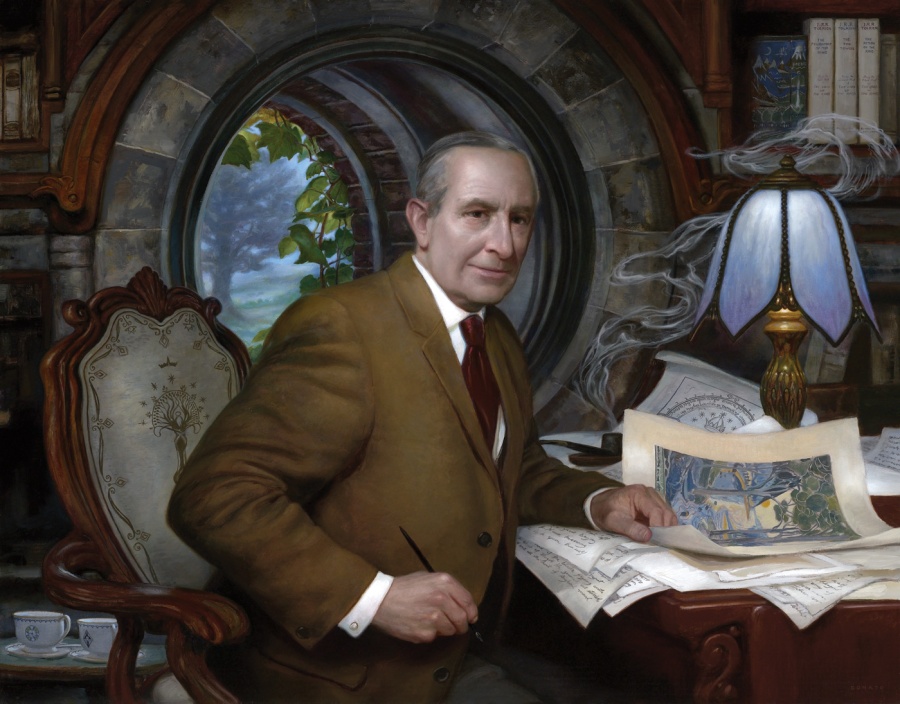
I want to thank Donato Giancola for allowing me to use his stunning portrait of J.R.R Tolkien as the featured image for this project. If you would like to purchase print of this painting, they are available on his website!

If you would like to contribute your own experience, you can do so by using the form on the contact page, or by emailing me directly.

Now, on to Druidsfire’s responses:


How were you introduced to Tolkien’s work?

When I was in single digits, we were assigned The Hobbit in Literature/English class. After reading it and falling in love with the dear old Hobbit and his love of maps, I found that there was a sequel trilogy, and was delighted that my favorite author Peter S. Beagle had done the foreword for it. Because Beagle’s own work was so influential in my life at the time, his ‘vouching’ for Lord of the Rings ensured I’d read it. And I never looked back.

2. What is your favorite part of Tolkien’s work?

“Elves, sir!” It’s Tolkien’s fault that any time I play a game where Elves are a playable race, my main is always an elf. The worldbuilding and the history is second to none.

3. What is your fondest experience of Tolkien’s work?

I’ve been a 12-year player of Lord of the Rings Online, so my fondest experience is getting to actually play in Middle-earth and inhabit this world I love so much on a daily basis. A couple of years ago, the game progressed in the story to the end of the Ring, and some months previous to that expansion’s release, I had the opportunity to interview some of the developers from Standing Stone Games, the studio that makes LotRO. I’d asked their primary story designer Jeff ‘MadeofLions’ Libby how they would handle that iconic and singular moment. One of the game’s features is called ‘session play’, where the player steps outside their own character to play through a short sequence as another character that their own couldn’t be present. They’d used this for things like players getting to witness the taking of the Oath with Isildur at the Stone of Erech, the first meeting of Gandalf and Aragorn, and even the breaking of the Fellowship and the fall of Boromir.

I’d surmised that they would turn the end of the Ring sequence on its head and let the players go through the event as Gollum instead of Frodo or Sam… and I was right. They of course wouldn’t answer at the time so as not to spoil the surprise, but when I got to the event after the expansion was released months later, I had the privilege of being the first streamer to play through it on the game’s Twitch channel. And yes, I yelled, ‘I called it! I called it!’ After my stream, I contacted Libby through the game’s forums and enthused about how they handled that scene and having guessed their plan so long ago. He admitted that he’d actually been miffed that I’d called it way back then, but then said it meant that they’d made the correct choice when they designed that piece of iconic content. Being a part of that has meant so much to me, and it’s one of my favorite LotRO stories to tell.

4. Has the way you approach Tolkien’s work changed over time?

Yes indeed! Before, I was merely a passive reader or viewer of the various animated and movie adaptations. Now I play in LotRO, I support Professor Corey Olsen’s Twitch streams by moderating and archiving, and I’ve even played in a couple of tabletop games. I’ve grown beyond the little girl who was always sad to hear the name Gondolin into a middle-aged woman who knows the various histories of the lost city and feels even more sorrow at Maeglin’s betrayal, and yet hope, because there are works of the First Age which still survived until the end of the Third that even the malice of Morgoth and his armies couldn’t destroy.

5. Would you ever recommend Tolkien’s work? Why/Why not?

Absolutely! Sure, some folks might feel The Silmarillion is a bit dry compared to the other works, it’s still worthy to read at least once. And if one liked the Middle-earth works, they might be interested in trying some of the others.


For more Tolkien talk from Jean ‘Druidsfire’ Prior, follow her on Twitter or view her website!

Xavier Accart’s Experience –Tolkien Experience Project (63)

This is one in a series of posts where the content is provided by a guest who has graciously answered five questions about their experience as a Tolkien reader. I am very humbled that anyone volunteers to spend time in this busy world to answer questions for my blog, and so I give my sincerest thanks to Xavier and the other participants for this.

To see the idea behind this project, check out this page

I want to thank Donato Giancola for allowing me to use his stunning portrait of J.R.R Tolkien as the featured image for this project. If you would like to purchase print of this painting, they are available on his website!

If you would like to contribute your own experience, you can do so by using the form on the contact page, or by emailing me directly.

Now, on to Xavier Accart’s responses:


1. How were you introduced to Tolkien’s work?

In primary school, in 1981. I was a ten year old boy and our teacher proposed us to read The Hobbit.

2. What is your favorite part of Tolkien’s work?

The Lord of the Rings

3. What is your fondest experience of Tolkien’s work?

The reading of The Lord of the Rings in the years 1983-1984.

4. Has the way you approach Tolkien’s work changed over time?

Yes. I appreciated The Silmarillion at 15 or 16 years old. But now I can no longer read it. Perhaps because I know the real christian metaphysic.

5. Would you ever recommend Tolkien’s work? Why/Why not?

Yes, because it opens your mind and heart to very ancient and permanent truth. There is the invisible lamp of christian faith which shines inside, and also the light of an Universal Truth, and more precisely the Tradition of our European forefathers.


If you want to follow Xavier Accart, you can find him on Twitter!

Brad M’s Experience–Tolkien Experience Project (62)

This is one in a series of posts where the content is provided by a guest who has graciously answered five questions about their experience as a Tolkien reader. I am very humbled that anyone volunteers to spend time in this busy world to answer questions for my blog, and so I give my sincerest thanks to Brad and the other participants for this.

To see the idea behind this project, check out this page

I want to thank Donato Giancola for allowing me to use his stunning portrait of J.R.R Tolkien as the featured image for this project. If you would like to purchase print of this painting, they are available on his website!

If you would like to contribute your own experience, you can do so by using the form on the contact page, or by emailing me directly.

Now, on to Brad M’s responses:


1. How were you introduced to Tolkien’s work?

I was first introduced to J.R.R. Tolkien unknowingly as a very young child via the Rankin and Bass animated movies, though I must confess it made little if any impact. I found as an adult a children’s book that was an old book of the “turn the page at the tone.” Read-along books with an LP stuffed in a collection of my children’s books.

2. What is your favorite part of Tolkien’s work?

3. What is your fondest experience of Tolkien’s work?

My first real introduction was in 6th-7th grade. I had absolutely worn out my paperback copies of Chronicles of Narnia, and my mother took me to a small bookstore in my hometown to get a new book. The old gentleman behind the desk suggested The Hobbit. I spent the next three days eagerly devouring that and Rapidly followed with Lord of the rings. Silmarillion was next as I was desperate for anything written by The Professor.

4. Has the way you approach Tolkien’s work changed over time?

I read Lord of the Rings about once a year.

5. Would you ever recommend Tolkien’s work? Why/Why not?

I recommend The Professor to any student of Sci-fi/ Fantasy.

Dr. Sian Pehrsson’s Experience–Tolkien Experience Project (61)

This is one in a series of posts where the content is provided by a guest who has graciously answered five questions about their experience as a Tolkien reader. I am very humbled that anyone volunteers to spend time in this busy world to answer questions for my blog, and so I give my sincerest thanks to Dr. Pehrsson and the other participants for this.

To see the idea behind this project, check out this page

I want to thank Donato Giancola for allowing me to use his stunning portrait of J.R.R Tolkien as the featured image for this project. If you would like to purchase a print of this painting, they are available on his website!

If you would like to contribute your own experience, you can do so by using the form on the contact page, or by emailing me directly.

Now, on to Dr. Sian Pehrsson’s responses:


How were you introduced to Tolkien’s work?

By my father. He is a huge classic sci-fi and fantasy fan and as a preteen I was mowing through hiscollection of Norse mythology, Analog, Asimov and Anderson when Christmas rolled around and there under the tree was the Allen-Unwin complete boxed set with LOTR, The Hobbit, Tree and Leaf and Farmer Giles of Ham. I spent the break completely lost in Middle-earth, utterly entranced. It was 1977, Star Wars had just come out the spring before, and there was so much excitement about new worlds—new stories- fandom really taking off. A few short years later the BBC radio play came out and I fell in love all over again. Funnily enough my father had not read Tolkien himself at that point and when he borrowed mine, he decided it wasn’t his cup of tea. I still remember our huge discussion at the breakfast table about ‘high fantasy’ versus Moorcock. My mother and sister hid!

What is your favorite part of Tolkien’s work?

How much space do I have? I have always loved the layering of backstory—the sense of other Ages, places and adventures wound so seamlessly into present plot. LOTR and specifically TTT is my favourite, but I devoured the LOTR Appendices and Silmarillion and HoME and anything I could get my hands on, wanting to know more. There is always a sense with his writing that the story is a duck gliding placidly across a pond while underneath its legs are madly paddling.  He is also a master at describing scene and environment, and as an Earth Scientist that is instinctively very near to my heart.   My absolute favourite section is the moving discussion in The Two Towers where Faramir gives Frodo and Sam some lore of Gondor and Numenor and they discuss their interactions with the Elves and then Sam accidentally reveals Isildur’s Bane.  I was horrified to learn that JRR considered cutting more of it out and putting it in the appendices!   And every Christmas The Father Christmas Letters is set out on our coffee table, to reread for the delight of its story and art—a connection to the magic time in Childhood when we still believed and our now grown son did.  As someone who has mapped the Arctic its depiction of a hidden realm always makes me smile.

What is your fondest experience of Tolkien’s work?

My fondest experience actually came out of tragedy.   In 2007 our baby daughter died.  It was an utterly devastating experience and my friends at work were searching for a gift that could be something of a balm.  They went out and sought a prelease copy of The Children of Hurin knowing that JRR was my favourite author—and having no idea what the story was!   It was such a moving and kind act… I did read it a month or so later—transported for a little while out of my own world.

My second fondest experience was discovering that one of our post-doctoral fellows was also a fan and had put up a meme of Boromir (One does not simply do Structural Geology) on his office door!  Of course I had to respond in kind.  Our hallway is slightly plastered with Rangers now… quite fitting for a team that spends long periods in the wilds.

Has the way you approach Tolkien’s work changed over time?

Absolutely.  As a teen I read it purely as transportation and entertainment.  Now as an adult I read it much more critically, intrigued to understand more of how he pulled the threads together, fascinated by how profound changes in science, culture, and politics through the start of the 20th century influenced even obliquely parts of his works.  Diving into scholarship on the philological, cultural and thematic aspects is a growing pleasure.   Coming back to Tolkien after a lifetime of science writing I am also fascinated with how many scientists are fans and how they interpret everything from Tectonics to Climate to Astrophysics for ME.  My favourite piece is Erik Klemetti’s rheological analysis of how Gollum would have bounced off the surface of the circulating lava lake at Sammath Naur.  Before bursting into flame.   And there might or might not be an exploration of the geological evolution of ME on my harddrive….

Would you ever recommend Tolkien’s work? Why/Why not?

Yes.  And I have many times over the years.   From a purely historical standpoint, it is the legendarium that launched a thousand copycats (Sword of Shannara anyone?) and laid the foundation for modern works like The Game of Thrones to enter the popular mainstream. I always encourage those who enjoyed GOT and Jackson’s movies to read the books—and they are always surprised how much more there is to love! As someone said there is more going on in a single JRR paragraph than in most author’s entire books.  If only I had a dollar for every time a surprised friend (with gentle encouragement) dipped a toe into The Silmarillion only to find themselves lost!  More fundamentally his works can be read on many levels and hence there are few keen readers that cannot find something to like therein.  I have found some inclined to not move on from Fellowship to The Two Towers–the pacing in the first book is quite different from the latter two—but perseverance pays off.

There is also a noticeable generational shift in attitudes toward his work.  Middle-Aged friends still have that unfortunate ‘genre writing is less serious’ attitude and may not pick it up whereas GenY and youth of my son’s age are quite unabashed about fandom of any sort—books, movies, comics–it’s refreshing.  I caught my son telling a buddy that I could give Stephen Colbert a run for his money in a Tolkien quiz.  He was proud of it—not embarrassed–that is huge change.

Troels Forchhammer’s Experience–Tolkien Experience Project (60)

This is one in a series of posts where the content is provided by a guest who has graciously answered five questions about their experience as a Tolkien reader. I am very humbled that anyone volunteers to spend time in this busy world to answer questions for my blog, and so I give my sincerest thanks to Troels (or Parmakenta) and the other participants for this.

To see the idea behind this project, check out this page

I want to thank Donato Giancola for allowing me to use his stunning portrait of J.R.R Tolkien as the featured image for this project. If you would like to purchase a print of this painting, they are available on his website!

If you would like to contribute your own experience, you can do so by using the form on the contact page, or by emailing me directly.

Now, on to Troels Forchhammer’s responses:


How were you introduced to Tolkien’s work?

I honestly do not remember how I was first introduced to Tolkien’s work.  I do remember hearing of Tolkien’s death, which was less than two months before my seventh birthday, and I suspect that I had been reading The Hobbit by then (or had had it read aloud to me, though I would have been able to read it myself at that point).

Otherwise, my first certain memory is getting a set of Danish book club paperback editions of The Hobbit, The Lord of the Rings, and The Silmarillion for my eighteenth birthday. I still have those books – particularly my  The Lord of the Rings volumes are now in tatters because I read them again and again, but they have a place on my shelves.

My second introduction to Tolkien was by way of student colleague with whom I did a project for Computer Science at Uni. We met at his place for our work, and he had an English set of The Lord of the Rings that I borrowed.  Reading that, I realised how much richer was the language and story in the original, and I was completely enchanted. The decade following that, I usually had at least one Tolkien book in English on loan from the public library in Copenhagen – then I bought my own first English edition just before the turn of the millennium: A nice Houghton-Mifflin hardback with large folding maps and Alan Lee illustrations on the dustwrapper.

What is your favorite part of Tolkien’s work?

I do not think that I can specify a single favourite part of Tolkien’s work – it is something that is depends on the situation, my mood, the purpose …

In some ways, my favourite part is Ulmo’s appearance to Tuor at Nevrast … his speech sends chills down my spine every time!

Or the Smith essay … “the love of Faery is the love of love” …

Or the alliterative poetry …

“Tide was turning.   Timbers broken,

dead men and drowned,   a dark jetsam,

were left to lie   on the long beaches;

rocks robed with red   rose from water.”

Or his description of Secondary Belief in On Fairy-stories which is the most precise description of my own reading experience that I know of.

Or the host praising Frodo (and Sam) at the Cormallen … brings tears to my eyes every time.

I do have some less favourite parts … the long Lay of Leithian in rhyming couplets is something I find impossible to read for more than 5 or 10 minutes at a time (making it quite an effort to get anywhere in that text). I also find that The Hobbit is one of my less favoured parts of Tolkien’s work, whereas The Lord of the Rings is definitely among my most favoured parts.

What is your fondest experience of Tolkien’s work?

My fondest experience of Tolkien’s work is another of those questions with many contending experiences.  That first reading of The Lord of the Rings in English would count very high, as would the gradual discovery of the depth of the text and of other texts – discovering passages so beautiful that the sheer beauty of the language brings tears to my eyes, or passages so intricate and dense with ideas that unravelling them is a great puzzle.

My first encounters with good Tolkien criticism – Tom Shippey and Verlyn Flieger – are other very fond experiences. As a physicist, Tom and Verlyn have been instrumental in opening up for me new ways of looking at a text.

But perhaps the fondest experience has been the slow and gradual piecing together of many passages and other bits of information to produce an understanding of Tolkien and his work as he and it evolved throughout his life.

Has the way you approach Tolkien’s work changed over time?

The way I approach Tolkien’s work has changed quite a lot and many times.

The first change was brought on by reading The Lord of the Rings in the original language.  The Danish translation is decent enough, and the story is, in and of itself, sufficiently captivating that I have read my first copy to tatters, but it does somewhat reduce the richness of the language, and suddenly getting this full range of tones and colours was, to me, far more significant than moving from black &white TV to colour TV (which we did in my youth).  What are mere images to the beauty that is the written word!

For a number of years I looked at Tolkien’s world, desiring to know every knowable detail about this sub-creation. This was very much spurred on by joining the on-line Tolkien community around the turn of the millennium, and I started to read Tolkien’s other works to understand this world: Unfinished Tales and The History of Middle-earth took me to another level, and I understood that the idea of a single “true” conception of Middle-earth is in and of itself a fallacy – a dangerous fallacy that obscures the nature of Tolkien’s legendarium.

Encountering proper criticism from the likes of Tom Shippey and Verlyn Flieger has changed my approach once more. Their desire to explore and understand the links between author, sub-creation, and text highly is contagious to me, later adding the context of the author (social, historical, physical, literary, etc.) to the mixture.  The reader, however, does not really interest me – for me, the reader is only interesting as a source of errors to be eliminated (it may seem paradoxical that I nonetheless contribute here, but the fact that I am uninterested in the topic does not mean that I do not consider it a worthy topic of academic research – I merely insist that it is not a study of Tolkien).

Would you ever recommend Tolkien’s work? Why/Why not?

I do not generally offer recommendations unless asked for them, but I would obviously gladly recommend Tolkien’s work to people whenever I have reasons to believe that they would enjoy it.  I am careful to not recommend it to people whom I think would not enjoy it, and I tend to respect people for reacting negatively to Tolkien’s work – it is their right to find his work unbearable.

I am perfectly happy to tell people about my own passion for Tolkien, and (when they pretend just the tiniest interest 😉 ) shower them with information, but I hesitate to recommend Tolkien’s work unless they ask for recommendations (where to start, what to read next, etc.) – I am careful not to presume that others will like something that I like, even if we have other things in common.

For children, I would probably recommend Astrid Lindgren before Tolkien – not because Tolkien’s children’s books are bad, but because Lindgren in my honest opinion was far superior to Tolkien as a writer for children (here I have the advantage of being able to read both authors in their original language). Also, unfortunately neither of the Danish translations of The Hobbit is particularly good.


For more from Troels, you can follow the blog on his website, Parma-kenta!

Tolkien 2019 Announcement

Hello friends, I wanted to share some exciting news with you.

I will be attending the Tolkien 2019 conference in Birmingham, England this August!Tolkien-2019-logo

I will be presenting a paper entitled “The Lord of the Rings, Young Readers, and Questions of Genre”. I would love for anyone interested in my research to attend!

I am very much looking forward to meeting up with friends and colleagues, as well as participating in the largest event ever hosted by the Tolkien Society!

If you would like more information, the event staff have posted a full schedule of events!

Sue Bridgewater’s Experience–Tolkien Experience Project (59)

This is one in a series of posts where the content is provided by a guest who has graciously answered five questions about their experience as a Tolkien reader. I am very humbled that anyone volunteers to spend time in this busy world to answer questions for my blog, and so I give my sincerest thanks to Sue and the other participants for this.

To see the idea behind this project, check out this page

I want to thank Donato Giancola for allowing me to use his stunning portrait of J.R.R Tolkien as the featured image for this project. If you would like to purchase a print of this painting, they are available on his website!

If you would like to contribute your own experience, you can do so by using the form on the contact page, or by emailing me directly.

Now, on to Sue Bridgewater’s responses:


How were you introduced to Tolkien’s work?

At University in the late sixties, I made some very good friends who have stuck with me for 50 years. One of these, during a conversation about what we had all read before we became official students of Literature and Language, turned an astonished gaze upon me and cried ‘What do you mean, you haven’t read The Hobbit?’

So I put off buying whatever set text I should have bought for a while, and bought The Hobbit. Fell in to it and disappeared for a while.  Came out and read The Lord of the Rings (I still got my required essays written, though they were rather a nuisance.)

And so it went on – and so it goes on.  New Tolkien text appears; I buy it, read it, cherish it. What would have happened if I’d fallen in with a different group of friends is something I try not to imagine.

What is your favorite part of Tolkien’s work?

I’m not keen on ‘favourite’ questions – each of Tolkien’s works, whether fiction or scholarly, has its own tones and nuances and qualities which need to be appreciated for themselves.  Over the years, I have when pushed begun to say that my favourites are Smith of Wotton Major and Leaf by Niggle; however, all the others are my favourites too!

What is your fondest experience of Tolkien’s work?

The many times I have been moved to tears reading or re-reading key passages: Thorin’s death; Frodo’s ‘I will take the ring’; the fall of Gandalf; ‘joy beyond the walls of the world, poignant as grief;’ and many others.

Has the way you approach Tolkien’s work changed over time?

Yes, as I have read more of his works, and more (and more) of the writings about him and his work, I have learned to understand how sub-creations affect us, that my tears were and are expressions of recovery, escape and consolation. When re-reading, I’m not looking at the works in that assessing kind of way, but do draw more from them as a reader because of my deeper understanding.  I’ve also written and had published a few articles about Tolkien’s work, and turned to writing my own sub-creative fiction.

Would you ever recommend Tolkien’s work? Why/Why not?

Yes, but not to everyone I know. You can’t make everyone over into copies of yourself, and ‘Fantasy’, speculative fiction, is not for everyone. Although everyone needs their own roads to recovery, escape and consolation, we have to accept that we can’t force people to like everything we like.  I’m happy to be in touch with fellow Tolkienists across the world and to share our pleasure in Tolkien; that’s a joy within the walls of the world, and a light when all other lights go out.


For more from Sue, you can follow the blog on her website!

LotRFI–Signing Off

Hello everyone,

I just wanted to add a postscript to this project thanking you all for joining me on this fun journey to reconstruct my first reading of LotR! If you want to revisit any of my First Impressions series, you can see them all listed at the index page.

This series is over, and I am planning a little hiatus while I work on completing my PhD dissertation on Tolkien! Don’t be sad, though, because I have two important announcements to share with you!

First, I will continue to post the Tolkien Experience Project over the hiatus. Second, I am already contemplating what my next series of posts will be. So you will still have weekly content from the blog, and even more will follow soon!

Thanks again for supporting me in my journey to explore how many readers respond to and interact with Tolkien!

Trevor Bowen’s Experience–Tolkien Experience Project (58)

This is one in a series of posts where the content is provided by a guest who has graciously answered five questions about their experience as a Tolkien reader. I am very humbled that anyone volunteers to spend time in this busy world to answer questions for my blog, and so I give my sincerest thanks to Trevor and the other participants for this.

To see the idea behind this project, check out this page

I want to thank Donato Giancola for allowing me to use his stunning portrait of J.R.R Tolkien as the featured image for this project. If you would like to purchase a print of this painting, they are available on his website!

If you would like to contribute your own experience, you can do so by using the form on the contact page, or by emailing me directly.

Now, on to Trevor Bowen’s responses:


How were you introduced to Tolkien’s work?

I stumbled upon a copy of The Hobbit in my primary school library when I was 10 years old. I can still remember the way my heart jumped and my intrigue was kindled, when I first opened the book and saw the enchanting inside cover. There was strange symbols I was later to learn are called runes, indecipherable points of the compass, and references to spiders, a Lonely Mountain and a Long Lake! And who were Thror and the Elvenking, and just what is a Great Worm? As I started to read, I quickly realized here was an adventures to be had; here was an escape from the everydayness of school and home life: here was a land I could travel to in my imagination and explore. The Hobbit whetted my appetite for my discovery of Tolkien’s trilogy which I savored with the same interest and enthusiasm. I traveled to many other imaginary lands in my younger years, and beyond our galaxy when I was a teenager. But I have always returned to Middle-earth, and still do.

2. What is your favorite part of Tolkien’s work?

I find it fascinating the way Tolkien created a mythology with a timescale spanning eons. There are creation stories, ancient chronicles, a fragmented antiquity of familial and tribal histories of amazingly nuanced detail and background. The magnitude of these annals is incredible in itself, and I find the depth and complexity of his storytelling throughout the ages compelling to read. It is wonderful the way these subtle through-lines, originating in earlier ages, are embedded within the well-known stories of The Hobbit and Lord of the Rings. I particularly enjoy reading the “Ainulindalë” and the way music themes are incorporated into the building of the Eä and Arda.

3. What is your fondest experience of Tolkien’s work?

I have read some of Tolkien’s works to groups of children, in particular The Hobbit. I have been quite surprised and reassured that children still enjoy having stories read to them, even though they have grown up in a world with so many exciting forms of digital entertainment. I realized for the first time that reading a text aloud is so much different from reading a story in your head. I had read The Hobbit many times previously, but in reading the story aloud, I experienced a different appreciation in how Tolkien crafted words and created imagery. In many of the children’s eyes, I could see that spark of attentiveness and interest that told me they had tasted something of the magic of Tolkien’s writings.

4. Has the way you approach Tolkien’s work changed over time?

Over the years I have progressed from being a ‘recreational’ reader of Tolkien’s writings enjoying regular re-readings of my favorite texts, to a more scholarly approach. Now there is a longing to dig deeper into his life and background, and to explore the expansive detail of his legendarium. I thoroughly enjoy delving into much of Christopher Tolkien’s History of Middle Earth, Tolkien’s minor works and the range of other texts published since the Professor passed away. I have put together a treasured collection of biographies, essays and reference books all Tolkien related. I enjoy following an element of his legendarium, exploring the languages created, cultures and creatures and the multitude of layers that go into making up his fascinating sub creation.

5. Would you ever recommend Tolkien’s work? Why/Why not?

Yes, I would. I think other people deserve to be exposed to stories that are both enthralling and entertaining at a heartfelt level, and challenging in the moral and cognitive sense. Reading Tolkien’s works often affect me emotionally and intellectually. I appreciate what he wrote in the preface to The Lord of the Rings: “applicability to the thought and experience of readers”. As a writer he gives the reader freedom to apply the outcomes you think and feel from reading his works to your own life. To me, there is much truth and encouragement in Tolkien’s work that can be supportive of a positive and fulfilling life of any reader.


For more Tolkien talk from Trevor Bowen, follow the Melbourne Tolkien Smial on Facebook!

LotRFI Pt60–The Last Word

‘Well, I’m back’ (RK, VI, IX, 1031).

Seriously, that is the end?!?

I was incredulous and underwhelmed. After such a lengthy and grueling journey, in which I had left so many characters and experiences behind, I expected, nay deserved, more! I was flabbergasted that this was the end to such an epic quest. After the shock of this ending passed, my mind began creating a number of endings that I thought were more suitable for the story.

im-back_orig
Image copyright New Line Cinema

Perhaps the three remaining hobbits ride out together on more adventures. They revisit Bombadil and purge the evil from the Barrow Downs. Perhaps they go back to Bree and set the record straight about the Rangers. My mind was racing because I could not settle for the ending I was presented with.

This was probably a major contributing factor for why I didn’t read the appendices. I was so let down by this ending that I walked away and entered into my own imagination to change it. I have subsequently realized that I would have undoubtedly been upset by any ending to the story, and that all of my own ‘endings’ were really an attempt to extend the story, even into a sequel. Indeed, it is probably because I did not read the appendices that my own imagination took flight into different stories. Had I read them, I probably would have been re-grounded in Middle-earth and the background of LotR instead of trying to extend the story in my own direction.

What Do You Think?

How did you react to this final line?
Did you go on to read the appendices?
Did I miss anything? Let me know!