An Open Letter to Christopher Tolkien on His 95th Birthday

An open letter to Christopher Tolkien:

Dear sir,

I wanted to share something with you on this day of special magnificence, your ninety-fifth birthday. For more than a year, I have asked for fans of your father’s work to send me their story for a series I call the Tolkien Experience Project. I ask a few questions for each participant to answer, and, in doing so, they share how they learned about J.R.R. Tolkien, what they love about his writing, how his writing has influenced their life, and how their approach to his texts has changed over time.

I wanted to make you aware of this project today especially. If you have the chance to read through some of the entries, you will find that many of the participants express gratitude for your father’s work and for your own. Your seemingly tireless dedication to editing and publishing texts and notes has influenced the lives of thousands. I know that this small sample does not do justice to the breadth and depth of Tolkien readers (both your father’s and your own), but maybe, just maybe, reading one or two will bring you a small bit of happiness on this, your birthday.

To see the project, you can go to: https://luke-shelton.com/tolkien-experience-project/

I would like to say happy birthday and sincerely thank you for all you have done to shape our understanding of your father’s work, of fantasy writing, of the creative process, and of Old English texts.


Sincerely,

Luke Shelton

Ed Strietelmeier’s Experience–Tolkien Experience Project (80)

This is one in a series of posts where the content is provided by a guest who has graciously answered five questions about their experience as a Tolkien reader. I am very humbled that anyone volunteers to spend time in this busy world to answer questions for my blog, and so I give my sincerest thanks to Ed Strietelmeier and the other participants for this.

To see the idea behind this project, check out this page

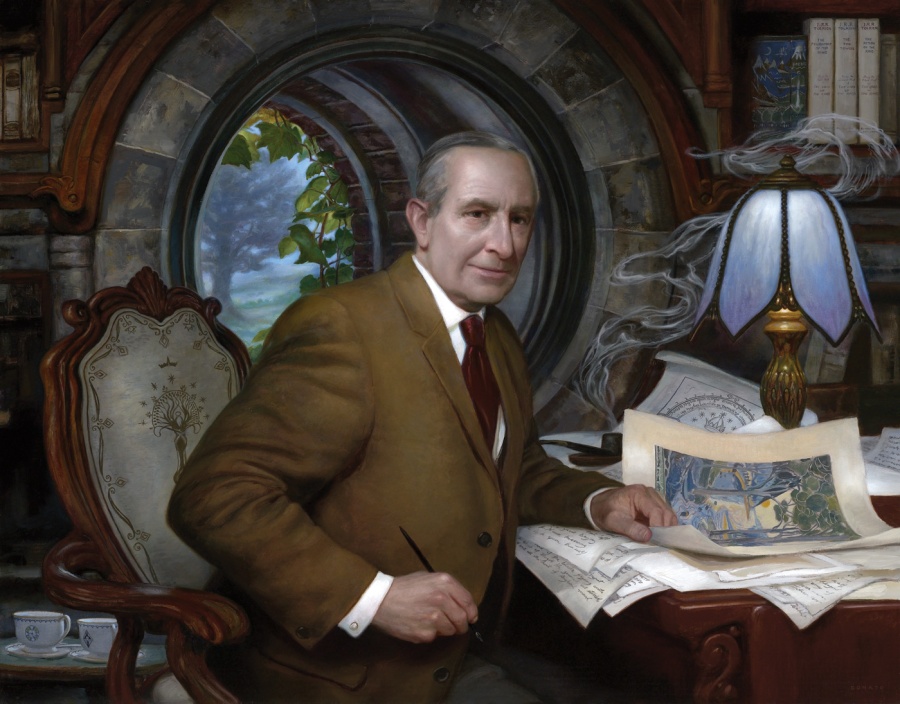
I want to thank Donato Giancola for allowing me to use his stunning portrait of J.R.R Tolkien as the featured image for this project. If you would like to purchase a print of this painting, they are available on his website!

If you would like to contribute your own experience, you can do so by using the form on the contact page, or by emailing me directly.

Now, on to Ed Strietelmeier’s responses:


1. How were you introduced to Tolkien’s work?

I was first introduced to Tolkien when my father read The Hobbit to me as a bedtime story while I was in elementary school in the 1980s. Along with The Chronicles of Narnia, The Hobbit became absolutely foundational in my psyche and worldview. It was as if I was both “walk[ing] in legends [and] on the green earth in the daylight” to paraphrase the Rider of Rohan as he speaks to Aragorn in The Two Towers.

I was also introduced to the Rankin Bass Hobbit and Lord of the Rings cartoons as well as the Ralph Bakshi Lord of the Rings while I was a kid. Looking back I cringe at so many aspects of those films, but at the time they really captured my imagination and made me love the stories even more. In a way they were like the silly figure of the Fairy Queen that Nokes put on the Great Cake in Smith of Wootton Major. To paraphrase the Fairy Queen, “Better a little [movie], maybe, than no memory of Faery at all. For some only a glimpse. For some an awakening…”

It was not until junior high that I read the Lord of the Rings myself, using my father’s old Ballantine paperback copies, which have since simply fallen apart! It was a long read for me at that age, but completely worth it.

2. What is your favorite part of Tolkien’s work?

There are so many to choose from! If forced to pick, I’d say the sequence in The Return of the King that begins with Chapter IV, “The Siege of Gondor” and ends with Chapter VI “The Battle of the Pelennor Fields.” These chapters have just about anything you could want.

All of the important parts connect to create a truly remarkable experience: The sense of impending doom that hangs over Minas Tirith jumps off the page and makes the moment when the cock crows and the horns of the Rohirrim call out so amazing. Reading about the Ride of the Rohirrim makes you feel like you are going along with them, on the way to Mundburg. The moment when Theoden sees the city under siege, slumps, but then gathers himself with the change of wind and the sound of the gate collapsing is Tolkien’s blending of providence and free will in microcosm. Eowyn and the Witch King.

Ultimately the moment when Eomer defies the Black Ships only to see the flag of Gondor and the arrival of Aragorn is the culmination of the entire experience. This moment is so powerful it’s hard to describe. But, even with all of that excitement and glory, you still are reminded of all those who fell and the loss that went into this miraculous victory. Simply amazing.

3. What is your fondest experience of Tolkien’s work?

My fondest experience has been reading The Hobbit to my oldest daughter (age 8 at the time). I watched her laugh out loud during the unexpected party, get scared at Gollum’s chapter, and wish she could live in Beorn’s house with his animals. She even drew her own version of Thror’s map and gave it to me.

At the end of the book we had a really thoughtful conversation about the “dragon sickness” and who really deserved the treasure in the Lonely Mountain. She could see how both the dwarves and the Lake Men had a claim but didn’t really see how the Elf King fit into the equation (which is a fair point!). In the end, she was just glad they found a way to work together. It has been one of my happiest experiences as a parent to date.

4. Has the way you approach Tolkien’s work changed over time?

Yes. I have been a Tolkien fan since childhood, but my interest rose to a whole new level in 2013 when I began listening to the Tolkien Professor Podcast. Corey Olsen’s lectures opened up a wider and deeper understanding in Tolkien’s works for me. His “Silmarillion Seminar” helped me to finally read The Silmarillion and understand it for the masterpiece that it is. Now I am able to see the wisdom, depth, and significance in Tolkien’s words in a new way.

I had read Tolkien’s various works sporadically over the years, but since listening to the Tolkien Professor as well as the Prancing Pony Podcast I’ve been reading the “Legendarium” annually. I’m a Lutheran pastor and my annual reading connects with the liturgical, or church, calendar. I read The Hobbit during the Christmas Season (12 days), The Silmarillion during the Season of Epiphany (January 6th to whenever Ash Wednesday arrives), and then The Lord of the Rings during Lent (40 days, plus Sundays). I’ve done this for the past 5 years: it’s been challenging but overwhelmingly rewarding.

5. Would you ever recommend Tolkien’s work? Why/Why not?

Would I?!?!? I’ve been handing used copies of Lord of the Rings to friends for a few years now! As a pastor and preacher, Tolkien quotes and themes find their way into my sermons regularly (although I try to no “over-do” it). His themes of escape, recovery, and the consolation of the happy-ending (eucatastrophy!) have crept into my way of seeing the world. Tolkien’s works have helped me recover a sense of wonder in our own world, which I have attempted to share with my two daughters. I hope they can carry that forward into their own lives.

I find that Tolkien’s works get at some of the central aspects of life and faith: providence, grace, the importance of mercy, the humbling of the strong and the rise of the weak, the sense of loss and sadness that so many people experience, bravery in the face of impossible challenges, and so much more. Tolkien’s works have helped so many people deal with their sadness and the losses they have suffered, I feel like his books can provide comfort and hope for people facing “the Shadow.”

Anne-Laure J.’s Experience–Tolkien Experience Project (79)

This is one in a series of posts where the content is provided by a guest who has graciously answered five questions about their experience as a Tolkien reader. I am very humbled that anyone volunteers to spend time in this busy world to answer questions for my blog, and so I give my sincerest thanks to Anne-Laure J. and the other participants for this.

To see the idea behind this project, check out this page

I want to thank Donato Giancola for allowing me to use his stunning portrait of J.R.R Tolkien as the featured image for this project. If you would like to purchase a print of this painting, they are available on his website!

If you would like to contribute your own experience, you can do so by using the form on the contact page, or by emailing me directly.

Now, on to Anne-Laure J.’s responses:


1. How were you introduced to Tolkien’s work?

I was given The Lords of the Rings when I was about 11 and got hooked

2. What is your favorite part of Tolkien’s work?

My favorite book is The Silmarillion and within it my favorite part is the fall of Gondolin. When I read the book that was recently published which details the evolution of the story, it strengthened my preference for this part. It embodies the whole of Tolkien’s universe : love, treason, death, grief, valor, high deeds.

3. What is your fondest experience of Tolkien’s work?

I spent one week with the most knowledgeable Tolkien specialists of France (and Adam Tolkien came too !) in a castle in Normandy in 2012. While I am usually isolated in my « geekness », it was great to meet fans and experts and delve into the specifics of Tolkien’s work.

I also spent one month in 2010 in New-Zealand to visit all the locations where the filming took place : Hobbiton (Matamata), Edoras (Mount Sunday), Dimholt Road (Putangirua Pinnacles), Mt Doom (MT Ngauruhoe), etc. It was breathtaking. One may agree or disagree with the way the movies were made but one thing is for sure : New Zealand is what Middle-earth would have looked like.

4. Has the way you approach Tolkien’s work changed over time?

No, I don’t think so. I still feel the same pleasure I felt when I first discovered The Lord of The Rings. Every time I reread one of the books, I discover something new.

5. Would you ever recommend Tolkien’s work? Why/Why not?

I can not recommend it enough. Sadly none of my friends/family are into it.

It has brought so much joy to me to discover this world that I want everybody to be able to benefit from it.


For more from Trotter, you can find her on Twitter!

Trotter’s Experience–Tolkien Experience Project (78)

This is one in a series of posts where the content is provided by a guest who has graciously answered five questions about their experience as a Tolkien reader. I am very humbled that anyone volunteers to spend time in this busy world to answer questions for my blog, and so I give my sincerest thanks to Trotter and the other participants for this.

To see the idea behind this project, check out this page

I want to thank Donato Giancola for allowing me to use his stunning portrait of J.R.R Tolkien as the featured image for this project. If you would like to purchase a print of this painting, they are available on his website!

If you would like to contribute your own experience, you can do so by using the form on the contact page, or by emailing me directly.

Now, on to Trotter’s responses:


1. How were you introduced to Tolkien’s work?

My teacher in 1973, read The Hobbit, one chapter per week, to my class, I was six years old at the time and loved the book. I spent my Christmas gift money in 1978 on a paperback copy of the UK Lord of the Rings, and a paperback copy of the UK Silmarillion, which had been first released in Hardback the year before. A couple of years later I noticed that my paperback Lord of the Rings was not as useful as the Hardback editions, the maps were not good and only one Appendix was included.

That started me down the route of collecting Tolkien’s books.

2. What is your favorite part of Tolkien’s work?

UK Hobbits

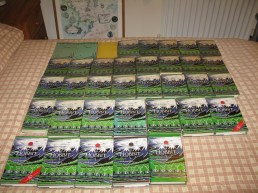
I have to go for The Hobbit, I own the first 40 UK hardback impressions of this book, plus quite a few more copies, and this is my favourite book by my favourite author. I love the whole book, but Riddles in the Dark is my favourite chapter.


3. What is your fondest experience of Tolkien’s work?

For me, it is Tolkien saying that “I cordially dislike allegory in all its manifestations, and always have done so since I grew old and wary enough to detect its presence.” And then reading Leaf by Niggle, which is a wonderful allegory about the Professor. Leaf by Niggle is very underrated, and I urge everyone who is interested in Tolkien to read this wonderful short story.

4. Has the way you approach Tolkien’s work changed over time?

Yes, as a Tolkien book collector I have collected items, that non collectors may not have read or seen. I love having items that Tolkien was personally involved with, my precious is a 1968 1st UK paperback one volume edition of The Lord of the Rings, that he signed.

5. Would you ever recommend Tolkien’s work? Why/Why not?

Have to say that I am struggling with this question, would anyone not recommend Tolkien’s work?
Absolutely I would recommend Tolkien’s work. He is still the number one fantasy writer, and it would be very difficult for anyone to claim his crown.
I’d love to be able to reread The Lord of the Rings again for the first time, like I did in 1978, that would be fantastic.


For more from Trotter, you can find him on Twitter or on Tolkienguide.com where he uses the same screen name!

Reading Questions for Dracula by Bram Stoker

Welcome to the spookiest time of the year!

dracula-between-myth-and-reality

Last year I lead a local book group through reading Dracula by Bram Stoker and had a blast! I thought that this year I would share some of the questions I used to prompt discussion among group members! I hope you enjoy the questions and that they make you want to revisit the book! I would welcome any discussion that they inspire!

(Note that Dracula is written in the format of an epistolary novel–a book made up of a collection of letters–and so each chapter will contain several letters.)

Things to think about from chapters 1 & 2:
–What indications do the locals give to Jonathan that his travels may end poorly?
–How does Jonathan respond to these indications? Why?
–How would you describe the appearance of castle? Who lives in the castle?
–Pay close attention to the description of Dracula. How is it similar to your expectations? How is it different?

Things to think about from _Dracula_ chapters 3 & 4:
–How much of Dracula’s family history is really his family history, and how much is his personal history?
–The scene at the end of chapter three is one of the most famous from the story. What does it tell us about other vampires? What does it tell us about Dracula?
–Harker is finally able to piece together all of Dracula’s plans. Does he get them right? What does he leave out or get wrong? Pay attention to these kinds of questions as you keep reading. Remember the Neil Gaiman quote, none of the narrators have all of the facts, so we have to work with what they give us.
–How is the end of chapter 4 enhanced because we are reading Harker’s journal?

Things to think about from _Dracula_ chapters 5 & 6:
–There is a dramatic shift in the narrative in chapter five. We suddenly start hearing multiple narrators. Each person who writes will be an important character in the story, so remember who is who. Their writing helps to develop their characters!
–We hear from women for the first time in the story. How does Stoker define their roles in society and relationships here? Do they accept those roles or push against them?
–Whitby is a city on the northeast coast of England (in Yorkshire). A lot of chapter 6 takes place here. Why is it dangerous for Lucy to sleepwalk? (PS. if you don’t understand every word of Mr. Swales, that’s okay! Just try to get the general idea!)
–Dr. Seward seems very preoccupied with his latest patient in this chapter. Why is Renfield important in this part of the story?

Things to think about from _Dracula_ chapters 7 & 8:
–The captain’s account of the ship’s voyage is haunting. Are his rationalizations of what is going on throughout his account believable?
–Mina begins to log Lucy’s illness. What seems to influence when Lucy feels ill or when she seems better?
–We glimpse back to Seward and Renfield again: Renfield escapes and goes to meet his master. How does he know that his master is there? How does this affect him?
–Okay, time to take stock: by the end of chapter 8, what powers have we seen Dracula use?

Things to think about from _Dracula_ chapters 9 & 10:
–The arrival of Van Helsing! This character has seen almost as many appearances in popular culture as Dracula himself. Pay close attention to what he actually looks like and how he acts.
–The end of chapter nine is a good place to take inventory of the cast of the story. All of the important characters have been introduced and their relationships to one another are set, though they will continue to change a bit.
–Blood transfusion was a relatively new concept at the time _Dracula_ was written. Whether or not blood typing was an understood science, it is clear that Stoker was uninformed about it. This is just one of the things we will have to accept in order to get into the story.
–We know a lot more about Lucy’s illness than any of the other characters. Remember, none of them have read Harker’s journal! When does Van Helsing suspect something unnatural? Why doesn’t he tell Seward of his suspicions immediately?

Things to think about from _Dracula_ chapters 11 & 12:
–We have already seen things ascribed to fate/chance/luck. That will continue throughout the story. How does this idea relate to the religious theme in the story?
–When we see the zookeeper is interviewed by the newspaper reporter, it is one of several times where Stoker portrays a difference in class between two characters in some very overt ways. What kind of social commentary does Stoker make in this interaction? What other places do you see different classes interacting?
–A change comes over Lucy after the tragic night. She seems more solid when asleep and more ethereal when awake. What does this change mean? Why is it described in this way?
— At the end of 12 there is no doubt that Van Helsing suspects that Lucy’s death is not the end of the ordeal. Yet he still does not tell anyone else what he suspects. Why? Perhaps more importantly: is he right to do this?

Things to think about from _Dracula_ chapters 13 & 14:
–Van Helsing tells Seward he wants to mangle Lucy’s body. Is it believable that Seward would agree to this without knowing why?
–The stories of the ‘bloofer lady’ start to spread in the Hampstead area of London. Who does this lady attack? Why?
–Jonathan sees Dracula in London and hasn’t slept well since, so Mina decides to read his journal. What are her reactions like?
–Mina and Van Helsing begin to add up all of the pieces. How does this change Van Helsing’s approach to Lucy/Dracula? How does it impact Mina and Jonathan?

Things to think about from _Dracula_ chapters 15 & 16:
—Van Helsing finally starts proving his suspicions to Seward. What kind of evidence does he present and how receptive is Seward to his theories?
–Van Helsing uses sacramental/spiritually significant items to keep Lucy in or out of her tomb. Why/how does this work?
–How is Lucy’s character different now from before?
–The group is about to prepare for an even bigger challenge. Pay attention to how their approach to confronting Dracula is different than their approach to confronting Lucy. Why?

Things to think about from _Dracula_ chapters 17 & 18:
–Pay close attention to the way the men treat Mina in these two chapters (look esp. closely at Van Helsing’s “man’s brain” comments). Do you think Stoker wants his readers to approve or disapprove of this treatment?
–The entire group shares notes. Who takes the lead in this part of the story?
–Mina meets Renfield. He is surprisingly polite, but warns her. Why does he warn her here? What is his purpose? What is the purpose to the story? Later he begs to leave but won’t say why. remember this section.
–The group meets to discuss Dracula and his powers. this is a good final place to take stock. Where have we seen each of the powers they talk about?

Things to think about from _Dracula_ chapters 19 & 20:
–The men go to investigate Carfax abbey. They only find some of the count’s boxes, how does this change their plans?
–Mina feels odd and has strange drams in her sleep. We have seen this before!
–Renfield is more erratic than ever, and then has a gruesome “accident”. Why does he die here and not later?
–By the end of the chapter, everyone is working on their own part of the plan to confront Dracula. How does this compare to what Van Helsing said at the outset: they would need to stick together and use all of their resources? How is it still true to his intent? How is it different?

Things to think about from _Dracula_ chapters 21 & 22:
–Renfield’s confession: is this the most sane we have seen Renfield? What is the difference between sanity and madness in this book?
–What is the purpose of the ‘baptism of blood’? Did Dracula baptize Lucy too? How do you know?
–What does Mina’s condition mean to her? To the others?
–The group plans to break into Carfax. Note the subtle critiques of classism that occur while they carry out this plan: what makes the plan seem respectable to others (like the locksmith or police)? what does this indicate about that kind of respectability?

Things to think about from _Dracula_ chapters 23 & 24:
–Remember that Mina’s ordeal is the worst thing going right now: who is reacting to it the worst? Who is bearing up pretty well?
–The confrontation at Carfax: victory? defeat? stalemate? You decide!
–Originally the group decided not to tell Mina what was going on. This decision led to her ‘baptism’ by Dracula. Now that Dracula can interact with Mina’s mind the group once again excludes her from their deliberations. How are these two exclusions the same? How are they different?
–Hypnosis was cutting edge science at the time (as was trepanning, phonographs, etc). How do the protagonists incorporate both new technology and old beliefs in their fight against Dracula?

Things to think about from _Dracula_ chapters 25 & 26:
–The group goes on a road trip! There is a lot of what some people might call ‘hurry up and wait’ in these chapters. How does the flow of the book change? Do you like this change?
–Mina is changing. What is different about the way she acts now as opposed to when she was first under Dracula’s influence?
–They take an account about Dracula’s arrival in Galatz. What elements of his arrival here are similar to his arrival at Whitby?
–Now the group splits up to chase Dracula in three different routes. How does the ‘compiled documents’ style of the book enable this? Do you like how the narrative jumps around here?

Things to think about from _Dracula_ chapter 27:
–How close is Mina to becoming a vampire?
–How do you like the pace of the ending?
–How do you like the results?
–The introduction I posted by Niel Gaiman suggests that Dracula may not be vanquished. What do you think?


I should also include a shout-out to to the fantastic close read seminar and adaptation discussion series that Mythgard Academy did a few years ago!

Christian S. Trenk’s Experience–Tolkien Experience Project (77)

This is one in a series of posts where the content is provided by a guest who has graciously answered five questions about their experience as a Tolkien reader. I am very humbled that anyone volunteers to spend time in this busy world to answer questions for my blog, and so I give my sincerest thanks to Christian and the other participants for this.

To see the idea behind this project, check out this page

I want to thank Donato Giancola for allowing me to use his stunning portrait of J.R.R Tolkien as the featured image for this project. If you would like to purchase a print of this painting, they are available on his website!

If you would like to contribute your own experience, you can do so by using the form on the contact page, or by emailing me directly.

Now, on to Christian S. Trenk’s responses:


1. How were you introduced to Tolkien’s work?

I first got to know Tolkien, as so many of my age did, through Peter Jackson’s The Fellowship of the Ring. One of my friends – I was in primary school at the time – told me he had won tickets to see a movie, would I like to come. Naturally I agreed and it turned out we went to see the first LotR movie – in a drive-in cinema of all places. The completely alien venue, combined with the otherworldy quality of the film meant: I was enchanted straight away.

For my next birthday, multiple friends – who at that time definitely arranged their birthday presents via our parents conferring – had decided to give me a copy of The Hobbit, so I actually ended up with two copies. And I remember very clearly reading Der Herr der Ringe, the German translation of LotR in a bright-green paperback edition during the next summer holiday while my brother darted off to watch Germany play in the 2002 World Cup finals before then going to see the other movies as they were released.

2. What is your favorite part of Tolkien’s work?

My favourite piece of fiction by Tolkien is undeniably Leaf by Niggle. It’s such a curious short story full of a certain gravitas that has always captivated me – long before I actually began to recognize any possible meanings behind it. Especially Tolkien’s description of Niggle as “kindhearted, in a way. You know the sort of kind heart: it made him uncomfortable more often than it made him do anything; and even when he did anything, it did not prevent him from grumbling, losing his temper and swearing (mostly to himself).” That has just always struck a chord with me and the Second Voice’s judgement hast always comforted me a little.

My favourite part of The Lord of the Rings would actually be Book V in which Tolkien masterfully threads together most of the narrative strings he has pulled apart over the course of the previous volume, weaving them together with very clever markers interspersed in the text. It beautifully sets up the hearkening back and eventual finish of Book VI as well. It’s just a masterful piece of pulling together multiple storylines.

3. What is your fondest experience of Tolkien’s work?

Apart from seeing Richard Medrington’s Puppet State Theatre Company Leaf by Niggle stage production for the first time at the 2016 Edinburgh Fringe and many times since and always shedding a few tears for the beauty of it?

I was spending a year abroad at a South African school in 2008 and had a long afternoon to myself at a shopping centre there. Naturally, I ended up in the bookshop before long. And perusing the shelves, I happened upon a beautifully white paperback edition of Return of the King which I decided to buy and another book by Tolkien next to it. It was The Treason of Isengard, I think – possibly the volume before or after it – and I bought it as well without understanding what it was I had found. That was the moment when Tolkien’s works acquired a whole new taste for me and the ridiculous chance behind it all is what to this day makes me smile: Something told me to just grab this book,

look at it and buy it even though (or because) there was something weird about it. Bookshops really are a Perilous Realm.

4. Has the way you approach Tolkien’s work changed over time?

As mentioned above, I was introduced to Tolkien via the first Jackson movie but read the other LotR volumes before the other films came out. Of course I was enraged at various discrepancies but over time and as I mainly busied myself with the tabletop figurines that came out alongside the films, I lost all sense of the finer distinctions between books and films. I did read The Silmarillion and a few other works connected to the Legendarium but my interest kicked into full gear again when discovering the History of Middle-earth and beginning to glimpse the depth and breadth of Tolkien’s works. A continued interest at university, a few thought-provoking books and a few offhand comments by professors then kicked a more academic interest in Tolkien into gear, so I guess that counts as change?!

5. Would you ever recommend Tolkien’s work? Why/Why not?

Would I ever NOT recommend it? Well, maybe if someone is looking for some short-lived tension or fast-paced action (Ben Aaronovitch, John Grisham, Robert Harris or Timothy Zahn for that).

Apart from that, Tolkien’s works offer such a variety of tone, style, setting and subject that I honestly think anyone can find something in it. If one approaches, expecting a book version of the films, they will be disappointed of course. If one doesn’t like reading at all, they will be disappointed of course (but also ‘shame!’ For they are missing out on so much). He has written charming little children’s stories like Roverandom and silly jokes like the Father Christmas letters and he has written the near-biblical epoch that we know as The Silmarillion. Whosoever is searching for something beyond those boundaries might be disappointed by Tolkien, but I’m not sure they’ll find it anywhere else either.

Peter Berg’s Experience–Tolkien Experience Project (76)

This is one in a series of posts where the content is provided by a guest who has graciously answered five questions about their experience as a Tolkien reader. I am very humbled that anyone volunteers to spend time in this busy world to answer questions for my blog, and so I give my sincerest thanks to Peter and the other participants for this.

To see the idea behind this project, check out this page

I want to thank Donato Giancola for allowing me to use his stunning portrait of J.R.R Tolkien as the featured image for this project. If you would like to purchase a print of this painting, they are available on his website!

If you would like to contribute your own experience, you can do so by using the form on the contact page, or by emailing me directly.

Now, on to Peter Berg’s responses:


1. How were you introduced to Tolkien’s work?

A former teacher handed me The Hobbit and said “I think you might like this” I was 12 going on 13 and was having some issues. I was starting to go do down a dark road. I always loved to read and maybe that’s why he handed it to me. I really wasn’t and still really am not a fan of the Fantasy genre.

2. What is your favorite part of Tolkien’s work?

The depth, with all the history and backstory. The realism this could have happened and Tolkien writes it in that way as if he’s telling a story that actually happened. The depth of culture and descriptions of the landscapes.

3. What is your fondest experience of Tolkien’s work?

Probably the first time reading Books 1 and 2 otherwise known as The Fellowship of the Ring. I was introduced to a world that has been a place of solace and comfort ever since. It changed my life I would say it saved me in some ways.

4. Has the way you approach Tolkien’s work changed over time?

Perhaps I take my time while reading Tolkien’s works now. I read with no particular agenda not needing to get to the end but just enjoy what’s there in the moment.

5. Would you ever recommend Tolkien’s work? Why/Why not?

I have on many occasions. Just for the depth alone, showing what writing can be like, that all the background is what sets Tolkien apart from any other fantasy author. Then again I don’t read a whole lot of fantasy. Being an educator I couldn’t get away with not reading the Harry Potter series and some Game of Thrones, but I don’t know much else about fantasy authors. Taking these two examples Tolkien’s work is in a different universe. Rowling’s writing though enjoyable and creative is surface level and I believe tried to take a lot of concepts from Tolkien. When I saw Mugworts I thought hmmm where I have seen that name before. Martin’s work is the same to me it may have a little more depth than Rowling’s but much of it is gratuitous and an attempt at shock value. He’s been praised because his characters are “complex” which really means they lack moral conviction. Tolkien’s characters are complex even more complex than Martin’s. Tolkien just didn’t have the need to be so overt.


You can find more from Peter Berg on Instagram!

Deborah Sabo’s Experience–Tolkien Experience Project (75)

This is one in a series of posts where the content is provided by a guest who has graciously answered five questions about their experience as a Tolkien reader. I am very humbled that anyone volunteers to spend time in this busy world to answer questions for my blog, and so I give my sincerest thanks to Deborah and the other participants for this.

To see the idea behind this project, check out this page

I want to thank Donato Giancola for allowing me to use his stunning portrait of J.R.R Tolkien as the featured image for this project. If you would like to purchase a print of this painting, they are available on his website!

If you would like to contribute your own experience, you can do so by using the form on the contact page, or by emailing me directly.

Now, on to Deborah Sabo’s responses:


1. How were you introduced to Tolkien’s work?

My dad, who was a great reader, enjoyed science fiction among other things. From a young age I got reading material by rooting around in cardboard boxes of his old paperbacks. I liked any kind of adventure story, especially if it was science fiction or historical. I had found a book at the library called The Gammage Cup by Carol Kendall about a kind of little people called Minnipins who lived in a secret Land Between the Mountains. In one village a group of nonconformist Minnipins get banished and have to live on their own in the wilderness, but they end up saving their village from deadly invaders. It’s a simple story written for children, with lovable characters and valuable messages about friendship, courage, the worth of every individual, and the importance of truth. I read this story over and over and still enjoy it today. I was about 15 when my dad brought home 3 paperback books that he thought, from the cover blurbs, were about the same little people as that book I kept checking out of the library. But they weren’t Minnipins, they were Hobbits. He’d bought The Hobbit and 2 volumes of The Lord of the Rings. I read The Hobbit, was instantly captivated, realized what The Lord of the Rings was and that we needed the other volume because they had to be read in order. I also noticed that we had a mixture of Ace and Ballantine paperbacks, which simply would not do. I used my babysitting money to replace the “unauthorized” Ace volume with a proper Ballantine. My dad and I both read them. Eventually all my close friends and my 3 siblings read them as well.

2. What is your favorite part of Tolkien’s work?

Definitely The Hobbit and The Lord of the Rings. The stories that are contained in The Silmarillion are majestic, but I do not re-read that book like I do the others. I re-read a couple of the essays frequently and I love Tolkien’s narrative poetry. The Lay of Leithian is one of my favorite Tolkien works. Some of Tolkien’s alliterative poetry is stunning.

3. What is your fondest experience of Tolkien’s work?

Introducing Tolkien to my two young kids by reading The Hobbit aloud to them. My daughter was about 6 at the time, and being a learning reader, she wanted to participate, so her job was to read all the poems when we came to them. She was so proud to play this role. They loved the story and hung on every word. Both remain serious Tolkien fans as adults.

4. Has the way you approach Tolkien’s work changed over time?

Yes, the biggest change was when I discovered that there was such a thing as Tolkien scholarship. This happened in the late 90s. I felt a mixture of elation and dismay. On the one hand a whole world of new reading and discovery opened up for me. I’m academic so I was determined to learn as much as I could, to attend conferences, and hopefully to contribute something, even just a small something, though I didn’t have background in any of the disciplines that I saw being brought to Tolkien studies. I took a number of courses online, which offered great opportunities to learn directly from some of the top people. I did manage to achieve some of what I’d hoped to do (I presented a few papers at the Medieval Congress in Kalamazoo and at Mythcon, and published an article in Mythlore), and the things I’ve learned have added so much richness and depth and layered meaning to my appreciation of the books. In addition I’ve met so many wonderful people, in person and online, fellow Tolkien lovers I count as friends who have really added a lot of enjoyment to my life. On the other hand, I felt and still feel a kind of regret, as if something had passed me by, because if I’d known earlier in my life that Tolkien scholarship was possible in this world, I think I would have done many things differently.

5. Would you ever recommend Tolkien’s work? Why/Why not?

I don’t really recommend Tolkien directly, but I “insert” him into conversations or activities involving literature (and I have lots of those). If it’s Poetry Month for example, I share something written by Tolkien. I use quotes from Tolkien’s stories, letters, and essays in discussions about other topics. I compare other books that my friends are reading to something or other in Tolkien. Most everyone has heard of him nowadays, so I hope that this more “subversive” kind of recommendation might remind people to give Tolkien another look—remind them that he’s a serious 20th century thinker and writer. But I don’t feel it’s my job to convince people to read him. My friends do know about my interest, and they sometimes ask me things.


You can hear more from Deborah Sabo by friending her on Facebook!

HT’s Experience–Tolkien Experience Project (74)

This is one in a series of posts where the content is provided by a guest who has graciously answered five questions about their experience as a Tolkien reader. I am very humbled that anyone volunteers to spend time in this busy world to answer questions for my blog, and so I give my sincerest thanks to HT and the other participants for this.

To see the idea behind this project, check out this page

I want to thank Donato Giancola for allowing me to use his stunning portrait of J.R.R Tolkien as the featured image for this project. If you would like to purchase a print of this painting, they are available on his website!

If you would like to contribute your own experience, you can do so by using the form on the contact page, or by emailing me directly.

Now, on to HT’s responses:


1. How were you introduced to Tolkien’s work?

Saw it on bookstore shelves in the 80’s

2. What is your favorite part of Tolkien’s work?

Character development and exposition of culture variances

3. What is your fondest experience of Tolkien’s work?

Reading LOTR (all three books) in the week before the first movie opened

4. Has the way you approach Tolkien’s work changed over time?

A bit, since becoming more comfortable with fictional locations (versus London in England, Moscow in Russia, etc. – places I know of on maps)

5. Would you ever recommend Tolkien’s work? Why/Why not?

Completely, without hesitation. Fantasy, good/bad events, characters, strong role models in his characters, extreme example of proper education and its potential outputs

Bombadil Bingo, a Party Game or Teaching Tool

Today I had an IDEA!

Sometimes readers complain that the Bombadil chapters of The Lord of the Rings are too slow. While I do not share this opinion (especially because these were some tense scenes for me in my first read), I can certainly understand it! So while I was scrolling through a certain social network, I saw a bingo card that someone posted. I thought: “wait, is that Tolkien-inspired bingo? It is amazing what people invent!” Upon further investigation, it was just bingo for a different literary work.

At first I was disheartened because no one had invented Bombadil Bingo yet, then I realized with excitement: I had invented Bombadil Bingo! (Disclaimer: someone else may have already invented it and I am just unaware.)

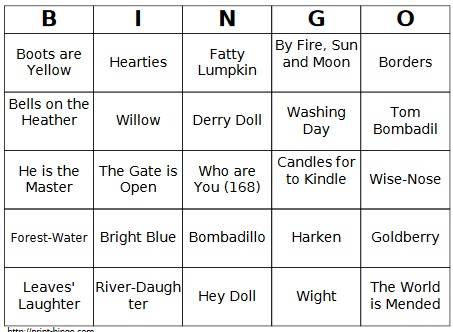
Bombadil Bingo

This can be used as a party game or as a teaching tool. I will cover the party game first, then suggest how I would implement it in the classroom!

Party Game Directions

Before the party starts:

  • either tell guests to bring their own copy of The Fellowship of the Ring, or a one-volume edition of The Lord of the Rings, or make sure to have several copies for them to use
  • Use the PDF at the bottom of this post to print off the bingo cards, then cut them out
  • Make sure you have a playing space large enough for your players, their cards, and copies of the text

Once the guests arrive:

  • Tell them that you are going to play Bombadil Bingo!
  • Give each participant a game card and then give these instructions:

Each of you has a game card. Each square on these game cards has words from the songs in the Tom Bombadil scenes in The Fellowship of the Ring. Your task is to search through these songs and find page numbers for the words in a given square. Once you find the page number, write it in the appropriate square. The center square is a ‘free’ square, so i have already provided a page number to get you started! The first person to fill in page numbers for five squares in-line (vertically, horizontally, or diagonally) will get a special treat! Remember: Tom Bombadil is in chapters other than “In the House of Tom Bombadil, so don’t forget to look at those scenes too!


Alternate activity:

  • Follow the same instructions, but have pairs of attendees work together!


(Please note: there are only ten cards, so if you want a larger party, you may have to make your own, or have multiple prizes since there could potentially be more than one winner.)


Teaching Tool Idea

What you will need:

  • The bingo cards from the PDF at the bottom of this page, printed and cut out for students.
  • An instructions slip with the block of instructions for students that I wrote below.
  • Students to have access to the book

Instructions:

The class period before your students arrive at the “House of Tom Bombadil” chapter in The Fellowship of the Ring, distribute the student bingo cards cut out from the PDF at the bottom of this post. Also distribute instruction slips that read as follows:

Each of you has a bingo game card. Each square on these game cards has words from the songs in the Tom Bombadil scenes in The Fellowship of the Ring. Your assignment is to search through these songs and find page numbers for the words in a given square. Once you find the page number, write it in the correct square. The center square is a ‘free’ square, so i have already provided a page number to get you started! Each student who fills in page numbers for five squares in-line (vertically, horizontally, or diagonally) will get a special treat!

*Remember: Tom Bombadil is in chapters other than “In the House of Tom Bombadil, so don’t forget to look at those scenes too!

I would not use this as a ‘reading check’ assignment. In other words, it should not take the place of a reading quiz or other assessment to check if the student has completed the reading. Instead, I would use it as a motivational tool to encourage them to complete their homework and to actually read the songs from the chapters instead of skipping them.

I would not ask for students to return their completed cards until after the “Fog on the Barrow Downs” chapter, because some cards will require that chapter in order to find a Bingo.

The reward is up to the teacher, but since there are only ten cards, and students can take their time to complete them, be prepared for multiple claimants! The easiest thing to do is to give them a bag of candy and all it “Barrow Treasure”!


*Please note that the center space is intended to be a “free” space. That is why it already has a page number for the words (it is also the only square where the words are pulled from dialogue instead of song). You may wish to update the page number with your edition in order to give guests or students a hint of where to look. Otherwise, you can just tell them that it counts as already found.

Bombadil Bingo cards