Liam H’s Experience–Tolkien Experience Project (101)

This is one in a series of posts where the content is provided by a guest who has graciously answered five questions about their experience as a Tolkien reader. I am very humbled that anyone volunteers to spend time in this busy world to answer questions for my blog, and so I give my sincerest thanks to Liam and the other participants for this.

To see the idea behind this project, check out this page

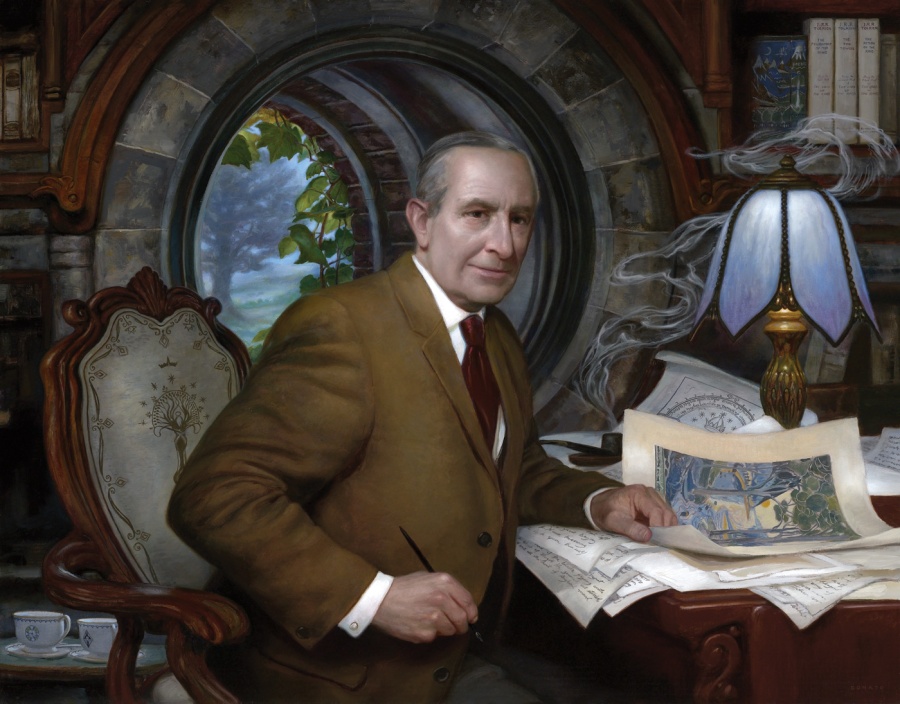
I want to thank Donato Giancola for allowing me to use his stunning portrait of J.R.R Tolkien as the featured image for this project. If you would like to purchase a print of this painting, they are available on his website!

If you would like to contribute your own experience, you can do so by using the form on the contact page, or by emailing me directly.

Now, on to Liam H’s responses:


1. How were you introduced to Tolkien’s work?

I was first exposed to Tolkien’s work through the Peter Jackson films. I was very young but I can remember vividly watching the Battle of the Pelennor Fields on my couch in my childhood home. I have watched those movies scores of times.

Later, while in eighth grade I was simultaneously introduced to Tolkien’s literature through the copy of The Children of Hurin my mother kept and a sweet Valentine’s Day gift I received from my Mother; a copy of The Hobbit.

2. What is your favorite part of Tolkien’s work?

His detail, more specifically with his invented languages. Tolkien brought a love for understanding in me. Directly as a result of his works I love English etymology and the meaning of words!

3. What is your fondest experience of Tolkien’s work?

Reading. Always, reading. I find that I go to a magical world when I open the pages of one of his works. So if I were to be specific it would be sitting on the loveseat in my parents room when we lived in Florida. A book on the shelf had caught my eye; a warrior, standing on a high point with his helmet reminiscent of a great worm. I picked it up, read a few words, looked at the stunning pictures and fell into a magical pool that has transformed my life since.

4. Has the way you approach Tolkien’s work changed over time?

Of course! About a year after I read The Lord of the Rings for the first time I dove in, but without very much thought. I bought The Silmarillion and the first few books in The History of Middle-earth. Those can be heavy books, particularly the Histories. I put off reading The Silmarillion for a few years but I tried to read the histories like normal books, which doesn’t really work, at least not for me. Now I have more of a study approach when reading the incomplete, fragmented works.

5. Would you ever recommend Tolkien’s work? Why/Why not?

Absolutely, I love fantasy and Tolkien is the granddad of the genre. Tolkien is very readable, though many feel he is not. His writing is so alive and a bizarrely fantastic mix of fairy-tale and epic. He really was a scholar, and his books are scholarly works. I think they have the potential of making scholars out of your simple, every-day folk.

Just the other day at work a coworker was listening to Shakespeare and he liked tragedy, so naturally I recommended The Children of Hurin. I have even managed to get my wife passively interested in Tolkien’s work and I got my in-laws hooked with the movies. When my children are older I plan to read Tolkien’s works to them until they hopefully pick them up on their own


To talk to Liam H about Tolkien, find him on Twitter!

TEP #8 – Mina Lukic

We are so happy to share with you our interview with an up-coming Tolkien researcher, Mina Lukic!

FtbblVxO.jpg small

Mina is currently a PhD student at the University of Belgrade, Serbia. Her current research includes looking into how people engage with Tolkien’s work using the lenses of participatory culture and cultural heritage. You can find out more about her research on her website. You can also be a part of her research by taking the survey for her study. We are so thankful to Mina for taking the time to speak with us and we hope some of our listeners will help with her research!

Please consider supporting the Podcast on Patreon!

Subscribe to the podcast via:

Comments or questions:

  • Visit us at Facebook or Twitter
  • Comment on this blog post
  • Send us an e-mail from the contact page
  • Email TolkienExperience (at) gmail (dot) com

Charis Loke’s Experience–Tolkien Experience Project (100)

This is one in a series of posts where the content is provided by a guest who has graciously answered five questions about their experience as a Tolkien reader. I am very humbled that anyone volunteers to spend time in this busy world to answer questions for my blog, and so I give my sincerest thanks to Charis and the other participants for this.

To see the idea behind this project, check out this page

I want to thank Donato Giancola for allowing me to use his stunning portrait of J.R.R Tolkien as the featured image for this project. If you would like to purchase a print of this painting, they are available on his website!

If you would like to contribute your own experience, you can do so by using the form on the contact page, or by emailing me directly.

Now, on to Charis Loke’s responses:


1. How were you introduced to Tolkien’s work?

When I was about ten or eleven years old, my father brought home a set of LOTR paperbacks which he’d purchased when he was pursuing his PhD in the UK (books were much cheaper there than in Malaysia, where I lived). It was fortunate that I was introduced to LOTR then and had about a year or so to devour it + the appendices + learn to write Tengwar before Jackson’s films came out.

2. What is your favorite part of Tolkien’s work?

Gandalf is my favourite literary character. It takes a bit of digging in the LOTR appendices and Unfinished Tales to find scenes that flesh out his personality further, but he can be as sassy and witty as he is wise and compassionate. The idea of being committed to a mission for thousands of years–far from home–without straying away from one’s principles is inspiring, and something which I began to better appreciate as I got older and started being involved in non-profit education work.

3. What is your fondest experience of Tolkien’s work?

Getting to see his original drawings and manuscripts when they were exhibited at the BnF – I don’t think anything else can compare to that experience. I spent a lot of time marvelling over the fine ink lines in his various depictions of Bilbo and the three trolls and had chills reading the handwritten page where the Riders of Rohan reach the Pelennor Fields.

4. Has the way you approach Tolkien’s work changed over time?

Over the years different parts of his work (and the fandom) have appealed to me; first, it was the layered worldbuilding, then the characters, then fanfiction which expanded and engaged with the canon in critical ways, and right now it’s the idea of a slower-paced, decades-long approach to being a writer and artist. I am now a full-time illustrator working in publishing; reading Tolkien’s work as a child set me on that path. He was brilliant at providing enough description to evoke vivid imagery, but not so much that it dictated how his world should be portrayed. Hence the myriad of illustrators who have plowed that fertile soil since; John Howe and Donato Giancola’s work, in particular, are inspirations to me.

5. Would you ever recommend Tolkien’s work? Why/Why not?

Yes – there’s a reason why it’s enduring and continues to appeal to readers. The value of Hope that’s espoused in the stories feels very timely in today’s circumstances, even as the issues that we face seem insurmountable. I think a lot about the ‘what weather they shall have is not ours to rule’ passage these days


You can find Tolkien-inspired illustrations by Charis Loke on her website, or follow her on Instagram or Twitter!

Annie’s Experience–Tolkien Experience Project (99)

This is one in a series of posts where the content is provided by a guest who has graciously answered five questions about their experience as a Tolkien reader. I am very humbled that anyone volunteers to spend time in this busy world to answer questions for my blog, and so I give my sincerest thanks to Annie and the other participants for this.

To see the idea behind this project, check out this page

I want to thank Donato Giancola for allowing me to use his stunning portrait of J.R.R Tolkien as the featured image for this project. If you would like to purchase a print of this painting, they are available on his website!

If you would like to contribute your own experience, you can do so by using the form on the contact page, or by emailing me directly.

Now, on to Annie’s responses:


1. How were you introduced to Tolkien’s work?

My mother was a fan and lent me her copy of The Hobbit and LOTR. I was 10. My teacher wrote home and said these works were inappropriate reading for a young lady. In response to this, my mother gave me The Silmarillion.

2. What is your favorite part of Tolkien’s work?

TBH I don’t know yet? Every year I find new material and my favourites keep changing. But I’ve always had a soft spot for Smith of Wootton Major.

3. What is your fondest experience of Tolkien’s work?

Discovering that every new reading uncovers new information and insight, not only into Middle-earth and it’s inhabitants, but also into the mind of Tolkien.

4. Has the way you approach Tolkien’s work changed over time?

Yes. I’ve started reading a lot more academic work in recent years and am enjoying exploring the depths of his work.

I’ve also become a shameless collector of first editions. 😂

5. Would you ever recommend Tolkien’s work? Why/Why not?

Is the Pope Catholic? Tolkien changed the way I view the world. His works were one of my first forays into language and created worlds and set the scene for the development of my own future writing. There is so much to be discovered and learnt from these texts and from Tolkien himself. My only regret is that I didn’t start reading his works earlier.

TEP #7 – Corey Olsen (Part 2)

This month, we have a special two-part interview for you! We are elated to have as our guest the Tolkien Professor himself: Corey Olsen!

This is the second part of our interview, so please make sure to go back and listen to part one to make sure you don’t miss anything!

corey-olsen-300x300Dr. Olsen is perhaps the most prolific and popular Tolkien podcaster in the world. His series like Exploring The Lord of the Rings, The Mythgard Academy, and The Silmarillion Film Project are recorded with live audiences each week, and he has thousands of listeners. The Tolkien Professor also has a nice book which walks readers through The Hobbit. We are so thankful that Corey could take the time to talk with us for a special, extended interview!

Please consider supporting the Podcast on Patreon!

Subscribe to the podcast via:

Comments or questions:

  • Visit us at Facebook or Twitter
  • Comment on this blog post
  • Send us an e-mail from the contact page
  • Email TolkienExperience (at) gmail (dot) com

Br. Pius, Norbertine friar’s Experience–Tolkien Experience Project (98)

This is one in a series of posts where the content is provided by a guest who has graciously answered five questions about their experience as a Tolkien reader. I am very humbled that anyone volunteers to spend time in this busy world to answer questions for my blog, and so I give my sincerest thanks to Br. Pius, Norbertine friar, and the other participants for this.

To see the idea behind this project, check out this page

I want to thank Donato Giancola for allowing me to use his stunning portrait of J.R.R Tolkien as the featured image for this project. If you would like to purchase a print of this painting, they are available on his website!

If you would like to contribute your own experience, you can do so by using the form on the contact page, or by emailing me directly.

Now, on to Br. Pius, Norbertine friar’s responses:


1. How were you introduced to Tolkien’s work?

I was introduced to Tolkien’s works by the wonderful films of Peter Jackson. Back in my childhood, I really enjoyed watching them, especially with my father who’s also a little bit addicted to the story (at least I made him interested in it). He thinks that everyone knows something about Tolkien’s breath-taking universe. Of course, after watching the films, I felt a hole inside me. I mean, they weren’t enough for my always-working imagination, so I wanted to know much more about Middle-earth. I immediately searched for The Lord of the Rings books in a bookstore’s online page and I bought my first ones by the beloved Professor. I was so happy when I received them and I read them as soon as it was possible during my vacation at my granny’s garden. I imagined that I was sitting on Bilbo’s bench, looking at his wonderful flowers and admiring Gandalf’s fireworks upon the sky.

2. What is your favorite part of Tolkien’s work?

Naturally, my favourite parts are my first reading experience, The Hobbit and The Lord of the Rings, but I also really venerate the whole of the universe which was made by Tolkien. I have to tell you that I’m not really into man-created worlds. I mean, I never saw Star Wars, Star Trek and several adaptations like these, but I was fulfilled by Tolkien’s work after reading just the first and the smallest part of it. The best part of all for me are the first sentences of the Hobbit, as I always feel so delightful and comfortable while reading: “In a hole under the ground…”

It lasted till my twenties,  as now I can look from another perspective at my Tolkien readings, as I’m older and I manage to understand the fond meaning of these works. I mean the real meaning of them. I like to think about the sequences and wise sayings of Tolkien, which can be suitable for every situation in our life.

3. What is your fondest experience of Tolkien’s work?

I have to tell that I’m a Norbertine friar, so my fondest experience was that I realised the religious side of Tolkien’s work. Even during reading, I stopped and I thought about where I’ve met with a situation or story like that in my philosophical or theological studies, or even in the Holy Scripture. Sometimes, if I start to talk about it to others, they look at me as one might look at something which is strange, as if they’ve never heard that the world made by Tolkien can also be seen as a religious or philosophical work. But yeah, he was a dedicated and conservative catholic, which makes him more sympathetic to me.
As I’m still studying philosophy and theology this year, I’ve decided to research the philosophical, especially metaphysical, relations of The Lord of the Rings for my annual exam.

4. Has the way you approach Tolkien’s work changed over time?

Indeed! Of course, as my first reading experience was in the beginning of my teenage period and the last was after entering the Norbertine convent. As I had time to spend reading during my formation, I mean the period of postulancy, I decided to extend a little bit my collection of Tolkien’s works. So I bought some studies about him, some language books of Quenya and Sindarin, and even a Hungarian-Quenya dictionary. That is not because I wanted to be fluent in elvish, as I have much more studies to do, even in Latin or Greek, it was just to have a closer look into this eye-catching universe. After that, I read The Silmarillon, Children of Hurin, The Lost Tales, and the History of Middle-earth… I’m so addicted to it all. They’re so deep, so fond, I managed not to see Tolkien’s work as a fairy tale as I did in my teenage years. I really understand now the idea of sub-creation

5. Would you ever recommend Tolkien’s work? Why/Why not?

I would recommend Tolkien’s work, but divided into age-levels. I mean, The Hobbit and The Father Christmas Letters are suitable for children as they’re written for them. To deeply understand the whole universe, we should be a little bit older. I mean, to find the real things behind the fairy tale, which I explained in my other answers. By the way, I think we should recommend the reading of Tolkien’s work for everyone as it has a meaning, maybe a different meaning for everyone. It could be a fairy tale or something to read before going to bed, but it can be someone’s fondest reading experience or even a subject to do research on or to find the real meaning of. I also really recommend it to religious people who know about Holy Scripture and have theological and philosophical knowledge, as they also can have a nice experience in finding these meanings of the novels.


If you want to talk to Br. Pius, Norbertine friar, you can find him on Facebook!

5 Books for Tolkien Fans Wanting to Read Scholarship

Most of my work is either attempting to help scholars understand the fan community, or helping fans who want to dig in to scholarship a bit more.

To further this endeavor, I decided to put together a short list of books that I would recommend to Tolkien fans who wanted to get a glimpse into Tolkien scholarship. Since I wanted it to be a fairly good overview of the available scholarship, I started with some caveats:

  • only one book by any author
  • written in a way that a non-academic audience could find it engaging
  • had to be affordable (around 30 USD or less)

There are of course many areas of research not represented here, and maybe I will compile more lists in the future. Here are my resulting suggestions, such as they are:

J.R.R. Tolkien: Author of the Century by Tom Shippey

Tom Shippey was a prominent scholar scholar in Tolkien studies for a generation, and his second book demonstrates why. A deep dive into Tolkien’s influences and inspirations, as well as an examination of Tolkien’s context makes this a valuable book for its insights and influence.

Splintered Light: Logos and Language in Tolkien’s World by Verlyn Flieger

This is an excellent book of textual analysis, and I include John D. Cofield’s in-depth Amazon review below, with permission.

Verlyn Flieger first published this book in the early 1980s, only a few years after the publication of The Silmarillion. It was the first important study of Tolkien’s great story, and this Revised Edition, published twenty years later, has additional value because the longer time period allows deeper perspective.

Many of the essays in this work deal with Flieger’s analysis of the influence on Tolkien of his fellow Inkling, Owen Barfield. Barfield had developed a linguistic theory of the fragmentation (or splintering) of meaning, which caused Tolkien to rethink many of his own ideas on philology. Flieger demonstrates that Tolkien used Barfield’s concept throughout his writings, but most especially in the stories and tales which became The Silmarillion. Flieger’s masterly retelling and analyses of many of those tales, especially those dealing with Feanor’s creation of the Silmarils, their theft by Morgoth after his destruction of the Two Trees of Valinor, and the ensuing rebellion of the Noldor breathe fresh life into words that I have dearly loved ever since first reading them in 1977.

Splintered Light, like the rest of Flieger’s work, is a highly scholarly but accessible and fascinating work. All lovers of the worlds created by J.R.R. Tolkien owe it to themselves to read and savor Flieger’s fascinating analyses.

Tolkien and the Great War by John Garth

For fans who are interested in biography, I have a whole post about good options for reading! This is one of my favorites, though. Garth has the skill and depth to develop meaningful and insightful story lines much more than an over-arching biography. I find it a gripp9ing read, and it’s accuracy is top-notch!

Tolkien and the Study of His Sources: Critical Essays edited by Jason Fisher

This collection is very helpful in tracing some likely literary influences on Tolkien. I provide John D. Cofield’s insightful Amazon review below, with permission.

John Ronald Reuel Tolkien was a man of decided likes and dislikes, and among his strongest aversions were those who read his works and picked them apart trying to identify every possible source for his literary creations. Since anyone who has read Tolkien’s letters is well aware of this aversion, it seems odd to think that some of the best known and most highly regarded Tolkien scholars would contribute to a book of essays titled “Tolkien and the Study of His Sources.” Yet, as Tom Shippey himself makes clear in one of those essays, studying Tolkien’s sources allows us to better understand his cultural background, the professional background against which he worked, and his immersion in the “Cauldron of Story,” the wide-ranging reading which dominated his life. Jason Fisher, who is the editor of as well as a contributor to this collection, warns that ignoring a writer’s context is to risk stripping his work of connections vital to understanding him and his world. As an appreciative reader of the essays in this collection, I would add that they provide scholarly but quite lively and entertaining insights into Tolkien’s “leaf-mould of the mind,” the rich literary background from which sprang Middle-earth.

There are eleven essays in this collection, including three by Shippey, Fisher, and E.L. Risden explaining source criticism as it applies to Tolkien. As an historian myself I found three essays dealing with Mesopotamian and Biblical history, the Byzantine Empire compared to Gondor and Arnor, and on the Rohirrim as possible Anglo-Saxons to be especially interesting. Similarly, I share with Tolkien an appreciation for the fiction of H.Rider Haggard and John Buchan, and so I enjoyed two essays focused on those authors. And I was intrigued by the insights of other essays on Caxton, the myth of Ceyx and Alcyone, and on some of Tolkien’s lesser known writings.

This collection includes contributions from some of the best known Tolkien scholars. The essays are well written and insightful. Each is accompanied by extensive notes and bibliographies. It belongs in the collection of every dedicated lover of Middle-earth

Tolkien and Alterity edited by Christopher Vaccaro and Yvette Kisor

A much-needed addition to the Tolkien discussion, the scholarship in this edited volume brings together voices discussing how Tolkien’s work intersects with topics of race and queer studies. The book offers essays on ideas of women and the feminine, the queer, language of familiarity and alterity, and identity more generally. I highly recommend it for Tolkien fans who would like to be able to consume more modern scholarship.

So this is my very short list. Do you agree or disagree? What other books would you recommend (keeping in mind the three caveats)?

Steffan O’Sullivan’s Experience–Tolkien Experience (97)

This is one in a series of posts where the content is provided by a guest who has graciously answered five questions about their experience as a Tolkien reader. I am very humbled that anyone volunteers to spend time in this busy world to answer questions for my blog, and so I give my sincerest thanks to Steffan and the other participants for this.

To see the idea behind this project, check out this page

I want to thank Donato Giancola for allowing me to use his stunning portrait of J.R.R Tolkien as the featured image for this project. If you would like to purchase a print of this painting, they are available on his website!

If you would like to contribute your own experience, you can do so by using the form on the contact page, or by emailing me directly.

Now, on to Steffan O’Sullivan’s responses:


1. How were you introduced to Tolkien’s work?

While browsing in a book store, I stumbled across the first US paperback publication of The Hobbit in 1965, when it had just been released. I was in high school, and a science fiction and fantasy reader since the late 1950s, so frequently checked the shelves for anything new.

2. What is your favorite part of Tolkien’s work?

The Hobbit, closely followed by the tale of Beren and Lúthien as found in The Silmarillion.

3. What is your fondest experience of Tolkien’s work?

Reading The Hobbit out loud to various people, both children and adults, over the years. They’ve all loved it.

4. Has the way you approach Tolkien’s work changed over time?

Well, sometimes I skip right to my favorite parts, but mostly my approach is the same. That is, I settle down to immerse myself in Tolkien’s worlds.

5. Would you ever recommend Tolkien’s work? Why/Why not?

I have, and do, and will continue to do so. Because it’s unique, and simply the best at what it does. I tell people The Hobbit is the best book written in the last hundred years, though I confess I haven’t read *all* the competition. I say it anyway.

Luke Shelton Named Editor of Mallorn

I am delighted to tell you that I have been named the new editor-in-chief of Mallorn: The Journal of the Tolkien Society.

mallornI am thankful to the Tolkien Society for their belief in me, and I hope to be a portion as professional and insightful as my predecessor, Rosalinda (Ro) Haddon.

Together, my editorial team and I hope to make Mallorn into a publication that scholars want to be a part of and an essential part of any Tolkien scholar or fan’s yearly reading list!

We have a lot of brilliant things planned, and I can’t wait for you to see them!

You can find out more about Mallorn from the Tolkien Society’s Publications page or Mallorn‘s Facebook page.

If you want to find out more about the society itself and even become a member (which I have always recommend, but now even more in order to get access to Mallorn) then visit their website.

If you want more information or updates from me, you can follow my Tolkien-related account on Facebook, or find my personal or Tolkien accounts on Twitter.

TEP #6 – Corey Olsen (Part 1)

This month, we have a special two-part interview for you! We are elated to have as our guest the Tolkien Professor himself: Corey Olsen!

corey-olsen-300x300Dr. Olsen is perhaps the most prolific and popular Tolkien podcaster in the world. His series like Exploring The Lord of the Rings, The Mythgard Academy, and The Silmarillion Film Project are recorded with live audiences each week, and he has thousands of listeners. The Tolkien Professor also has a nice book which walks readers through The Hobbit. We are so thankful that Corey could take the time to talk with us for a special, extended interview. So if you enjoy this episode, make sure to subscribe and watch out for part two, coming just two weeks from today!

Please consider supporting the Podcast on Patreon!

Subscribe to the podcast via:

Comments or questions:

  • Visit us at Facebook or Twitter
  • Comment on this blog post
  • Send us an e-mail from the contact page
  • Email TolkienExperience (at) gmail (dot) com