LotRFI Pt.12–Boromir the Bad

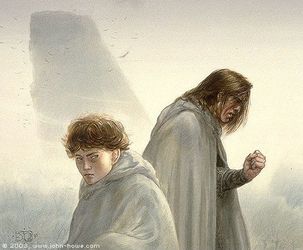
When I first read FR, I remember that I distrusted Boromir entirely. Perhaps it is because in the first two mentions of Boromir the reader is told that he is “from the South” (FR, II, II, 240) and a “stranger” (FR, II, II, 243). I already knew that the real bad guys were in the south, and that the shadowy men from Bree were “strangers.”  Perhaps, too, it was because his first action is to interrupt Elrond in order to boast about his country and ask about the Ring; at least that is how I interpreted his statements at the time.

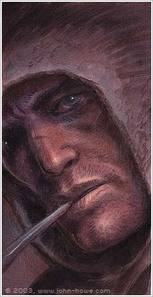
john-howe-good-sense-revolts
Image copyright John Howe

Boromir is one of the largest detractors from the plan to destroy the ring while at the Council of Elrond. Throughout his journey with the Fellowship, Boromir is constantly preoccupied with the Ring and how it should be used, not destroyed. I think that my childhood instinct to view people, and characters, I loved as infallible played a role in the way I perceived Boromir. To me, he was ‘the enemy’ who was against the wisdom of Gandalf (whom I loved dearly, which I will cover in detail later). As such, I did not see him as a real man, as a character who was valiant yet flawed. I saw him, honestly, in the same way that many conservative American Christians see the devil: as a crafty and deceitful enemy who has his goal in front of him the whole time and picks his spots to exploit weakness. My reading was not to see Boromir as occasionally tempted, but as wholly corrupt and hiding his nature until he can sate his desires.

This interpretation of Boromir stayed with me for approximately three years. When I was sixteen, I audited a course on J.R.R. Tolkien which Dr. Amy H. Sturgis taught at a university near me. It was through her class that I first realized that Boromir was not an entirely unredeemable figure. Since then, my views on Boromir have changed drastically, but that evolution is a story for another time!

Where do we go from here?

Next, I want to talk about some of the obstacles the Fellowship encounter on the journey to Moria.

What Do You Think?

What was your first impression of Boromir?
Has your reading of Boromir changed over time?
​Let me know in the comments!

LotRFI Pt.11–Rivendell

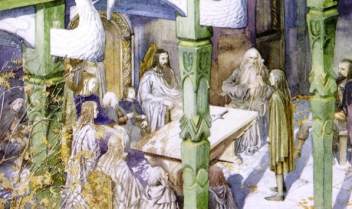
I will readily admit that I was not an avid fan of the events in Rivendell when I first read LotR. As a young reader, it was very difficult to find the patience to work through the Council of Elrond, although the passages where the events of H were briefly rehashed and expanded upon were helpful. I think that I succumbed to the fault of many contemporary readers because I believed that chapters that did not have conflict, by which I mean battles or evading hunters, were boring. It was not until I completed the book and revisited Rivendell that I really understood its importance.

sda-alan-lee-the-council-of-elrond_orig
Image copyright Alan Lee

Aside from the Council, I always enjoyed the privilege of seeing Bilbo in Rivendell. His poetry was difficult to follow because I was unclear about the meter in my first reading and Aragorn’s joke about Earendil was over my head; however, my curiosity about Bilbo was piqued by the second chapter and I wondered what would happen to him on his latest adventure. I also enjoyed the bits of comedy that peek through in the Rivendell chapters. Pippin especially stood out to me as a cut-up who wanted to offer his opinions and was not afraid to talk back to his betters.

For me, the most notable event in Rivendell through the first several reads was the establishment of the Fellowship. I enjoyed learning who would join in the quest, and even looked back over the chapter to make sure I had all of the information about Gimli, Legolas, and Boromir. This is a pretty good spot for me to transition into talking about the characters of the Fellowship, so I will do so for the next several posts, and then come back to Rivendell before moving on into the quest.

Where do We Go From Here?

A brief pause in the chronological approach will let us reflect more on the characters of the Fellowship before we return to Rivendell and continue on the quest itself.

What Do You Think?

How did you approach the Council of Elrond in your first reading?
Were you forewarned about the length or content of the Council?
What about the other events at Rivendell?

LotRFI Pt. 10–Glorfindel, Gildor, and the Elves Pre-Rivendell

In my discussions of Aragorn, Bombadil, and Maggot I have established that my general approach to new characters during my first reading of LotR was skepticism and mistrust. The only new characters that this mistrust did not touch were the elves. This is a little ironic, given that I read H shortly before starting LotR. It would make sense, given the background of the Elf King of Mirkwood, that I would mistrust the elves, especially those wandering in the woods. It seems, however, that the impression left by Elrond had more of an influence on me as a reader of LotR.

alan-lee-feasting-with-the-elves_1
Image copyright Alan Lee

I was very quick to trust the elves. Once the Black Rider fled from Gildor Inglorion and his company, I essentially trusted elves from then on. I do not remember a single instance when I questioned this trust throughout LotR. Even when the Fellowship confronted elves in Lothlórien, I felt the tension between two factions on the same side but did not assume that the Galadhrim were evil. To rewrite the Frodo line from the meeting with Strider, I deemed that elves seemed fair and felt fairer. Even if this perspective is unique to me or is not entirely based on the published text, it has proved very significant in my understanding of Middle-earth. From the beginning of my experience, the elves were truly Good People. The evil loose in Middle-earth could not tarnish their spirits. They were the bright light in dark places, even among the trees of the Shire.

My interpretation of the elves owes a lot to the fact that Gildor’s people are aware of Bilbo’s farewell from the Shire, they call Bilbo a “good master” and they laugh in their dealings with the hobbits (FR, I, III, 80-1). The familiarity and kindness of the elves, along with their opposition to the Rider make them likable. I found myself, like the hobbits, cheered by their presence.

This feeling of wholesomeness extends to Glorfindel, although he meets the company under more dire conditions. While the group is struggling to get to Rivendell when they meet the elf, Glorfindel acts as a catalyst for action. He spurs Frodo on across the Ford and he helps the others confront the Riders. More significantly than this, however, is that Frodo glimpses Glorfindel “as he is upon the other side” (FR, II, I, 223). This cements the association between the elves and the ethereal, making explicit the goodness of the Good People.

The other-worldly view of Glorfindel not only reasserted the allegiance of the elves, but it prepared me to experience Rivendell as a place removed from the world. We will talk about Rivendell more in the next post, but for now I just wanted to link Glorfindel’s ability to be both in the world and yet detached from it as foreshadowing one of the essential qualities of Rivendell and Lothlórien.

Where Do We Go From Here?

The next post will be on Rivendell, then I should probably take a break from the plot-based approach to cover some of the characters who will be in the Fellowship.

What Do You Think?

What was your impression of the elves before you arrived at Rivendell (in LotR)?

LotRFI Pt. 9–Strider Again

On the journey between Bree and Rivendell, Strider’s character becomes more complex, especially when the group arrives at Weathertop. The first suggestion that Strider is more than a roaming do-gooder is the fact that he has earned Gandalf’s respect. According to Gandalf’s letter, and Strider’s subsequent ruminations on how Gandalf would likely proceed, we understand that the two of them have often worked together and that they understand one another well. Just before they reach Weathertop, however, Strider’s learning is on full display. It is here that the ranger of the north divulges his knowledge of history. He answers the hobbits’ questions about Weathertop by sharing his historical knowledge of the area, then he relates some of the tale of Gil-galad.

To the surprise of all, Sam goes on to recite a bit of Gil-galad’s tale! This was a marvelous occurrence to me, as I did not expect it from Sam at all. He was listening to Bilbo closer than I ever gave him credit for! Unfortunately, Sam’s knowledge does not extend past this excerpt and he is unaware of its significance. Later, the hobbits request that Strider tell them the full story and he declines, saying that now is not the time. Instead,

“I will tell you the tale of Tinúviel” said Strider, “in brief—for it is a long tale of which the end is not known” (FR, I, xi, 191).

Then follows a lengthy poem that recounts the story of the meeting of Beren and Lúthien.

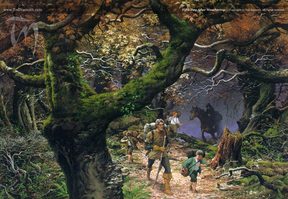
Fifth Day After Weathertop, by Ted Nasmith
Image copyright Ted Nasmith

This poem is significant for several reasons. First, it allows for exposition of Aragorn’s character and of the history of Middle-earth. This incident shows Aragorn to be knowledgeable of the lore of men and elves. Additionally, this sharing of lore seems to have the side-effect of forestalling the encounter with the Black Riders. They seem to lurk in the shadows until the tale is told and silence falls again. Finally, Corey Olsen posits that this is the moment in the drafting process where Tolkien decides to have LotR and The Silmarillion (not italicize because here it refers to the entire legendarium and not the published text) inhabit the same imaginative world. While this may be the case, when I first read the text, all I garnered from this episode is that Strider has much more wisdom than simply the skills of a tracker and forester. This sense is underlined after the events on Weathertop when Strider reveals that he has been to, and in fact lived in Rivendell for a time.

On Weathertop we see Strider’s real fighting skills for the first time. Contrary to how the movie adaptation depicts the scene, Strider does not use a sword in his combat against the Riders. Instead he uses fire brands to hold them off. This was significant to me in a couple of ways. First, it demonstrates that he is a formidable warrior in that he can adapt and use different weaponry when the situation dictates. Also, the imagery of Aragorn wielding the fire, a source of light, against the dark, shadowy Riders was symbolically important to me as a young reader.

The final insight I wanted to discuss about Strider is his use of Athelas on Frodo’s wound before Glorfindel arrives. This episode underscores Strider’s learning again, but it is not strange that a forester would have a bit of herb lore. The scene, however, demonstrates more about Strider than just his knowledge base. It demonstrates his emotional investment in the hobbits. Strider seems to genuinely care for the hobbits and he wants to ease Frodo’s suffering and delay the poison of the blade as much as he can. This care becomes more evident as this leg of the journey continues and he becomes increasingly worried about Frodo.

Where Do We Go From Here?

Glorfindel and the elves (pre-Rivendell) are next! Then we will cross the Ford and enter Rivendell.

What Do You Think?

What Aspects of Strider’s initial characterization change for you in this section? When?
​Did you picture Aragorn with a sword on Weathertop or not?

LotRFI Pt. 8–About Strider

You can probably anticipate what my initial approach to Strider was. As with almost everything in the story, I was untrusting or even outright skeptical about him at first. Who was this shadowed figure trying to wheedle himself into the confidence of the hobbits? Unlike previous encounters where I held on to my preconceived notions longer than other readers might or where, however, I imagine that I changed my opinion around the same time as most other readers. I decided to trust Strider the same time that the hobbits did: after they see Gandalf’s letter and he proves that he is Aragorn by showing his broken blade.

I think part of the reason that I decided to like Strider is because the rest of the Breelanders did not like him. Frodo claims that


“You have frightened me several times tonight, but never in the way the servants of the Enemy would, or so I imagine. I think one of his spies would – well, seem fairer and feel fouler, if you understand.”

strider

I think that this passage helps to explain my own approach. Throughout the early parts of LotR, I had an innate mistrust of any characters that seemed fair, because their aspect is unbelievable (the elves are excluded from this, but we will talk more about that as we enter Rivendell). Therefore, my approach to this unknown world of Middle-earth was similar to Frodo’s own. I had reservations, often verging on misgivings, about people who seemed to be better than they were. Hobbits I innately trusted because they were familiar; for example, even though Maggot is daunting, he was still a hobbit, and so was not a source of fear so much as tension or conflict. Once the hobbits leave the Shire, however, most of their encounters were cause for alarm to me because each was an encounter with the unknown.

Strider is the exception to this rule so far. He mirrors the trajectory of Maggot in that he seems gruff and unlikable, but eventually grows into an ally for the hobbits. This is the first character that the hobbits meet outside the Shire who is not as he appears. The foreboding caused by Old Man Willow and the fear of the Barrow wights were appropriate responses and Bombadil really was a merry, if frighteningly powerful, fellow (even though I had my doubts). For the first time, a character who is not a hobbit presents some real complexity of character and does not fit in to his surroundings. This makes him intriguing to the reader and we want to know more about him. In fact, we, like Frodo, want all of our questions answered on the spot there in Bree. It is the artistry of Tolkien, however, to prolong the mystery and only unravel Aragorn’s true significance bit by bit.

I will go a bit more into Aragorn’s lore and medicinal skills in my next post, as we approach and then descend Weathertop, but I did want to say a bit more about his character on the road, as it were, with the hobbits. I came to like Strider very quickly because he is direct in his guidance, but does not take himself so seriously that he does not have fun while with the hobbits. I think Jackson’s characterization of Aragorn strays quite a bit here. The hobbits are the characters that readers are supposed to identify with, that is why the tale is told from their vantage point. This elevates Aragorn to be above the station of the reader. The reader does not like Aragorn as an equal, but appreciates the burden of his responsibility and his condescension in being a ranger and protecting the hobbits. This makes his character much more complex and interesting. Aragorn is not the character whose history we can understand or whose purpose we can see ourselves mirrored in, but the fact that he is willing to come alongside the hobbits and help them in their quest demonstrates a quality of character well beyond what is expected of individuals with power and station.

Where Do We Go From Here?

Next stop: Weathertop. Then I want to pause and talk about Glorfindel and elves before we head into Rivendell

What Do You Think?

What was your first impression of Strider?
Do you relate more to the hobbits or the men depicted in LotR​? Why?

LotRFI Pt. 7–Signs in the Prancing Pony

We have finally arrived at Bree! As the first non-Shire settlement, there is much for the hobbits to adapt to and many new avenues of experience for them. Perhaps the plethora of innovations that the hobbits experience impacts the way that this scene can be interpreted in different ways.

In his Exploring the Lord of the Rings podcast, Dr. Corey Olsen suggested that Peter Jackson did not accurately portray the Prancing Pony in his film. According to Olsen, the great peril of the Pony is that it was so warm and inviting that it would put the hobbits off their guard, which could trick them into revealing more about their errand than they should. He denounced Jackson’s interpretation as far too scary and dark.

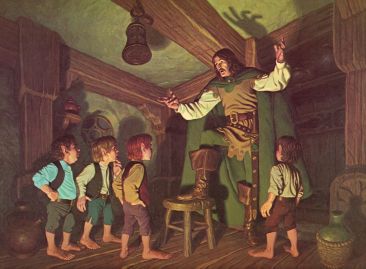
ba91a841b992bb1b6e1677f5bb14e45b
Image copyright Greg and Tim Hildebrandt

Personally, my own experience echoes Jackson’s interpretation more than Olsen’s, although I do see parts of the hobbits’ experience at the Pony as pleasant. While I can appreciate Olsen’s perspective, I always saw the common room at the Pony as in intimidating place because it is the first time that the hobbits encounter the Big People, if you will. Reading the scene as child, it resembled my own experience of entering a room of adults. The feelings of uncertainty and unease that occur to anyone who enters a room where they can assume that they are the least knowledgeable about the world and other people. This connection is obviously an extension of my reading of the hobbits as children.

While the common room unsettled me, I understood that the hobbits were at ease for part of their time there and relaxed for most of their time before going to the common room. Perhaps a more accurate assessment of my response would be that I thought the Pony was, to paraphrase Aragorn, both fair and perilous. The warmth of the caretaker and his staff were more than enough to allow any weary travelers to rest and be at peace. The inclusion of hobbit rooms at the Pony was certainly an unlooked-for balm for the hobbits as they relaxed from their travels. Once the hobbits are refreshed, they confront the world of the Bog People without being properly prepared. While the hobbits felt ease in the beginning of their encounter in the common room, it quickly became a source of intimidation and fear. Just as Frodo was aware of the danger before his fellow hobbits, so I, as the reader, was aware of the danger upon entering the common room.

This is partly because of the warnings that Merry and Pippin bandy back and forth before going to the common room. In Olsen’s opinion, most of these warnings are friendly ribbing among the hobbits. As a young reader, though I took them all very seriously. This put me on guard as they entered the common room, and Frodo’s misgivings only acted as a confirmation of my presuppositions. I do not think that the disagreement in interpretation here changes much of the characterization of important people moving forward. Therefore, it seems to me that this episode supports either of these two interpretations because later developments do not necessitate one interpretation over the other.

Where Do we Go From Here?

I would like to take a post to reflect on Aragorn-as-Strider and then probably move on to Weathertop and the lore that breaks in there.

What do you think?

What were your first impressions of the Prancing Pony or of Bree?
When, if ever, did you begin to mistrust the Big People?
What were your impressions of Butterbur, Hob, and Nob?

LotRFI Pt. 6–The Barrow Wights

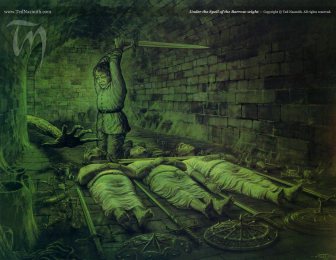
For some reason, I always equated the Barrow wights with the Black Riders chasing our band of hobbits through the Shire. I imagined that they were somehow related or in collusion. Perhaps it was just my way of simplifying the danger that the company faced, thinking that evil was a single, combined force instead of a multi-faceted and diverse set of challenges or opponents. It was not until much later, probably around a decade, that I began to realize that there were some textual reasons why I made this assumption as a first-time reader.

Under the Spell of the Barrow-wight, by Ted Nasmith
Image copyright Ted Nasmith

As a twenty-something, I wrote a word study focusing on Tolkien’s use of   glimmer throughout LotR. This project led me to Shadow, which displays the development of the wights and Riders through several drafts. In a prior version of this text, J.R.R. Tolkien describes how Tom Bombadil “seemed to think that the Riders and Barrow wights had some kind of kinship or understanding.”

Perhaps this assumption which is present in the previous iterations of the text still lingers in some of the creative decisions in the published text. While the two dangers are not in collusion as-published, the characterization of the Riders and the wights is very similar, down to the word choice (as I argued, somewhat, in that earlier paper).

I am not naïve enough to suggest that I was able to detect Tolkien’s earlier intent as a young child. What I would assert, however, is that Tolkien revised his text in such a way as to leave this connection between the Riders and the Barrow wights as a possibility for readers to interpret into the text, even if he does not suggest the link outright.

Where Do We Go From Here?

I hope to be in Bree next week!

What Do You Think?

Did you ever think that the Barrow wights were related to the Black Riders?

LotRFI Pt. 5–Farmer Maggot

I feel like my first impression of Farmer Maggot was typical. At first, I did not like Maggot because I took Frodo’s account as accurate. I believed that he and Maggot had a history of clashing and were at odds with one another. This made Frodo’s reaction to being on his land seem logical.

“One trouble after another!” said Frodo, looking nearly as much alarmed as if Pippin had declared the lane was the slot leading to a dragon’s den. (FR, I, iv, 91)

It was not until Maggot offered food and shelter to the young hobbits that I began to trust him. So far, I think that most readers would agree with this impression, though some of them may have tempered their opinion of Maggot earlier, when Pippin began to push back against Frodo’s characterization.

Interestingly, I was recently listening to a podcast (Corey Olsen’s Exploring The Lord of the Rings, episode seventeen) which highlighted a disagreement that my perspective may have with others. In this podcast, Corey Olsen presents his belief that Maggot’s account of his interaction with the Black Rider is a rather objective recounting. Here is the passage in question:

“Good-day to you!” I says, going out to him. “This lane don’t lead anywhere, and wherever you may be going, your quickest way will be back to the road.” I didn’t like the looks of him; and when Grip came out, he took one sniff and let out a yelp as if he had been stung: he put down his tail and bolted off howling. The black fellow sat quite still.

‘“I come from yonder,” he said, slow and stiff-like, pointing back west, over my fields, if you please. “Have you seen Baggins?” he asked in a queer voice, and bent down towards me. I could not see any face, for his hood fell down so low; and I felt a sort of shiver down my back. But I did not see why he should come writing over my land so bold.” (FR, I, iv, 94)

Olson contends that, because Maggot’s account is objective, the Rider’s use of “yonder” is an attempt for him to blend in to the local dialect to collect information. My interpretation, however, has always been to treat this passage as reported speech. That is, Maggot is conveying the general sense of the interaction using his own idiomatic way of speaking. I never considered, then, that the Rider actually uses “yonder.” Instead, I always thought, and still believe, that Maggot is putting that word into the Rider’s mouth instead of trying to recount the interaction verbatim. This approach to the dialogue seems probable to me because it is a way of retaining the established characterization of both the Black Rider and Maggot. In that the Black Rider is not going to demean himself to try and fit into the dialect of the hobbits, and Maggot has no qualms about paraphrasing other people in his own dialect when it suits him. Also, I think that had Tolkien meant for readers to treat this scene has objective dialogue then he would have embedded the interaction into the text in a different way. As it stands in the published text, however, the entire episode is intended to be reported speech from Maggot’s perspective.

A second manner in which my approach to Maggot was very different from the norm is that he served as a proto-Bombadil encounter to me. My experience of Bombadil was very similar to the pattern that most people adopt with Maggot. It began with distrust but gradually evolved into respect and amiability. I know that this is very different from the opinion of others (as I recounted in my first post), but the pattern established by the Maggot encounter served as a template for many of the meetings that followed it in LOTR.

Where do we Go From Here?

Next we will visit the Barrow Downs, and then on to Bree!

What Do You Think?

How do you approach this passage which recounts dialogue between Maggot and the Black Rider?
Did the Maggot episode serve as a template of encounter for you as a reader?


LotRFI Pt. 4–The Hobbits as Children

It is still very clear in my mind that I considered the hobbits to be children during my first reading of LotR. In fact, I remember the animosity I initially felt toward the portrayal of the hobbits in the Peter Jackson films because they showed the hobbits as (what I deemed at the time) weak adults, instead of as an inexperienced, sheltered, child-like race. I will readily admit that I probably adopted this viewpoint to better relate to the hobbits as a reader, but it seems to be a very supportable perspective. I want to go into more detail with the character of Pippin in a separate blog post, he has long been my favorite hobbit, but I want to give just a small vignette of each hobbit here that bolster this approach to the hobbits as a group. Now that I am older, I can read into the nuances of characterization much more than I was able to in my first reading. I am not saying that the analysis that follows is the only way or the right way to approach the text, in fact I would explicitly say that some of the analysis is the wrong way to approach the text, but in my first reading I assumed that the hobbits were child-like, and so many aspects that otherwise would contribute to a different understanding of the group only served to validate that perspective in my first reading.

One of the shortcomings in my understanding of LotR as a young reader was that I did not understand the class distinction among the hobbits. I knew that they were on unequal social footing, what with Sam working for Frodo, but I did not really have an appreciation of how this impacted the interactions between the hobbits. Most of the instances where Sam adopts a deferential or submissive attitude which many adults would discern as a marker of his lower-class status, conveyed a much different meaning to me. I saw in these instances the actions of a young boy who was uncertain of the world and his place in it. Therefore, Sam’s appeal to Frodo in his first scene with dialogue, his “Don’t let him hurt me, sir!” (FR, I, ii, 63), struck me as a plea to someone with more understanding of the situation, not as a petition to someone of higher social distinction. This interpretation pairs well with Sam’s expressions of unbridled joy and sense of adventure in a way that makes him seem young and naive. In the same scene, Sam’s ability to change to “Me go and see Elves and all! Hooray!” in just a few lines is very characteristic of the way these two currents of Sam’s personality intersect to make him seem young (FR, I, ii, 64).

In a similar fashion, I interpreted the other hobbits using this same lens. Merry’s “know-it-all” personality came across as a child whose ignorance enabled their over-confidence. Pippin’s joviality struck me as a “cut-up,” someone who was always trying to make others laugh and be the center of attention. The best scene to quickly illuminate both interpretations is the exchange between them in the Prancing Pony just before Frodo, Pippin, and Sam head into the common room. Merry warns the others to “mind your Ps and Qs, and don’t forget that you are supposed to be escaping in secret, and are still on the high-road and not very far from the Shire” (FR, I, ix, 154). To which Pippin responds “Mind yourself! Don’t get lost, and don’t forget that it is safer indoors” (FR, I, ix, 154). Merry’s warning comes from a place of superiority. He feels like he knows more than the other hobbits, and it is his burden to keep them in-line, even though he has never been much farther than they have and has only heard tales of Bree. Pippin’s response starts with a rebuttal. He starts indicating that Merry should be as wary as they are, and goes on to give his own warnings. Pippin’s warnings are a mockery of Merry’s in that they expose the unnecessary statements of common sense for what they are. This shows Merry’s high self-regard and Pippin’s playful way of bringing him back down to hobbit stature.

The final scene I want to talk about is the interaction in “Three is Company” where Pippin orders Sam to prepare breakfast for the others after their first night camping in the Shire. The following exchange takes place:

[Frodo] stretched. “Wake up, hobbits!” he cried. “It’s a beautiful morning.”

“What’s beautiful about it?” said Pippin, peering over the edge of his blanket with one eye. “Sam! Get breakfast ready for half-past nine! Have you got the bath-water hot?”

Sam jumped up, looking rather bleary. “No, sir, I haven’t, sir!” he said.

Frodo stripped the blankets from Pippin and rolled him over, and then walked off to the edge of the wood. (FR, I, iii, 72)

I choose this scene for a couple of reasons. Again, remember that I was unaware of the class distinction as a young reader. This scene, then, demonstrated the kind of hierarchy of joking that can persist within a friend-group. Pippin’s entitlement leads him to order Sam around and Sam, as the stereotypical member of the group who is seeking belonging, is quick to accommodate the demand. In a sense, I considered this a joke from Pippin that he took too far. This crossing of a line is what compels Frodo to stick up for their mutual friend and check Pippin, much like Pippin does to Merry in the Prancing Pony scene discussed above. It would not have surprised me, in my initial read, if Pippin directed this command at Frodo; though I would have expected Frodo to stand up for himself had that been the case.

The only exception to this form of stereotyping was Frodo. Frodo was a very difficult character for me to understand as a young first-time reader. He was very complex, too complex for me to really grasp much of until I read the book a second time as a teenager. While he was on the same level with the other hobbits, meaning they treated him as an equal, he was altogether more grave and serious than the rest of them. I almost want to say that I approached Frodo as the “straight man” of the group. He was the one who understood the larger situations so he endured the colorful expressions of delight and humor without engaging in them himself very often. I was much more engrossed by Frodo’s character later in the book, but I did not particularly like him this early on—even though I probably identified more with him on a personal level than any of the other hobbits. His reserved demeanor and aloof personality among the inhabitants of the Shire were very relatable for an introverted middle-schooler.

Where do We Go From Here?

I hope to stop by Farmer Maggot’s pretty soon, then explore the Barrow Downs!

What Do You Think?

Did you equate the hobbits with a specific age when you read LotR? If so, what age were they?
How has your mental-image of the hobbits changed over your experience rereading/discussing LotR?
LotRFI Pt. 3–Shire Trees and Old Man Willow

Landscape

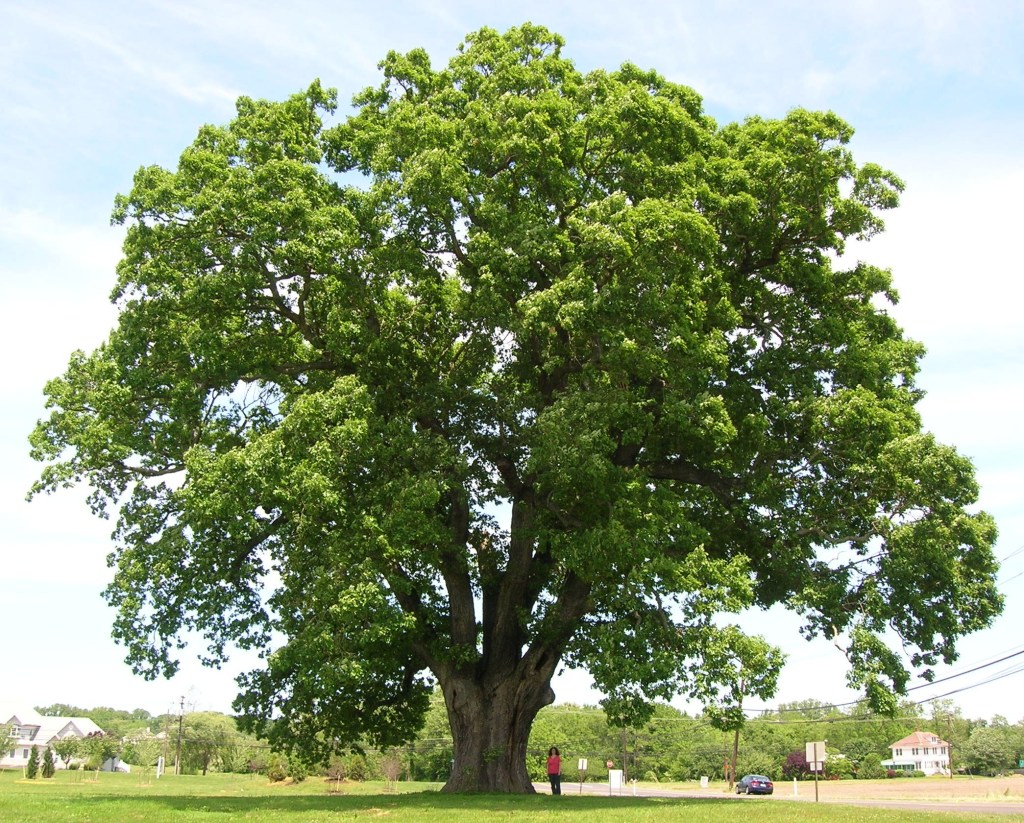
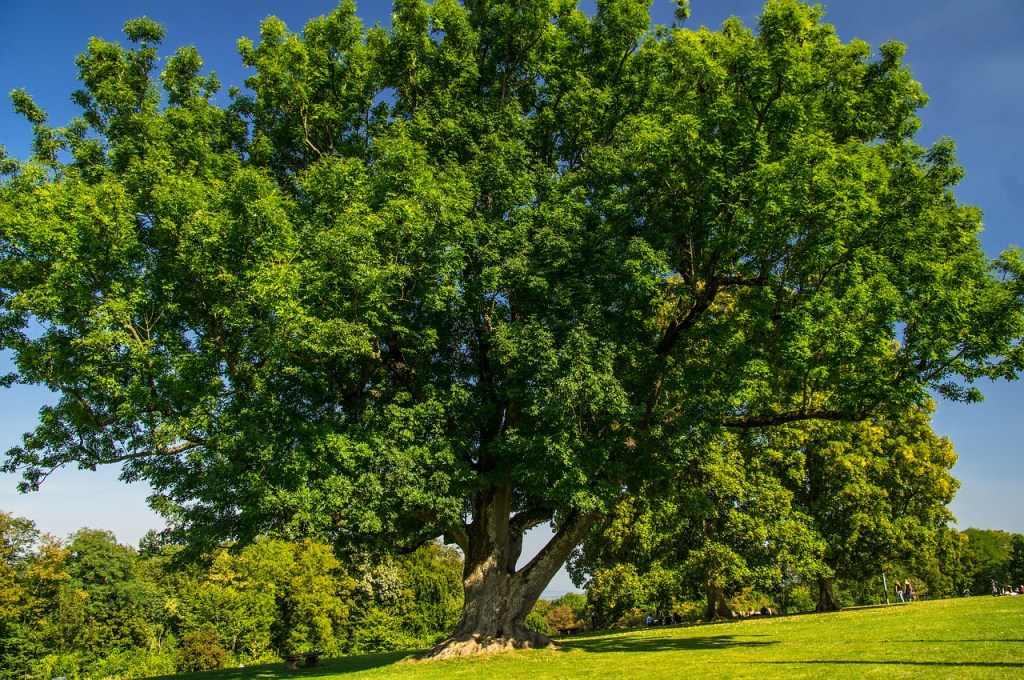
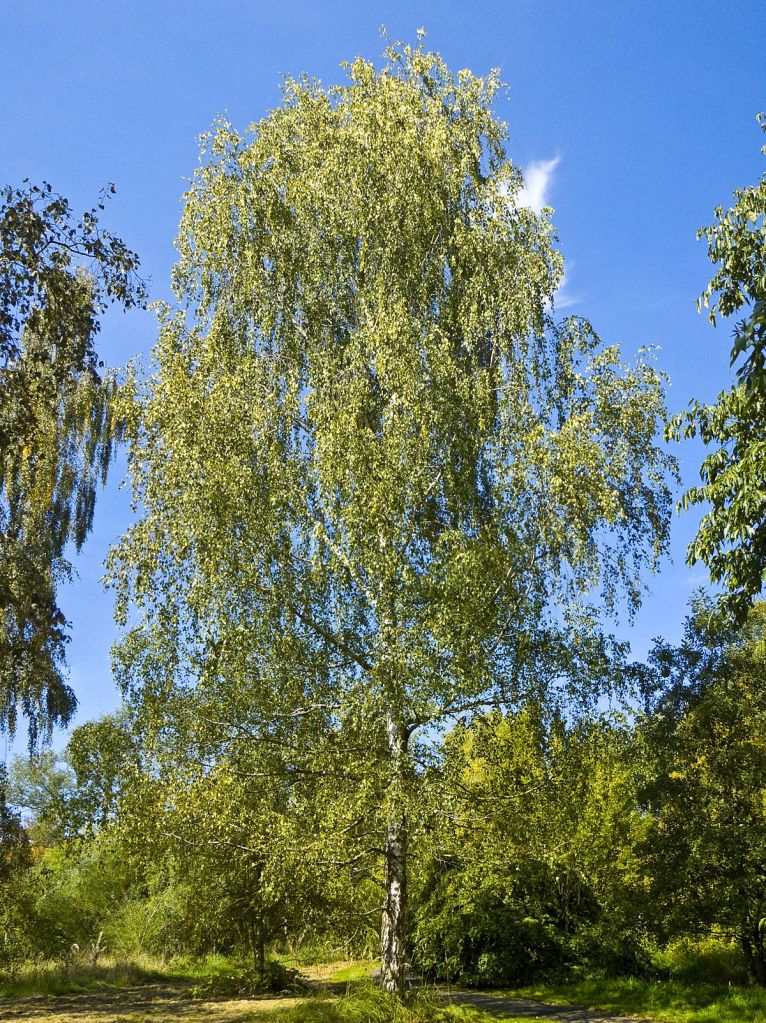
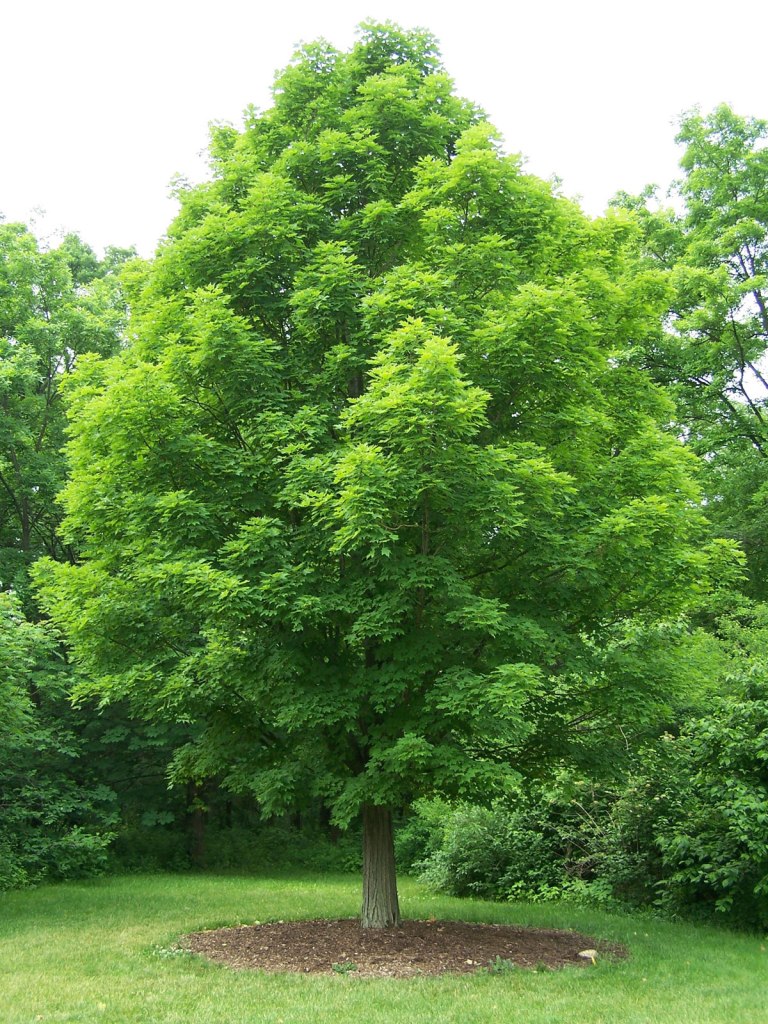
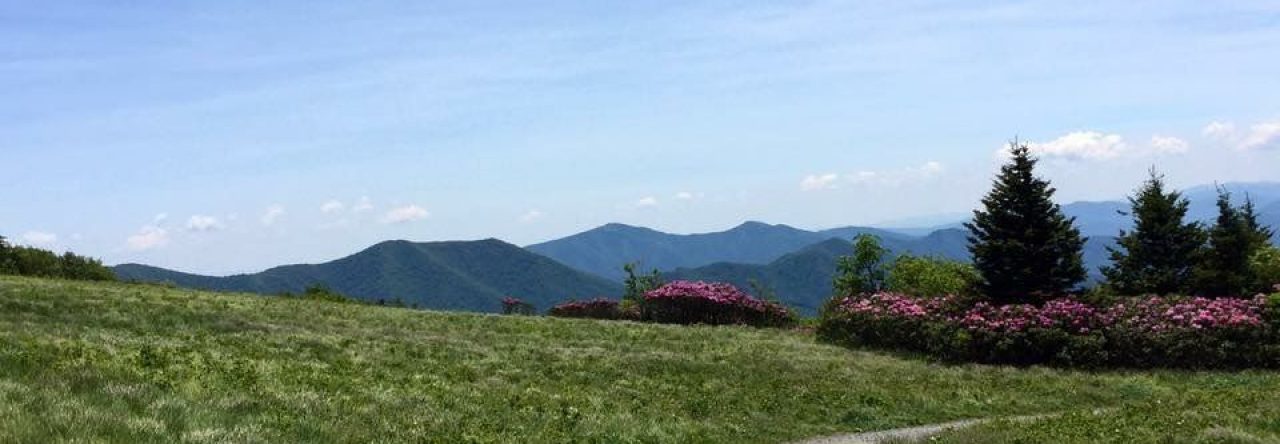
Since I read the books as a child, I had no real concept of what different kinds of trees looked like. Growing up in Southern United States, the most common trees around me were birch, maple, oak, and ash. Tolkien only uses two of these species in his descriptions (oak and ash), but I undoubtedly pictured The Shire with the same trees that I encountered every day.

Tolkien Included:

Oak Trees

Ash Trees

I added:

Birch Trees

Maple Trees

At first, this may seem like a trivial matter, but it can have a very large impact on the visual landscape in the reader’s mind. For example, in Chapter three, the travelers (Frodo, Sam, and Pippin) stop in a “fir-wood” and make camp for the night:

“Just over the top of the hill they cam on the patch of fir-wood. Leaving the road they went into the deep resin-scented darkness of the trees, and gathered dead sticks and cones to make a fire” (FR, I, iii, 72).

Tolkien describes the hobbits setting up camp under a group of trees similar to this:

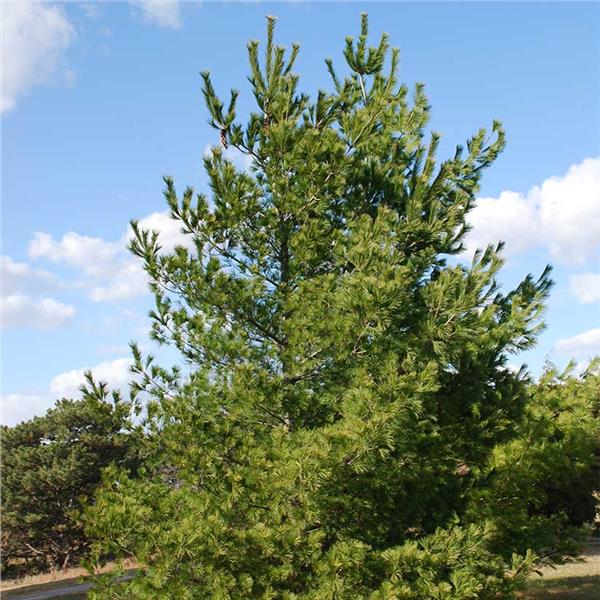
However, I had never seen fir trees. Using the context clues, I assumed that it had to be a kind of tree that had “cones.” Well, I was certainly familiar with one of those, we had dozens of pine trees in my back yard! So I pictured the three hobbits sitting in a group of trees that looked something like this:

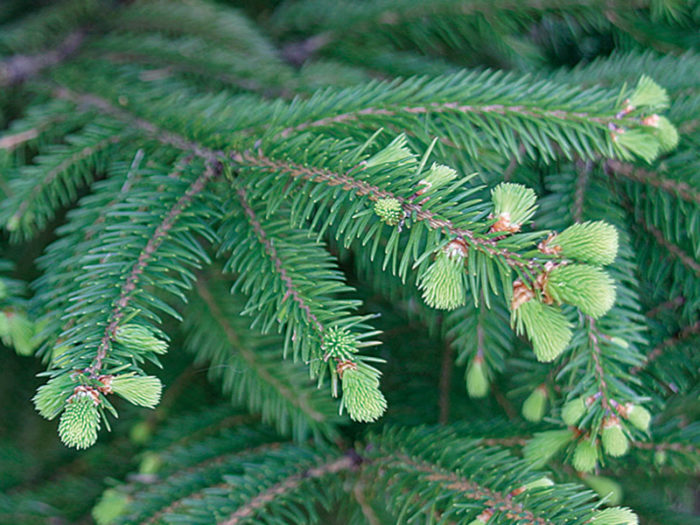
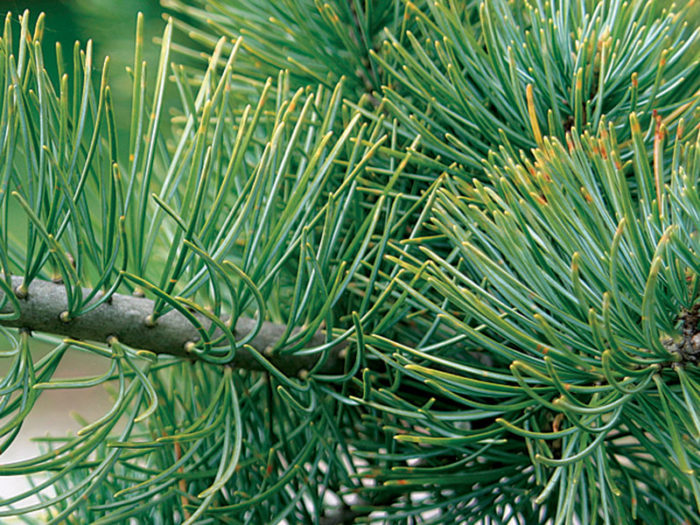
Now I know that many readers are saying, “They are all evergreen conifer trees, this really isn’t a big deal!” But I would ask you to look closer. Here is a close comparison of branches from each (images from http://www.finegardening.com/fir-vs-spruce-vs-pine-how-tell-them-apart):

Fir Needles

Pine Needles

This view shows you the very different appearance of each tree. Also, if you grew up with pine trees (or used one for your Christmas/Yule celebration) then you know that they have two very unique characteristics: they shed their needles and their sap is very sticky and odoriferous. This means that in order to start a fire under the pine trees, the hobbits would likely have had to clear a space among the fallen, dead needles of a pine so as not to start a larger fire than they intended! So while this distinction of trees is very small, it makes a very large difference in the impression it leaves on the reader.

In the end, The Shire that I pictured as a child had a few more birch and maple trees than Tolkien probably envisioned, and all of the fir trees were replaced with pine. This leads to a very different mental image and also changes the associations that the reader has with the trees. These differences of experience lead to different individual interpretations and responses to the text.

Old Man Willow

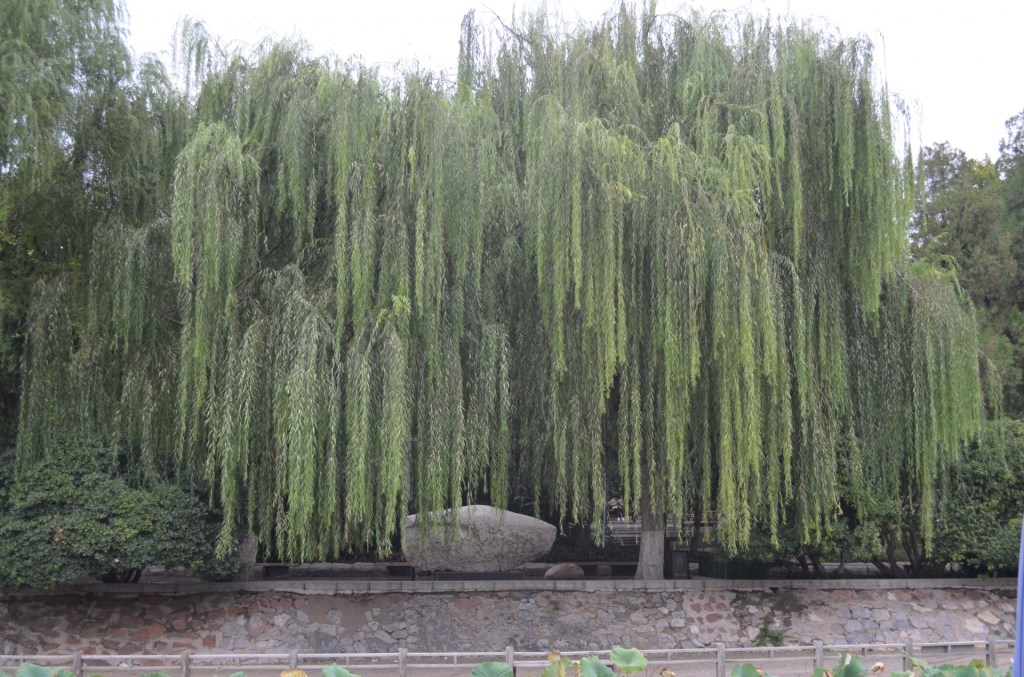
This actually explains why many of the artists who have portrayed Old Man Willow have made the dangling limbs shorter than I always imagined them. I had always thought that it was largely artistic license, since a curtain of dangling limbs is less appealing than a clear view of the action,. Perhaps this latter consideration still plays a role, but the fact that the types of willow in England ​and that many of them have characteristically shorter limbs than a Black Willow certainly reaffirms their decision.

Where Do We Go From Here?

I intend to have the first reflection on the character of a hobbit soon. I also want to look at the events with Farmer Maggot and the Barrow Downs before we head on to Bree.

What Do You Think?

What trees have you always pictured in the Shire?
Do you think that the kind of trees you imagine change the way you think about the setting?
How have you always pictured Old Man Willow?