Jasper’s Experience — Tolkien Experience Project (199)

This is one in a series of posts where the content is provided by a guest who has graciously answered five questions about their experience as a Tolkien fan.

To see the idea behind this project, or if you are interested in sharing your own, visit the project homepage. If you enjoy this series, please consider helping us fund the project using the support page.

I want to thank Donato Giancola for allowing me to use his artwork for this project. Prints are available on his website!

Now, on to   Jasper’s responses:


1. How were you introduced to Tolkien’s work?

I was perhaps 5 or 6 when my dad first started The Hobbit with me as a bed time story. We had an old set of all of the (then) published Middle-earth books bound in green leather and marbled card, and he would read for me every night. Once we finished The Hobbit, he began reading The Fellowship of the Ring, which might have been a little old for a 6 year old, but I loved it nonetheless. We moved on to The Two Towers when I was about 7, and I have the distinct memory of forgetting our copy when we went on holiday and my dad scolding me for forgetting it, but buying a cheap paperback version anyway so that we didn’t have to miss a week of Frodo’s journey.

2. What is your favorite part of Tolkien’s work?

When I was a child it was definitely the world he had built, the vastness and scope of the place that I felt fully immersed in, even during the long and unwieldy songs, and the Ent portions. As an adult, though, it’s got to be the linguistics. I actually chose to do my Masters degree in Historical Linguistics, with a focus on Old Germanic Dialects directly due to Tolkien’s own scholarship. Studying diachronic linguistics, then returning to the worlds and languages Tolkien created, you can really appreciate how much he loved both his academic and creative writing. The progression of Primitive Quendian to Common Eldarin, then to Quenya and Telerin, then down to Sindarin and all the different branches, is so organic. The detail with which he notes changes in phonology and morphology in The Etymologies is so exciting and mirrors his own studies into Proto-Germanic and its related dialects so beautifully. It’s hard not to get very nerdy about it right alongside him.

3. What is your fondest experience of Tolkien’s work?

The first Peter Jackson movie was released when I was 8, and my childhood best friend and I would spend hours in the fields around his house playing Rangers, fighting Orcs and speaking all the Elvish we could remember. We saw each other after school almost every day, and we didn’t stop playing our elaborate, dramatised Middle-earth games until we were 13.

4. Has the way you approach Tolkien’s work changed over time?

Absolutely. As I mentioned above, choosing to study linguistics in the same vein has given me a whole new respect for the world, languages and cultures that Tolkien created, however as an adult there are things now that I find wanting in that world. In many ways it was a product of its time (though it was as much a product of Beowulf’s time too) and as such there are limitations to the world-building that a current writer of Fantasy wouldn’t dare restrict themselves to. Fantasy nowadays without more than 2 or 3 women in an entire series feels off, as does a cast without representation beyond the White Brythonic/Norse cultures of Tolkien’s wheelhouse. I find now that as much as I love and respect Tolkien’s original works, I want people who are adapting and building upon his works to create something that better reflects those who are consuming it. Why should the beautiful, graceful races of Middle-earth be blonde haired and blue eyed? Why is it only ever the villains that are described in ways that evoke the cultures of People of Colour? Why should the sweeping romances be just between a man and a woman? In Tolkien’s day these things might have been out of the scope of most of his readers, but as seminal a work of Fantasy as he created in his world of Middle-earth, our world and its imaginations have grown exponentially, and any Fantasy should reflect that and take it in its stride. That’s one of the things I love about Tolkien’s work, though, it’s not difficult to imagine infinite different facets of life in Middle-earth. Whether that is Orcs really understanding what a ‘menu’ is, and therefore having a complex and nuanced culture of their own beyond being “villainous creatures”, or the truth of Dwarf women and the more complicated relationship Dwarves may have to sex and gender. There is so much more that Tolkien’s works can become when put in the diverse and variable hands of the people who love it.

5. Would you ever recommend Tolkien’s work? Why/Why not?

Yes, but I understand that it’s not everyone’s cup of tea. I would love people to love Tolkien as much as I do, but there is so much more Fantasy written now that is more engaging, easier to read, and better reflects its readers. Perhaps dipping a toe into Middle-earth might be appropriate for people who want the linguistics or the history, or just to see how newer Fantasy has been shaped by the success of Tolkien’s works, but I don’t think it’s necessarily an accessible, ‘one size fits all’ kind of Fantasy.

Madeline Bauer’s Experience — Tolkien Experience Project (198)

This is one in a series of posts where the content is provided by a guest who has graciously answered five questions about their experience as a Tolkien fan.

To see the idea behind this project, or if you are interested in sharing your own, visit the project homepage. If you enjoy this series, please consider helping us fund the project using the support page.

I want to thank Donato Giancola for allowing me to use his artwork for this project. Prints are available on his website!

Now, on to   Madeline Bauer’s responses:


1. How were you introduced to Tolkien’s work?

My mom read The Hobbit and all The Lord of the Rings to my brother and I when we were kids; we also watched the movies very young including The Return of the King in theaters. I just totally fell in love with the world and the wonderful characters.

2. What is your favorite part of Tolkien’s work?

I love the sensitivity with which he writes. Characters in Tolkien’s works have deep emotion – they laugh, they cry, they have strong bonds with each other. Relationships between characters feel real and when reading I care about them more than I’ve ever experienced with another fictional world. I also love how much artwork there is of Middle-earth – not just Tolkien’s own, but so many accomplished artists have shared their interpretations of his world.

3. What is your fondest experience of Tolkien’s work?

It’s so hard to choose! At this time, what comes to mind is the exhibit at the Morgan Library in NYC of Tolkien’s sketches, watercolors and some notes. It’s amazing how much of his creative process is still available to fans now, and he had such a great eye for landscapes.

4. Has the way you approach Tolkien’s work changed over time?

Considerably. As a kid even though I’d read the books I still very much was primarily a movie fan. And I still love the movies, they’re wonderful! But recently I’ve read The Silmarillion again and it is just full of great stories. Knowing those stories better has really deepened my appreciation for Tolkien’s other works and I’ll be excited to read The Lord of the Rings and The Hobbit again with The Silmarillion fresh in my memory.

5. Would you ever recommend Tolkien’s work? Why/Why not?

I would and regularly do, to anybody who will listen! I’ve also made some more friends recently who share my love for Tolkien so it’s also been fun to talk to people more regularly who already get it.

Lucy’s Experience — Tolkien Experience Project (197)

This is one in a series of posts where the content is provided by a guest who has graciously answered five questions about their experience as a Tolkien fan.

To see the idea behind this project, or if you are interested in sharing your own, visit the project homepage. If you enjoy this series, please consider helping us fund the project using the support page.

I want to thank Donato Giancola for allowing me to use his artwork for this project. Prints are available on his website!

Now, on to  Lucy’s responses:


1. How were you introduced to Tolkien’s work?

My father was an OG Tolkien nerd in the 60s/70s, and read The Hobbit and Lord of the Rings to me as a kid. I actually dodged an enormous bullet in that I was almost named Éowyn before the movies came out, after which it would have been… rough.

2. What is your favorite part of Tolkien’s work?

To be addressed in more depth in 4, but I’ve always appreciated that his work manages to be optimistic but not naïve about human nature. On a more personal note, my parents moved away from NYC shortly after 9/11, when I was still pretty young, and reading the trilogy to myself for the first time shortly after that gave me a huge soft spot for Boromir, as I too was extremely homesick and had a Minas Tirith/Manhattan-sized chip on my shoulder. He’s still hands-down my favorite, for even more reasons than that we’re both from objectively the best cities in our respective worlds—but it hurts a bit that I got to move back home.

3. What is your fondest experience of Tolkien’s work?

After we moved, my father stayed in NYC six days a week for work. I actually barely spoke to him in person until he retired when I was in my late teens, but until then, he wrote me two letters at least once a week. The first was from him, about everyday life. Mostly just goofy stuff when I was younger, but as I got older he told me about his childhood, complained about his boss, etc.

The second letter would be signed by and in the “voice” of one of several Tolkien characters, determined by whether: I liked them, he found them interesting, and he could think of a reasonably in-character reason for them to be writing to a random child in 21st century USA. I remember Bilbo (researching a book on Big People), Maedhros (as an exercise in writing left-handed), and Faramir (interested in foreign life) featuring most prominently, but there were quite a few others as well. Even after I was too old to suspend my disbelief, it was oddly reassuring to have pen-pals who I knew were written by my father and therefore cared about me, but would provide advice or insight that I could pretend wasn’t from a parent.

4. Has the way you approach Tolkien’s work changed over time?

Absolutely, especially given how young I was when I first read them. I’ve definitely become much more aware of and critical of a lot of the racial and religious biases in his work as I’ve gotten older, and a linguistics minor in college gave me a very cool perspective, but more importantly, I went to grad school for and now work in forensic psychology. I love it, but it’s a field that makes it easy to become very cynical, and (as referenced in 2) I think that Tolkien beautifully addresses the flaws of individuals without being hopeless about humanity at large. In my office, I actually have a framed watercolor of the quote:
“The world is indeed full of peril, and in it there are many dark places; but still there is much that is fair, and though in all lands love is now mingled with grief, it grows perhaps the greater.”

5. Would you ever recommend Tolkien’s work? Why/Why not?

I would, and I have, but the nature of my recommendation has evolved quite a bit over time.


You can find more from Lucy on Twitter!

Why Calling Tolkien’s Work “A Mythology for England” is Wrong and Misleading

The idea that Tolkien wanted to create a ‘mythology for England’ is still a popular notion among fans, and it needs to be clarified (and, to be frank, popularized) that this is no longer the prevailing opinion among scholars.

As Jason Fisher points out in his entry for “Mythology for England” in the J.R.R. Tolkien Encyclopedia: “This must surely be the most-often cited quotation that Tolkien never actually said” (445).

To find the source of the phrase, one must turn to the biography of Tolkien, written by Humphrey Carpenter. The idea of a ‘mythology for England’ is prevalent in two sections. First, Carpenter describes how Tolkien “read a paper on the Kalevala to a college society, and in it began to talk about the importance of the type of mythology found in the Finnish poems. ‘These mythological ballads,’ he said, ‘are full of that very primitive undergrowth that the literature of Europe has on the whole been steadily cutting and reducing for many centuries with different and earlier completeness among different people.’ And he added: ‘I would that we had more of it left – something of the same sort that belonged to the English.’ An exciting notion; and perhaps he was already thinking of creating that mythology for England himself” (Carpenter, 59).

The second occurs a bit later, when Carpenter quotes the now infamous letter to Milton Waldman, which I will quote later. For context here, just know that Carpenter prefaces his excerpt from the letter with “And there was a third element playing a part: his desire to create a mythology for England. He had hinted at this during his undergraduate days when he wrote of the Finnish Kalevala: ‘I would that we had more of it left – something of the same sort that belonged to the English.’ This idea grew until it reached grand proportions. Here is how Tolkien expressed it, when recollecting it many years later” (Carpenter, 89-90).

So, Let’s dig into the text of the letter to Milton Waldman. Here is the pertinent excerpt:

“Do not laugh! But once upon a time (my crest has long since fallen) I had a mind to make a body of more or less connected legend, ranging from the large and cosmogonic, to the level of romantic fairy-story – the larger founded on the lesser in contact with the earth, the lesser drawing splendour from the vast backcloths – which I could dedicate simply to: to England; to my country. It should possess the tone and quality that I desired, somewhat cool and clear, be redolent of our ‘air’ (the clime and soil of the North West, meaning Britain and the hither parts of Europe; not Italy or the Aegean, still less the East), and, while possessing (if I could achieve it) the fair elusive beauty that some call Celtic (though it is rarely found in genuine ancient Celtic things), it should be ‘high’, purged of the gross, and fit for the more adult mind of a land long now steeped in poetry. I would draw some of the great tales in fullness, and leave many only placed in the scheme, and sketched. The cycles should be linked to a majestic whole, and yet leave scope for other minds and hands, wielding paint and music and drama. Absurd.’ (Letters, 144-145)

The initial part of this excerpt makes it sound as if Tolkien would indeed approve of the phrase ‘Mythology for England’, which has been applied to his work. However, the entire idea is couched in language that undermines the proposal: “Don’t laugh!…Absurd!” Suggesting that Tolkien no longer wished to create such a mythology, or at the very least no longer saw the mythology he was creating as connected with England.

To be fair, Verlyn Flieger always warns that one must pay attention to who Tolkien is writing to in the letters. In this case, Milton Waldman was a publisher who Tolkien wished to convince to publish both LotR and The Silmarillion.

It is also worth noting that a close reader of Letters will also find the unsent letter from 1956 to Mr. Thompson where Tolkien also references this desire, and his desire does not seem as dormant there as it does in the letter to Waldman. This is less valuable evidence because we do not know who the recipient was to be and Tolkien never actually sent the letter, meaning he could have been in the process of considering his opinion.

In her own discussion of this letter in Splintered Light: Logos and Language in Tolkien’s World, Verlyn Flieger discusses this letter in her introduction. She reads the beginning and end remarks as indicating “a sensibility braced for ridicule” and that readers should still see that Tolkien “did not think his dream was nonsense or that his ambition was absurd, but that he took both very seriously indeed” (Flieger, xiv). Many other scholars have made similar claims and observations.

Perhaps the most notable scholar to promote this notion of the ‘mythology for England’ was Jane Chance. In her book Tolkien’s Art: A Mythology for England, she claims that the first point made by her text is that “Tolkien wished to construct an overarching mythology that was embedded in all his published fiction except for the fairy-stories and his medieval parodies” (Chance, vii). Her entire venture in her text is aligned with this conception of Tolkien’s work.

Literary scholarship, however is both an art and a science. It is an art because we are always dealing with inexactitudes and uncertainties. We can never know what an author ‘truly meant’, because we always have to rely on words, an imperfect medium, to communicate meaning. It is a science because it addresses and considers new information as it comes along in order to update and improve our understanding.

Recently, scholars have begun questioning this perspective on Tolkien’s work.

The first to question Carpenter’s use of the phrase ‘mythology for England was Anders Stenström. In his article “A Mythology? For England?”, Stenström diagnoses how Tolkien never used the phrase “mythology for England” in his own writing. Instead, this phrase was first used by Carpenter in his biography of Tolkien. Unfortunately, because the phrase was indexed in quotation marks it made the phrase seem as though it was originally from Tolkien.

I would like to point especially to the work of Dimitra Fimi. Her text Tolkien, Race and Cultural History is an essential text for any aspiring Tolkien scholar because it is a linchpin of modern Tolkien scholarship.

In her text, one of Fimi’s brilliant analyses follows the development of Tolkien’s framing devices in his works. She carefully demonstrates how Tolkien tried multiple framing devices in different narratives, including time travel in The Notion Club Papers, etc. These earlier framing devices could allow Tolkien to make Middle-earth into a mythology for England: “This ‘framework’ [time travel] would still make the mythology ‘belong’ to England, since the underlying idea was that time travelling through dreams accessed the collective unconscious of modern Englishmen’s ancestors. Through the use of this narrative device, the legendarium would still be a ‘mythology for England’” (Fimi, 129).

She goes on to talk about how Tolkien moved away from time travel as a framing device. She ultimately discusses his use of the Red Book as the framing device for LotR instead of these other framing methods. She concludes with this brilliant summation: “Tolkien did not choose to use this framework [time travel] in the end and the link of the legendarium with England practically disappeared’ (Fimi, 129). Instead, ‘the ‘Silmarillion’ would be the mythic and legendary history of the First and Second Ages of Middle-earth – a semi-fictional world loosely associated with northern Europe – not the long-lost tradition of England as The Book of Lost Tales or even the Notion Club Papers had been envisaged” (Fimi, 129).

Fimi goes on to discuss the potential reasons why Tolkien decided to make this change:

“Tolkien’s nationalism had waned, for one thing…in The Book of Lost Tales the emphasis was on England’s Anglo-Saxon past, in contrast with ‘Britain’ and the ‘Celtic’ tradition of Wales and Ireland. By the 1950s this opposition had lost its significance. I have explored elsewhere (2006b, 2007) Tolkien’s complicated relationship with ‘things Celtic’: how they crept into his legendarium right from the beginning, how they were later consciously inter-linked with the Anglo-Saxon tradition and how eventually Tolkien’s project ended up being a ‘mythology for Britain’ rather than ‘a mythology for England’. The Anglo-Saxonism movement also practically disappeared after World War I. The moment of English nationalism, which emerged at a time when the rest of Europe was searching for the soul of the ‘Volk’, had passed and in the inter-war period Englishness came to be associated with the simple ways of the English countryside, rather than with England’s glorified Anglo-Saxon ancestors. Tolkien’s hobbits and their provincial Englishness can be read as a move towards this alternative portrayal of England.” (Fimi, 129)

In other words, Tolkien tried several framing devices for The Lord of the Rings that would allow him to continue to position it as a ‘mythology for England’. Instead of using any of these, however, he developed the framing device of the Red Book and uses that instead. This choice severs the connection and creates a self-contained mythological cycle which is separate from England and its history.

Again, this small excerpt does not do justice to the breadth and depth of Fimi’s masterful and convincing analysis. Since her book was published (and I should mention that it received the 2010 Mythopoeic Scholarship Award from the Mythopoeic Society), it has revolutionized the way that scholars characterize Tolkien’s work. Most have abandoned the phrase ‘mythology for England,’ and those who still use it do so advisedly or with an allusion to earlier literature to contextualize that they are talking about an outdated concept for a specific purpose.

Unfortunately, Fimi’s analysis has not received the same popular attention as books by other notable scholars, like John Garth or Tom Shippey. This has led to perhaps one of the largest disconnects between parts of Tolkien fandom and scholarship.

Many fans still believe the concept of the ‘mythology for England’ was a driving force for Tolkien, and it is largely because they are unaware that there is newer scholarship. The reasons for this disconnect are varied and complicated and, quite frankly, would require another blog post even longer than this one to expound upon.

For now, then, I will conclude by encouraging people to stop saying that Tolkien wrote his stories as a ‘mythology for England.’ I would also encourage those who read this post and feel like they need a further explanation to read Dimitra Fimi’s book. It really is some of the best scholarship currently available on Tolkien’s work.

Works Cited

Carpenter, Humphrey. 2000. J.R.R. Tolkien: A Biography. (New York: Houghton Mifflin).

Chance, Jane. 2001. Tolkien’s Art: A Mythology for England, rev. edn. (Lexington, KY: University Press of Kentucky).

Fimi, Dimitra. 2010. Tolkien, Race and Cultural History: From Fairies to Hobbits (New York: Palgrave Macmillan).

Fisher, Jason. 2013. “Mythology for England.” in Drout, Michael D.C. 2013. J.R.R. Tolkien Encyclopedia: Scholarship and Critical Assessment. pp. 45-447.

Flieger, Verlyn. 2002. Splintered Light: Logos and Language in Tolkien’s World, rev. edn. (Kent, Ohio: Kent State University Press).

Stenström, Anders. 1992. “A Mythology? For England?” in Patricia Reynolds and Glenn H. GoodKnight.1992. Proceedings of the Tolkien Centenary Conference 1992. pp. 310-314.

Tolkien, J.R.R. 2000. The Letters of J.R.R. Tolkien, ed. by Humphrey Carpenter (New York: Houghton Mifflin).

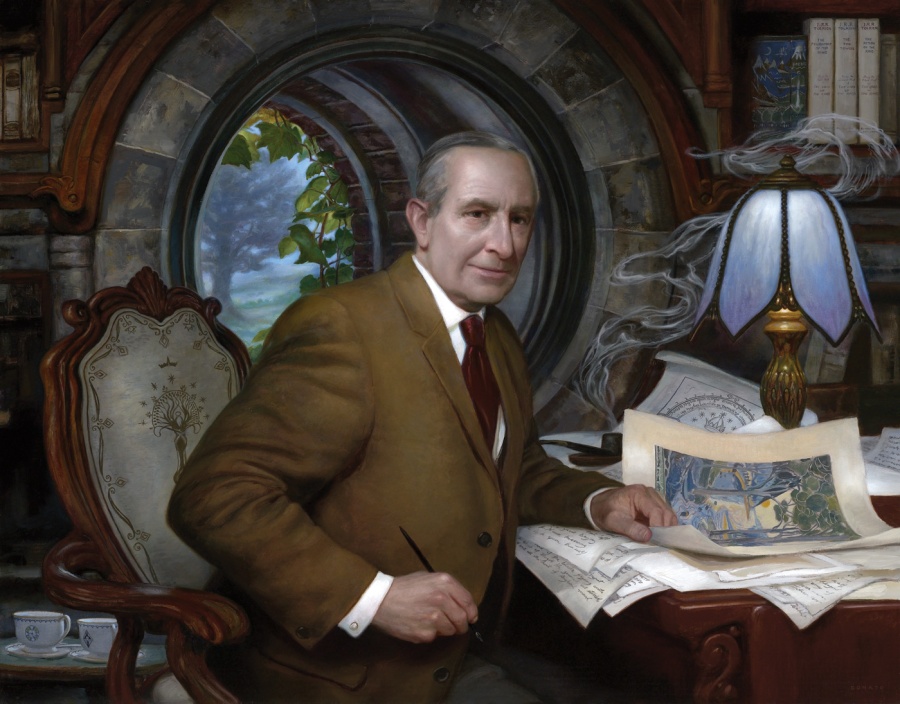
Chad Bornholdt’s Experience — Tolkien Experience Project (196)

This is one in a series of posts where the content is provided by a guest who has graciously answered five questions about their experience as a Tolkien fan.

To see the idea behind this project, or if you are interested in sharing your own, visit the project homepage. If you enjoy this series, please consider helping us fund the project using the support page.

I want to thank Donato Giancola for allowing me to use his artwork for this project. Prints are available on his website!

Now, on to  Chad Bornholdt’s responses:


1. How were you introduced to Tolkien’s work?

I did not realize it at the time, but in my cartoon-filled pre-teen days I saw the Rankin/Bass The Hobbit and The Return of the King along with Ralph Bakshi’s The Lord of the Rings. Back then I believed them to be just any other cartoon and it was not until a coworker told me that Peter Jackson was filming a movie that I would love that I investigated, devoured, and repeated the books for the past 20-plus years.

2. What is your favorite part of Tolkien’s work?

I love the immense magnitude of the Legendarium, the complexity of the work, and every aspect within that world. As I learn more, I add more to this answer (but never remove.)

3. What is your fondest experience of Tolkien’s work?

Every time I see someone grasp a part of the Legendarium with which they have been having trouble, I feel a sense of accomplishment. (This is still ongoing!) Also, getting to personally interact with everyone is very high on the list.

4. Has the way you approach Tolkien’s work changed over time?

Definitely so: I get a lot of satisfaction from teaching Tolkien. As my comprehension improves and new media comes along to help in my teaching, I am constantly improving my approach. Every time I think of a new way to teach a phase of the Legendarium, I make a tool so others can learn from it at their own pacing. In the very beginning of my own journey I was warned to keep notes. I went overboard then and nothing has changed since.

5. Would you ever recommend Tolkien’s work? Why/Why not?

I am so confident that others will enjoy some aspect of the Legendarium that I always recommend it. When someone is confident that they will not enjoy it, I evaluate whether the reasoning is sound and go from there. I have come to the conclusion before that someone really would not enjoy it (rarely.)


You can connect with Chad Bornholdt on the Texas Tolkien website!

G. Connor Salter’s Experience — Tolkien Experience Project (195)

This is one in a series of posts where the content is provided by a guest who has graciously answered five questions about their experience as a Tolkien fan.

To see the idea behind this project, or if you are interested in sharing your own, visit the project homepage. If you enjoy this series, please consider helping us fund the project using the support page.

I want to thank Donato Giancola for allowing me to use his artwork for this project. Prints are available on his website!

Now, on to  G. Connor Salter’s responses:


1. How were you introduced to Tolkien’s work?

I was just over 5 years old when Fellowship of the Ring came out, so my early childhood was full of Burger King toys and Lord of the Rings movie tie-in games. Since my father was a diehard fan of the books and enjoyed many of these games, I grew up knowing the characters for as long as I could remember. By age 11 I had read The Hobbit multiple times, and by age 15 I had read The Lord of the Rings trilogy in full. Shortly after reading The Lord of the Rings trilogy, I saw the movies.

2. What is your favorite part of Tolkien’s work?

I enjoy the wide range of his work. Whether it’s the quaint Father Christmas Letters he wrote for his children, the more complex children’s literature of The Hobbit, or the tragic stories for adults in The Silmarillion, Tolkien always told the story well.

3. What is your fondest experience of Tolkien’s work?

I often think of the moment in The Fellowship of the Ring where the group is attempting to get through a snowy mountain pass, and Legolas pokes fun at the others as he treads lightly on it. It’s a lighthearted moment that shows how the characters have bonded during the quest, learned to joke with each other.

4. Has the way you approach Tolkien’s work changed over time?

As I have read more fantasy literature from Tolkien’s period (from Robert E. Howard’s Conan stories to T.H. White’s The Once and Future King), I have noticed how much the genre dialogues about whether might equals right. It’s interesting to me that Tolkien gives complex answers to that question – Faramir’s comment about not loving the sword, loving what it protects. I particularly find that position interesting in light of Tolkien’s World War I service.

5. Would you ever recommend Tolkien’s work? Why/Why not?

I would definitely recommend Tolkien’s work to readers who want an introduction to fantasy. The Hobbit provides a great way to enter the genre without feeling too challenged, and transitioning from that into The Lord of the Rings gives a gradual dive into more complex work. I also love how Tolkien’s work is enjoyable but can never be accused of “juvenile escapism,” a label that gets thrown around a lot when dismissing fantasy literature.


You can find more from G. Connor Salter on his blog!

Carl W. Brown Jr’s Experience– Tolkien Experience Project (194)

This is one in a series of posts where the content is provided by a guest who has graciously answered five questions about their experience as a Tolkien fan.

To see the idea behind this project, or if you are interested in sharing your own, visit the project homepage. If you enjoy this series, please consider helping us fund the project using the support page.

I want to thank Donato Giancola for allowing me to use his artwork for this project. Prints are available on his website!

Now, on to  Carl W. Brown Jr’s responses:


1. How were you introduced to Tolkien’s work?

I came upon it on my own, the summer between 5th and 6th grade, age 10 in 1972. I also saw 2001: A Space Odyssey that summer, and generally say that I was never the same after those two things. Unlike perhaps most fans I read LotR first and then The Hobbit, which has given me an odd relationship to the first book because while I loved the story I wasn’t keen on the old-fashioned telling-the-story-to-children style. (I was greatly relieved when reading in Tolkien’s letters that he came to regret that tone himself lol). I was a senior in high school when Silmarillion came out, which was easily the greatest book-publishing event of my life… my local bookstore saved the first copy they took out of the box for me.

2. What is your favorite part of Tolkien’s work?

I’ll answer this in both the meanings of “part”: in the broader sense the breadth and depth of his creation and the sweep of the narrative from the Elder Days to the end of the Third Age… very few authors have built worlds and peoples that live and breathe the way he did. In the what part of his works aspect, my single favorite moment is Gandalf and Shadowfax facing off against the Morgul-Lord as Grond shatters the gates of Minas Tirith and the horns of the Rohirrim echo off the mountain.

3. What is your fondest experience of Tolkien’s work?

The sheer delight of reading Silmarillion for the first time, having new Tolkien to read, and not just new but the core of the story really for the first time, and the experience of rereading LotR after reading Silmarillion for the first time, and the added depth of truly understanding the references to the Elder Days… closely followed by seeing Jackson’s version of Fellowship in the theater for the first time and marveling at how well it all was done.

4. Has the way you approach Tolkien’s work changed over time?

I still consider LotR my “favorite book”, and as an adult and an historian I am both more aware of his work’s limitations in terms of gender and racial issues but also able to analyze it in the context of both the time it was created in and the reasons for which it was made. His work has all the power and all the problems of most of the classic canon, which I think should be used but carefully examined to make their issues clear.

5. Would you ever recommend Tolkien’s work? Why/Why not?

The power and resonance of the quest story is undeniable, and in LotR there is little doubt that Tolkien did it as well as anyone ever has. For those fond of detailed world-building, the entire corpus would seem to be required reading. The continuing success of both the books and the 2 movie trilogies shows that it has an appeal even in the 21st century, and I would recommend it to those who like those things, perhaps with a caution that they might find it old-fashioned in several ways.


You can find more from Carl on Twitter!

Victoria Willey’s Experience — Tolkien Experience Project (193)

This is one in a series of posts where the content is provided by a guest who has graciously answered five questions about their experience as a Tolkien fan.

To see the idea behind this project, or if you are interested in sharing your own, visit the project homepage. If you enjoy this series, please consider helping us fund the project using the support page.

I want to thank Donato Giancola for allowing me to use his artwork for this project. Prints are available on his website!

Now, on to  Victoria Willey’s responses:


1. How were you introduced to Tolkien’s work?

My older brothers saw the Fellowship in theaters and that got them into the books. They would tell me about parts of it, sometimes showing me scenes or large portions of the films. Little did they know then, our mom was already somewhat familiar with Tolkien through her favorite author, C.S. Lewis, and later read The Hobbit aloud to my younger brother and me. One of my brothers gifted me the 50th anniversary single-volume edition for my birthday, then later, a copy of The Silmarillion.

2. What is your favorite part of Tolkien’s work?

Oh goodness.

My favorite book is The Silmarillion. I love all of them, but I’ve actually read The Silmarillion more recently and more times than the trilogy. I love how large scale the stories are and how they can suddenly zoom in and give so much detail like in “The Children of Hurin” or “Of Beren and Luthien”. I love the image of the two trees and the stars, characters like Finrod Felagund and Beleg Cuthalion, and the intense, palpable solitude of Eärendil searching the empty streets of Tirion. I could go on about The Silmarillion forever.

My favorite scene, aside from Eärendil, is where Aragorn heals Faramir and Faramir wakes and immediately knows who Aragorn is- better than almost everyone around him, despite having never met him before. That’s also the scene where it dawns on you what Kingsfoil actually means. And Faramir and Eowyn’s whole story in the Houses of Healing.

My favorite element or theme in all the works is probably just the acknowledgment of how an experience can change you so much that you don’t quite fit in your normal home anymore. You start longing for somewhere that’s more “home” than home. And that never leaves. Sometimes it’s a traumatic experience that does it, like bonding with a company of dwarves and then watching some of them die, or carrying a cursed object all the way across the world. But other times, it happens by experiencing something good. Or just other. The forest of Lothlorien or Fangorn, the caverns of Helm’s Deep, or The Sea. People joke about how much Tolkien goes on about trees, but the way he talks about the Sea always hit me hardest and stuck with me the most.

3. What is your fondest experience of Tolkien’s work?

In 2012, a theater in our town did a showing of all the extended LOTR films, back to back and I got to go see them with my older brother and cousin. It was my first time seeing all of them together, seeing the Extendeds, and the first time seeing The Return of the King.

Much later, my mom- the one who read me The Hobbit– decided to read The Silmarillion aloud to my younger brother and I. I had already read it and probably talked her ear off about it. When it was describing the different Valar, she kept pausing to say “Oh, he’s just borrowing” about how some of them resemble classical deities, implying his work was less original for it. When we got to “Of Beren and Luthien” we stopped in the middle of the chapter and decided to finish it the next day. (She read them to us right before bedtime.) She then took the book to bed with her and finished that chapter herself and when we gathered to hear the rest, she actually said “Ok, pay attention, this story is really good…”

Mainly, though, I think my fondest experience is using it as a kind of shorthand language to communicate with other fans- friends and family. It gives me a vocabulary with which to express things that we don’t talk about much in everyday life, but definitely experience in some form or another. I can reference a scene with a very specific and hard to describe tone and others immediately know what I mean. Once, after turning in my last assignment of the semester in college, I sent a GIF of Frodo saying “It’s over, Sam!” to my siblings and one of them quickly texted back “Breathe the free air again, my friend!” Really, just sharing the experience of it all with others who love it as much as I do is the best part. 

4. Has the way you approach Tolkien’s work changed over time?

I used to be so annoyed when people would joke that Frodo and Sam were gay. And when it’s meant as an insult, or to imply that their relationship was anything other than wholesome, I still do. But as I’ve gotten to hear more from queer Tolkien fans who ship them and others, I think they mainly appreciate the portrayal of open and very genuine affection that is so rare even in literature and especially in films. I think how we categorize that affection, be it platonic friendship, loyalty, romantic love, or something else, matters less than the fact that it’s displayed in such a positive way. To me, at least. I’m not queer and I don’t personally read Frodo and Sam as a romantic couple, but I think I understand why so many do a little better.

5. Would you ever recommend Tolkien’s work? Why/Why not?

Absolutely. I understand that it can be hard to get through, even though I devoured it, so I don’t always recommend it to anyone. But I hope more and more people keep reading it. I love getting to share it with others.


You can find more from Victoria on her blog or on Twitter!

Quincy Wheeler– Tolkien Experience Project (192)

This is one in a series of posts where the content is provided by a guest who has graciously answered five questions about their experience as a Tolkien fan.

To see the idea behind this project, or if you are interested in sharing your own, visit the project homepage. If you enjoy this series, please consider helping us fund the project using the support page.

I want to thank Donato Giancola for allowing me to use his artwork for this project. Prints are available on his website!

Now, on to  Quincy Wheeler’s responses:


1. How were you introduced to Tolkien’s work?

When I was 10 years old, I was given a copy of The Hobbit by our dad. (Our dad had received a copy from his oldest brother when he was around that same age). I was immediately hooked and spent days just reading through all of The Hobbit and The Lord of the Rings and talking to my dad about every new event in the books. I then immediately shared it with my siblings, eventually encouraging my 5 younger sisters and 1 younger brother to love them in turn.

2. What is your favorite part of Tolkien’s work?

I love the ability of Tolkien to create characters that both delight and inspire, or both horrify and challenge me. His carefully-crafted world-building leads to endless fodder for the imagination, and I deeply appreciate his ability to share wisdom and humor in the midst of telling an epic story.

3. What is your fondest experience of Tolkien’s work?

From the days I spent devouring every page to first finish The Lord of the Rings in book form, to attending the midnight showing of The Fellowship of the Ring film the night of its release, Tolkien’s work always reminds me of family and a shared adventure to stand up for what is good in this world.

4. Has the way you approach Tolkien’s work changed over time?

I have been challenged to see how Tolkien’s work is perceived by people from different cultural, racial and life-experience backgrounds, and I have learned to appreciate deeply the needed efforts by so many talented artists, scholars and fans to make Tolkien more accessible to everyone.

5. Would you ever recommend Tolkien’s work? Why/Why not?

Yes, of course! While not everyone likes the kind of literature Tolkien writes, I want everyone to at least try to engage with his world because it is a place where we have found love, hope, and encouragement – and everyone needs a little more of that in their lives!

If you would enjoy hearing seven siblings talk about Tolkien’s work, you can check out our monthly podcast, “Seven Stars, Seven Siblings, and One White Tree” on whatever podcast service you prefer, and find our Twitter page at @7stars7siblings


You can find more from Quincy on his podcast’s Twitter or Facebook accounts!

Nadia Wheeler’s Experience — Tolkien Experience Project (191)

This is one in a series of posts where the content is provided by a guest who has graciously answered five questions about their experience as a Tolkien fan.

To see the idea behind this project, or if you are interested in sharing your own, visit the project homepage. If you enjoy this series, please consider helping us fund the project using the support page.

I want to thank Donato Giancola for allowing me to use his artwork for this project. Prints are available on his website!

Now, on to  Nadia Wheeler’s responses:


1. How were you introduced to Tolkien’s work?

My Dad and older brother read the books and talked about them to me as their favorite books. We also watched the animated Hobbit movie and Return of the King. When I was 10 I was allowed to read the books myself, which I did, and they became my favorite fiction books.

2. What is your favorite part of Tolkien’s work?

I love the epic and hopeful tone of the work as well as the hilarious and true to life characters. I appreciate the challenges it offers to me to live better and seek for more truth and justice.

3. What is your fondest experience of Tolkien’s work?

I have a memory of finishing “The Fields of Cormallen,” the chapter where they are celebrating the ring being destroyed, and closing the book because I didn’t want it to end. The words in that chapter still make me cry and feel as real as anything in life to me.

4. Has the way you approach Tolkien’s work changed over time?

Seeing the films as they came out and having the rest of the world enjoy something which had been more of a niche and a “test” for kindred spirits who also liked them has changed my perspective a bit. I love that Gollum is in everyone’s lexicon now and that people appreciate the brilliance of Tolkien, it’s been fun to share it with the world.

5. Would you ever recommend Tolkien’s work? Why/Why not?

Absolutely, and I would also recommend reading over watching it if you can. I also do a podcast with my seven siblings about Tolkien and our perspectives on the works having grown up in a Tolkien loving family and been part of the excitement as the films came out. You can find “Seven Stars, Seven Siblings, and One White Tree” on podbean, or whatever podcast service you prefer, and find our Twitter page at @7stars7siblings.


You can find more from Nadia on her podcast or her Amazon author page!