LotRFI Pt.11–Rivendell

I will readily admit that I was not an avid fan of the events in Rivendell when I first read LotR. As a young reader, it was very difficult to find the patience to work through the Council of Elrond, although the passages where the events of H were briefly rehashed and expanded upon were helpful. I think that I succumbed to the fault of many contemporary readers because I believed that chapters that did not have conflict, by which I mean battles or evading hunters, were boring. It was not until I completed the book and revisited Rivendell that I really understood its importance.
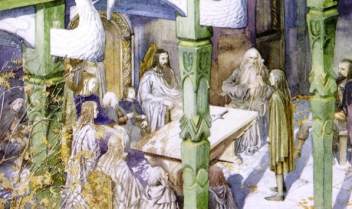
sda-alan-lee-the-council-of-elrond_orig
Image copyright Alan Lee

Aside from the Council, I always enjoyed the privilege of seeing Bilbo in Rivendell. His poetry was difficult to follow because I was unclear about the meter in my first reading and Aragorn’s joke about Earendil was over my head; however, my curiosity about Bilbo was piqued by the second chapter and I wondered what would happen to him on his latest adventure. I also enjoyed the bits of comedy that peek through in the Rivendell chapters. Pippin especially stood out to me as a cut-up who wanted to offer his opinions and was not afraid to talk back to his betters.

For me, the most notable event in Rivendell through the first several reads was the establishment of the Fellowship. I enjoyed learning who would join in the quest, and even looked back over the chapter to make sure I had all of the information about Gimli, Legolas, and Boromir. This is a pretty good spot for me to transition into talking about the characters of the Fellowship, so I will do so for the next several posts, and then come back to Rivendell before moving on into the quest.

Where do We Go From Here?

A brief pause in the chronological approach will let us reflect more on the characters of the Fellowship before we return to Rivendell and continue on the quest itself.

What Do You Think?

How did you approach the Council of Elrond in your first reading?
Were you forewarned about the length or content of the Council?
What about the other events at Rivendell?

PL’s Experience–Tolkien Experience Project (9)

This is one in a series of posts where the content is provided by a guest who has graciously answered five questions about their experience as a Tolkien reader. I am very humbled that anyone volunteers to spend time in this busy world to answer questions for my blog, and so I give my sincerest thanks to PL and the other participants for this.

To see the idea behind this project, check out this page

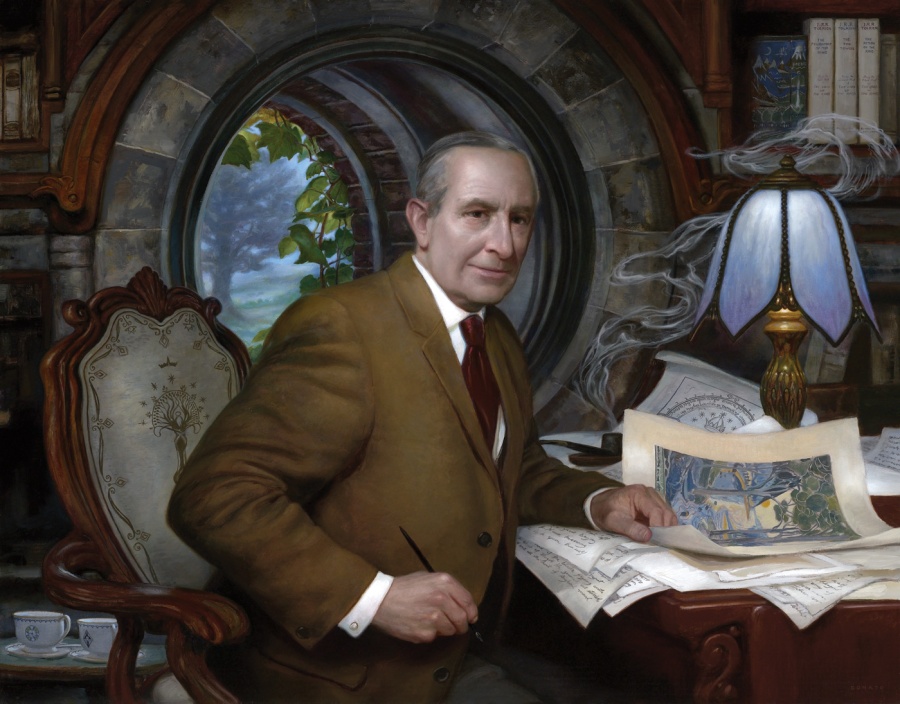
I want to thank Donato Giancola for allowing me to use his stunning portrait of J.R.R Tolkien as the featured image for this project. If you would like to purchase print of this painting, they are available on his website!

If you would like to contribute your own experience, you can do so by using the form on the contact page, or by emailing me directly.

Now, on to PL’s responses:


How were you introduced to Tolkien’s work?

A friend of my parents (English professor) gave it to me for my 10th birthday.

What is your favorite part of Tolkien’s work?

I used to say it was the Lord of the Rings but as I have grown older I have come to appreciate The Silmarillion far more. It is epic in scope, rich in description and full of complex, nuanced characters. Each time I read it I seem to find something new to explore–a character I may have overlooked, a turn of phrase that did not catch my attention on an earlier reading, details about a favorite character that I had not fully appreciated.

What is your fondest experience of Tolkien’s work?

Sharing my love of Tolkien with my children and having them share this love of Middle-earth with me.

Has the way you approach Tolkien’s work changed over time?

Yes. I used to reread it purely for enjoyment of the story and reunion with beloved characters. But now I have delved further into the scholarship and Christopher Tolkien’s later publications: HoME, Unfinished Tales, Letters, Hammond and Scull’s work, the Tolkien Professor and more. On first encountering Tolkien I was a child–the story and characters of The Hobbit and The Lord of the Rings appealed to me. I had a hard time with The Silmarillion initially–I was so excited to buy it when it first came out. I was 11 and I found it a difficult read at that time.

Would you ever recommend Tolkien’s work? Why/Why not?

I recommend it constantly. To children, young adults, adult friends. These stories are epic in scope but the characters are timeless. Flawed, funny, brave, grim, faithless, loyal–all characteristics humans share. The friendships in these tales are so uplifting.


LotRFI Pt. 10–Glorfindel, Gildor, and the Elves Pre-Rivendell

In my discussions of Aragorn, Bombadil, and Maggot I have established that my general approach to new characters during my first reading of LotR was skepticism and mistrust. The only new characters that this mistrust did not touch were the elves. This is a little ironic, given that I read H shortly before starting LotR. It would make sense, given the background of the Elf King of Mirkwood, that I would mistrust the elves, especially those wandering in the woods. It seems, however, that the impression left by Elrond had more of an influence on me as a reader of LotR.

alan-lee-feasting-with-the-elves_1
Image copyright Alan Lee

I was very quick to trust the elves. Once the Black Rider fled from Gildor Inglorion and his company, I essentially trusted elves from then on. I do not remember a single instance when I questioned this trust throughout LotR. Even when the Fellowship confronted elves in Lothlórien, I felt the tension between two factions on the same side but did not assume that the Galadhrim were evil. To rewrite the Frodo line from the meeting with Strider, I deemed that elves seemed fair and felt fairer. Even if this perspective is unique to me or is not entirely based on the published text, it has proved very significant in my understanding of Middle-earth. From the beginning of my experience, the elves were truly Good People. The evil loose in Middle-earth could not tarnish their spirits. They were the bright light in dark places, even among the trees of the Shire.

My interpretation of the elves owes a lot to the fact that Gildor’s people are aware of Bilbo’s farewell from the Shire, they call Bilbo a “good master” and they laugh in their dealings with the hobbits (FR, I, III, 80-1). The familiarity and kindness of the elves, along with their opposition to the Rider make them likable. I found myself, like the hobbits, cheered by their presence.

This feeling of wholesomeness extends to Glorfindel, although he meets the company under more dire conditions. While the group is struggling to get to Rivendell when they meet the elf, Glorfindel acts as a catalyst for action. He spurs Frodo on across the Ford and he helps the others confront the Riders. More significantly than this, however, is that Frodo glimpses Glorfindel “as he is upon the other side” (FR, II, I, 223). This cements the association between the elves and the ethereal, making explicit the goodness of the Good People.

The other-worldly view of Glorfindel not only reasserted the allegiance of the elves, but it prepared me to experience Rivendell as a place removed from the world. We will talk about Rivendell more in the next post, but for now I just wanted to link Glorfindel’s ability to be both in the world and yet detached from it as foreshadowing one of the essential qualities of Rivendell and Lothlórien.

Where Do We Go From Here?

The next post will be on Rivendell, then I should probably take a break from the plot-based approach to cover some of the characters who will be in the Fellowship.

What Do You Think?

What was your impression of the elves before you arrived at Rivendell (in LotR)?

Richard Rowland’s Experience–Tolkien Experience Project (8)

This is one in a series of posts where the content is provided by a guest who has graciously answered five questions about their experience as a Tolkien reader. I am very humbled that anyone volunteers to spend time in this busy world to answer questions for my blog, and so I give my sincerest thanks to Richard Rowland and the other participants for this.

To see the idea behind this project, check out this page

I want to thank Donato Giancola for allowing me to use his stunning portrait of J.R.R Tolkien as the featured image for this project. If you would like to purchase print of this painting, they are available on his website!

If you would like to contribute your own experience, you can do so by using the form on the contact page, or by emailing me directly.

Now, on to Richard Rowland’s responses:


How were you introduced to Tolkien’s work?

An English teacher (Mr Coot) I had for one term in 1965 read to my class for one period a week from The Fellowship of The Ring, by the end of that term he had finished reading the book to us. Sadly we got a new teacher the next term so this was not continued, however two of us got hooked.

What is your favorite part of Tolkien’s work?

This is a difficult one to answer. My favourite story from the First Age is “Of Tuor and his coming to Gondolin” – its a great pity this was never finished. Re: his non legendarium books my favourite is “The Fall of Arthur” and of course a favourite is Lord of the Rings.

What is your fondest experience of Tolkien’s work?

I guess this must be the first time I read Lord of the Rings in 1965.

Has the way you approach Tolkien’s work changed over time?

Yes definitely my approach has changed. As I have got older I have wanted to read more of Tolkien’s work – I only have Sir Garwain still to read, however my main interest is the Legendarium and not so much his other books.

Would you ever recommend Tolkien’s work? Why/Why not?

I always recommend Professor Tolkien’s work and have compiled a suggested order for reading his books. In my opinion no one else has ever compiled a fictional world that has so much depth – this is hinted at in the Lord of the Rings – however this only scratches the surface and any serious study of the legendarium must include the Silmarillion (although admittedly I still battle with the creation section). Also I strongly recommend people should see his paintings and sketches as Professor Tolkien was a very fine artist as well as being a good author. I recently showed my copy of J R R Tolkien Artist and Illustrator to a friend who only has a passing interest in Tolkien’s work and he commented that he was impressed with the variety of styles Professor Tolkien used depending on the context of the painting or sketch – something that I had not thought about before.


For more Middle-earth fun with Richard Rowland, check out the Middle-earth themed Facebook group that he moderates!

LotRFI Pt. 9–Strider Again

On the journey between Bree and Rivendell, Strider’s character becomes more complex, especially when the group arrives at Weathertop. The first suggestion that Strider is more than a roaming do-gooder is the fact that he has earned Gandalf’s respect. According to Gandalf’s letter, and Strider’s subsequent ruminations on how Gandalf would likely proceed, we understand that the two of them have often worked together and that they understand one another well. Just before they reach Weathertop, however, Strider’s learning is on full display. It is here that the ranger of the north divulges his knowledge of history. He answers the hobbits’ questions about Weathertop by sharing his historical knowledge of the area, then he relates some of the tale of Gil-galad.

To the surprise of all, Sam goes on to recite a bit of Gil-galad’s tale! This was a marvelous occurrence to me, as I did not expect it from Sam at all. He was listening to Bilbo closer than I ever gave him credit for! Unfortunately, Sam’s knowledge does not extend past this excerpt and he is unaware of its significance. Later, the hobbits request that Strider tell them the full story and he declines, saying that now is not the time. Instead,

“I will tell you the tale of Tinúviel” said Strider, “in brief—for it is a long tale of which the end is not known” (FR, I, xi, 191).

Then follows a lengthy poem that recounts the story of the meeting of Beren and Lúthien.

Fifth Day After Weathertop, by Ted Nasmith
Image copyright Ted Nasmith

This poem is significant for several reasons. First, it allows for exposition of Aragorn’s character and of the history of Middle-earth. This incident shows Aragorn to be knowledgeable of the lore of men and elves. Additionally, this sharing of lore seems to have the side-effect of forestalling the encounter with the Black Riders. They seem to lurk in the shadows until the tale is told and silence falls again. Finally, Corey Olsen posits that this is the moment in the drafting process where Tolkien decides to have LotR and The Silmarillion (not italicize because here it refers to the entire legendarium and not the published text) inhabit the same imaginative world. While this may be the case, when I first read the text, all I garnered from this episode is that Strider has much more wisdom than simply the skills of a tracker and forester. This sense is underlined after the events on Weathertop when Strider reveals that he has been to, and in fact lived in Rivendell for a time.

On Weathertop we see Strider’s real fighting skills for the first time. Contrary to how the movie adaptation depicts the scene, Strider does not use a sword in his combat against the Riders. Instead he uses fire brands to hold them off. This was significant to me in a couple of ways. First, it demonstrates that he is a formidable warrior in that he can adapt and use different weaponry when the situation dictates. Also, the imagery of Aragorn wielding the fire, a source of light, against the dark, shadowy Riders was symbolically important to me as a young reader.

The final insight I wanted to discuss about Strider is his use of Athelas on Frodo’s wound before Glorfindel arrives. This episode underscores Strider’s learning again, but it is not strange that a forester would have a bit of herb lore. The scene, however, demonstrates more about Strider than just his knowledge base. It demonstrates his emotional investment in the hobbits. Strider seems to genuinely care for the hobbits and he wants to ease Frodo’s suffering and delay the poison of the blade as much as he can. This care becomes more evident as this leg of the journey continues and he becomes increasingly worried about Frodo.

Where Do We Go From Here?

Glorfindel and the elves (pre-Rivendell) are next! Then we will cross the Ford and enter Rivendell.

What Do You Think?

What Aspects of Strider’s initial characterization change for you in this section? When?
​Did you picture Aragorn with a sword on Weathertop or not?

BlueberryMuffins76’s Experience–Tolkien Experience Project (7)

This is one in a series of posts where the content is provided by a guest who has graciously answered five questions about their experience as a Tolkien reader. I am very humbled that anyone volunteers to spend time in this busy world to answer questions for my blog, and so I give my sincerest thanks to BlueberryMuffins76 and the other participants for this.

To see the idea behind this project, check out this page

I want to thank Donato Giancola for allowing me to use his stunning portrait of J.R.R Tolkien as the featured image for this project. If you would like to purchase print of this painting, they are available on his website!

If you would like to contribute your own experience, you can do so by using the form on the contact page, or by emailing me directly.

Now, on to BlueberryMuffins76’s responses:


How were you introduced to Tolkien’s work?

My mother has owned the [LotR] trilogy, The Hobbit, and The Silmarillion ever since her teenage years and has always been fond of the latter four. In fact, I had to check out The Fellowship of the Ring from the library before I finally obtained my own copy because her copy (a paperback) had been loved and read so much it was missing the first fifty pages! So I became interested in them when I was in my early to mid teen years and have enjoyed most things Tolkien ever since!

What is your favorite part of Tolkien’s work?

Choose just one favorite part?!? As far as an entire book goes, I must say The Two Towers is my absolute favorite. However, my top two favorite stories are The Adventures of Tom Bombadil (one of my favorite characters) and Beren and Luthien as found in The Silmarillion, not The Lost Tales. I really enjoyed finally buying the book Beren and Luthien; having the various versions in one place is awesome!

What is your fondest experience of Tolkien’s work?

Again, that is a tough question! My favorite memories are writing fanfictions with my best friend, particularly about Dirhael and Ivorwen.(Their story is the third installment of our Legends of Love short series).

Has the way you approach Tolkien’s work changed over time?

I think my approach changed a little when I started writing fanfictions in college. I began researching more, finding I needed to learn more in order to make my stories accurate (although I will say I take a lot of license with some of them!). As I learned more about Tolkien’s life, it helped me to understand his writing a little more, especially why he seems to kill off so many people. He was certainly a gifted author and a very brilliant man!

Would you ever recommend Tolkien’s work? Why/Why not?

Yes! I quite frequently suggest people read the books since the films are so popular. While I do enjoy the movies, the books are ever so much better and contain a depth that the films do not and cannot accurately portray. The films even changed some of the characters’ personalities, so seeing the deviations from Tolkien’s written works are interesting. As I said before, Tolkien was quite a gifted author and certainly deserves his place in the classics!


For more great insights from BlueberryMuffins76, you can find her on The Council of Elrond and on FanFiction.net

LotRFI Pt. 8–About Strider

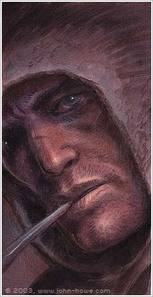
You can probably anticipate what my initial approach to Strider was. As with almost everything in the story, I was untrusting or even outright skeptical about him at first. Who was this shadowed figure trying to wheedle himself into the confidence of the hobbits? Unlike previous encounters where I held on to my preconceived notions longer than other readers might or where, however, I imagine that I changed my opinion around the same time as most other readers. I decided to trust Strider the same time that the hobbits did: after they see Gandalf’s letter and he proves that he is Aragorn by showing his broken blade.

I think part of the reason that I decided to like Strider is because the rest of the Breelanders did not like him. Frodo claims that


“You have frightened me several times tonight, but never in the way the servants of the Enemy would, or so I imagine. I think one of his spies would – well, seem fairer and feel fouler, if you understand.”

strider

I think that this passage helps to explain my own approach. Throughout the early parts of LotR, I had an innate mistrust of any characters that seemed fair, because their aspect is unbelievable (the elves are excluded from this, but we will talk more about that as we enter Rivendell). Therefore, my approach to this unknown world of Middle-earth was similar to Frodo’s own. I had reservations, often verging on misgivings, about people who seemed to be better than they were. Hobbits I innately trusted because they were familiar; for example, even though Maggot is daunting, he was still a hobbit, and so was not a source of fear so much as tension or conflict. Once the hobbits leave the Shire, however, most of their encounters were cause for alarm to me because each was an encounter with the unknown.

Strider is the exception to this rule so far. He mirrors the trajectory of Maggot in that he seems gruff and unlikable, but eventually grows into an ally for the hobbits. This is the first character that the hobbits meet outside the Shire who is not as he appears. The foreboding caused by Old Man Willow and the fear of the Barrow wights were appropriate responses and Bombadil really was a merry, if frighteningly powerful, fellow (even though I had my doubts). For the first time, a character who is not a hobbit presents some real complexity of character and does not fit in to his surroundings. This makes him intriguing to the reader and we want to know more about him. In fact, we, like Frodo, want all of our questions answered on the spot there in Bree. It is the artistry of Tolkien, however, to prolong the mystery and only unravel Aragorn’s true significance bit by bit.

I will go a bit more into Aragorn’s lore and medicinal skills in my next post, as we approach and then descend Weathertop, but I did want to say a bit more about his character on the road, as it were, with the hobbits. I came to like Strider very quickly because he is direct in his guidance, but does not take himself so seriously that he does not have fun while with the hobbits. I think Jackson’s characterization of Aragorn strays quite a bit here. The hobbits are the characters that readers are supposed to identify with, that is why the tale is told from their vantage point. This elevates Aragorn to be above the station of the reader. The reader does not like Aragorn as an equal, but appreciates the burden of his responsibility and his condescension in being a ranger and protecting the hobbits. This makes his character much more complex and interesting. Aragorn is not the character whose history we can understand or whose purpose we can see ourselves mirrored in, but the fact that he is willing to come alongside the hobbits and help them in their quest demonstrates a quality of character well beyond what is expected of individuals with power and station.

Where Do We Go From Here?

Next stop: Weathertop. Then I want to pause and talk about Glorfindel and elves before we head into Rivendell

What Do You Think?

What was your first impression of Strider?
Do you relate more to the hobbits or the men depicted in LotR​? Why?

Joe Hoffman’s Experience–Tolkien Experience Project (6)

This is one in a series of posts where the content is provided by a guest who has graciously answered five questions about their experience as a Tolkien reader. I am very humbled that anyone volunteers to spend time in this busy world to answer questions for my blog, and so I give my sincerest thanks to Joe and the other participants for this.

To see the idea behind this project, check out this page

I want to thank Donato Giancola for allowing me to use his stunning portrait of J.R.R Tolkien as the featured image for this project. If you would like to purchase print of this painting, they are available on his website!

If you would like to contribute your own experience, you can do so by using the form on the contact page, or by emailing me directly.

Now, on to Joe Hoffman’s responses:


How were you introduced to Tolkien’s work?

A classmate showed up with the Tolkien Calendar (Tim Kirk, 1975). I was curious, so he lent me the books on a Tuesday. I read The Hobbit in a couple of evenings, and inhaled the entire Lord of the Rings over the weekend.

What is your favorite part of Tolkien’s work?

It changes every time my life enters a new stage. At the moment, I enjoy imagining how Bilbo lived in the Shire in the years between The Hobbit and The Unexpected Party. I too am a sort of old man, happy with his books and his gardens. When I find likely youngsters, I make sure they‘re made aware of a wider world than the one about which their schools tell them. I too get occasional sidelong looks from my more respectable neighbors.

What is your fondest experience of Tolkien’s work?

In college, I loved to talk about books. But I’m a scientist, so my views about them were idiosyncratic and ignorant. I met an English major who thought my ideas were amusing, and who showed me there were other, much better ways to read books. Tolkien was the only author we both enjoyed. She married me.

Has the way you approach Tolkien’s work changed over time?

Of course! You can’t step into the same river twice, and you can’t read The Lord of the Rings the same way twice.

Would you ever recommend Tolkien’s work? Why/Why not?

I would recommend his books to anyone. Different ones first, depending on the person. Some people don’t like them; they are not of our Fellowship; no harm done. It would be a tragedy, though, if someone were a lover of Tolkien who never read him.


You can see regular blog posts about Tolkien and many other subject from Joe on his website: www.idiosophy.com

LotRFI Pt. 7–Signs in the Prancing Pony

We have finally arrived at Bree! As the first non-Shire settlement, there is much for the hobbits to adapt to and many new avenues of experience for them. Perhaps the plethora of innovations that the hobbits experience impacts the way that this scene can be interpreted in different ways.

In his Exploring the Lord of the Rings podcast, Dr. Corey Olsen suggested that Peter Jackson did not accurately portray the Prancing Pony in his film. According to Olsen, the great peril of the Pony is that it was so warm and inviting that it would put the hobbits off their guard, which could trick them into revealing more about their errand than they should. He denounced Jackson’s interpretation as far too scary and dark.

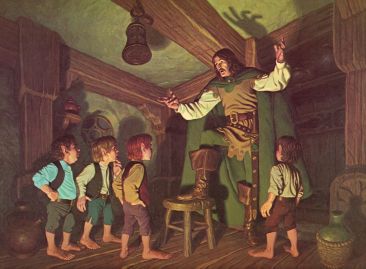
ba91a841b992bb1b6e1677f5bb14e45b
Image copyright Greg and Tim Hildebrandt

Personally, my own experience echoes Jackson’s interpretation more than Olsen’s, although I do see parts of the hobbits’ experience at the Pony as pleasant. While I can appreciate Olsen’s perspective, I always saw the common room at the Pony as in intimidating place because it is the first time that the hobbits encounter the Big People, if you will. Reading the scene as child, it resembled my own experience of entering a room of adults. The feelings of uncertainty and unease that occur to anyone who enters a room where they can assume that they are the least knowledgeable about the world and other people. This connection is obviously an extension of my reading of the hobbits as children.

While the common room unsettled me, I understood that the hobbits were at ease for part of their time there and relaxed for most of their time before going to the common room. Perhaps a more accurate assessment of my response would be that I thought the Pony was, to paraphrase Aragorn, both fair and perilous. The warmth of the caretaker and his staff were more than enough to allow any weary travelers to rest and be at peace. The inclusion of hobbit rooms at the Pony was certainly an unlooked-for balm for the hobbits as they relaxed from their travels. Once the hobbits are refreshed, they confront the world of the Bog People without being properly prepared. While the hobbits felt ease in the beginning of their encounter in the common room, it quickly became a source of intimidation and fear. Just as Frodo was aware of the danger before his fellow hobbits, so I, as the reader, was aware of the danger upon entering the common room.

This is partly because of the warnings that Merry and Pippin bandy back and forth before going to the common room. In Olsen’s opinion, most of these warnings are friendly ribbing among the hobbits. As a young reader, though I took them all very seriously. This put me on guard as they entered the common room, and Frodo’s misgivings only acted as a confirmation of my presuppositions. I do not think that the disagreement in interpretation here changes much of the characterization of important people moving forward. Therefore, it seems to me that this episode supports either of these two interpretations because later developments do not necessitate one interpretation over the other.

Where Do we Go From Here?

I would like to take a post to reflect on Aragorn-as-Strider and then probably move on to Weathertop and the lore that breaks in there.

What do you think?

What were your first impressions of the Prancing Pony or of Bree?
When, if ever, did you begin to mistrust the Big People?
What were your impressions of Butterbur, Hob, and Nob?

Geoffrey B. Elliott’s Experience–Tolkien Experience Project (5)

This is one in a series of posts where the content is provided by a guest who has graciously answered five questions about their experience as a Tolkien reader. I am very humbled that anyone volunteers to spend time in this busy world to answer questions for my blog, and so I give my sincerest thanks to Geoffrey and the other participants for this.

To see the idea behind this project, check out this page

I want to thank Donato Giancola for allowing me to use his stunning portrait of J.R.R Tolkien as the featured image for this project. If you would like to purchase print of this painting, they are available on his website!

If you would like to contribute your own experience, you can do so by using the form on the contact page, or by emailing me directly.

Now, on to Geoffrey B. Elliott’s responses:


How were you introduced to Tolkien’s work?

There’s not so much one watershed moment as a slow realization of and acclimation to the work. My local bookstore, Books to Share in Kerrville, more or less introduced me to the genre, and the shop’s owner, Gloria, made several suggestions that slowly spurred me to pick up Tolkien–beginning a series of re/readings that has continued for more than twenty years, now. (And which reminds me: I need to do the re-read again.)

What is your favorite part of Tolkien’s work?

Hm. Really hard to say with that one. I suppose the easy answer would be to cite some passage in Lord of the Rings, but, in truth, I’ve gotten more use out of “On Fairy-Stories” than just about anything else he wrote. While incomplete in itself, the essay forms a useful starting point for criticism of fantasy literature, one I’ve deployed on several occasions.

What is your fondest experience of Tolkien’s work?

Reading The Hobbit to my daughter. It was the first book I read to her (and I need to do so again), and having her infant self contentedly cooing and gurgling at me as I did…yeah. Good times.

Has the way you approach Tolkien’s work changed over time?

It could scarcely not. I went from being a passive consumer of the work to an avid devourer of it as I came up through high school. In college, Tolkien was a source of comfort, something of a cultural touchstone and a springboard for undergraduate research. In graduate school, it undergirded my early efforts and led to my MA project on Robin Hobb; as I have moved into and through my PhD and onward, it has fostered the Tales after Tolkien Society, which remains my primary engagement with the better parts of academe. Even now, Tolkien’s corpus continues to be a reference point for how I read fantasy as a genre.

Would you ever recommend Tolkien’s work? Why/Why not?

Clearly, there are problems with the writing. That the Middle-earth corpus arises from Tolkien’s linguistic project is clear, and the man’s poetry is not the best. Too, there are time- and place-of-composition-specific concerns that end to make modern readers cringe. But Tolkien’s work in fantasy is pivotal to the genre, and his work on older Germanic languages remains useful, so he still needs reading–with eyes open, of course.


You can see regular blog posts from Geoffrey on Tolkien, as well as other writers and education topics, on his fantastic blog: https://elliottrwi.com/

Full disclosure, I also work on the leadership team of the Tales After Tolkien Society with Geoffrey!