Nelson Goering’s Experience–Tolkien Experience Project (18)

This is one in a series of posts where the content is provided by a guest who has graciously answered five questions about their experience as a Tolkien reader. I am very humbled that anyone volunteers to spend time in this busy world to answer questions for my blog, and so I give my sincerest thanks to Nelson and the other participants for this.

To see the idea behind this project, check out this page

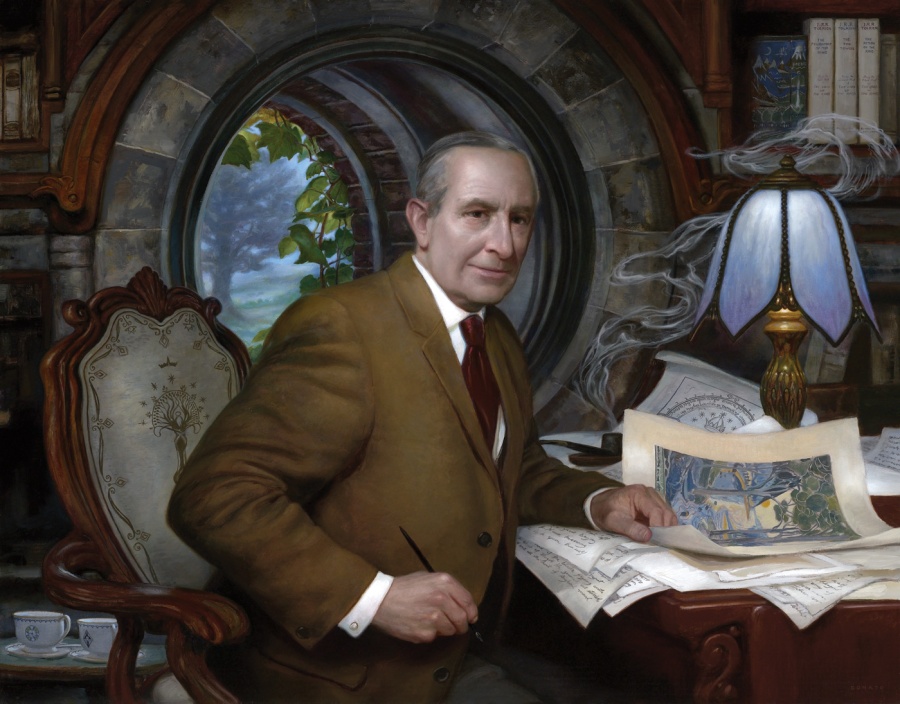
I want to thank Donato Giancola for allowing me to use his stunning portrait of J.R.R Tolkien as the featured image for this project. If you would like to purchase print of this painting, they are available on his website!

If you would like to contribute your own experience, you can do so by using the form on the contact page, or by emailing me directly.

Now, on to Nelson Georing’s responses:


How were you introduced to Tolkien’s work?

My parents read The Hobbit to me when I was 5 or so. I vaguely remember that I was initially reluctant, but my dad persuaded me to listen to him read the first chapter. That was all it took to hook me, and after that it was me asking them to read me The Lord of the Rings, and then re-reading both books many times on my own ever since. Tolkien’s other works came later. The Silmarillion I think I just sort of discovered on my own, on a bookshelf in the house (I’m not sure my parents had ever actually read it). I read that when I was about 12 (took me two tries: I started reading it during the summer one year, got stalled out, and tried again sixth months later — once I got past the initial cosmogonical bits, I finished it in two or three days). Things like The History of Middle-earth came later, when I started to get involved with online Tolkien communities, especially the Lord of the Rings Plaza.

2. What is your favorite part of Tolkien’s work?

Probably the later parts of The Hobbit, from their arrival at the Lonely Mountain through the Battle of Five Armies. These have everything that’s best about Tolkien: a strong feeling of the natural world, complex political tensions (even more complicated than is obvious at first glance), an elegiac tone as they wander in the ruins of the past, witty conversations, exciting action, and a dragon.

3. What is your fondest experience of Tolkien’s work?

Just sitting and reading, especially when the weather is doing something interesting, or while travelling. No one big moment stands out, but there are hundreds of small ones.

4. Has the way you approach Tolkien’s work changed over time?

I suppose it’s broadened a bit. Maybe the biggest change is reading his academic work, since I always have two hats on: my Tolkien fan hat, and my philologist hat. It’s odd reading something like his essay on ‘Ofermod’, which I think is thoroughly wrong in terms of argument, but is interesting to me as something Tolkien wrote. But the basic thing with his stories is to just sit and read and enjoy, and that hasn’t changed a bit for me, whether it’s The Hobbit, The Wanderings of Húrin, or The New Lay of Gudrún.

5. Would you ever recommend Tolkien’s work? Why/Why not?

I personally think Tolkien is the best writer of his generation, but I don’t actually recommend him very often. This is mostly because nearly everyone I know is already familiar with at least some of his writings anyway, and partly because I feel really good things are best stumbled across, not hyped up. I do sometimes recommend particular works by Tolkien, such as The Fall of Arthur, to people who I think might enjoy them but may not run across them on their own.

LotRFI Pt.19–Galadriel’s Mirror

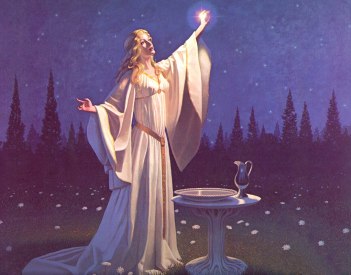
Finally, we come to Galadriel’s mirror and the surrounding scenes. Again, I must admit to a ‘misreading’ of an important scene in LotR. Since I did not trust Galadriel, my interpretation of her speech at the well was closer to Jackson’s than to mainstream Tolkien criticism. I did not like his over-production of the scene because I thought it was a cheap way to build suspense, but I did feel uncertainty in this scene while reading it. (I also started to grow exasperated with Frodo’s tendency to throw the Ring at any strong character nearby.) It was not until I understood the Arwen story from the appendices and started to read Galadriel’s history from S, that I understood the true nature of the interaction.

galadriel_orig
Image copyright Greg and Tim Hildebrandt

Beyond this observation, there is an element in these scenes that molded the way I interpreted ‘magic’ in Tolkien’s secondary world. The characterization of ‘magic’ throughout the Fellowship’s stay in Lothlórien left a profound impact on me the first time I read Tolkien’s work. It made so much sense to me that magical creatures would not interpret their own actions as magical, but as part of their life. It was a logical perspective, but one I had not considered before. The further characterization of ‘magic’ by Galadriel, wherein she expresses confusion about how it is applied to good and evil intentions was revelatory for me:

‘This is what your folk would call magic, I believe; though I do not understand clearly what they mean; and they seem to use the same words for the deceits of the Enemy’ (FR, II, vii, 362).

This rational approach to magic was so verisimilitudinous with the way that people who understand a concept dispel the mystery of those who do not that I was completely sold on the existence of ‘magic’ in Tolkien’s world.

Where Do We Go From Here?

I want to talk about the breaking of the Fellowship, then move in to the second volume!

What Do You Think?

What do you think of Tolkien’s characterization of magic?
Did you follow the Arwen subplot on your first reading?
​Did I miss something? Let me know!

Jay Karpowich’s Experience–Tolkien Experience Project (17)

This is one in a series of posts where the content is provided by a guest who has graciously answered five questions about their experience as a Tolkien reader. I am very humbled that anyone volunteers to spend time in this busy world to answer questions for my blog, and so I give my sincerest thanks to Jay and the other participants for this.

To see the idea behind this project, check out this page

I want to thank Donato Giancola for allowing me to use his stunning portrait of J.R.R Tolkien as the featured image for this project. If you would like to purchase a print of this painting, they are available on his website!

If you would like to contribute your own experience, you can do so by using the form on the contact page, or by emailing me directly.

Now, on to Jay Karpowich’s responses:


How were you introduced to Tolkien’s work?

I was 17 years old in 1978, we did not have cable TV back then, but where I lived there was something called Wometco. It was a over the air station that broadcast on UHF channel 50. During the day it was a Public Broadcast Station, but at 8pm every night they would scramble their signal and broadcast current movies. If you bought a $10 a month subscription, you would get a box for your TV that would unscramble the picture and sound. One of the movies that they showed was Ralph Bakshi’s animated The Lord of the Rings. Wometco would rebroadcast the same movies many times in a month so I saw the movie 5 or 6 times. I was immediately drawn into the story the movie was trying to tell. (I also found some of Bakshi.’s animations pretty cool for back then). But I was left hanging because the movie ended at the battle of Helm’s Deep, and no second part was ever made.
My sister who was at college at this time found out I saw and liked the movie. She told me she had the paperbacks in her room and to go borrow her copies if I wanted to read them. After reading them, I was hooked for life. And while I see the movie as a pale shadow of the literary work, I still hold a soft spot for it for introducing me to Tolkien, though I know many people hated it.
I then read The Hobbit, and The Silmarillion, (both borrowed from my sister again). But very soon bought my own copies, and any other works by Tolkien I could find.

2. What is your favorite part of Tolkien’s work?

There are many, and like everyone else, hard to point to just one. But to pick one, I would say the Horns of the Rohirrim. Horns, horns, horns. In dark Mindolluin’s side they dimly echoed. Great horns of the North wildly blowing. Rohan had come at last. Always gives me chills and misty eyes. Even the version of this in the Jackson movies does the same.

3. What is your fondest experience of Tolkien’s work?

That would have to be playing the MMO The Lord of the Rings Online. I have always been a gamer going back to pinball games through console games and computer games. Was lucky to be invited to play LOTRO in it’s beta testing days, and have now been playing it for over 11 years. The development team has done a fantastic job of story telling and in their own way fleshing out parts of Tolkien’s works that he left vague. And just to be able to run around in Middle-earth, though it be a digital version, is just too much fun to describe.

4. Has the way you approach Tolkien’s work changed over time?

Somewhat. At first I read the books or listened to the audio versions just for the joy and entertainment they brought to me. And each time I would find something new I missed before. Now, by listening to pod casts like The Tolkien Professor’s, and talking to other fans, I look at the works with a keener eye, looking for things that I may have missed or miss-interpreted before.

5. Would you ever recommend Tolkien’s work? Why/Why not?

Always have and always will. They are a wonderful body of work that I would want others to have the chance to love as much as I do.


If you want to hear more from Jay, he is on Facebook. You can also find him in Lord of the Rings Online as Linlen or Louni (on Landroval server).

My Early Tolkien Reading History

Many readers of my Tolkien Experience Project have asked me to share a bit of my own story. Here are a few recollections I have of my early Tolkien reading history. These are non-textual reflections, if you want more about my ideas about parts of the book, please check out my First Impressions series where I reconstruct my first reading over several installments!


One of my fondest early memories of The Hobbit was when a storyteller came to my elementary school and recited the entire book (from memory) to my fourth grade class in installments. This was a marvelous feat. I must have read the book shortly before then, because I remember following along in my head to make sure that he remembered every single word!

I went on to read LotR a few years after this. I vividly remember sitting in my seventh-grade science lab, the tall, black tables that were always icy to the touch, and pouring over the final chapters in RK.  This would mean that I finished the trilogy about a year before the Peter Jackson adaptations came out. Mind you, I was a fairly unconnected kid, so I did not realize that the movies were upon me at the time of reading. I thought I had found this secret treasure that I was one of the lucky few to read.

In eighth grade, I had to present a biography in my English class, so I naturally chose to present on Tolkien. This was the first time I ever bought a book to do research about another book or its author, so in a way, I owe some of my first scholarly impulses to Tolkien. Unfortunately, an eighth-grader does not know how to sift through critical material, so I ended up purchasing Grotta’s Architect of Middle Earth and Day’s The Hobbit Companion. Another unfortunate decision was to buy the large hardback edition of both of these books. It is the burned hand that learns best, I suppose.

Later that same year, I saw The Fellowship of the Ring movie and I was a bit of a purist, to be honest. Then again, what child isn’t a purist when it comes to a book they love? So I did not really get into the movies until much later.

The next huge development in my evolution as a Tolkien fan came several years later, I was in my second year of high school, when a nearby University where my mother worked offered a Tolkien course. My mother, knowing my love for Tolkien, audited the course with me. This was where I met Dr. Amy H. Sturgis and her infectious love for all things SFF and Tolkien.

This class forced me to reexamine many of my beliefs about LotR and Tolkien’s legendarium in general (and was really my first proper exposure to Tolkien’s larger legendarium, since I had failed in earlier attempts to read through S).
This led me to write the first real research paper in my life (a requirement in the third year at my high school) on Tolkien. The minimum page requirement was ten pages, and I wrote eighteen—yes, I was that student. Surprisingly, my teacher read it all and gave me marvelous feedback!


This is the end of my Tolkien journey up through high school. I may revisit this frame narrative again later on to fill in more details, or extend it on, we shall see!

LotRFI Pt. 18–Lothlórien

FR, II, vi starts with a good bit of character development: Aragorn laments his prescience; Gimli reflects at Kheled-Zâram; Legolas talks about the relations between his kindred and the elves of the Golden Wood; Boromir shares a mistrustful legend of his people; and the hobbits yearn for a return journey.

dsc-0115_orig
Image copyright IaValerosa from Iavalerosa.com

Once the company enters the Golden Wood, they encounter sentries from Lothlórien. These guards are mistrustful of the Fellowship and confront them with force. For the first time in my reading of LotR, I did not know if I could trust all of the elves in the story. The tension between the Fellowship and this small group of guards continues word arrives from Lothlórien that the Fellowship is expected and allowed to walk freely. I must admit that I was wary of the elves up until the Fellowship left Lothlórien.

I thought that the depiction of the Cerin Amroth and Caras Galadon were too good to be true. I suppose that this is another example of taking Frodo too seriously when he warns that the agents of the enemy seem fair and feel foul (to paraphrase FR, I, x, 171). Galadriel’s mind tricks when she greets the Fellowship certainly bolster this interpretation. As Boromir reflects:

‘Maybe it was only a test, and she thought to read our thoughts for her own good purpose; but almost I should have said that she was tempting us, and offering what she pretended to have the power to give’ (FR, II, vii, 358).

This made me question Galadriel’s motivation for welcoming the Fellowship. I knew that Aragorn has spoken of Galadriel as a friend, but I did not know if perhaps she had changed allegiances, maybe she was like Saruman. I should admit that I completely missed the relationship between Arwen and Aragorn in my first reading of the text, which means that I did not have this extra connection to reinforce the idea of Galadriel’s commitment to Aragorn.

Where Do We Go From Here?

I want to talk about Galadriel and her mirror a bit more, then on to the final chapter of FotR​.

What Do You Think?

Did you always trust the Lothlorien elves?
How did you interpret Galadriel’s temptations?
​Did I miss anything important? Let me know!

Silmarien Ingoldo’s Experience–Tolkien Experience Project (16)

This is one in a series of posts where the content is provided by a guest who has graciously answered five questions about their experience as a Tolkien reader. I am very humbled that anyone volunteers to spend time in this busy world to answer questions for my blog, and so I give my sincerest thanks to Silmarien and the other participants for this.

To see the idea behind this project, check out this page

I want to thank Donato Giancola for allowing me to use his stunning portrait of J.R.R Tolkien as the featured image for this project. If you would like to purchase a print of this painting, they are available on his website!

If you would like to contribute your own experience, you can do so by using the form on the contact page, or by emailing me directly.

Now, on to Silmarien Ingoldo’s responses:


How were you introduced to Tolkien’s work?

I watched Peter Jackson’s films when I was little and I absolutely loved them. But it wasn’t until I was 21 years old that I finally managed to read Tolkien’s works. When I was around 19, I came across a Wiki article about The Silmarillion. I remember the title struck me as somewhat ethereal and I made a mental note to read it. Coincidentally, around the same time, a friend told me he was reading it and advised me to read it as well. I tried but I found the beginning tiring and confusing. I tried again during the summer but I gave up for a second time. The next year, I had a Lord of the Rings [films] marathon and I became hooked. I searched for some details I was curious about and I was amazed to see that there was a whole mythology behind everything. Then, I managed to finally sit down and read the whole book [The Silmarillion].

2. What is your favorite part of Tolkien’s work?

It is the longing feeling that his works evoke about something you haven’t experienced but you wish it was real. And I love how his work succeeds in making me feel nostalgia. I reach the final pages of The Lord of the Rings or I read the poems and songs that various characters sing about the days of old and I can feel the depth of time, the world-weariness of the Elves in Middle-earth and their bittersweet nostalgia. You start the whole journey from The Silmarillion, throughout The Hobbit and finally The Lord of the Rings and when you are done, you feel as if you yourself experienced what you read. Finally, another favourite part is that a person reading Tolkien’s work can become a better person. You get influenced by the high and noble morals of the characters, you get motivated to go through difficulties and you can gain a whole new appreciation of nature; what I call “seeing the world through Elven eyes”.

3. What is your fondest experience of Tolkien’s work?

Undoubtedly, reading The Silmarillion for the first time. I cannot overestimate what reading this book did to me. I was completely astonished with its epicness and world-building, and the tragedies moved me as no other book has ever moved me. This book made me lose myself in a fantasy world.
Also, the friends I made. I became a member of online communities where I met some of the kindest and deepest people I could ever had hoped for. Those people were with me when I wanted to have someone to share my love (or rather obsession) for Tolkien’s works and we still talk everyday. You can tell the influence that Tolkien had on their character formation to an extent and this creates a peculiar, special bond between us.

4. Has the way you approach Tolkien’s work changed over time?

Definitely. I read Tolkien’s works before I started studying English Literature. So, everything was new and amazing. After I started my studies, I saw how extensively Tolkien was influenced by other literatures. This gave me a new perspective of his intellectualism and erudition, I realised that his work possessed the best elements of older works and motifs combined and improved with his own imagination and talent.

5. Would you ever recommend Tolkien’s work? Why/Why not?

I would certainly recommend it. It is the kind of high literature that is didactic and reminds us that it is alright to seek escapism once in a while. You can elevate yourself higher if you permit it to draw you in.


If you would like to see some of Silmarien Ingoldo’s fusions of Tolkien and other literature, visit literature-fusions.tumblr.com/

LotRFI Pt.17–The Gate and the Chamber

Honestly, I do not have much to say about Moria itself. The incident with Pippin and the well, I want to save for talking about Pippin’s development as a character, and I have already covered the death of Gandalf. The only other incidents that I paid much attention to in my first reading were the puzzle of the gate, including the fight with the Watcher, and the discovery of the Chamber of Mazarbul.

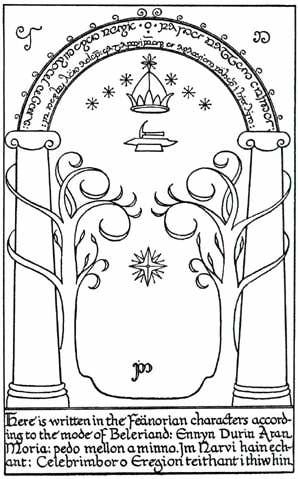
The puzzle at the gate was an interesting pause in the movement of the text for me. I liked how it acted as a hiatus from the onrush of foes to serve two purposes: to develop character more and to heighten suspense. The depth of character comes first. When the gates are finally revealed, Gandalf, Gimli, and Legolas all have dialogue which indicates that they have learned some of the lore surrounding the doorway and its design:

‘There are the emblems of Durin!’ cried Gimli.

‘And there is the Tree of the High Elves!’ said Legolas.

‘And the Star of the House of Fëanor, said Gandalf.

j-r-r-tolkien-doors-of-durin_orig
Image copyright J.R.R. Tolkien

Along the journey through the mines, Gandalf constantly turns to Gimli for counsel. These chapters start to establish the usefulness of having both a dwarf and an elf among the Fellowship; however, there is more to the scene at the gate than showing the learning of Legolas and Gimli, it also demonstrates the practicality of hobbits when the wise over think something simple. Out of the whole Fellowship, it is Merry who finds the hint for the words of opening. This demonstrates the importance of having characters with a practical approach to the world around them. While Gandalf and many of the others constantly seek to interpret events and artifacts for their deeper meaning, the hobbits often take things at face value and concern themselves mostly with the world of concrete reality. Frodo is perhaps the largest exception to this rule, though each of the hobbits grow a tendency to interpret events as the story progresses.

The second aspect of this scene comes with the introduction of the Watcher in the Water. This event is the second physical threat that confronts the Fellowship after Rivendell. Unlike the Wargs, however, the warriors seem stunned by the sudden appearance of this adversary. Sam leaps to Frodo’s aid, then Gandalf commands them to move on. Gandalf’s words “Rous[ed] them from the horror that seemed to have rooted all but Sam to the ground where they stood” (FR, II, iv, 309). For the second time in the same location, the hobbits have proved themselves worthy to be among the Fellowship. Despite how the movie interprets this event, Tolkien’s characterization of the action leaves more mystery surrounding the nature of the Watcher. I had never assumed that there was some gigantic octopus-like head which combined all the arms, nor did I assume that the Fellowship could hold their own against the Watcher. These were both additions from Jackson’s interpretation which I have never accepted.

14a-ae
Image copyright Anke Eissmann

The other interesting scene during my first reading was the Chamber of Mazarbul. I have to admit that, not knowing how long the trip through Moria was going to take, I felt like the plot dragged a bit in the Mines. It felt like an arduous trek through darkness, which I did not particularly enjoy. Therefore, I was elated when something finally happened three-fourths of the way through the trip. In fact, I remember setting the book down at least once and resuming later. It was not until the action resumed in Balin’s tomb that I regained my momentum for the story. The chamber, just like the gate scene, has the dual purpose of character development and conflict. First, this section expounds upon the history of Moria and Gimli’s attachment to it. Then, the major confrontation with enemies inside Moria begins with the vanguard that assaults the Fellowship in the chamber. The pace quickened here, and this propelled me into and beyond the next chapter, which I cover in my preceding post.

Where Do We Go From Here?

I think that the next stop will be to talk about Galadriel and her mirror.

What Do You Think?

Did I miss something in the Mines of Moria? Did you have another part that you enjoyed?
Do you like or dislike Jackson’s interpretation of the Watcher in the Water?

Jeffrey Hawboldt’s Experience–Tolkien Experience Project (15)

This is one in a series of posts where the content is provided by a guest who has graciously answered five questions about their experience as a Tolkien reader. I am very humbled that anyone volunteers to spend time in this busy world to answer questions for my blog, and so I give my sincerest thanks to Jeffrey and the other participants for this.

To see the idea behind this project, check out this page

I want to thank Donato Giancola for allowing me to use his stunning portrait of J.R.R Tolkien as the featured image for this project. If you would like to purchase print of this painting, they are available on his website!

If you would like to contribute your own experience, you can do so by using the form on the contact page, or by emailing me directly.

Now, on to Jeffrey Hawboldt’s responses:


How were you introduced to Tolkien’s work?

Via the film trilogy by Peter Jackson that went from 2001 – 2003.

2. What is your favorite part of Tolkien’s work?

The extremely detailed world-building and mythos.

3. What is your fondest experience of Tolkien’s work?

Reading the books for the first time during the winter months.

4. Has the way you approach Tolkien’s work changed over time?

Not really. Always been a fan, so my views of Tolkien’s works hasn’t changed over time, but rather, my view of the world and myself.

5. Would you ever recommend Tolkien’s work? Why/Why not?

Absolutely. They are not for everyone though.


To read more of Jeffrey Hawboldt’s thoughts on Tolkien, see his blog: insurrbution.blogspot.com

LotRFI Pt.16–Gandalf Falls

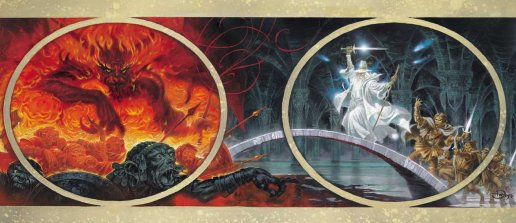
Gandalf was my favorite character from the beginning of LotR. As I noted in a previous post, I always found him mysterious and funny. Unlike H, Gandalf was present throughout LotR, so the reader has the chance to know him well. His character was so well developed that I could often laugh at the little word-games he played on the hobbits, while always taking his warnings seriously. This is probably why his death at the Bridge of Khazad-Dûm was so heart-wrenching for me.

My reaction was not immediate. I thought that it was surely some kind of trick, Gandalf would levitate out of the chasm somehow. It was not until the other characters reacted and the chapter ended that it finally sunk in. This death was sudden and unexpected. There was no dramatic pause in his fall, as the movie depicts, rather this famous line comes out of the pit while he is falling. Aragorn’s seizing of control and his determination to get the Fellowship out of Moria drives the reader on and does not leave time for reflection until the chapter concludes.

moria
Image copyright David Wyatt

I must admit that I cried profusely before I began reading the next chapter. . I ruminated a while on how nonchalant the passage about Gandalf’s death seemed. It was not built-up and magnanimous as Thorin’s in H.  Perhaps it was Tolkien’s war experience that taught him how death is a sudden separation. Unfortunately, when I read LotR, I was too young to know about literary tropes. I knew of the quest archetype, of course, but I had no indication whatsoever that Gandalf, as the mentor figure, had to leave in order for the rest of the fellowship to mature.

As much as the heights of Caradhras shaped my understanding of Tolkien’s world, the depths underneath the Bridge of Khazad-Dûm defined the terms of the quest. Suddenly, I became aware that the true hazard of the quest was death; abduction or discovery were no longer the worst possible outcomes, but sudden and permanent death. As someone who had read mostly “children’s literature” up to this point, death was not the consequence of failure in most of my reading. Perhaps this is the point when I realized that the world I entered weeks before was more than just a fantasy land, but there were dire consequences here, worse than in the real world (I was, and still am, fortunate in how few times I have had to experience the death of a loved one).

I will take a moment to clarify that, on my initial reading, I did not fall victim to either of two popular fan interpretations of this passage. I never believed that Gandalf meant anything other than “run” when he shouts the word fly. Also, I never had any notion that the Balrog had literal wings. I always read the passage which sparked this fan theory as a metaphor, and I suppose I never questioned it because the Balrog falls down the expanse. I probably just justified that he could not have fallen if he had wings. (Perhaps this is a bit easier with the naiveté and certainty of youth, as I never considered alternatives such as “the Balrog had wings, but their span was too large to be efficacious in the depths.)

Wayne A’s Experience–Tolkien Experience Project (14)

This is one in a series of posts where the content is provided by a guest who has graciously answered five questions about their experience as a Tolkien reader. I am very humbled that anyone volunteers to spend time in this busy world to answer questions for my blog, and so I give my sincerest thanks to Wayne and the other participants for this.

To see the idea behind this project, check out this page

I want to thank Donato Giancola for allowing me to use his stunning portrait of J.R.R Tolkien as the featured image for this project. If you would like to purchase print of this painting, they are available on his website!

If you would like to contribute your own experience, you can do so by using the form on the contact page, or by emailing me directly.

Now, on to Wayne A’s responses:


How were you introduced to Tolkien’s work?

I was first introduced to Tolkien in grade 10 by an English teacher who was using the Return of the King as a novel study. I was hooked immediately!

What is your favorite part of Tolkien’s work?

Not sure if you mean a particular piece or a central theme to his works, but I think the idea of good vs. evil against all odds has fascinated me, as it manifests in so many of his literary works.

What is your fondest experience of Tolkien’s work?

Ironically, my fondest experience is that it was the last major work that my now much older children let me read to them as a bedtime story. As early teenagers they sat with me every night while I read to them the adventures of Bilbo Baggins.

Has the way you approach Tolkien’s work changed over time?

I find myself reading one or more of his works each winter…. Something about this author’s writing whilst the snow flies appeals to my innermost Tolkien admiration.

Would you ever recommend Tolkien’s work? Why/Why not?

I would highly recommend any of Tolkien’s work….. And have many times over my 22 years as a high school teacher. I continue to use The Hobbit and The Fellowship of the Ring as mainstays for novel studies…. And students still enjoy them!