Ina’s Experience–Tolkien Experience Project (23)

This is one in a series of posts where the content is provided by a guest who has graciously answered five questions about their experience as a Tolkien reader. I am very humbled that anyone volunteers to spend time in this busy world to answer questions for my blog, and so I give my sincerest thanks to Ina the other participants for this.

To see the idea behind this project, check out this page

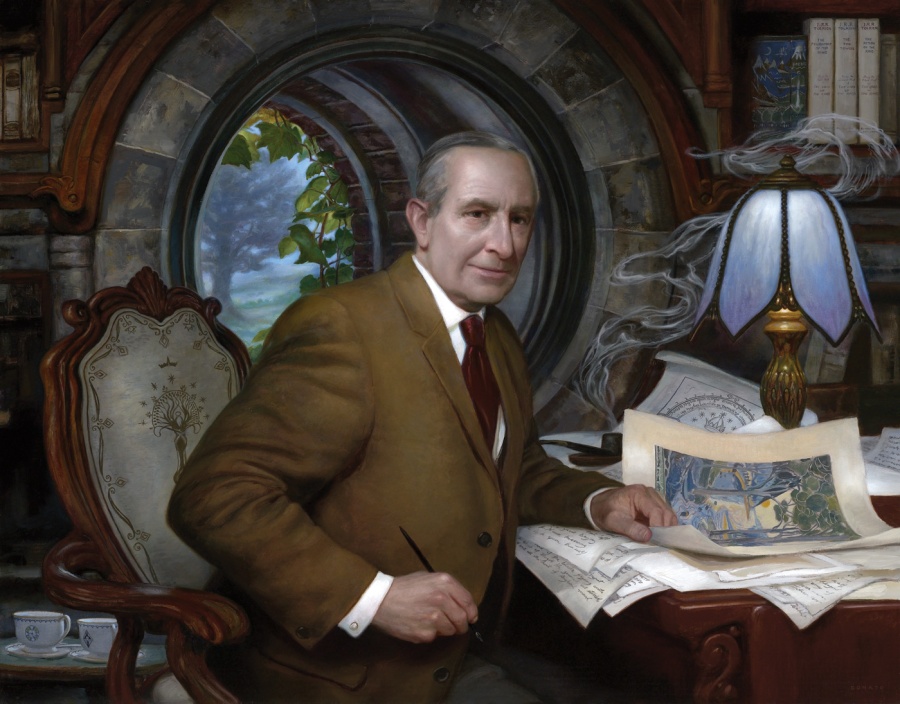
I want to thank Donato Giancola for allowing me to use his stunning portrait of J.R.R Tolkien as the featured image for this project. If you would like to purchase a print of this painting, they are available on his website!

If you would like to contribute your own experience, you can do so by using the form on the contact page, or by emailing me directly.

Now, on to Ina’s responses:


How were you introduced to Tolkien’s work?

I was introduced by my German/philosophy teacher at the German grammar school I was attending at the time. I was 17.
He gave me the three-volume German edition of The Lord of the Rings, published by Klett-Cotta. When I handed it back to him, he asked me if I had liked it, and I told him I hadn’t.
I also didn’t understand what the hype was all about. At the time, I didn’t understand why I hadn’t liked it.
Several years later, my English had improved, so I decided to read the original version (since I had been lucky enough to find an affordable one-volume edition with the appendices; English books used to be very expensive in Germany before the advent of Amazon).
I devoured the book within a few days and loved it!
I also realised why I hadn’t liked the German translation:

a) All the songs and poems were translated with rhyme and meter, which is commendable; however, the meaning/content went out the window, so I hadn’t understood the backstory of the ring and the history of Middle-Earth.

b) The prose of the German translation is by no means on a par with Tolkien’s use of language. Also, the translator had changed a number of the names to what he probably thought was easier for German readers. I only found it confusing.
I‘ve read it several times since then and love it more each time.

2. What is your favorite part of Tolkien’s work?

My favourite work by Tolkien is still The Lord oft he Rings, although I have also read The Hobbit and The Silmarillion.

3. What is your fondest experience of Tolkien’s work?

My fondest experiences are:

a) Reading such a magical, beautiful book in the original language.

b) Watching The Lord of the Rings Trilogy (the extended version). One thing I like about the films in particular is that the female characters are portrayed more strongly – and as stronger.

4. Has the way you approach Tolkien’s work changed over time?

Well, I’m 50 now and have a somewhat more mature approach (I hope). As a young adult, I read novels mostly for entertainment. Then I went to university to study English and learned much about literature, so I came to appreciate it more. Nowadays, I also want to know about the author’s and the story’s backgrounds.

5. Would you ever recommend Tolkien’s work? Why/Why not?

I definitely recommend Tolkien’s work to others – if at all possible, in English. The Lord of the Rings is a milestone of unprecedented genius. You can read it on many levels, starting from reading it simply for pleasure all the way to writing your thesis on it. It’s a marvel of world-building, which makes the reader see something new every time they read it. For me, it’s the best book of the 20th century.


LotRFI Pt. 24–Legolas

I always found Legolas’s character arc to be one that begins in haughtiness and becomes more approachable as he engages in the hardships of the Fellowship. Looking back with a wider literary reference frame than I had in my first reading, I would almost say that my first interpretation of his transformation would not raise any eyebrows if it were set in a Jane Austen novel, though his bow skills might.

lotr-19
Image copyright Alan Lee

He is always quick-witted, especially when engaging in repartee with Gimli; however, this arguing transforms into a light-hearted badinage by the end of their time together in Rohan. I always enjoyed watching these two become friends over the course of the tale and appreciated the note about their friendship in the appendices.

As an individual, Legolas is a formidable bowman, he does not defy the law of gravity mind you. He is always a reliable aid to his companions and he shows up when he is needed. For all of these elements, though, I never really felt drawn to Legolas as a character. I think his oft-mentioned ethereal nature made him seem remote from me as a young reader. He was a character to be marveled at, when he walks on the snow of Caradhras, for instance, but not related to.

I think this was underscored for me in Lothlórien when the elves are grieving for Gandalf. Legolas refuses to translate their song for the Fellowship and, by extension, the reader. This always made me feel as though Legolas wanted to be an outsider in some ways. Surely my interpretation of Legolas was, and is, a projection of a part of myself, in that I am reading what I would desire if I were to act as Legolas. To me, though, it is not until later when he volunteers to follow Aragorn on the Paths of the Dead that his desire for attachment is demonstrated.

Where Do We Go From Here?

I suppose we should talk about being ‘Orc dragged’ across Rohan.

What Do You Think?

What was your initial reaction to Legolas?
Did you like Jackson’s super-elf?
​Have I missed anything? Let me know!

Beth H’s Experience–Tolkien Experience Project (22)

This is one in a series of posts where the content is provided by a guest who has graciously answered five questions about their experience as a Tolkien reader. I am very humbled that anyone volunteers to spend time in this busy world to answer questions for my blog, and so I give my sincerest thanks to Beth and the other participants for this.

To see the idea behind this project, check out this page

I want to thank Donato Giancola for allowing me to use his stunning portrait of J.R.R Tolkien as the featured image for this project. If you would like to purchase a print of this painting, they are available on his website!

If you would like to contribute your own experience, you can do so by using the form on the contact page, or by emailing me directly.

Now, on to Beth H’s responses:


How were you introduced to Tolkien’s work?

I was first introduced to Tolkien’s work in late junior high or freshman year of high school when my sister brought home a library copy of The Hobbit. I may be remembering this wrong—what year of my life it happened. It had to have been before freshman year of high school. Then I think the Rankin Bass cartoon of The Hobbit was shown on TV and I liked it, so I read the book, and liked the parts about yearning for cupboard comforts the best, the Gollum scene second best, and the troll scene next best.

What is your favorite part of Tolkien’s work?

My favorite part of Tolkien’s work is The Lord of the Rings—and my favorite part of that is the hobbitry. Really the mixture of country bumpkins yearning for adventure, loving the comfortable life, but wanting to see more interesting things. It was the story of my life growing up in a small farm town before the Internet, feeling that there must be SO MUCH MORE out there. At first read through the Black Rider scare and intrigue hooked me so that I could not put the book down, and I fell in love with Glorfindel—as small a part as that was. He seemed to me to most clearly evoke what was beautiful—promisingly possible about elves. Makes you want to learn more about what life in his world would be like—but we never really get it, do we? We are always left wanting more.

What is your fondest experience of Tolkien’s work?

When I first read the LOTR I was all about the Englishness of it and cared the most about the hobbit story lines. I studied in England for a year in college and I blame the LOTR for planting a romantic idea in my head about what England would be. This was before I read The Wind in the Willows. Same kind of love, though. Love of nature and simple pleasures and yearning for adventure.

My experience changed most after finally being able to digest The Silmarillion—ONLY possible with the help of Corey Olsen and The Silmarillion Seminar podcasts. It was like being given the LOTR all over again, and this time the parts that I had previously found to be tedious (long descriptions of landscapes and chapters having to do with Gondor and Rohan) became the more interesting parts.

Has the way you approach Tolkien’s work changed over time?

Post Silmarillion Tolkien has become an extension of my spiritual life—in the sense that it provides another “in” to a sense of gratitude for beauty, the importance of sorrow and pity. As a writer I am always amazed by Tolkien’s skill. He is much loved but underrated, and many who try to copy him suggest that they miss most of what is great in his writing. By that I mean that the charm has less to do with the variety of creatures/sentient beings. Writing a story that has dragons and elves does not give you Tolkien, so the value lies elsewhere.

Would you ever recommend Tolkien’s work? Why/Why not?

I always try to get people to read Tolkien and try to keep Little Free Libraries near me always stocked, hoping to give that experience to another person. The first biggest value is in an appreciation of beauty in a biblical sense—“…and God saw that it was good,” and so do we.


LotRFI Pt.23–Treebeard

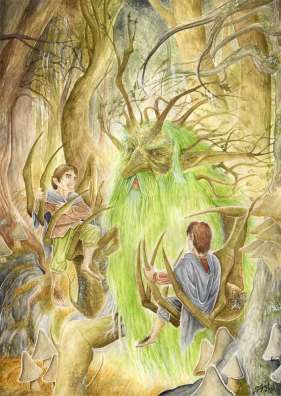
When I first met Treebeard, I was enamored! He was completely outside of the realm of my reading experience up to that point in my life. The closest character I had read about was the titular character from Roald Dahl’s BFG. I was amazed by this walking, talking tree. Unlike the other characters whom the company meet, I instantly liked Treebeard. His first passage is very similar to the humorously brusque tone that Gandalf sometimes adopts:

‘Almost felt you liked the Forest! That’s good! That’s uncommonly kind of you’ said a strange voice. ‘Turn round and let me have a look at your faces. I almost feel that I dislike you both, but do not let us be hasty’ (TT, III, iv, 463).

Per_Sjögren_-_Treebeard_and_the_hobbits
Image copyright Per Sjögren

The way that Treebeard tactlessly offers an unkind judgement of the hobbits, but then castigates himself for jumping to conclusions was endearing to me. I must admit that I was an inordinately tactless child. The remainder of his first day with the hobbits, getting to know them and taking them to shelter and to sustenance won me over. Interestingly, I sometimes imagine that what I felt about Treebeard is how many people recount feeling about Tom Bombadil. I supposed that I trusted Treebeard more because he seemed more natural to me. I did not suspect his motives because, unlike Bombadil, Treebeard would speak plainly about his motives.

Interestingly, because I grabbed onto Treebeard with my entire imagination, it deeply impacted me when he becomes angry on his way to drop off the hobbits. This tempestuous state of emotions is probably what lead the war march of the Ents to become one of my favorite songs from the text.

Where Do We Go From Here?

Legolas, Uruk-Hai, and Meduseld!

What Do You Think?

What was your first impression of Treebeard?
Where do you rank the Ent March among Tolkien’s songs?
​Have I missed anything? Let me know!

Dom N’s Experience–Tolkien Experience Project (21)

This is one in a series of posts where the content is provided by a guest who has graciously answered five questions about their experience as a Tolkien reader. I am very humbled that anyone volunteers to spend time in this busy world to answer questions for my blog, and so I give my sincerest thanks to Dom and the other participants for this.

To see the idea behind this project, check out this page

I want to thank Donato Giancola for allowing me to use his stunning portrait of J.R.R Tolkien as the featured image for this project. If you would like to purchase a print of this painting, they are available on his website!

If you would like to contribute your own experience, you can do so by using the form on the contact page, or by emailing me directly.

Now, on to Dom N’s responses:


1. How were you introduced to Tolkien’s work?

My dad gave me The Hobbit to read when I was in junior high. I remember we were going to visit my mom, who lived in another state. I started reading before we left and was so engrossed I couldn’t wait for us to arrive at my mom’s house so I could rush out of the car and continue reading. I continued to devour The Lord of the Rings (the old Ballentine editions). I devoured the books. I even told my family one night that I was skipping dinner so I could keep reading.

2. What is your favorite part of Tolkien’s work?

The richness of the text. His writing has so many layers. There’s so much to discover upon rereading the books.

3. What is your fondest experience of Tolkien’s work?

Two experiences. First, the first time I read the books (see above). I was hooked! Second, I presented a paper about politics in Lord of the Rings at Mythmoot and Mythcon. The paper was well received and I received very positive feedback from several scholars, including Prof. Corey Olsen. I won the Alexei Kondratiev Award for the paper and it was published in Mythlore (2014). So I am now a published Tolkien scholar!

4. Has the way you approach Tolkien’s work changed over time?

Definitely. As noted in the answers above, I went from reading the books as a young pre-teen on my mom’s couch to publishing an academic paper on Tolkien’s works. I loved the books as a kid for the epic action/adventure and vivid world-building. As I got older, I’ve grown to appreciate the themes and the writing style and the stories that influenced Tolkien.

5. Would you ever recommend Tolkien’s work? Why/Why not?

Of course. With that said, I would also say that Tolkien’s writing is not for everyone. Tolkien set out to create a fantasy story in the style of a medieval epic. He succeeded wildly, but I realize that’s not what all readers want or expect from epic fantasy. Some readers have complained about the book because Tolkien spends so much time with the Hobbits walking and walking and walking. I obviously love the books, but they’re probably not for the casual reader.


If you want to hear more from Dom, check out his great SFF blog: https://domnardireviews.wordpress.com or follow him on twitter: @Nardiviews

LotRFI Pt.22–Of Rohan

When I was a child, the character I identified with the most out of the whole book was Pippin. Somehow, though, the passages I loved the most were those in Rohan. I loved the descriptions of the open plains where horses could run for miles at a stretch. This is probably strange because I did not grow up around open plains, spending most of my time in the hill region in America’s southern states. I also only rarely had encounters with horses. I still very much liked the idea of horses, the riding of them, not the care of them. (If I were to confess all, I would have to tell of a certain early birthday party where my present was a horse ride.)

Pursuit in Rohan by Ted Nasmith
Image copyright Ted Nasmith

Nevertheless, I feel that I was drawn to the passages in Rohan because of their otherness. While I identified with the hobbits and saw their journey as something relatable, the expansive medieval world of Rohan was something I had only ever experienced in books and in my imagination. I certainly had no clue that the Rohirrim were inspired by the Anglo-Saxons, but I could feel the ancientry and sense of history that pervades the pages.

To get to more specific responses, I am sure that no consistent reader will be surprised by the fact that I was untrusting of Éomer when he first interacts with the Three Hunters. Perhaps I had a bit more reason to be mistrustful here than previously, as his men actually drew weapons on the protagonists. After his decision to gift them horses, I knew I would like him for the rest of the story, and I was not let down.

I will go into Théoden’s character in much more detail in a later post, but here I wanted to mention that he seemed to me a kind of father figure. Once Gandalf releases him from Wormtongue’s influence, he becomes a kind, generous leader. I must admit that I developed quite a soft spot for him and was grieved by later events.

This will have to suffice for a general introduction to Rohan. Much more to come!

Where Do We Go From Here?

I want to take a look at some of the events which take place in the opening chapters of book three, but I think we will also examine Legolas soon!

What Do You Think?

What was your first impression of Rohan?
When did you discover the tie of the Rohirrim to Tolkien’s day job?
​Have I missed anything? Let me know!

Nico Berger’s Experience–Tolkien Experience Project (20)

This is one in a series of posts where the content is provided by a guest who has graciously answered five questions about their experience as a Tolkien reader. I am very humbled that anyone volunteers to spend time in this busy world to answer questions for my blog, and so I give my sincerest thanks to Nico the other participants for this.

To see the idea behind this project, check out this page

I want to thank Donato Giancola for allowing me to use his stunning portrait of J.R.R Tolkien as the featured image for this project. If you would like to purchase print of this painting, they are available on his website!

If you would like to contribute your own experience, you can do so by using the form on the contact page, or by emailing me directly.

Now, on to Nico Berger’s responses:


How were you introduced to Tolkien’s work?

When I was freshly 15 and the second Lord of the Rings film had just been released, my father was in the living room rewatching the first one. I had seen previews for it but I misinterpreted it as a scary film, and I avoided those like the plague! But I was curious. It looked so beautiful, the elves in their glowing gowns and the characters looked medieval and magical. I loved that kind of thing, usually. I watched a few scenes, understanding nearly nothing, my dad giving a vague explanation since he hadn’t read the books, and when it was over I put the Blockbuster VHS back in. I watched it maybe 4 times in two days. I had so many questions – what is the Ring, how exactly does it have power, and most importantly, what happens next?

I looked into it, and the internet told me to read The Hobbit and then The Lord of the Rings. I found The Hobbit on my bookshelf at home and slogged through it, not really feeling compelled by the story, and then bought the trilogy. We left for Christmas vacation then, and bored in the Bahamas with my family (I’m not a beach person), I devoured the three books in 4 days. When I finished The Return of the King, it was already dark and I was supposed to be asleep. I didn’t know how it all ended. Needless to say, it’s so deeply heartbreaking and beautiful I hugged the book tightly and cried myself to sleep. When I got back home, I went to see The Two Towers, and got all the Tolkien books I could get my hands on. It’s been 15 years and I still reread and rewatch it all regularly.

2. What is your favorite part of Tolkien’s work?

So many things come to mind; small things that together are powerful. The depth of the languages Tolkien created (funny enough I am a Norwegian speaker via my mother, so I was able to grasp some of the Elvish structure already), the deep (and sometimes even boring!) history of this world, and the occasional sad endings or unfinished stories make for such a realistic world. It was exactly what I needed as a teenager to escape. It felt as real and full as this world.

3. What is your fondest experience of Tolkien’s work?

Kind of corny but that night I mentioned before: the story was so exquisitely sad, I felt as if I’d been stabbed. I was only 15, this felt like my first real heartbreak. All I could think was Frodo, Bilbo, Gandalf – I don’t want you to die. You made it through! I don’t want you to die. As soon as I’d read “‘Well, I’m back,’ he said.,” I hugged the book and sobbed. I’ve been a voracious reader since I was little, but no book had ever affected me like that. So it’s painful, my fondest experience, but by far the most potent book experience I’ll ever have.

4. Has the way you approach Tolkien’s work changed over time?

Yes! I’m 30 now, a linguist of all things, and I’ve studied Elvish and the Dwarvish runes quite a bit. I am essentially constantly in the middle of rereading the 17 Tolkien books I have on my shelf, which I either read intensely or passively between the other novels that come my way. I consider watching the films a nearly ritualistic experience, where I have to be in just the right mood and have done all the preparations before (freshly rereading the book on which the film is based). I spend more time now learning about Tolkien and his other nonfiction writings, whereas when I was a child the appeal was less academic and more about the sensation that it was all real. It’s gone from escapism to appreciation for me.

5. Would you ever recommend Tolkien’s work? Why/Why not?

To anyone and everyone. I really do believe reading is so very important, and exercising one’s imagination, and Tolkien’s work is challenging. It’s not written as accessibly as Harry Potter. I could write that fanfiction all day, it’s easy – but Tolkien writes like a learned scribe from a time long since past and it’s nearly impossible to mimic. Reading his writing style takes conscious thought to understand sentences you’d never hear in ordinary life, such as “Thy account has wrought in me much joy, for I am fain to learn of her fate.” Ok, I just made that up, but you know what I mean! Aside from the cognitive benefits of reading Tolkien, it’s just such a treasure trove. For example I also love Philip Pullman’s His Dark Materials trilogy – but that’s it. It’s just those 3.5 books. There’s not a lot more to dig into this world, whereas with Tolkien there is a near-endless supply of drafts, stories, and history to explore. Disclaimer: rumor has it Pullman is writing again, so hopefully I’ll be wrong soon. Also if someone could fall in love with these characters as deeply as I did, it’s worth it. Everyone deserves that feeling of magic.

LotRFI Pt.21–Boromir the Brave

In a previous post, I indicated that the death of Boromir was not the “breaking” of the fellowship, but its mending. Many readers may question my ability to see this act in such a positive light, given my previous post about my mistrust of Boromir. As I stated earlier, I saw Boromir as totally “corrupted” by the Ring, and this only exhibited itself when Boromir had a chance to fulfill his desires. To me, the fact that Frodo left the company means that Boromir, for all intents and purposes, could never fulfill his desire to obtain the Ring for use in battle. This allows him to be free to be a noble, valiant, courageous man in his final act. No longer under the burden of the ring, his true nature comes back. This does not undermine my earlier interpretation at all. In fact, it bolsters my perspective that Boromir was under the Ring’s influence for the entire trip.

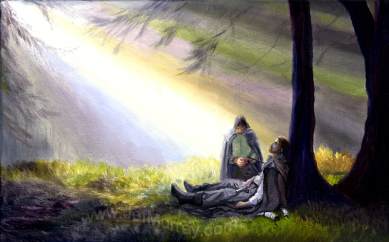
12-08-493-boromir-fallen-enh-800_orig
Image copyright Jef Murray

Several readers will identify the flaw in this reasoning, and I will remind them that I was eleven at the time. The fact is, Boromir did not know that the Ring was lost forever at the time of his sacrifice. He knew that Frodo had run away from him and that enemies were attacking. It is possible that Frodo could be hiding until the attack is over, then he could reappear and oust Boromir from the group. Whatever the case may be, my interpretation is not entirely supported by the sequence of events for the characters in the text. As a child, though, I already knew that Frodo was gone from the fellowship and out of Boromir’s reach, so this influenced my interpretation of events.

This is another instance of what can be called, and has been called by many (most notably Harold Bloom), ‘misreading.’ It is an interpretation of the text that is that a reader honestly holds until she/he later interprets the text in a different way. I should note that, while some of these ‘misreadings’ sometimes prove to be invalid after a later examination of the text, that does not change the important influence that such a reading can have on the reader. In fact, these misreading are an important part of the reader’s experience of the text, since the correction or alteration of interpretation is not a unique experience among readers.

Where Do We Go From Here?

Into the land of the Horse Lords: Rohan!

What Do You Think?

Do you have a ‘misreading’ experience like this?
If so, how has it changed your view of the text over time?
​Am I missing something? Let me know!

Liam Chung’s Experience–Tolkien Experience Project (19)

This is one in a series of posts where the content is provided by a guest who has graciously answered five questions about their experience as a Tolkien reader. I am very humbled that anyone volunteers to spend time in this busy world to answer questions for my blog, and so I give my sincerest thanks to Liam and the other participants for this.

To see the idea behind this project, check out this page

I want to thank Donato Giancola for allowing me to use his stunning portrait of J.R.R Tolkien as the featured image for this project. If you would like to purchase a print of this painting, they are available on his website!

If you would like to contribute your own experience, you can do so by using the form on the contact page, or by emailing me directly.

Now, on to Liam Chung’s responses:


How were you introduced to Tolkien’s work?

My mom religiously buys out library sales, and owns copies of almost every classic work of literature, from The Name of the Rose to The Great Gatsby. Naturally, she owned an absolutely ANCIENT copy of LOTR, and as a kid I was so enticed by the art and style of the books that I read The Hobbit at around 9. I didn’t get around to the rest of the books until I was about 13, but when I got there I fell in love with them, and after I finished reading them on my mom’s edition, I went out and bought my own leather bound copy.

2. What is your favorite part of Tolkien’s work?

Easy. When Samwise fights Shelob to protect Frodo at the end of The Two Towers. I still remember reading it for the first time, and being blown away. I especially remember glancing at the table of contents and seeing the name of the chapter, “The Choices of Master Samwise,” and being incredibly excited to get there, because (at the time) Samwise was my favorite character.

3. What is your fondest experience of Tolkien’s work?

I finished The Return of the King sitting outside in my backyard, and felt a powerful sense of peace after finishing that epilogue-esque ending with Sam returning home to his family. Nothing special, but an incredibly meaningful moment in my life.

4. Has the way you approach Tolkien’s work changed over time?

Yes. My view of the characters and their struggles has been put in context just by being able to sit with them for a couple years, and I’m sure it will continue. The most notable change was after I read The Silmarillion, and a lot of the prologue in Fellowship of the Ring was put into context. It completely changed how I viewed the entire adventure, because it made it more like these tiny figures marching through a world that’s much older and much more jaded than they are.

5. Would you ever recommend Tolkien’s work? Why/Why not?

Absolutely. I recognize it’s not for everyone, and the vast majority of people I recommend it to say “it’s so boring! I couldn’t finish it!” and at this point, I just sigh and move on. But it means a lot to me when I can actually talk someone into reading them and enjoying them. I remember I had this English teacher in high school who, upon finding out the LOTR was my favorite work of literature, proceeded to just absolutely trash them, saying how they’re a lazy children’s book where nothing happens. I’m not sure I’ve ever been more angry in my whole life, but I survived. I hope that one day she changes her mind.

LotRFI Pt.20–Breaking Up Is Hard To Do

Unlike the death of Gandalf, I saw the fissures forming in the Fellowship long before Frodo set out on his own. The decision seemed like the appropriate one to me, and I loved how Sam is the only member of the Fellowship that understands how Frodo is thinking; this understanding put Sam and me in a very small club together. This was one of the first scenes where I started to understand Sam’s depth. His ability to parse out his master’s actions and understand the animating emotions is more than I expected of Sam up to this point. We will have more on my interpretation of Sam later, when he really comes into his own.

cor-blok-19_orig
Image copyright Cor Blok

For now, I also wanted to focus on the importance of the “breaking” of the Fellowship. Many fans cheered Jackson’s decision to include the death of Boromir in the first film. I have to admit that I did not appreciate the change for several reasons. First, is the fact that Tolkien’s text is formatted in such a way to emphasize that the end of the Fellowship is not death, but the physical, and perhaps mental, splitting of the group. If death were the cause for the ending of the Fellowship, then the Fellowship was already broken in Moria. The end of the Fellowship, however, is when Boromir falls to temptation and tries to take the ring. This sparks an abiding mistrust in Frodo. This infighting and conflict is the brokenness indicated by the chapter title.

This idea is underscored in the first chapter of the second volume. Here, Boromir mends the rent he caused by dying for Pippin and Merry; furthermore, Aragorn indicates that, if the Fellowship remains true to one another, then it will not have been in vain, regardless of the outcome.

‘My heart speaks clearly at last: the fate of the Bearer is in my hands no longer. The Company has played its part. Yet we that remain cannot forsake our companions while we have strength left’ (TT, I, i, 419).

Therefore the “breaking” of the Fellowship is a temporary condition that exists in the gap between books two and three. It is rectified by Boromir’s death, not caused by it.

This sentiment is one that I felt when I was younger, but I could not really express it well. It has taken considerable time and reflection to be able to make it seem as clean and neat as it does here.

Where do wee go from here?

I want to focus on Boromir’s death a bit more, then head into Rohan!

​What do you think?

Did you like Jackson’s change?
What do you think is the true “breaking of the Fellowship?”
​Have I missed something? Let me know!