Bombadil Bingo, a Party Game or Teaching Tool

Today I had an IDEA!

Sometimes readers complain that the Bombadil chapters of The Lord of the Rings are too slow. While I do not share this opinion (especially because these were some tense scenes for me in my first read), I can certainly understand it! So while I was scrolling through a certain social network, I saw a bingo card that someone posted. I thought: “wait, is that Tolkien-inspired bingo? It is amazing what people invent!” Upon further investigation, it was just bingo for a different literary work.

At first I was disheartened because no one had invented Bombadil Bingo yet, then I realized with excitement: I had invented Bombadil Bingo! (Disclaimer: someone else may have already invented it and I am just unaware.)
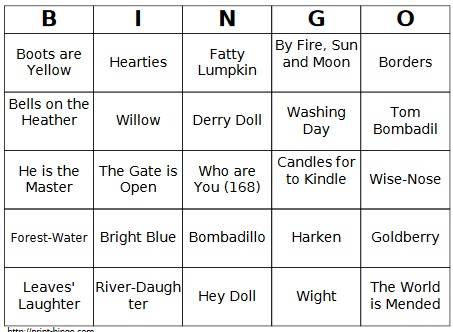
Bombadil Bingo

This can be used as a party game or as a teaching tool. I will cover the party game first, then suggest how I would implement it in the classroom!

Party Game Directions

Before the party starts:

  • either tell guests to bring their own copy of The Fellowship of the Ring, or a one-volume edition of The Lord of the Rings, or make sure to have several copies for them to use
  • Use the PDF at the bottom of this post to print off the bingo cards, then cut them out
  • Make sure you have a playing space large enough for your players, their cards, and copies of the text

Once the guests arrive:

  • Tell them that you are going to play Bombadil Bingo!
  • Give each participant a game card and then give these instructions:

Each of you has a game card. Each square on these game cards has words from the songs in the Tom Bombadil scenes in The Fellowship of the Ring. Your task is to search through these songs and find page numbers for the words in a given square. Once you find the page number, write it in the appropriate square. The center square is a ‘free’ square, so i have already provided a page number to get you started! The first person to fill in page numbers for five squares in-line (vertically, horizontally, or diagonally) will get a special treat! Remember: Tom Bombadil is in chapters other than “In the House of Tom Bombadil, so don’t forget to look at those scenes too!


Alternate activity:

  • Follow the same instructions, but have pairs of attendees work together!


(Please note: there are only ten cards, so if you want a larger party, you may have to make your own, or have multiple prizes since there could potentially be more than one winner.)


Teaching Tool Idea

What you will need:

  • The bingo cards from the PDF at the bottom of this page, printed and cut out for students.
  • An instructions slip with the block of instructions for students that I wrote below.
  • Students to have access to the book

Instructions:

The class period before your students arrive at the “House of Tom Bombadil” chapter in The Fellowship of the Ring, distribute the student bingo cards cut out from the PDF at the bottom of this post. Also distribute instruction slips that read as follows:

Each of you has a bingo game card. Each square on these game cards has words from the songs in the Tom Bombadil scenes in The Fellowship of the Ring. Your assignment is to search through these songs and find page numbers for the words in a given square. Once you find the page number, write it in the correct square. The center square is a ‘free’ square, so i have already provided a page number to get you started! Each student who fills in page numbers for five squares in-line (vertically, horizontally, or diagonally) will get a special treat!

*Remember: Tom Bombadil is in chapters other than “In the House of Tom Bombadil, so don’t forget to look at those scenes too!

I would not use this as a ‘reading check’ assignment. In other words, it should not take the place of a reading quiz or other assessment to check if the student has completed the reading. Instead, I would use it as a motivational tool to encourage them to complete their homework and to actually read the songs from the chapters instead of skipping them.

I would not ask for students to return their completed cards until after the “Fog on the Barrow Downs” chapter, because some cards will require that chapter in order to find a Bingo.

The reward is up to the teacher, but since there are only ten cards, and students can take their time to complete them, be prepared for multiple claimants! The easiest thing to do is to give them a bag of candy and all it “Barrow Treasure”!


*Please note that the center space is intended to be a “free” space. That is why it already has a page number for the words (it is also the only square where the words are pulled from dialogue instead of song). You may wish to update the page number with your edition in order to give guests or students a hint of where to look. Otherwise, you can just tell them that it counts as already found.

Bombadil Bingo cards


Dimitrios Kolovos’s Experience–Tolkien Experience Project (73)

This is one in a series of posts where the content is provided by a guest who has graciously answered five questions about their experience as a Tolkien reader. I am very humbled that anyone volunteers to spend time in this busy world to answer questions for my blog, and so I give my sincerest thanks to Dimitrios Kolovos and the other participants for this.

To see the idea behind this project, check out this page

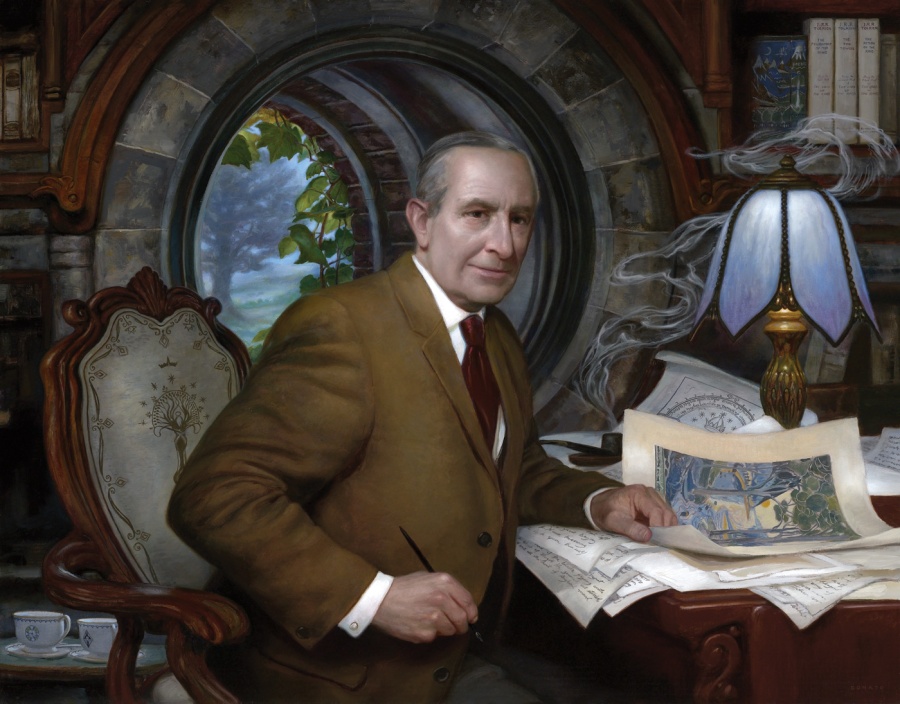
I want to thank Donato Giancola for allowing me to use his stunning portrait of J.R.R Tolkien as the featured image for this project. If you would like to purchase a print of this painting, they are available on his website!

If you would like to contribute your own experience, you can do so by using the form on the contact page, or by emailing me directly.

Now, on to Dimitrios Kolovos’s responses:


1. How were you introduced to Tolkien’s work?

My first true introduction to Tolkien’s work came through an uncommon channel, the music of the Blind Guardian metal band. It was Christmas. I was 10 years old. Family and friends were gathered. I wanted to listen to music, and I asked my cousin for his Mp3 player. There I found a song called “Lord of the Rings”. The damage was done. A few days later I saw him reading The Fellowship of the Ring. A while later it fell into my hands. Thus, it began.

2. What is your favorite part of Tolkien’s work?

I’m not sure I can choose one aspect of Tolkien’s work. The first that comes to mind is his invented languages. The second one would be the creation of the Tolkienian universe, which is vast, full of variety but the same time open to interpretations of our fantasy. There are a lot of things for the readers to imagine and create, many small gaps to fill.

3. What is your fondest experience of Tolkien’s work?

My fondest experience of Tolkien’s work would be my participation in Tolkien2019. A 5-day event with academic presentations, workshops, art and a lot of fun with fellow Tolkien-lovers. I met a lot of great people, and it felt like a very friendly and inspired community. Secondly, I would mention my trip to the Forodrim celebration in 2017. Dressed in Tolkien-inspired clothing we had a great time singing, watching theatrical plays. Both events will never fade from memory.

4. Has the way you approach Tolkien’s work changed over time?

It has. It differs when you read the books at the age of 10, 15, 20 and 25. I loved the way I used to perceive them when I was 10. It was a true journey, an amazing adventure. Innocent mind. Slowly the experience changed. I started looking for things, focusing on his languages, his approach on matters such as immortality, death, war, peace. Ι began reading about Tolkien’s background and how he was influenced by it. Nowadays, I’m trying to study different aspects of his work. It’s very enjoyable to try to read between the lines but at the same time I take effort to read it through the eyes of the 10-year-old boy I remember.

5. Would you ever recommend Tolkien’s work? Why/Why not?

I would definitely recommend Tolkien’s work. It would be a great adventure for readers starting their journey into fantasy literature. It is a great way to experience a big adventurous journey. There is a lot in the background. There are two ways to address the matter. Try to understand Tolkien’s work as a whole. Read about his life, the experiences that shaped who he was, his languages or just sit back and enjoy reading his books.


If you would like to follow Dimitrios Kolovos for more thoughts on Tolkien, you can find him on Twitter or his blog!

Marita Arvaniti’s Experience–Tolkien Experience Project (72)

This is one in a series of posts where the content is provided by a guest who has graciously answered five questions about their experience as a Tolkien reader. I am very humbled that anyone volunteers to spend time in this busy world to answer questions for my blog, and so I give my sincerest thanks to Marita and the other participants for this.

To see the idea behind this project, check out this page

I want to thank Donato Giancola for allowing me to use his stunning portrait of J.R.R Tolkien as the featured image for this project. If you would like to purchase print of this painting, they are available on his website!

If you would like to contribute your own experience, you can do so by using the form on the contact page, or by emailing me directly.

Now, on to Marita’s responses:


1. How were you introduced to Tolkien’s work?

When I was nine, my older cousin was a huge Tolkien fan and recreated the maps, made himself a copy of the ring etc. One day I was visiting his house and his copy of The Silmarillion was left on the table so I read the parts of it that sounded interesting. I was hooked after that and found myself copies of The Lord of the Rings, Unfinished Tales, and, finally, The Hobbit.

2. What is your favorite part of Tolkien’s work?

I love the paratext. The maps, the art. I’ve also always loved the poetry and I genuinely appreciate the pacing of The Lord of the Rings.

3. What is your fondest experience of Tolkien’s work?

Movie marathons with friends, while we loudly complain about the differences in adaptations and point at orcs saying “this is you”

4. Has the way you approach Tolkien’s work changed over time?

I’ve gotten simultaneously more critical and more protective of him. I think there are clear elements in his work that need to be criticised (the racism, the women) but at the same time I think a lot of people write him off because his writing style is not to their taste or they don’t understand his pacing.

5. Would you ever recommend Tolkien’s work? Why/Why not?

Yes. I’m with Diana Wynne Jones and Ursula K. Le Guin in thinking that he’s one of the all time greats not only in terms of world building but also style, pacing, and pure craftsmanship.


If you would like to follow Will Sherwood for more thoughts on Tolkien, you can find her on Twitter!

Last-Minute Tips For Making Hobbit Day Memorable!

Hobbit Day comes but once a year, so why not make it a party of special magnificence by adding some book-related frivolity to the festivities?

For those of you who don’t know: Hobbit Day is on September 22 each year, and is the observation of Bilbo and Frodo’s birthday party! Tolkien fans around the world gather together in large parties or small groups to celebrate the joyous occasion! (It is also the day after the original publication date of The Hobbit!)

Now, on to the Tolkien-themed silliness!


You can try greeting each other using this simple formula from The Hobbit!

Greeter: _[Greeter’s name]_, at your service!

Respondent: __[Respondent’s name]__, at yours and your family’s.


As the host or hostess, you can always excuse the tardiness of a meal (or course) by reassuring your guest with a quick paraphrase of Gandalf from The Lord of the Rings (*a word of caution, this one might not go over as well if you are around book purists!*):

“[food that the group is waiting on] is never late, Frodo Baggins! Nor is it early, it arrives precisely when it means to”


Don’t forget to make some memorable toasts!

  • The easiest one is the simple “May the hair on [your/his/her/their] toes never fall out!” from The Hobbit.alcoholic-beverage-ale-beer-1464825
  • If anyone is feeling particularly verbose, they can give Bilbo’s birthday toast from the first chapter of The Lord of the Rings! This could be especially entertaining if someone has a party popper for just the right moment, or if it leads to murmuring about what is meant by the compliment “I don’t know half of you half as well as I should like; and I like less than half of you half as well as you deserve.”
  • On a more somber tone, you could use Thorin’s final words from The Hobbit: “If more of us valued food and cheer and song above hoarded gold, it would be a merrier world.” Although, this might cause more introspection than you want at your Middle-earth themed party!

Whatever you do, don’t upset your host by performing your own rendition of “Chip the Glasses and Crack the Plates!”


I would recommend, even if you don’t want to do all of the silliness above, that at some point when everyone has a glass of their favorite beverage, just take a moment to raise a glass with the simple toast “The Professor!” It is a nice way to honor the memory of the creator whose work brings us all together!

If you want to make it a really memorable day, you could take it in turns to share the story of how you came to Middle-earth, and maybe something about what you have found there. I would be elated if anyone used my basic questions from the Tolkien Experience Project to get to know their fellow celebrants better! After all, that is the whole point of the project!

However you celebrate, and whoever you do it with, just know that there are many others celebrating with you on this day! May it be a joyous occasion indeed!

Will Sherwood’s Experience–Tolkien Experience Project (71)

This is one in a series of posts where the content is provided by a guest who has graciously answered five questions about their experience as a Tolkien reader. I am very humbled that anyone volunteers to spend time in this busy world to answer questions for my blog, and so I give my sincerest thanks to Will and the other participants for this.

To see the idea behind this project, check out this page

I want to thank Donato Giancola for allowing me to use his stunning portrait of J.R.R Tolkien as the featured image for this project. If you would like to purchase print of this painting, they are available on his website!

If you would like to contribute your own experience, you can do so by using the form on the contact page, or by emailing me directly.

Now, on to Will Sherwood’s responses:


1. How were you introduced to Tolkien’s work?

My parents bought me the BBC audio tapes of The Hobbit when I was five. It was the one where the narrator is joined by Bilbo’s first-hand interpolations. There was music, sound effects, a Gandalf that I did not find amiable (until Ian McKellen rode onto the big screen) and a setting of the Dwarves song that I remember more fondly than the one that didn’t live beyond ‘An Unexpected Journey’ (a major shame!) It must have been for Christmas because we had our open fire roaring. I remember being curled up on the sofa with the first tape playing, and as Bilbo was listening to the dwarves singing, he was staring into his fire, just as I was staring into my own, starting to drift off into sleep. The enchantment and awakening of Bilbo’s Tookish genes coincided with my own thirst for adventure. Twenty-two years later, I’m about to hand in an MbyRes thesis on Tolkien.

2. What is your favorite part of Tolkien’s work?

The vast wealth and interconnectedness of it all. Although you can read The Lord of the Rings or The Hobbit as a stand-alone text, I find that my reading is strengthened by voraciously consuming as much as I can. From The Silmarillion, to the Unfinished Tales, The Histories of Middle-earth, the various translations of texts (Beowulf, Gawain and the Green Knight), to smaller works like Father Christmas Letters etc etc etc. My appreciation and eternal love lies in the depth of Tolkien’s art.

3. What is your fondest experience of Tolkien’s work?

Standing on top of Mount Sunday where Peter Jackson and his team shot Edoras. It felt like the completion of a pilgrimage. But I suppose that’s more related to the adaptions of Tolkien. Perhaps my fondest experience of Tolkien’s words would be a more collective appreciation of his ecological descriptions. He has an uncanny ability to make you FEEL what he is describing. Whether it be a warming scent passing or the green and gold sunlight. I think Sam’s first sensory experience after waking in ‘The Fields of Cormallen’ most suitably exemplifies my point.

4. Has the way you approach Tolkien’s work changed over time?

Yes and no. I continue to delve deeper and deeper into his works, finding new and exciting bits of information in The Histories of Middle-earth. I think one’s approach changes with one’s maturity and outlook on the world. The more you learn and experience, the more you can apply to and extract from his work. But I never relinquish the enjoyment one gains from just reading the stories. My copy of The Hobbit is close to disintegrating because of how many times I’ve read it! I feel like I can switch from scholar to reader quite easily.

5. Would you ever recommend Tolkien’s work? Why/Why not?

I would and would not. My friends can easily be split into those who try to outmatch my love for Tolkien (and fail epically) and those who cannot stand the Oxford don. A lot of jokes have been made for the past twenty years to new people I have met: ‘be careful, he’s a Tolkien nut; don’t tell him you don’t like The Lord of the Rings or he’ll never speak to you!’ It’s a shame that such superficially hyperbolic and inherently wrong judgements are passed to people whose names I have only just learnt. If someone was interested in reading something new I would most certainly recommend Tolkien, if someone wished to start with Tolkien but didn’t know where, I’d eagerly help them. But I would never forsake friendship for an elitist perspective on what my friends should consider art or be reading in their spare time. I also think Tolkien would back this perspective as friendship is, after all, the foundation of The Lord of the Rings.


If you would like to follow Will Sherwood for more thoughts on Tolkien, you can find him on Facebook and Twitter!

Snippety Giblets’ Experience–Tolkien Experience Project (70)

This is one in a series of posts where the content is provided by a guest who has graciously answered five questions about their experience as a Tolkien reader. I am very humbled that anyone volunteers to spend time in this busy world to answer questions for my blog, and so I give my sincerest thanks to Snippety Giblets and the other participants for this.

To see the idea behind this project, check out this page

I want to thank Donato Giancola for allowing me to use his stunning portrait of J.R.R Tolkien as the featured image for this project. If you would like to purchase print of this painting, they are available on his website!

If you would like to contribute your own experience, you can do so by using the form on the contact page, or by emailing me directly.

Now, on to Snippety Giblets’ responses:


1. How were you introduced to Tolkien’s work?

My mum read The Hobbit and The Father Christmas Letters to me when I was small. I liked them well enough, but not as much as say the Anne of Green Gables books. Then she told me about The Lord of the Rings. I think it was my ninth birthday. I had money to spend at the bookshop, and was already an enthusiastic reader. My mum suggested getting the big paperback omnibus. She read it aloud to me and I was absolutely bowled over by it. I was obsessed with it for a good eighteen months to the exclusion of everything else. I read it ceaselessly. I was so desperate to be Gandalf or Aragorn. I lived and breathed it, and found out all about Norse mythology because I was told that was part of Tolkien’s inspiration. It was just magical.

2. What is your favorite part of Tolkien’s work?

The Lord of the Rings and The Silmarillion. I love the stories about the elves and the men of Númenor. Tolkien wrote so well about natural and spiritual beauty so any part of it that conveys those thoughts are my favourite.

3. What is your fondest experience of Tolkien’s work?

Probably as a young kid. I’ve always liked having kind of private pleasures. Before the films, and before I was on line I didn’t know anyone else who liked it. It felt like it was just for me, and I thought about it all the time. Although I’ve re-read it many times as an adult it’s never quite the same. Also introducing my husband to it, and then endlessly discussing it with him; inviting him into my private enjoyment.

4. Has the way you approach Tolkien’s work changed over time?

A little with an adult understanding of his religious life and his experience of war. It’s still very special.

5. Would you ever recommend Tolkien’s work? Why/Why not?

Only to people I really love. It’s like sharing a part of oneself. I tried to share it with my son, but he wasn’t that keen! He prefers the films which is maybe understandable. It’s up on the list with David Bowie and John Crowley – for kindred spirits only 🙂

Arne G’s Experience–Tolkien Experience Project (69)

This is one in a series of posts where the content is provided by a guest who has graciously answered five questions about their experience as a Tolkien reader. I am very humbled that anyone volunteers to spend time in this busy world to answer questions for my blog, and so I give my sincerest thanks to Arne and the other participants for this.

To see the idea behind this project, check out this page

I want to thank Donato Giancola for allowing me to use his stunning portrait of J.R.R Tolkien as the featured image for this project. If you would like to purchase print of this painting, they are available on his website!

If you would like to contribute your own experience, you can do so by using the form on the contact page, or by emailing me directly.

Now, on to Arne G’s responses:


How were you introduced to Tolkien’s work?

Back when I was six years old, my mother visited a friend of hers whose son was one year older than me and had just gotten a brand new DVD of the Fellowship of the Ring, which we watched together. Sauron, Durin’s Bane and the Uruk-hai disturbed my dreams for weeks, but also started my interest in fantasy literature. It was only six years later at a common friend’s party that I decided at last to continue my journey through Middle Earth. The next day, I spent all my pocket money for one copy each of both The Lord of the Rings and The Silmarillion.

What is your favorite part of Tolkien’s work?

There are so many awesome things, I don’t even really know where to begin. My favorite chapter in any of Tolkien’s books is ‘Of Aulë and Yavanna’. The compassion Aulë has for both his works and his wife always makes me emotional. But more than straight up reading a specific book, I love to just open a random page in the HoME and muse over the different versions of the text presented. Last, but not least, the last paragraph of the ‘Siege of Gondor’ chapter gives me massive goosebumps every time, what a fine piece of writing!

What is your fondest experience of Tolkien’s work?

Due to being exposed to Tolkien so early in my life, every piece and adaptation of his works, but especially The Lord of the Rings movie trilogy always give me a nostalgic feeling and makes me think back to my elementary school days.
Talking about specific events, there are two. Once, I offered my help and discussion for Tolkien fanfiction writers, one of those authors later became my longterm girlfriend. The second happened two years later. We went to an all-six-movies-back-to-back cinema event when the third hobbit movie was released. After 21 hours of unfiltered Middle-earth experience, the real world actually felt less real than Arda, a very bizarre yet incredible feeling.

Has the way you approach Tolkien’s work changed over time?

Several times, I think. From ‘whoa, what a scary, but awesome movie’, to ‘so that’s how things worked out’, to ‘wait, there is even more stuff, and it’s even better!’, to ‘Tolkien has become a big part of my life and so much more than just a fandom.’

Would you ever recommend Tolkien’s work? Why/Why not?

No matter if movie, book or music, I only ever recommend stuff to people when I think they have a general liking for that genre. And everybody who already is into fantasy knows of Tolkien. At most, I may give them a nudge, if they are hesitant in regards to reading The Silmarillion.

Michaela Hausmann’s Experience–Tolkien Experience Project (68)

This is one in a series of posts where the content is provided by a guest who has graciously answered five questions about their experience as a Tolkien reader. I am very humbled that anyone volunteers to spend time in this busy world to answer questions for my blog, and so I give my sincerest thanks to Michaela and the other participants for this.

To see the idea behind this project, check out this page

I want to thank Donato Giancola for allowing me to use his stunning portrait of J.R.R Tolkien as the featured image for this project. If you would like to purchase print of this painting, they are available on his website!

If you would like to contribute your own experience, you can do so by using the form on the contact page, or by emailing me directly.

Now, on to Michaela Hausmann’s responses:


How were you introduced to Tolkien’s work?

My sister told me about The Lord of the Rings when I was twelve years old. She promised to go and see the film with me but I wanted to read the book first. I did and became enchanted. I still am. And I shall be forever grateful to my sister.

What is your favorite part of Tolkien’s work?

My favourite chapter in LotR is the chapter “Farewell to Lórien” as it poignantly portrays the tragedy of the Elves and of Galadriel, who also happens to be my favourite character. I still think that this chapter is one of the most important passages in Tolkien’s legendarium as it makes a crucial statement about the necessity and pain of loss but also about the beauty and importance of hope.

What is your fondest experience of Tolkien’s work?

My first Tolkien Society Seminar in 2015. In German academia, fantasy literature is sometimes still not taken seriously. To meet so many like-minded Tolkien enthusiasts at the seminar made me ridiculously happy and encouraged me to continue my work.

Has the way you approach Tolkien’s work changed over time?

It has. Of course, reading The Silmarillion is an altogether different experience than reading LotR. For many years, I preferred The Silmarillion with its creation myth, the epic wars between Morgoth and the Elves, and the touching stories of the fall of Gondolin or the love of Beren and Lúthien. The Silmarillion fascinates me because it oscillates between the bigger picture and the portrayal of individuals. However, after learning more about narrative techniques and Tolkien’s works in general, I began to appreciate the unique narrative style of LotR more than the necessarily fragmented stories of The Silmarillion. And finally, writing my PhD thesis on the poems in LotR required a more detached view and analysis of Tolkien’s works. This was an important and necessary experience. The enchantment continues but it has changed, and that is a good thing.

Would you ever recommend Tolkien’s work? Why/Why not?

YES! Because they take you to a beautifully written world full of wonder, tragedy, good & evil deeds, and fascinating stories. Yet they also take you back to “recover” your own world, as Tolkien called it, to see your own world in a new light. And, what is more, Tolkien’s hopes came true. His works indeed left “scope for other minds and hands, wielding paint and music and drama” (Letters, 145). Even people who are not voracious readers can take the road to Tolkien’s Faërie – through music, pictures, films, games, cosplay, etc. Tolkien’s works have, in many ways, become a shared experience.


For more from Michaela, you can follow her on Twitter!

Lo’s Experience–Tolkien Experience Project (67)

This is one in a series of posts where the content is provided by a guest who has graciously answered five questions about their experience as a Tolkien reader. I am very humbled that anyone volunteers to spend time in this busy world to answer questions for my blog, and so I give my sincerest thanks to Lo and the other participants for this.

To see the idea behind this project, check out this page

I want to thank Donato Giancola for allowing me to use his stunning portrait of J.R.R Tolkien as the featured image for this project. If you would like to purchase print of this painting, they are available on his website!

If you would like to contribute your own experience, you can do so by using the form on the contact page, or by emailing me directly.

Now, on to Lo’s responses:


1. How were you introduced to Tolkien’s work?

I was, sadly, introduced to Tolkien through Peter Jackson’s movies. I tried reading The Hobbit when I was younger, around 11, but I admit to not having made it past the tedious beginning with the genealogy and things. At that time, I stuck mostly to nonfiction. I had discovered paganism after starting middle school, and devoured any book on nature religions and the occult that I could find. Of course, when I did finally see the movie a year later, I was VERY ready to absorb the values, characters, and story given to me by the saga. I read the trilogy, The Hobbit, The Silmarillion, as well the Lost and Unfinished Tales, and even part of Lays not long after.

2. What is your favorite part of Tolkien’s work?

My favorite part of Tolkien’s work is his philosophy. Of crafting “sub-creations”, of myth-making, of living fully and peacefully, of his skepticism of industry and money, and, even though I am still pagan, of his religious devotion. He endeared me in a most profound way to the art of slowness, deep listening, and conviviality. He shaped my deep interest in environmental matters, and my respect for honest labor of the soil. He helped to form the basis of my understanding of the world and of the importance of story. Small things no longer elude me, and I know that wonder is often found in the humblest of places.

3. What is your fondest experience of Tolkien’s work?

If I ignore the fun times I had with friends in high school who would get together to watch all 3 films in one day every year, or dress up with them as characters for Halloween, my fondest moments were probably over the course of reading The Silmarillion. Certain scenes, lines of dialogue, images, would stick out to me, and I would have to put down the book to process what had happened. Invariably I would sit for a while, or here and there over several days, and ponder things like Feanor burning the ships, or the men and elves arguing about the pain of death and the pain of immortality, or the sinking of Beleriand and the idea that a world could truly be changed for ever.

I was also wholly enamored with the act of “sub-creating” itself, and dove head-first into designing otherworldly alphabetic ciphers when I was younger. My affinity for writing and storytelling eventually combined with alphabets to pull me towards hobbyist language creation in high school, which I didn’t have much of a gift for in the end. Fortunately, my artistic talents prevailed, and in college I started a graphic novel that owes a great deal of its narrative, philosophical, and world-building sensibilities to Tolkien’s influence. And though I’ve since shifted focus away from linguistics and genealogies, I hope that I’ve successfully conveyed in my own work the same sense of deep history as well as the wonder and vastness of nature that so moved me when reading about Middle-earth.

4. Has the way you approach Tolkien’s work changed over time?

Absolutely. When I was younger, I was drawn to the idealism underpinning the stories of many of Middle-earth’s heroes. From Aragorn to Glorfindel, I was most receptive to scenes of bravery and beauty, as well as the aesthetics of a world that values such things highly. But in the past 5 years or so, I’ve since come to better understand the plight of our own world, and that it will, in my lifetime, also be changed forever. I’ve since come to see many of Tolkien’s tales to be tales of collapse, of peoples navigating a shrinking, increasingly hostile world, and the end of days in a most literal way. But maybe the most valuable lesson to be had with that reading is that the years will always march on, no matter how old you feel, no matter the tragedies you’ve witnessed, and that the best thing to do is to surround yourself with good food, good pipe-weed, and good company. And to remember that all things will pass.

5. Would you ever recommend Tolkien’s work? Why/Why not?

I have and I do recommend Tolkien’s work for the simple reason that it is one of the bedrocks of my life and that knowing at least part of his corpus is one of the quickest ways to understand me, as well as the kind of humility and values I strive to represent.


To see Lo’s work, you can visit aquapunk.co!

Thoughts on Post-Conference Feelings and Imposter Syndrome

Hello everyone, I posted this thread on my social media sites, and it received some attention, so I thought it might be worth sharing here, and I will also elaborate a little more because I can do that in a blog!

It started as just thinking aloud, so I began with “Important post-conference reminder (mostly for myself, but I though it might help someone else):” but it has evolved and many people seemed to find it helpful. I hope you do too!


It is wonderful to be engaged in a field where I am able to meet others and get excited about their projects and ideas for the future! I am privileged to have such opportunities, so I want to get everything I can out of them. Importantly, then, I want to concentrate on keeping the joy that comes from these events and not let it feed imposter syndrome!

It is easy, especially when I am feeling melancholy after a wonderful conference ends, to make a harmful transition from “these people are remarkable and I am fortunate to meet them” to “I’m not as remarkable and I don’t know if my project is worth doing”. Ideally, I want to sit with the first thought, and avoid the second.

This is difficult, though, especially for introverts. It is okay to feel sad and even a little depressed after “being up” for several days. It is normal, and many people experience the same feeling. Allow yourself to be sad, this is part of life. The trick is to allow yourself the time you need to recover without allowing this sadness to combine with the thoughts that are harmful.

These times of recovery are often the times when doubts are most likely to come up. I struggle with this a lot! I will give you some things that I have learned to help myself, though I still struggle, and maybe they will help you!

Things to remember:

  1. Forgive yourself: it is okay to be sad. This just means that you have enjoyed the past several days and the people you have met!
  2. Thoughts like this are something that a lot of people struggle with. Remember that rebounding will happen, these thoughts are temporary!
  3. Most importantly, reaching out to others is the best way to help imposter syndrome!

Talking about imposter syndrome doesn’t make the feelings go away entirely, but knowing that you are not alone eases a lot of the stress and anxiety associated with it.

If you don’t have anyone to reach out to, message me!