TEP #22 – Megan Fontenot

For this episode, I had the opportunity to talk with a wonderful writer who has produced excellent scholarship as well as engaging popular posts about Tolkien: Megan Fontenot!

Megan is a Ph.D. student at the University of Georgia.

I first met Megan in 2018 when she gave her award-winning paper “‘No Pagan ever loved his god’: Tolkien, Thompson, and the Beautification of the Gods.” at Mythcon. Since then, Megan has pursued her interest in Tolkien in several venues, including a series of articles for tor.com. You can find out more about Megan from her University of Georgia profile, or from her website!

Please consider supporting the Podcast on Patreon!

Subscribe to the podcast via:

Comments or questions:

  • Visit us at Facebook or Twitter
  • Comment on this blog post
  • Send us an e-mail from the contact page
  • Email TolkienExperience (at) gmail (dot) com

Dean Abercrombie’s Experience–Tolkien Experience Project (128)

This is one in a series of posts where the content is provided by a guest who has graciously answered five questions about their experience as a Tolkien reader. I am very humbled that anyone volunteers to spend time in this busy world to answer questions for my blog, and so I give my sincerest thanks to Dean and the other participants for this.

To see the idea behind this project, check out this page

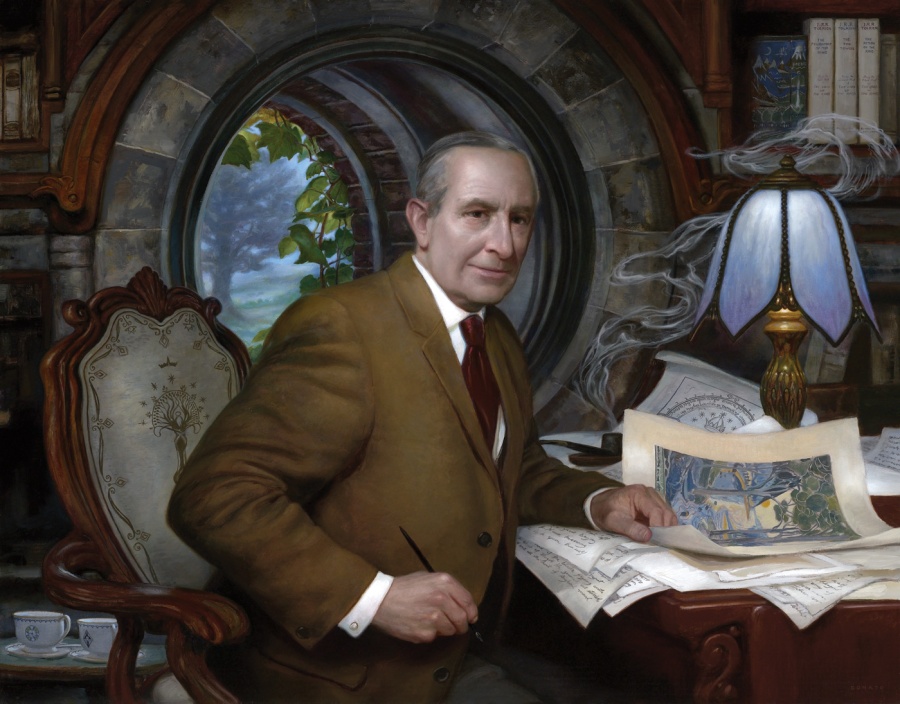
I want to thank Donato Giancola for allowing me to use his stunning portrait of J.R.R Tolkien as the featured image for this project. If you would like to purchase a print of this painting, they are available on his website!

If you would like to contribute your own experience, you can do so by using the form on the contact page, or by emailing me directly.

Now, on to Dean Abercrombie’s responses:


1. How were you introduced to Tolkien’s work?

My father introduced me to it when he was reading The Hobbit and LOTR in the late 1970s. He also had a copy of The Hobbit illustrated with images from the Rankin and Bass film. I was about 10 years old at the time and not familiar with the fantasy genre. I was initially drawn to the illustrated edition.

2. What is your favorite part of Tolkien’s work?

Before I read The Silmarillion, the courting of Faramir and Eowyn was probably my favorite. Currently, I most enjoy the Ainulindale.

3. What is your fondest experience of Tolkien’s work?

In my second reading of LOTR, when I was in college, I experienced my first real emotional connection to Tolkien’s writing. The farewell at Grey Havens saddened me significantly because I felt like I had really come to know the characters and the realization of saying goodbye to them was emotional. I had not previously experienced such feelings from literature.

4. Has the way you approach Tolkien’s work changed over time?

Yes. In the last year or so I have been trying to take a more academic approach. While not a writer myself, I have become very interested in Tolkien’s writing process, as well as the influences and inspirations that contributed to the lore he created.

5. Would you ever recommend Tolkien’s work? Why/Why not?

Certainly. I have purchased The Hobbit and LOTR for my own children, my siblings, and their children. Tolkien has created a world that I find engrossing and I am proud to share with others.


You can connect with Dean on Facebook!

Peter Turecek’s Experience– Tolkien Experience Project (127)

This is one in a series of posts where the content is provided by a guest who has graciously answered five questions about their experience as a Tolkien reader. I am very humbled that anyone volunteers to spend time in this busy world to answer questions for my blog, and so I give my sincerest thanks to Peter and the other participants for this.

To see the idea behind this project, check out this page

I want to thank Donato Giancola for allowing me to use his stunning portrait of J.R.R Tolkien as the featured image for this project. If you would like to purchase a print of this painting, they are available on his website!

If you would like to contribute your own experience, you can do so by using the form on the contact page, or by emailing me directly.

Now, on to Peter Turecek’s responses:


1. How were you introduced to Tolkien’s work?

When I was roughly 10 years old, my father gave me the Abrams Artbooks large paperback edition of The Hobbit, which was illustrated with pictures from the Rankin Bass movie.  I read that book to pieces, quite literally—pages started to fall from the glue binding because I read it so much.  I read The Lord of the Rings a couple of years later and then tackled, unsuccessfully, The Silmarillion

2. What is your favorite part of Tolkien’s work?

It’s the vivid storytelling.  His writing makes you FEEL and you are transported to and immersed in his world, so much richer at heart for the experience. 

3. What is your fondest experience of Tolkien’s work?

For me it’s the quiet heroism of the hobbits—Bilbo, Frodo, Sam. They’re not looking for glory and renown.  They are simply trying to help to make the world a better place by their actions. The author Patrick Rothfuss summed it up well: “The truth is that the world is full of dragons, and none of us are as powerful or cool as we’d like to be. And that sucks. But when you’re confronted with that fact, you can either crawl into a hole and quit, or you can get out there, take off your shoes, and Bilbo it up.”

4. Has the way you approach Tolkien’s work changed over time?

Tolkien has been there for me throughout my life. His works have been a refuge, a comfort, a spark of courage, an escape, and an inspiration, all at different times. I remember during childhood injuries or illnesses being laid up in bed, reading The Hobbit or LOTR or even once listening to the BBC radio play of LOTR, helping to make the time pass so quickly. I remember reading LOTR annually in high school, at times torn by self doubt, the fiery heights and deep doldrums of teen romance, or perceived parallel paths of new adventures, all mirroring life moments.  

In high school and college, I started to take a more analytical bent, broadening to other Tolkien works and writing papers related to Tolkien for English or Religion or other courses. 

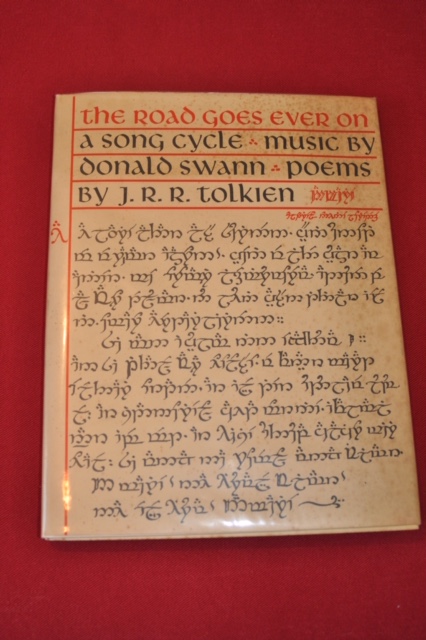
On my first trip ever to London in the mid 1990s as a new analyst, I found a signed first edition of The Hobbit!  I kick myself for passing on it but it was literally half of my annual salary at the time (and that was before the movies had been announced). I did finally start some collecting, including UK first editions of LOTR and a signed copy of The Road Goes Ever On.

I’ve also found moments of irony in my life via Tolkien. Almost six month after triple bypass surgery, I realized that the date of my open heart surgery was October 6th, the same day Frodo was stabbed on Weathertop, the wound ultimately making him wiser for the experience. (Let’s hope I took away some wisdom of my own!)

As a private pilot, when I was able to finally buy myself an airplane, I named it Gwaihir. The link to the blog entry of the naming contest is here.

5. Would you ever recommend Tolkien’s work? Why/Why not?

Absolutely and unconditionally. It may not be everyone’s cup of tea, but I’ll introduce it at the very least.  I tried to introduce my wife to The Hobbit, reading aloud to her.  Unfortunately (fortunately?!), we found that my voice (not Tolkien) was a strong sleep aid for her.

TEP #21 – Anke Eissmann

For this episode, Sara was able to talk with an artist whose work is well known to many Tolkien fans: Anke Eissmann!

You may have seen Anke’s artwork as the cover of some of your favorite Walking Tree Publisher works! She also is a prolific contributor to Tolkien conferences and fan communities in Germany and the UK. In addition to all of her Tolkien credentials, she has also published an illustrated edition of Beowulf! To see more about Anke and to see examples of her work, visit her website!

Please consider supporting the Podcast on Patreon!

Subscribe to the podcast via:

Comments or questions:

  • Visit us at Facebook or Twitter
  • Comment on this blog post
  • Send us an e-mail from the contact page
  • Email TolkienExperience (at) gmail (dot) com

Maria Zielenbach’s Experience – Tolkien Experience (126)

This is one in a series of posts where the content is provided by a guest who has graciously answered five questions about their experience as a Tolkien reader. I am very humbled that anyone volunteers to spend time in this busy world to answer questions for my blog, and so I give my sincerest thanks to Maria and the other participants for this.

To see the idea behind this project, check out this page

I want to thank Donato Giancola for allowing me to use his stunning portrait of J.R.R Tolkien as the featured image for this project. If you would like to purchase a print of this painting, they are available on his website!

If you would like to contribute your own experience, you can do so by using the form on the contact page, or by emailing me directly.

Now, on to Maria Zielenbach’s responses:


1. How were you introduced to Tolkien’s work?

My mother read The Hobbit to me and my brother when I was very young (under 6) and I do not remember it at all. When I was about 8, my uncle lent the German radio play of The Lord of the Rings to my brother. I remember very well when my brother asked me to listed to the scene at the Gates of Moria and had me try the riddle – I failed 😀 However, I do not recall listening to the Mount Doom scene for the first time – I sometimes joke that in my world the Ring has always been destroyed.

2. What is your favorite part of Tolkien’s work?

I really like all the stories related to Númenor and the Second Age in general. My favourite scene, however, is the one at the Barrow-downs since I enjoy this kind of horror a lot.

3. What is your fondest experience of Tolkien’s work?

I met a lot of awesome people (some of my closest friends now) through Tolkien related events. Tolkien fans seem to be a very special kind of species – a very great one actually 😀

When it comes to a very personal moment, I very fondly recall reading the biography by Humphrey Carpenter for the first time. I realized how many of Tolkien’s thoughts and views on Myths and languages I had unknowingly shared with him for a long time. Maybe that is one of the reasons why I like his works so much.

4. Has the way you approach Tolkien’s work changed over time?

As I told before, I started out with the radio play of The Lord of the Rings, next came the radio play of The Hobbit. After that, when I was about 13, I tried to read The Lord of the Rings in German – and hated it. But fortunately, I had also taken The Silmarillion from the library and that was much more to my taste. Perhaps the problem was the German translations of The Lord of the Rings (I still do not like them today). I never read The Lord of the Rings in full until I was about 20 and well established in the Tolkien Fan scene. Only then I tried the English original and the spirit took over, so to say. So the change was from Silmarillion to The Lord of the Rings.

5. Would you ever recommend Tolkien’s work? Why/Why not?

I regularly recommend Tolkien to both friends and the public when I visit events with the German Tolkien Society. I think The Hobbit and The Lord of the Rings still rank very high on the list of the best Fantasy books ever published, and I am specially trying to convince people who have only seen the movies that the books a worth a read. I have encountered several people in Germany who, like me, struggle with the translations but enjoyed the original a lot better. I also think that with Tolkien a ‘holistic’ access to Fantasy literature is not possible. Most Fantasy (and Science Fiction) authors, consciously or unconsciously, make reference to Tolkien’s works or consider them as common knowledge of their readers.


You can find more from Maria on Twitter!

Joel Merriner’s Experience – Tolkien Experience (125)

This is one in a series of posts where the content is provided by a guest who has graciously answered five questions about their experience as a Tolkien reader. I am very humbled that anyone volunteers to spend time in this busy world to answer questions for my blog, and so I give my sincerest thanks to Joel and the other participants for this.

To see the idea behind this project, check out this page

I want to thank Donato Giancola for allowing me to use his stunning portrait of J.R.R Tolkien as the featured image for this project. If you would like to purchase a print of this painting, they are available on his website!

If you would like to contribute your own experience, you can do so by using the form on the contact page, or by emailing me directly.

Now, on to Joel Merriner’s responses:


1. How were you introduced to Tolkien’s work?

I first encountered Tolkien’s work when I was around eight years old, whilst rummaging through the second-hand book stall at my primary school jumble sale. Among the old paperbacks I came across a 1966 edition of The Hobbit (priced 10 pence), the one with the famous Death of Smaug drawing on the cover. Two things struck me immediately about this book; firstly I had never seen a book with a real live drawing on the cover (I failed to realise it was a printed image until I got it home and looked a little closer) and secondly what kind of person sticks a price label right in the middle of a dragon’s head?

Reading The Hobbit eventually lead me to the local library where I began searching the shelves for other Tolkien works. First, I found Humphrey Carpenter’s Tolkien biography, but this was far too dry and dusty for me to tackle. What the biography succeeded in doing however was alert me to the existence of The Lord of the Rings which then became the focus of my search. Unfortunately, all I could find in the library was a battered hard-back copy of The Return of the King so I read that first, using the faithful synopsis to bring me up to speed with the plot. Later, I borrowed copies of the first two volumes from a family friend. It is strange, but during the week I was reading RotK my Dad was decorating the house and there was white paint being splashed everywhere, including on my library book. Whenever I smell emulsion now it takes me back to that first Middle-earth journey.

2. What is your favorite part of Tolkien’s work?

For me it is the evocation of landscape, and if I were to pick a passage in his works where that touches me most it would be the LotR chapter “Three is Company.” The hobbits’ tramp over the fields and lanes of the Shire is so beautifully described, the bucolic scenes tempered by the creeping menace of the Black Rider, played out both in “real time” on the woodland path and in flashback via Sam’s Gaffer anecdote. And then of course, we have added attractions of the inquisitive fox and the arrival of Gildor Inglorion to lift the shadow.

3. What is your fondest experience of Tolkien’s work?

As a young reader obsessed with drawing it would be the many hours spent creating cartoon strips and battle maps based on the made-up adventures of characters from “The Line of the Dwarves of Erebor” family tree in “Appendix A” of RotK. Their names sparked my artistic imagination like nothing I had previously encountered and became a springboard for many subsequent creative endeavours.

More recently I would say my fondest experience has been sharing the stories afresh with my daughter. Reading The Hobbit, LotR and Farmer Giles of Ham together has been both fantastic and eye-opening. Watching her formulate her own Tolkien-inspired stories and art (including some fiendishly complex Dwarvish inscriptions) has also been a wonderful highlight.

4. Has the way you approach Tolkien’s work changed over time?

In certain ways, yes. From my first encounter with The Hobbit cover image my approach to the material has been rooted in visuality. When reading the books it has always been the images evoked in my mind, the sights of landscape and material culture that have dominated. Originally this would translate into the creation of my own artistic interpretations, painting, comic strips and illustration.

However, in recent years as my career has altered trajectory in favour of an academic approach to Tolkien so my focus has shifted to other people’s visual responses to the legendarium. By this I do not refer simply to those people engaged in illustrating Tolkien’s work, but also to the viewers of those illustrations. How textual and visual motifs combine in the mind to create meaning for the viewer is now central to my analysis of the material.

5. Would you ever recommend Tolkien’s work? Why/Why not?

Yes, and no. Yes, because I love the work and it has given me so much over the years it would feel remiss not to do so. On the other hand, no, because often it is better to discover something for yourself. This is how I first encountered Tolkien, and it imparted a strong sense of ownership – “This is my world, I found it by myself.” I still feel like that today. But not in a Gollum sense.


You can find more from Joel Merriner on his blog or on Twitter!

TEP #20 – Amy Sturgis

For this episode, I had the opportunity to talk with a scholar whose work spans the gap between science fiction and fantasy, between history and literary analysis: Dr. Amy H. Sturgis.

Amy holds a Ph.D. in Intellectual History and specializes in the fields of Science Fiction/Fantasy and Indigenous American Studies.

She recently gave the keynote address “Speculative Fiction as ‘Reflecting Shield’: Defying and Defining the Darkness” at Mythmoot VII. She is a monthly contributor on the StarShipSofa Podcast and is the Editor in Chief of Hocus Pocus Comics. Her Tolkien-related scholarship includes a long list, only some of which we get to address in the episode. Please see the bottom of the show notes for a more complete list! Also visit her website to keep up to date on her always updating contributions!

Please consider supporting the Podcast on Patreon!

Subscribe to the podcast via:

Comments or questions:

  • Visit us at Facebook or Twitter
  • Comment on this blog post
  • Send us an e-mail from the contact page
  • Email TolkienExperience (at) gmail (dot) com

Articles by Amy H. Sturgis:

Reimagining Rose: Portrayals of Tolkien’s Rosie Cotton in Twenty-First Century Fan Fiction” in Mythlore 24.3.

Harry Potter Is A Hobbit: Rowling, Tolkien, and The Question of Readership,” in CSL: The Bulletin of the New York Tolkien Society 35.3

Abram Gregory’s Experience – Tolkien Experience Project (124)

This is one in a series of posts where the content is provided by a guest who has graciously answered five questions about their experience as a Tolkien reader. I am very humbled that anyone volunteers to spend time in this busy world to answer questions for my blog, and so I give my sincerest thanks to Abram and the other participants for this.

To see the idea behind this project, check out this page

I want to thank Donato Giancola for allowing me to use his stunning portrait of J.R.R Tolkien as the featured image for this project. If you would like to purchase a print of this painting, they are available on his website!

If you would like to contribute your own experience, you can do so by using the form on the contact page, or by emailing me directly.

Now, on to Abram Gregory’s responses:


1. How were you introduced to Tolkien’s work?

As a kid I had weaved in and out between fantasy and science fiction, having been raised a fervent fan of Harry Potter and eventually falling for Star Wars on my own. My family went to the midnight releases of each Harry Potter book as long as I could remember, and while I loved each book, I always wanted more to be said of the roles of wizards and mythical creatures. I had gone several years exhaustively poring over Star Wars movies, paperbacks, and video-games, when one day, when I was just barely a teen, an aesthetically pleasing novel caught my eye in the bookstore. It depicted a wizard with a staff auspiciously walking toward an interesting-looking house burrowed into the side of a hill. Over a decade later, Middle-earth has never ceased to capture my intrigue.

2. What is your favorite part of Tolkien’s work?

The Hobbit is undoubtedly my favorite Tolkien work so far, though I’m mid-read of The Silmarillion, so this could be subject to change. I’ve read The Hobbit over a half-dozen times and hope to one day read it in Spanish and Irish Gaelic as well as English, just to re-live my first time being immersed in Hobbiton as much as can be replicated. Though the Irish translation of the work, An Hobad, still collects dust on my bookshelf as my proficiency in the language improves, the Irish version of Thorin’s map is permanently with me in the form of a tattoo, which reads “Talamh Bánaithe Smóg”—roughly, “The Desolation of Smaug.”

3. What is your fondest experience of Tolkien’s work?

My fondest experience of Tolkien’s work was a visit to the Morgan Library in New York City, which was exhibiting a Tolkien exhibit with artifacts on loan from the Bodleian Library in Oxford. I live a train’s ride away from the city, and I felt like an excited little kid again. As the train car traversed the springtime Hudson Valley, I could not help but feel as though I was exiting the Shire, on the way for a grand day trip, personal copy of The Hobbit in hand. I was within the first dozen people in line for a several-hour wait before the museum opened, and my love for Tolkien’s work was paralleled by that of the elderly professor in line behind me. Indeed, our enthusiasm could only have been exceeded by the devotion the professor’s wife must have had for him, given that she committed to accompanying him for the day without having read a single word of Tolkien, but just wanting to see her husband enjoy the frenzy of fans of all ages. Either that, or she had no idea what she was getting into. The exhibit itself was lovely, containing memorabilia and papers from Tolkien’s family life, career as a medievalist, and all things Middle-earth. It was truly gratifying to point to the original drawing of Smaug in Tolkien’s own hand, and then compare it to its reproduction tattooed on my arm. After spending several hours in the exhibit, I just barely escaped the gift shop’s temptation to stock up on Hobbiton’s Meadow Mint tea blend, a blend I’d recommend to anybody.

4. Has the way you approach Tolkien’s work changed over time?

I’m too young to have undergone the experience of re-reading Tolkien at different phases of life and discovering new philosophical meaning each time, as my fencing coach assures me I someday will. However, as I approach completing my undergraduate studies in English, studying Old English in an academic setting has given me a newfound appreciation for the aesthetic and linguistic background for the cultures of humans in Middle-earth. Moreover, as I begin my undergraduate thesis on Tolkien and Middle-earth, I hope that further study of Old English, Tolkien’s linguistic work, and further reading of the legendarium can allow me to draw new conclusions about world-building and storytelling that I can implement in my own future career as a writer and academic.

5. Would you ever recommend Tolkien’s work? Why/Why not?

Not only would I recommend Tolkien’s work, but I hope to one day give my children the fantastical experiences with Middle-earth that my parents used Harry Potter’s wizarding world in order to inspire me. At its barest level, Thorin’s companions and the later Fellowship provide positive reconstructions of masculinity that ought to be emulated in the next generation of young men, and examples of strong women in and out of positions of power can be inspirations for girls and young women as well. Through various heroes Middle-earth embody traditional values of valor and honor through meaningful violence as in earlier medieval literature, such violence is preserved only as a last resort. Moreover, though I am not religious, Tolkien deploys the two most important aspects of Christian theology that all people can benefit from pondering: that the most important and profound force compelling humans can and ought to be love; and that peeling back the seemingly senseless thrum of day-to-day life through lore and introspection can tell us about the meaningful, if not the spiritual.


You can find more from Abram Gregory on Instagram!

Phillip “SilmFilm Composer” Menzies’s Experience – Tolkien Experience (123)

This is one in a series of posts where the content is provided by a guest who has graciously answered five questions about their experience as a Tolkien reader. I am very humbled that anyone volunteers to spend time in this busy world to answer questions for my blog, and so I give my sincerest thanks to Phillip and the other participants for this.

To see the idea behind this project, check out this page

I want to thank Donato Giancola for allowing me to use his stunning portrait of J.R.R Tolkien as the featured image for this project. If you would like to purchase a print of this painting, they are available on his website!

If you would like to contribute your own experience, you can do so by using the form on the contact page, or by emailing me directly.

Now, on to Phillip “SilmFilm Composer” Menzies’s responses:


1. How were you introduced to Tolkien’s work?

I was first introduced to Tolkien by my Year 8 English teacher in 1977 when I was 13. Our English class was in the school library, it was the last day of term and about to start two weeks of holidays. I told Mrs. Barran that I had finished the class novel and I had nothing to read over the holidays. She disappeared into the library and came back with a book, The Hobbit. She told me the class was going to read it next term and I could get a head start. I borrowed it and quickly devoured it, following it up quickly with local library copies of the Lord of The Rings trilogy. The following year I read The Silmarillion only a year after it was published, not knowing what an important book it was. The only disappointing part of the story is that my English class never ended up reading The Hobbit.

2. What is your favorite part of Tolkien’s work?

Identifying my favourite part of Tolkien’s work is difficult. The best way to identify this would be remembering when I was studying in the years after school. As a form of procrastination, I would pick up my favourite books off my shelf and read a chapter. I often found myself picking up either the Chronicles of Thomas Covenant or The Lord of the Rings. I remember reading the chapters in Moria again and again. I think I found irresistible the immense age of the mines, the mystery behind the disappearance of Balin’s company, and the terror of the revelation of the balrog along with the fall of Gandalf. These passages are such a rollercoaster to read and I never tired of them. I also found myself mesmerised with the Ainulindale, and I was excited to find that my two favourite authors at the time Tolkien and Lewis both used music to create their imaginative worlds.

3. What is your fondest experience of Tolkien’s work?

I recently rediscovered a forgotten experience on Youtube. A video was recommended due to my viewing history and was a track from Bo Hansson’s Music Inspired by The Lord of the Rings. It took me back to the early 1980’s when I was at university and the library had a relaxing area where you could listen to records wearing headphones. This record was part of the university’s collection and I would listen to this during my lunch breaks. It is very dated with a strong 1970’s sound, but I remember the distinctive artwork on the cover and staring at it for ages trying to work out how the images related to the book as the images are very abstract. Even at that time I was drawn to the idea that a book could inspire music and the music could draw images in your mind.

In 2010, 2011 and 2012 I was lucky to be able to see the three Lord of the Rings movies at the Sydney Opera House with the Sydney Symphony Orchestra playing the scores. This was absolutely amazing to hear the music being played live and also began a journey for me to plunge into the music of the films and to develop a deeper understanding of how music was used by Howard Shore and other composers to convey themes and characters in Middle-earth.

4. Has the way you approach Tolkien’s work changed over time?

My approach to Tolkien has changed dramatically over time. I have always held it apart from other works of fiction, particularly other fantasy novels. I identified very early that The Lord of the Rings contained a depth that other novels did not have. All other fantasy novels seemed to be two dimensional with very basic backstories with little detail. These novels always tied up everything nicely and there were no lose ends. Tolkien’s works were not so tidy with references to things that were never explained, a bit like real life. This led to a great dissatisfaction with other fantasy writers as I was expecting the same level of detail that I was getting in Tolkien’s works. Over the years as I have tackled the History of Middle-earth series (which I have still not finished) and I have been more forgiving of other writers, understanding that Tolkien worked his whole life on integrating these stories into each other and it is something that he never completed. Listening to the podcasts of the Tolkien Professor has also helped me to gain a greater insight into Tolkien’s works and also to change the way I read, paying greater attention to what is written and slowing down and taking it in rather than hurrying on with the story.

Recently through my involvement with the Silmarillion Film Project I have started to write music based on The Silmarillion. This has opened up the Silmarillion even more to me as I try to make sense of how musical themes can interact with each other to indicate relationships that might not be visible to the hasty reader. My understanding of the Ainulindale, Tolkien’s creation story has leapt forward. In tackling an adaptation of The Silmarillion and the Ainulindale, many people go from, first there was Eru straight to the playing of the music and the three themes because that is the name of the story, “the Music of the Ainur”. My careful reading has informed me that lots of things happen between Eru and the “music” being played and I have made it my challenge to write this in music in a way that it has not been done before. Many of the attempted adaptations of the Ainulindale into music do not show the complex interweaving of the music to my satisfaction. My latest revelation musically in The Silmarillion was reading “Of Beren and Luthien”. The song that Luthien sang to Mandos for the release of Beren after his death is described thus, “For Luthien wove two themes of words, of the sorrow of the Eldar and the grief of Men.” For me finding links in the music is important if I am going to write it. I came to the conclusion in this passage that what could move Mandos to release Beren was no less than the third theme of the Ainulindale as stated “For the Children of Iluvatar were conceived by him alone (Iluvatar); and they came with the third theme and were not in the theme that Iluvatar propounded at the beginning”. To me, the great, glorious, sad third theme of the Ainulindale expresses the sorrow of the Eldar and the grief of Men. When writing music using Leitmotifs I am always looking for relationships. In my piece “The Hiding of Valinor” I needed some music to represent the creation of the Enchanted Islands, so I looked at the enchantment, not the land masses and came to the conclusion that the enchantment that causes you to fall into an everlasting slumber and to dream must come from Este and Irmo, so I used their themes, albeit in a warped way, to depict the islands. So, my interaction with Tolkien’s worlds has moved from just enjoying stories to looking deeper and becoming a sub creator myself.

5. Would you ever recommend Tolkien’s work? Why/Why not?

I always recommend Tolkien’s works. I can’t contain my love of his works and I find myself talking about them often to people who will listen and even to those who won’t listen. Once you find something that inspires you it is hard to restrain yourself. The Lord of the Rings and Hobbit movies have been a great springboard for me to engage other people and I recently visited New Zealand and was able to visit some of the filming locations which was another great way to engage other people with the worlds of Tolkien. I was able to take the tour guide to a deeper level by explaining the bird imagery on the Rivendell set and engage with other tourists who like me were looking for the Twelve Mile Delta site where Frodo and Sam saw the mumukil. At the same time, I am very aware that for many people, the Lord of the Rings books and movies are just like any other book or movie and hold no special significance and therefore I tend to choose my audience. I will geek out on Twitter where I have connected with other Tolkien fans, but not on Facebook where I have family and old school friends who just don’t understand.


You can find more from Phillip Menzies on YouTube!

Banner with Tolkien Experience Logo

TEP #19 – Elvella

For this episode, I had the opportunity to talk with Elvella. She is a passionate fan who has some great insights! In this episode we talk about audio adaptations, fanfiction, and whiteness in fandom.

Elvella is a college senior with majors in religion and classical piano. As she starts her senior year, join us in wishing her the best! If you want more insights from Elvella, you can find her on Twitter or subscribe to her YouTube channel!

Please consider supporting the Podcast on Patreon!

Subscribe to the podcast via:

Comments or questions:

  • Visit us at Facebook or Twitter
  • Comment on this blog post
  • Send us an e-mail from the contact page
  • Email TolkienExperience (at) gmail (dot) com