TEP #24 — Marcel Aubron-Bülles

We have a fantastic guest to start off our second season of the Tolkien Experience Podcast: Marcel Aubron-Bülles!

Marcel, also known as The Tolkienist, is very involved in Tolkien fandom. Marcel is best know for his work as the founder of the German Tolkien Society. He is also an independent Tolkien scholar, and a very active member of the Tolkien Society and Tolkien Tribe. He has recently started a Patreon where you can keep up with his travels and Tolkien news.

Please consider supporting the Podcast on Patreon!

Subscribe to the podcast via:

Comments or questions:

  • Visit us at Facebook or Twitter
  • Comment on this blog post
  • Send us an e-mail from the contact page
  • Email TolkienExperience (at) gmail (dot) com

Marie Louise’s Experience — Tolkien Experience (143)

This is one in a series of posts where the content is provided by a guest who has graciously answered five questions about their experience as a Tolkien reader. I am very humbled that anyone volunteers to spend time in this busy world to answer questions for my blog, and so I give my sincerest thanks to Marie Louise and the other participants for this.

To see the idea behind this project, check out this page

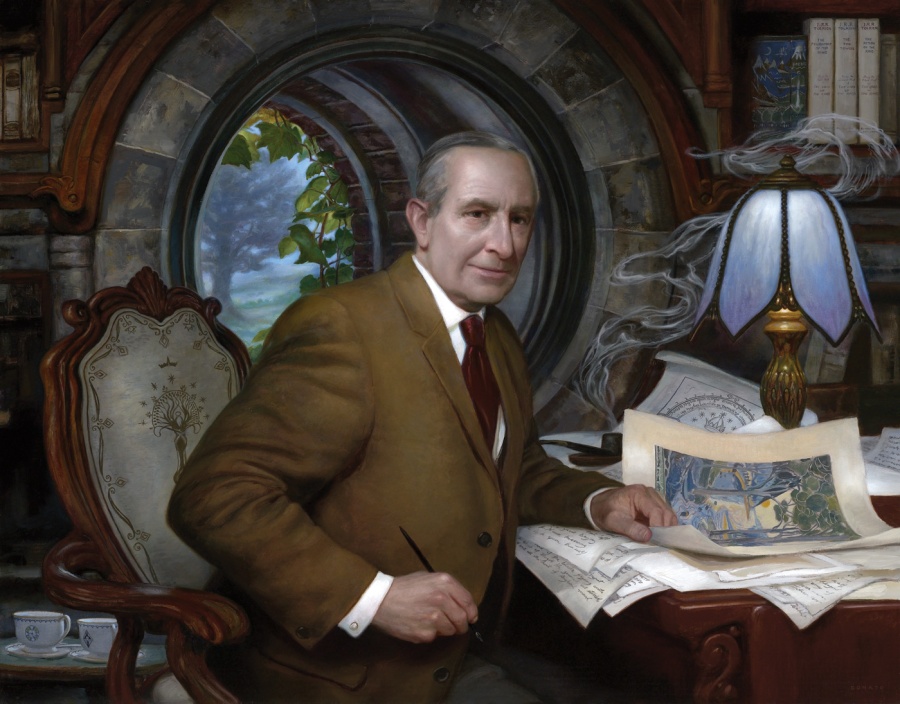
I want to thank Donato Giancola for allowing me to use his stunning portrait of J.R.R Tolkien as the featured image for this project. If you would like to purchase a print of this painting, they are available on his website!

If you would like to contribute your own experience, you can do so by using the form on the contact page, or by emailing me directly.

Now, on to Marie Louise’s responses:


1. How were you introduced to Tolkien’s work?

My dad read The Hobbit aloud to my sister and I when we were very little – I think I was about 4 years old. It is one of my favorite memories, sitting on either side of him on the couch. We also watched the animated Rankin-Bass films when we were young and they were a major part of my childhood.

2. What is your favorite part of Tolkien’s work?

The themes of life and death, duty, stewardship, and forgiveness. I was raised in a very Catholic household and recognized these as very Catholic themes. I am no longer Christian, but Tolkien’s work is still a touchstone to those parts of Christianity that were very important to me.

3. What is your fondest experience of Tolkien’s work?

Reading Tolkien aloud! His writing is very lyrical and perfect for sharing. When I was 11, I remember my dad reading The Lord of the Rings aloud to us around the fire while on a camping trip. Years later after I moved 12 hours away from home, I kept in touch with my sister over Skype by having breakfast every Sunday morning and reading The Silmarillion aloud to her over the course of year or two.

4. Has the way you approach Tolkien’s work changed over time?

My relationship with Tolkien’s work has grown with me over my whole life. When I was little Gollum was the monster under my bed, when I was in high school it was my nerdy obsession, and as an adult it is my connection both to my family and to my former religion.

5. Would you ever recommend Tolkien’s work? Why/Why not?

I do all the time! I gave my niece a copy of The Hobbit to read together with her dad and all my friends know they can get me talking about Tolkien at the drop of a hat. I want to share the beautiful experiences I’ve had with other people who I hope will find them just as meaningful.


You can read more from Marie Louise on her blog!

Alkisti’s Experience – Tolkien Experience Project (142)

This is one in a series of posts where the content is provided by a guest who has graciously answered five questions about their experience as a Tolkien reader. I am very humbled that anyone volunteers to spend time in this busy world to answer questions for my blog, and so I give my sincerest thanks to Alkisti and the other participants for this.

To see the idea behind this project, check out this page

I want to thank Donato Giancola for allowing me to use his stunning portrait of J.R.R Tolkien as the featured image for this project. If you would like to purchase a print of this painting, they are available on his website!

If you would like to contribute your own experience, you can do so by using the form on the contact page, or by emailing me directly.

Now, on to Alkisti’s responses:


1. How were you introduced to Tolkien’s work?

I was going through a bad break-up when I was around 16 and my father bought me the Lord of the Rings books to have something to occupy my mind with. I’m so glad I have editions with pre-movie covers!

2. What is your favorite part of Tolkien’s work?

The invented languages and how a whole world was built around them. The light at the end of the tunnel.

3. What is your fondest experience of Tolkien’s work?

I always go back to how I was first introduced to Tolkien’s work because through the years it has become a very dear experience and one I’m very fond of. The LotR movies are some of the few book adaptations I like and I still cry obsessively when I watch certain scenes – even if it’s isolated ones on YouTube. I sometimes do it on purpose even. I believe it must be the notion of the Sublime some of the scenes evoke. The emotions are so intense and so very rare, even in real life experiences.

4. Has the way you approach Tolkien’s work changed over time?

What started as (just) an epic fantasy story has become one of my favourite stories and worlds of all time that has accompanied me for several years. I’ve become more engaged into the details after these years and I’m also interested to see deeper into the story and its compartments as well as the ways it came to be. I’ve started to read work on Tolkien now, instead of stopping at Tolkien’s work.

5. Would you ever recommend Tolkien’s work? Why/Why not?

Of course! Although several people find it hard to get into his books because they find the writing overly detailed and intricate, I’d think they miss out from what is perhaps the most wholesome world that has ever been imagined if they do not engage with Tolkien’s work be it via reading or a different way.


You can read more from Alkisti on Twitter!

Tolkien Experience Launches Patreon Account

Hello everyone!

If you follow me on social media, you may have already seen the big news. If not, here it is:

I have launched a Patreon to help support the Tolkien Experience Project and the Tolkien Experience Podcast!

It has become too much for me to continue paying for the fees for the website and the podcast, so I have started a crowdfunding effort! I am very fortunate in that the response has been very positive so far.

Thankfully, enough people have already joined that I will be able to keep the lights on around here, and even be able to have better audio quality on the podcast!

I have added some more goals to the Patreon that people constantly ask for, namely: more content! If we are able to reach some of those goals, I will be able to create even more for you and the other readers and listeners!

So head over to Patreon to see the perks available at each patron level!

Alistair S’s Experience – Tolkien Experience Project (141)

This is one in a series of posts where the content is provided by a guest who has graciously answered five questions about their experience as a Tolkien reader. I am very humbled that anyone volunteers to spend time in this busy world to answer questions for my blog, and so I give my sincerest thanks to Alistair and the other participants for this.

To see the idea behind this project, check out this page

I want to thank Donato Giancola for allowing me to use his stunning portrait of J.R.R Tolkien as the featured image for this project. If you would like to purchase a print of this painting, they are available on his website!

If you would like to contribute your own experience, you can do so by using the form on the contact page, or by emailing me directly.

Now, on to Alistair S’s responses:


1. How were you introduced to Tolkien’s work?

I first became aware at Primary school at the age of 9 or 10 when we were set to write an essay on a book we were reading. Someone in class wrote about The Two Towers. I had never heard of it so he described it and recommended The Hobbit. I found a second hand copy at a jumble sale and that was me hooked. Later another friend lent me The Lord of the Rings. I still remember the edition, hardback with the dust jacket with Pauline Baynes’s illustrations. Those were good times to discover Tolkien as soon after came the Ralph Bakshi film and the BBC Radio 4 adaptation.

2. What is your favorite part of Tolkien’s work?

I think now there are two aspects that have become favourite. The ‘quiet’ moments of The Lord of the Rings such as meeting the Elves outside the Shire, the Rivendell passages and the Houses of Healing. Also I have recently started exploring the works that Christopher Tolkien has added to the canon such as The Fall of Gondolin and that has opened up a whole world.

3. What is your fondest experience of Tolkien’s work?

There are several to be honest. Reading Lord of the Rings about every six months as a teenager was magical. Discovering all the different artists who have interpreted Middle-earth – Rodney Matthews, Brothers Hildebrandt, Alan Lee, John Howe, Michael Kaluta, Ted Naismith and so many more. Listening to Blind Guardian’s concept album – Nightfall in Middle-earth–just fantastic. Watching The Fellowship of the Ring film and against the odds it was great. Lastly when my son fell in love with Middle-earth too and it is a huge bond we have in common.

4. Has the way you approach Tolkien’s work changed over time?

Yes it has as when I first discovered it I gravitated to the Hobbits as I think is natural in children. Later I found the Elves to be more attractive as I imagined them hanging out in forests drinking cider. Later Aragorn who has to take up the mantle almost of adulthood and responsibility as we ourselves do. I suspect the next stage for me will be identifying with Gandalf or Radagast. I hope so. Other than that I have begun to explore the wider world of Middle-earth via The Silmarillion, The Fall of Gondolin whereas I used to stick to The Hobbit/Lord of the Rings only. I think my appreciation of his creation has only deepened over the years,

5. Would you ever recommend Tolkien’s work? Why/Why not?

I would always recommend it but I appreciate it is not for everyone. I have tried F.Scott Fitzgerald, Patrick O’Brian and some other notables but can’t really get into them so I believe in ‘each to their own.’


For more from Ed, you can find him on Twitter!

Steve’s Experience — Tolkien Experience Project (140)

This is one in a series of posts where the content is provided by a guest who has graciously answered five questions about their experience as a Tolkien reader. I am very humbled that anyone volunteers to spend time in this busy world to answer questions for my blog, and so I give my sincerest thanks to Steve and the other participants for this.

To see the idea behind this project, check out this page

I want to thank Donato Giancola for allowing me to use his stunning portrait of J.R.R Tolkien as the featured image for this project. If you would like to purchase a print of this painting, they are available on his website!

If you would like to contribute your own experience, you can do so by using the form on the contact page, or by emailing me directly.

Now, on to Steve’s responses:


1. How were you introduced to Tolkien’s work?

I’d heard on and off about The Hobbit and Bilbo Baggins so that the names were vaguely familiar to me as a child and teenager, but my first real introduction was the trailer to the 2001 adaptation of The Lord of the Rings: The Fellowship of the Ring” I watched the trailer over and over because it looked so good! I ended up seeing the first movie in theaters seven times. From there, I read the LotR trilogy for the first time and started obsessing over Middle-earth

2. What is your favorite part of Tolkien’s work?

The movies (Peter Jackson’s adaptations) are my favorite way to partake. They’re my favorite movie experience ever in my life. I adored The Hobbit trilogy, so that’d probably be number two, though I’ve got two sourcebooks (Foster’s Tolkien’s World from A to Z: The Complete Guide to Middle-earth and Tyler’s The Complete Tolkien Companion that I can pour over endlessly. I got REALLY into the LotR tradeable card game Decipher published in the early 00’s. And I love Martin Shaw’s audiobook reading of The Silmarillion.

3. What is your fondest experience of Tolkien’s work?

Watching each of the Peter Jackson chapters for the first time. It was unlike anything I’d ever seen before and filled me with a deep longing to learn more and experience more of Tolkien’s work.

4. Has the way you approach Tolkien’s work changed over time?

I’ve only appreciated it more and more as I’ve expanded into his non-Middle-earth works (like Roverandom) and dived deeper into his Middle-earth works (I’m low-key obsessed with The Silmarillion). I’ve come to appreciate it on a religious level, finding poignant lessons and comparisons with what Tolkien writes about and my own faith and beliefs.

5. Would you ever recommend Tolkien’s work? Why/Why not?

Absolutely. I will tell anyone to watch the movies. Beyond that, there’s a depth to his writings that makes it so each time one reads, one can find new things or new insights or new little discoveries. He can be heavy at times – it’s not always light or easily digestible writing – but there’s a richness to his stories and words that takes it beyond just fantasy. There’s almost a divine quality to his work that take it beyond world-building and really make it feel like world-creating.


You can find Steve on Twitter!

Reading Tolkien during the Insurrection

I happened to be reading the final three chapters of The Lord of the Rings this week as supporters of an incompetent president attempted an insurrection in America. I am going through the book with a middle school student, and did not want to burden them with these thoughts, so instead I thought I would inflict them upon you. My apologies!


As an avid Tolkien reader and researcher, sometimes I can’t help but reflect on the ways that my reading and real-world events sometimes intersect. This is especially true when I am in the process of rereading one of his primary works.

I know that white supremacists and white nationalists have used Tolkien to support their ideals and bolster their racist sense of identity. Unfortunately, Tolkien’s work is open to that interpretation in many respects. Thankfully, it is also open to interpretations that run counter to those beliefs.

If we use Tolkien’s biography, it is fairly easy to say that he would not agree with open fascism or Nazism. For this, we have his letters to revert to. I am not interested in Tolkien’s actual opinions today, so much as with the ways that his text can be interpreted by readers.

Recently, many have chosen to talk about Tolkien’s themes of hope and courage during this tough time. The Tolkien Society announced that “hope and courage” is their theme for Tolkien Reading Day this year, the Athrabeth podcast recently released an episode focusing on Nienna and the themes of “Endurance and Hope”, and Polygon released an article by Susana Polo talking about how Tolkien’s text is a source for hope.

I want to propose a different lens through which to look at the text today. Tolkien does not simply give us hope for a better future or strength to endure hardship. Instead, the text can be read as a call to action, a challenge to us as readers to not sit idly by. I find no better place for this theme than in the final chapters I was reading this week.

During the Scouring of the Shire, Sam claims that the ruination he sees is like Mordor. To this, Frodo responds:

‘Yes, this is Mordor,’ said Frodo. ‘Just one of its works. Saruman was doing its work all the time, even when he thought he was working for himself. And the same with those that Saruman tricked, like Lotho.’

RK, VI, viii (p.1018 in 50th ed.)

Here, I am led to the realization that the way Lotho grasps for power, enabled by corrupt and amoral external influences, has the exact same kind of impact as the more global problems that Fellowship’s quest was undertaken to defeat. This message places the, arguably, more mundane conflict in the Shire alongside the more noteworthy happenings in the text by showing their shared cause: an overreaching for power, an entitlement that is unwarranted, and a greed that is unsatisfied. These are the same motivators for Sauron, for Saruman, and for Lotho.

Furthermore, it illustrates that the consequences of this impulse are evil and damaging, no matter where they occur. The devastation of the party tree, the way that the field is barren of grass, and the quarry taking up Bagshot Row are haunting, if dim, reflections of the Dead Marshes outside of Mordor, or the areas where trees have been ripped out and uprooted around Orthanc.

Some have incorrectly argued that Sauron represents a kind of creeping pluralism. That is utterly incorrect from this vantage point. When we realize that Saruman and Lotho have become miniature Saurons, it becomes clear that this pride, this sense of identity that elevates oneself over someone else, is what really leads to the evil that they commit. It is clear that the text acts as a condemnation of these kinds of beliefs.

This perspective is compounded when I consider that many of the heroes of the story: Frodo, Sam, Gandalf, all demonstrate humility and right action as their central characteristics.

So what do our heroes do with this knowledge?

They do what Gandalf suggests they “have been trained for” (RK, VI,vii [p.996 in 50th]). Gandalf’s framing is that the hobbits’ excursion into the larger world was really a means by which they could grow as individuals. It was a way for them to grow in maturity and knowledge so that they could handle this specific moment in the Shire. In a sense, Gandalf re-frames the narrative so that the Scouring of the Shire is the climax.

Pippin, Merry, Sam, and Frodo start a rebellion and confront the ruffians. they try to end the occupation as peacefully as possible. In fact, they are able to manage their task with far fewer deaths than they expected. There was the killing of a ruffian boss in one skirmish, the killing of Wormtongue (who himself killed Saruman), and then one battle where many ruffians were killed because they refused to surrender.

Then they set about trying to undo the damage that Lotho, Saruman, and the ruffians caused. They disbanded the regiments that had been installed around the Shire, reduced the number of Shirrifs to their normal duties, and set about rebuilding the land and infrastructure that had been ruined.

So what lessons can the reader take from this?

Honestly, many different interpretations are possible, but here is how I read this chapter.

Tolkien challenges us to not be inactive when hardship comes. Not even when it is in our own land. It is the inaction of the hobbits in the Shire that allows the ruffians to have their way. This is underscored by both Farmer Cotton and by Robin Smallborrow.

Tolkien illustrates how those who take action against a totalitarian regime at home will likely suffer consequences, but that they will be celebrated for their efforts. The prime example of this is the raising of Lobelia in the esteem of the Shire hobbits. Additional evidence is the way that Pippin and Merry become heroes for their part in organizing the hobbits.

After the ruffians are removed from the Shire, steps are taken to ensure that this kind of thing will not happen again. Frodo helps to decentralize the power in the Shire, and eventually Sam, one of the most down to earth hobbits in the whole story, is made the mayor.


To conclude, I think that Tolkien’s text forces us to confront a statement that Gandalf makes Frodo at the very beginning of LotR. When Frodo laments that he has to live in such a dreadful time, Gandalf states,

‘So do I,’ said Gandalf, ‘and so do all who live to see such times. But that is not for them to
decide. All we have to decide is what to do with the time that is given, us.’

FR, I, ii (p.51 in 50th ed.)

Tolkien’s text demonstrates that we have to do something more than hope and endure. Readers are called to action against the kind of self-aggrandizement that leads to dictators. If we are to live through awful times, we must oppose the actions that make them awful. To do otherwise would be to ensure that future generations will have to deal with the problems that we allowed to persist.


Obviously, this is a quickly-written and cursory overview. But I find it is an okay introduction to one of the key themes that I read in the text. I am very open to discussing this further and I welcome your comments. Does this perspective make sense to you? Is it one that you have read from the text before?

Robert Falzon’s Experience–Tolkien Experience Project (139)

This is one in a series of posts where the content is provided by a guest who has graciously answered five questions about their experience as a Tolkien reader. I am very humbled that anyone volunteers to spend time in this busy world to answer questions for my blog, and so I give my sincerest thanks to Robert and the other participants for this.

To see the idea behind this project, check out this page

I want to thank Donato Giancola for allowing me to use his stunning portrait of J.R.R Tolkien as the featured image for this project. If you would like to purchase a print of this painting, they are available on his website!

If you would like to contribute your own experience, you can do so by using the form on the contact page, or by emailing me directly.

Now, on to Robert Falzon’s responses:


1. How were you introduced to Tolkien’s work?

When the movies came out, I was about 17 years old, and a school friend of mine told me about Tolkien and The Lord of the Rings. I first bought the CD with Howard Shore’s music for the The Fellowship of the Ring, then I watched the movies, and finally I read the books. The experience remained with me but for a long time I did not delve deeper. Until a couple of years ago when I started to read more and more of Tolkien’s works as well as about Tolkien’s works. I am now building my own little collection of Tolkien books.

2. What is your favorite part of Tolkien’s work?

Perhaps the most difficult question! I would have to say Leaf by Niggle. It contains everything and gives me so much encouragement: the parts when Niggle sees his tree, all beautiful and complete, just as he had imagined it and yet even more beautiful; when his work with Parish becomes a source of rest and comfort for others; when Niggle and Parish are heard laughing in the mountains at the end, oblivious to the pathetic remarks of Tompkins. If I had to choose a part from the Legendarium (still a very difficult thing to do) it would have to be Ainulindale, because in it there is everything that will happen after: pretty much like the Christological Hymns we find in St Paul’s Epistles. God’s or Illuvatar’s vision that will materialise in time, with the cooperation of the Ainur, and everything, even Melkor’s dissonance, leads to the completion of that vision; and still the freedom of Men is always respected. I find this very encouraging.

3. What is your fondest experience of Tolkien’s work?

Very recently I was collecting data from young adults in view of my Masters in Spirituality dissertation about how they engaged with Tolkien’s works (connecting with life experiences and so on) and we got to have 5 discussion workshops spread over 5 months. Discussing Tolkien’s works takes the experience of reading Tolkien to another level.

4. Has the way you approach Tolkien’s work changed over time?

Definitely. Whereas before I was mostly interested in the movies, now I am much more interested in the original written works. Not only that: I used to look at The Lord of the Rings as allegory, but now I have realised that this was quite inappropriate and am enjoying it and the rest of the Legendarium, simply as story with a high degree of applicability. I am also interested in languages. I haven’t started learning Sindarin, but I have started learning Old English. I’d love to learn the other old languages that influenced Tolkien in his development of Elvish. I’d like to see more through his eyes.

5. Would you ever recommend Tolkien’s work? Why/Why not?

Definitely. But I also would like to be careful to recommend Tolkien’s works at the right moment for each person so as to be sure that they appreciate them more. Having said that, I firmly believe that in our metamodern age, fantasy should be integrated further in school curricula in an interdisciplinary approach to schooling. Fantasy equips children, youth and adults to approach a reality when we are no longer sure of what is real. Postmodernism has almost changed anthropology – we sometimes talk of the post-human era – and fantasy helps us in the “recovery” of the human. Tolkien’s fantasy, then, makes sure that this recovery is done well as his ethics are sound and his aesthetics are rich.

Zane Libiete’s Experience–Tolkien Experience Project (138)

This is one in a series of posts where the content is provided by a guest who has graciously answered five questions about their experience as a Tolkien reader. I am very humbled that anyone volunteers to spend time in this busy world to answer questions for my blog, and so I give my sincerest thanks to Zane and the other participants for this.

To see the idea behind this project, check out this page

I want to thank Donato Giancola for allowing me to use his stunning portrait of J.R.R Tolkien as the featured image for this project. If you would like to purchase a print of this painting, they are available on his website!

If you would like to contribute your own experience, you can do so by using the form on the contact page, or by emailing me directly.

Now, on to Zane Libiete’s responses:


1. How were you introduced to Tolkien’s work?

I read The Hobbit in 1991 at the age of ten, as soon as it was translated in Latvian. I liked it, but no more. A long gap followed, until the first of the LOTR movies was released in 2001. I remember that after watching it I thought for some reason that this is a very strange film but that I like it a lot and that I would like to read the book. But there was neither Latvian translation, nor English edition available at the time. For the next year I was in Sweden, studying. Quite homesick, I spent long hours in the evenings in the computer class surfing the internet, and there I somehow found a copy of The Lord of the Rings in English. A typed Word document! I printed it, read it, and I was drawn into Middle-earth. And there I have remained, to this day.

2. What is your favorite part of Tolkien’s work?

My favourite work is The Silmarillion, and the favourite parts are several. The Music of the Ainur, the idea of creation through music. The rescue of Maedhros. ‘Utúlien aurë!’, that moment before the Battle of Unnumbered Tears. The song-duel of Finrod and Sauron. Friendship, trust and hope are the themes that move me most, and I am endlessly fascinated by Tolkien’s skill to create depth and complexity of an event or a character with a single sentence.

3. What is your fondest experience of Tolkien’s work?

My visit to the exhibition of the Bodleian Library in Oxford in autumn 2018. That was a bit strange. I accidentally found out about this exhibition only a few weeks before its closure. I usually do not make spontaneous decisions about traveling, but on that occasion, I had the plane tickets bought on the same evening. I spent a wonderful day in Oxford and then a wonderful day in Warwick, wandering around the castle and along the river and reciting ‘Kortirion among the Trees’. A few months before this trip I had read the first volumes of HoME and memorized it. My interest in things can take quite extreme forms sometimes…

4. Has the way you approach Tolkien’s work changed over time?

Yes, a lot. Initially I was more attracted to The Lord of the Rings, and I used to re-read it once a year, as well as to re-watch the movies quite often. Gradually my interest shifted more towards the foundations of the legendarium, and I acquired the other books too, being particularly impressed by The History of Middle-earth. Two years ago I became a member of the Tolkien Society and started to read more of the scholarly works. With time, I have come to appreciate the language and stylistic nuances more and more, as well as the literary development of the works. I follow the podcast of The Tolkien Professor Cory Olsen and his Mythgard Academy recordings, and I find his in-depth knowledge of Tolkien’s works amazing. During the recent years I have also discovered a lot of wonderful Tolkien-inspired art and music; my favourite Tolkien artist is Jenny Dolfen, and I love the music by The Tolkien Ensemble and also Paul Corfield Godfrey’s Epic Scenes from The Silmarillion.

From my first reading of the LOTR I have been creatively inspired by Tolkien’s books and made illustrations of my favourite scenes and places. However, I am not a professional artist and only lately, encouraged by the supportive atmosphere of the Tolkien Society FB page, I have started to share my paintings.

5. Would you ever recommend Tolkien’s work? Why/Why not?

I definitely would. Tolkien’s works have helped me through some of the darkest times of my life. I think that the themes of escape, recovery and consolation are extremely relevant nowadays. Still, I would recommend people read Tolkien in English, if possible. I do not believe that translation can convey the full beauty of the language. These works are ‘primarily linguistic’, after all.


For more from Zane, you can find her on Facebook!

JuanKi Kürsch’s Experience–Tolkien Experience Project (137)

This is one in a series of posts where the content is provided by a guest who has graciously answered five questions about their experience as a Tolkien reader. I am very humbled that anyone volunteers to spend time in this busy world to answer questions for my blog, and so I give my sincerest thanks to JuanKi and the other participants for this.

To see the idea behind this project, check out this page

I want to thank Donato Giancola for allowing me to use his stunning portrait of J.R.R Tolkien as the featured image for this project. If you would like to purchase a print of this painting, they are available on his website!

If you would like to contribute your own experience, you can do so by using the form on the contact page, or by emailing me directly.

Now, on to JuanKi Kürsch’s responses:


1. How were you introduced to Tolkien’s work?

I discovered The Hobbit at the public library in Jaén (Spain) when
I was 13. Somebody told me there was “a sequel”…

2. What is your favorite part of Tolkien’s work?

Even if Lord of the Rings is more heroic, dense and adventurous, I
think I still prefer the “natural spontaneity” of The Hobbit as a story.

3. What is your fondest experience of Tolkien’s work?

One of the happiest moments in my life was when I successfully
defended my master thesis on the origin and evolution of Gollum (it
was worth the effort).

4. Has the way you approach Tolkien’s work changed over time?

When I was 13-19 years old, I kept on discovering Tolkien’s
mythology; after some decades, I continue looking for linguistic and
philological details.

5. Would you ever recommend Tolkien’s work? Why/Why not?

I will always recommend Professor Tolkien’s work to anybody and anywhere.