Anna Voß’s Experience — Tolkien Experience Project (212)

This is one in a series of posts where the content is provided by a guest who has graciously answered five questions about their experience as a Tolkien fan.

To see the idea behind this project, or if you are interested in sharing your own, visit the project homepage. If you enjoy this series, please consider helping us fund the project using the support page.

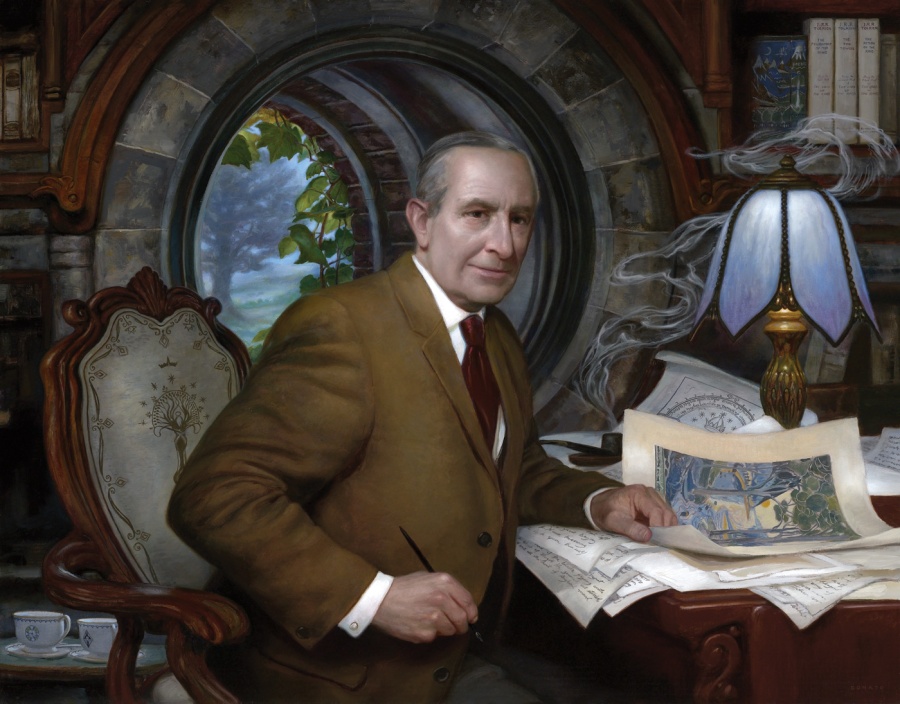
I want to thank Donato Giancola for allowing me to use his artwork for this project. Prints are available on his website!

Now, on to Anna’s responses:


1. How were you introduced to Tolkien’s work?

I saw the trailer to the Fellowship movie when I went to see the first Harry Potter movie. I forgot all about Harry Potter immediately. I was 11 and the age limit to see the movie without express permission was 12 at the time. My mother promised me she would let me go if I read the books first. I did, and I loved them so much, but by the time I had gotten and finished them, the movie didn’t run anymore – something I still hold against her. She understands 🙂

2. What is your favorite part of Tolkien’s work?

The theme of hope. There is always hope, even when things look hopeless. But equally, it doesn’t sugar coat: bad things happen, the world will change because of them, and you cannot get the old world back. I had a traumatic childhood and greatly appreciate this approach to undying hope and goodness without the expectation that bad can only be overcome by undoing it – something that is unrealistic.

Also, the way he deals with (sub)-creation: the entire Legendarium is full of cautionary tales about creativity, making and it’s pitfalls. I do relate to Aule as much as to Feanor in a way. I am a creative professional and I like having that aspect to relate to.

3. What is your fondest experience of Tolkien’s work?

Oh, that’s difficult. I reread Tolkien’s work typically in Autumn and Winter, my favorite Seasons, and I think it’s something that has turned into a tradition that is fully mine, something just for myself that I find very soothing.

The other is rewatching the Jackson Trilogy’s making-of the way other people watch Disney or Ghibli movies whenever they feel unwell. I have seen them way more than the actual movies themselves. I understand this is about Tolkien’s work, not Jackson’s, but the visuality of those movies was my gateway and the creativity of the people involved is so very inspiring and dear to me, and was 100% instrumental to me becoming a designer. I think I am fond of how Tolkien extracted the very best out of a group of people I first considered my role models, and now my peers.

Another thing that I would mention: Like most Tolkien obsessed teens, I used to teach myself writing Tengwar. Nowadays I research writing systems by way of typesetting/typography. It’s a field very much connected to Philology. I didn’t make the connection for a long time, but when I did it felt like coming full circle: Like it was something the Professor already told me when I was 11, 12, and that I had just forgotten about and had rediscovered.

4. Has the way you approach Tolkien’s work changed over time?

My first instinct here was to say yes, of course. I am 20 years older, and not a child anymore. But I think my approach is exactly the same: Wonder, and yearning for a moral compass especially in dark times. I always find it, too, it just tells me slightly different things each time.

5. Would you ever recommend Tolkien’s work? Why/Why not?

I find it difficult to “recommend” something so close to my heart. Not proactively, I think. The vast majority of people I meet have either already read Tolkien, or heard about it and haven’t read it yet. If people are reluctant about reading it because it’s a long book rumoured to be hard to get into, I will always, always encourage them!!! I don’t like wasting my time trying to convince the “no fantasy” crowd. I do tell people that I am a huge fan when it comes up and hope it serves as a recommendation, if you will. If people are interested, I will tell them more, of course, and I don’t think I am very good at concealing enthusiasm. 🙂


You can find Anna Voß on Instagram!

Eve Hooper’s Experience — Tolkien Experience Project (211)

This is one in a series of posts where the content is provided by a guest who has graciously answered five questions about their experience as a Tolkien fan.

To see the idea behind this project, or if you are interested in sharing your own, visit the project homepage. If you enjoy this series, please consider helping us fund the project using the support page.

I want to thank Donato Giancola for allowing me to use his artwork for this project. Prints are available on his website!

Now, on to Eve’s responses:


1. How were you introduced to Tolkien’s work?

My first memory of Tolkien’s work was as a child, where my dad read The Hobbit to me. We had (and still have) a beautiful large hardback 1992 edition, illustrated by Michael Hague, who some may also know as the illustrator of The Wind in the Willows. It’s definitely an edition I recommend for children, the illustrations tell the story well, and Hague’s Smaug is really stunning. From there I read Lord of the Rings for the first time for myself when I was 11, borrowing a three-in-one edition from the local library, which was the ethereal 1991 Alan Lee hardback edition. Working through a book of that size as an 11-year-old was a challenge, but certainly brought with it a sense of achievement!

When the first movie (The Lord of the Rings: The Fellowship of the Ring) came out, I bought the 2001 movie tie-in editions and they remain my well-worn copies. My dad, sisters and I saw the movies together and they instantly became a staple in our house – every Christmas over the school holidays I would re-read the books, and we would borrow a projector from school and play the movies projected on the bedroom wall, sitting on the floor near the warm pipes – the perfect winter activity. In this way, Tolkien is and remains a sense of comfort in my life.

2. What is your favorite part of Tolkien’s work?

Tolkien’s works, the Peter Jackson movies, and hopefully now Amazon’s The Rings of Power, have always brought a powerful sense of connection and community. Being a part of the Tolkien Society over lockdown, particularly the Tolkien and Diversity seminar, really helped to strengthen this recently in a Global sense – Will Sherwood the education secretary has done a great job! On a more personal note, the people I have loved most in my life have also been lovers of Tolkien. It is something my sisters and I can bond over – sending each other memes, taking ‘which orc are you’ quizzes, quoting the movies back to each other, gifting each other an oversized cardboard cut out of Gollum and the Evenstar jewelry…

In addition, many features from Tolkien’s works were used at my wedding – our table plan was a map from The Lord of the Rings, and the table names were places from the legendarium, from Númenor to Bree. Whilst preparing for the wedding, we also had a poster on our door, using the ‘Ringbearer’ font from the movies, of Bilbo’s sign from his 111th birthday: ‘no admittance except on party business’. That’s without mentioning the money we won on the Lord of the Rings slot machines on honeymoon in Las Vegas…

3. What is your fondest experience of Tolkien’s work?

One of the aspects of Tolkien’s work that makes it so special to me is the personal connection to both Oxford and the Midlands. I was born in Oxford, and grew up there until I was ten years old. My family then moved to the Midlands, not far from Birmingham which inspired the eponymous two towers, and where Tolkien went to school. He then went on to Oxford University and raised his family in Headington, where I grew up. This included his youngest daughter Priscilla, the president of the Tolkien Society, who recently died, and it was an honor to sign her last-ever birthday card along with fellow members of the society. It was also a wonderful experience to see the Maker of Middle Earth exhibition at the Bodleian Library in Oxford in 2018 and see many of the original manuscripts, illustrations and letters there.

Reading Tolkien has always been a way for me to find and sustain that connection between Oxford where I grew up as a child, and the Midlands where I moved to as a teenager. Tolkien’s description of the landscape, and how it feels to move from place to place has always made such an impression on me, in how he manages to convey a sense of belonging, and how no detail is too small or unimportant – everything adds to your experience of being welcomed into and connected to his world.

4. Has the way you approach Tolkien’s work changed over time?

I have always taken Tolkien’s world-building seriously, and believe that is how he would have wanted his works to be understood, considering his knowledge of and dedication to philology; there is no doubt in my mind that the language is fundamental to the legendarium, and particularly how it functions as an alternate history of England. As a child, I first viewed Tolkien’s work as fun adventure stories full of challenges and experiences, and as a teenager, I related heavily to Eowyn’s feeling of being trapped by her familial expectations of duty, and society’s expectations of her gender. However, it was also as a teenager that the lightness and silliness of Tolkien’s work also came to the fore with online fandom taking off, and in the mid to late 2000s I ran the official fanlistings site for Ian Holm, who played Bilbo in The Lord of the Rings movies, and was a part of fan culture online, creating memes, digital artwork, attending comic con, etc., and I remain a part of the online fandom. Something that I have also done for the past few years is be involved in Tolkien Reading Day on March 25th: the Tolkien Society chooses a theme each year, and you can choose a passage from the legendarium that touches on the theme – during covid in 2021 the theme was Love and Friendship, and it was a surprisingly emotional and healing experience to be in a zoom meeting of strangers, but fellow Tolkien lovers reading and supporting each other.

5. Would you ever recommend Tolkien’s work? Why/Why not?

This is an easy question – of course! The only caveat I usually give is that in The Lord of the Rings there are very lengthy descriptions of the landscape, which not every reader can take. With regards to the three Lord of the Rings movies, I consider them perfect cinematic masterpieces (extended editions), from the editing to the score. I sometimes also give a caveat here on the depiction of race and gender. I am a supporter of the changes to Arwen’s character (and even to an extent the introduction of Tauriel in The Hobbit movies) but overall in the legendarium there is comparatively not a lot of diverse representation of gender and even less of race.

I would highly recommend The Hobbit as a fantasy novel for parents to read to children, it’s a great introduction to a family-friendly series that explores important values such as friendship, betrayal, good and evil, love, struggle, sacrifice, and the beauty of the natural world. Being exposed to world-building and strong characters at a young age can also develop a child’s literacy, imagination and creativity, and strengthen the connection between you through the act of sharing Tolkien’s works together.


You can find Eve Hooper on Twitter!

Yoeri Emmaneel’s Experience — Tolkien Experience Project (210)

This is one in a series of posts where the content is provided by a guest who has graciously answered five questions about their experience as a Tolkien fan.

To see the idea behind this project, or if you are interested in sharing your own, visit the project homepage. If you enjoy this series, please consider helping us fund the project using the support page.

I want to thank Donato Giancola for allowing me to use his artwork for this project. Prints are available on his website!

Now, on to Yoeri’s responses:


1. How were you introduced to Tolkien’s work?

My first introduction to Middle-earth was The Fellowship of the Ring movie in 2001. I still remember leaving the movie theater with my brothers and parents and it was snowing. In my memory that moment is still full with a sense of wonder.

Later I read the Dutch translation of Lord of the Rings and in between the coming out of the movies I read The Silmarillion.

2. What is your favorite part of Tolkien’s work?

The depth and history of the world. Because of the amount of history that is spread trough The Lord of the Rings, reading it feels like stepping into a real world. It all feels real and I would call reading it fairie magic.

That is enhanced when I read The Silmarillion. I image that behind every page of The Silmarillion is a story the size of The Lord of the Rings. As is seen when The Lord of the Rings is summarized in two pages in ‘Of the rings of power and the third age’.

3. What is your fondest experience of Tolkien’s work?

The fondest experience is always the latest reading. Last week I read The Fall of Gondolin. I still remember that when I first read it I loved that chapter. When I first read the 50 page expansion of the one and a half pages in The Silmarillion, besides seeing what we could have been reading about the coming of Ulmo out of the water and the spiritual experience that Tuor has when Ulmo blows on the Ulumúri, I enjoyed seeing and feeling that all the water in creation is connected. Reading it makes me see the world with new wonder.

Also after reading it, I can’t get the image of Earendil watching Tuor and Idril sailing away out of my head and how it parallels Sam seeing Frodo sail away. I guess that Sam and Earendil both “stood far into the night hearing only the sigh and murmur of the waves on the shores of Middle-earth, and the sound of them sank deep into the hearts.”

4. Has the way you approach Tolkien’s work changed over time?

At first, I read The Lord of the Rings/The Hobbit/The Silmarillion form time to time.

The last few years, I taken to reading the whole Legendarium once a year when the itch arises, usually during the turning of the seasons, around autumn. I start at The Silmarillion and when I arrive at the great tales I pick up fuller versions of that tale. (Lay of Leithian, Children of Hurin, Lall of Gondolin), reading it as the tale of the jewels and the Ring trough the three ages.

5. Would you ever recommend Tolkien’s work? Why/Why not?

I don’t think I would say that people should read it, but I would say what the stories mean to me and why I think Tolkien is the most influential writer of the 20th century.


You can find Yoeri Emmaneel on Twitter or Instagram!

Jonathan Purdy’s Experience — Tolkien Experience Project (209)

This is one in a series of posts where the content is provided by a guest who has graciously answered five questions about their experience as a Tolkien fan.

To see the idea behind this project, or if you are interested in sharing your own, visit the project homepage. If you enjoy this series, please consider helping us fund the project using the support page.

I want to thank Donato Giancola for allowing me to use his artwork for this project. Prints are available on his website!

Now, on to Jonathan’s responses:


1. How were you introduced to Tolkien’s work?

I was introduced to Tolkien when I was about 9 and my parents took us to see Fellowship in the cinema. I got home and immediately took my mum’s copy off the shelf and devoured it. Badly, I was picking up bits I’d skimmed over for years to come, which really made rereading all the better.

Tell a lie, it was my headmaster reading “Riddles in the Dark” in assembly when I was even earlier in primary school. I even wrote a poem based on the fall of Esgaroth that won a competition and was published well before FotR came out, but I don’t think I joined the dots between the two for a few years.

2. What is your favorite part of Tolkien’s work?

As a whole, it’s the depth of the legendarium that stirs something in me. Lots of fantasy books and series have big histories and ancient characters, but apart from Malazan, none of them feel as real or vast as Tolkien’s work. When I first realised just how old Galadriel is, or that Elrond’s dad became a star in the First Age and Elrond is still just walking around and chatting to people like Sam, it blew my mind.

I think it’s the way that he stubbornly presented it as historical fact, writing as though he were interpreting real events that actually happened to real people that makes it so believable.

Also, the manner in which the man wrote. I adore his prose. The fall of Fingolfin, the ride of the Rohirrim and so many other scenes are presented so sublimely that reading them never feels stale. Excellent horror work as well.

3. What is your fondest experience of Tolkien’s work?

I can’t think of a specific experience. Generally speaking, if I’m in the countryside, surrounded by grass and trees and the open air, Tolkien is the only writer it really feels appropriate to read, especially chapters set in the Shire, so I’d say any time I’ve read LotR outside in the shade of a tree. I think he’d appreciate that.

4. Has the way you approach Tolkien’s work changed over time?

I honestly don’t think it has, except that I’ve faltered in my attempts to read LotR on a yearly basis (inspired by Sir Christopher Lee) and tend more nowadays towards dipping in and out, just picking it, or The Silmarillion, up and reading favourite passages or chapters for a quick bump of comfort or awe.

5. Would you ever recommend Tolkien’s work? Why/Why not?

Yes. All the time. Because I want him to continue to be recognised as the titan of literature and worldbuilding that he was for as long as possible, and for other people to find as much happiness in his work as I do. I do, however, realise that it’s not for everyone and that not every reader will find the same connection that I have, but I still want them to try.


You can find more from Jonathan on Twitter!