This is one in a series of posts where the content is provided by a guest who has graciously answered five questions about their experience as a Tolkien reader. I am very humbled that anyone volunteers to spend time in this busy world to answer questions for my blog, and so I give my sincerest thanks to Ed and the other participants for this.
To see the idea behind this project, check out this page
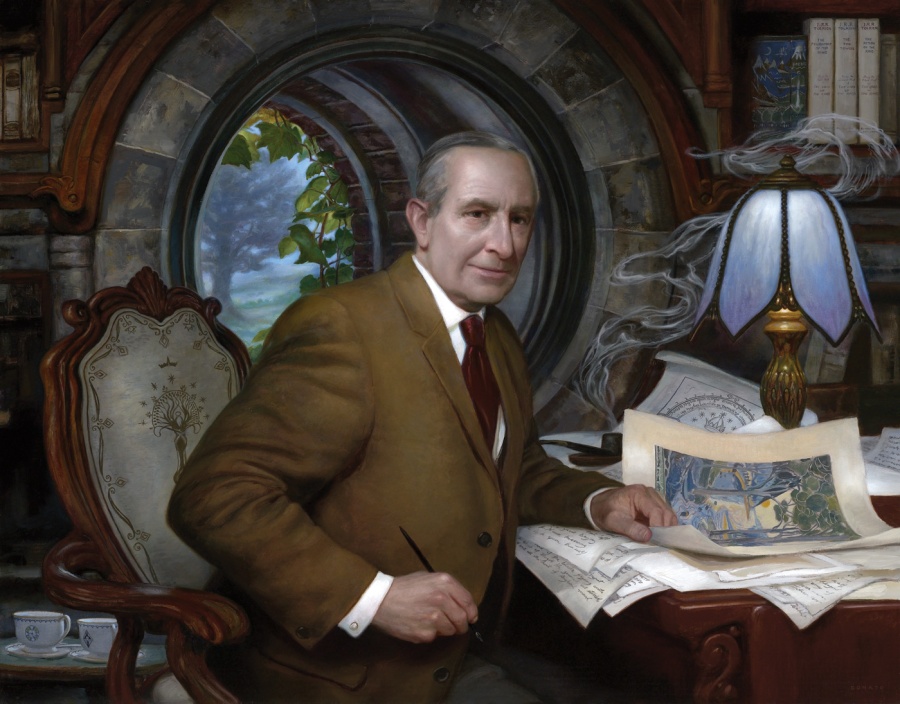
I want to thank Donato Giancola for allowing me to use his stunning portrait of J.R.R Tolkien as the featured image for this project. If you would like to purchase a print of this painting, they are available on his website!
If you would like to contribute your own experience, you can do so by using the form on the contact page, or by emailing me directly.
Now, on to Ed Pierce’s responses:
1. How were you introduced to Tolkien’s work?
When I was around six or seven years old a group who did dramatic readings of literature visited my elementary school and put on a performance. One of their readings was of the “Riddles in the Dark” chapter from The Hobbit. Shortly after that I discovered The Hobbit book in the public library and read it. I may have also had a vague recollection of the Rankin/Bass Return of the King TV movie which came out around this time (I was born in 1973, and the movie came out in 1980) although I don’t recall actually watching it before I read The Hobbit (perhaps this was a good thing). After reading The Hobbit, I promptly went out and bought The Lord of the Rings and read it as well. This was followed a few years later by Unfinished Tales, The Silmarillion, and then eventually the HOME series. A new volume of the latter would come out around October or November almost every year from 1983 until 1996, and starting with volume III, I’d usually get the latest volume for Christmas every year (it was always my favorite present each year!).
2. What is your favorite part of Tolkien’s work?
It’s hard to decide. Perhaps how deeply it touches upon the themes of loss, of friendship, and of doing what is right in the face of adversity.
3. What is your fondest experience of Tolkien’s work?
Nothing probably beats the experience of reading The Lord of the Rings (not just the first time, but the increased appreciation and enjoyment with each re-reading), but I also have especially fond memories of my first time reading the Turin story (as it appeared it Unfinished Tales—I read this before I read the chapter on Turin in The Silmarillion), as well as the magical experience of reading Smith of Wootton Major for the first time.
4. Has the way you approach Tolkien’s work changed over time?
Not really, except that obviously I can appreciate some of the adult themes now more than I did when I was younger.
5. Would you ever recommend Tolkien’s work? Why/Why not?
Definitely (with some reservations). I have learned that many people don’t have the patience to read through The Silmarillion or similar works (it takes a certain amount of concentration, and—as Tom Shippey has pointed out—if you don’t make a concerted effort to keep track of everyone and learn their familial relation to one another, a lot of the richness will get lost on you early on), but I think that there are many people who would enjoy The Hobbit or The Lord of the Rings, or some of Tolkien’s lighter and/or shorter works (like Farmer Giles or Leaf by Niggle) if they give it a try. However, I’ve also learned that trying to foist something on someone often leads nowhere, so I rarely try to recommend Tolkien unless someone shows interest first in that direction.
I know that my “brand” is Tolkien and fantasy content. Many of you subscribe to my site specifically to see that content, and I appreciate your support!
I will go ahead and let you know that this post has nothing to do with Tolkien, instead it is about my personal and family situation over the past few of weeks. If you want to hear it, please keep reading. If not, I understand completely and you are certainly under no obligation to hear the story.
I will go ahead and warn that this post does involve COVID and death. So please know that beforehand and I would encourage you to not read it or to read it in a way that minimizes your stress and anxiety if this topic is difficult for you. I hope to share something of what I am going through, and I certainly don’t want to cause pain or suffering for anyone reading.
If any of you have seen me posting on social media about my grandparents and my uncle Dan, this is where I am going to share much more of that story. I am still too close to the events to really reflect on them, so this is mostly going to be a recounting of events and information. Maybe later I will have the strength to revisit this and share my feelings, but I can’t promise that.
If you are inspired to help my family, there is GoFundMe that my brother has set up to help pay for medical expenses.
Dan, Ray, and Jean at a birthday celebration
I know that a lot of people have had a difficult, stressful early November. We recently had “the most important election ever” here in America and tension and feelings have been running high for many people.
In the midst of all of this societal upheaval, my family has also been suffering from a personal catastrophe. Unfortunately, this personal catastrophe is all too familiar for many this year who have seen COVID ravage their families.
In early October, my grandmother was scheduling a back surgery because her stability and mobility were declining. At that time she had a cough and was tested for COVID because that is standard procedure. She tested negative. After a few days, she was showing more symptoms of illness, so my mother took her to the hospital. Some of my other family members were also feeling unwell and were already waiting on their results for COVID, but we didn’t think grandmom had COVID because she had just been tested.
On Sunday, Oct. 11, grandmom received a positive test result for COVID. That same day, we heard that of the three other family members tested, one was positive for COVID (a cousin).
Dan, my uncle, took my grandfather and they were both tested for COVID the next day, on Monday, Oct. 12. They both received negative test results on Oct. 15. We were staying cautious, though, because of grandmom’s negative test result that developed into COVID.
Both of my parents waited until Oct. 14th to be tested for COVID (thinking that they may get a negative result if they went too early) and both received their negative results on Oct. 16th.
Also on Oct. 16th, my grandad was showing signs of delirium So they had him taken to the hospital for care. Up to this point, my grandmother was not deteriorating quickly, and we still had a lot of hope that she would recover. In fact, we the family was planning what to do about her back surgery that was scheduled to take place not too long after she had to go in to the hospital.
–I should add that while all of this was going on, my parent’s house was also trespassed into and my father’s wallet taken. We found out that it was a man who was intoxicated. His father had died and the man confused my parents house for his house. He had wandered in thinking it was his own house. My parents didn’t press charges.–
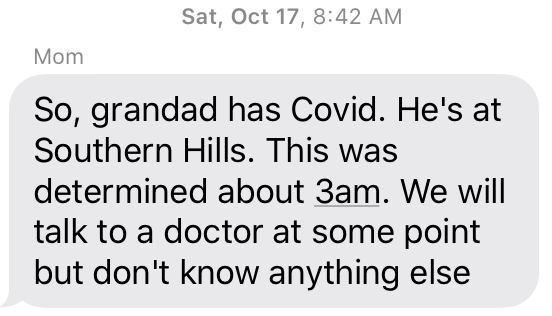
On Saturday, Oct. 17th, we learned that grandad had tested positive for COVID.
From this point on, for both of my grandparents, it was a struggle. Just like the cliche, there were some good days and bad days. Days when there was hope for a full recovery, and days when we knew they would never come home.
On Oct. 20, my grandmother needed to go to the ICU, but there were no beds available. They had to transport her to a different hospital. They managed to take her to the hospital where my grandfather had been admitted.
My brother was tested for COVID on Oct. 21, out of an abundance of caution. Also, a second negative test result came back for my mother. Even though Dan’s test was negative, he started feeling ill and he had a fever, so he was self-quarantining.
On Oct. 25 my mom, as the designated visitor to her parents, started being able to visit them in the hospital. I know this was a great comfort to her, and I am sure it was also a comfort to her parents. This was the day that grandmom made it clear that she did not want to go on a ventilator.
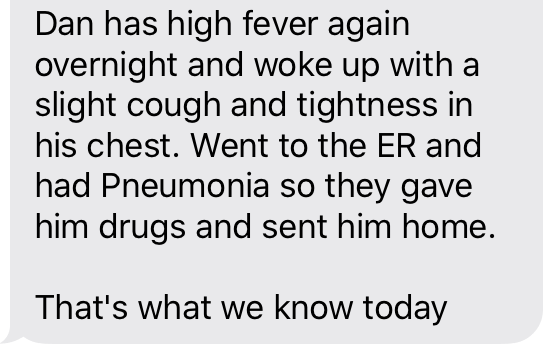
On Oct. 26 Dan went back to the hospital. He had a high fever overnight, shortness of breath, and tightness in his chest. He went to the ER and had Pneumonia. They gave him some medicine and sent him back home.
On Oct. 27, grandad was transferred to the ICU because he couldn’t keep his oxygen levels up. Dan was managing pretty well at home, and grandmom had come to terms with death. She had started telling my mother that she was ready to “go home”.
On Oct 27, we had a moment of happiness:
Jean and Ray share a few moments in the ICU
Since both of my grandparents were in the same ICU, the medical teams made it possible for them to spend two hours in the same room. My mother was also there.
During this time, Dan was still at home managing a high fever and pneumonia. On Oct. 28th, Dan went back to the hospital because his symptoms were getting worse. They changes his medicines and admitted him to the hospital.
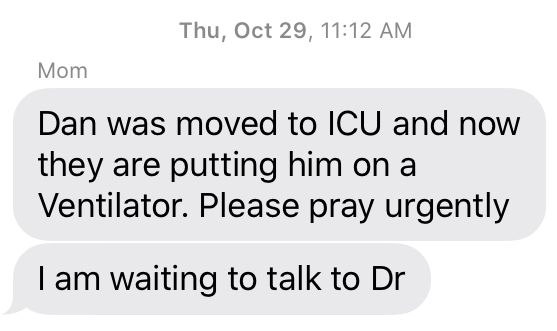
On Oct. 29th, Dan was moved to the ICU and placed on a ventilator. On Oct. 30th, they placed Dan on an ECMO machine.
On Oct. 31st, my mother FaceTimed her children and grandchildren from her mother’s hospital room. I am so grateful that she gave us the chance to say goodbye to our grandmother. Dan seemed to be doing well on the ECMO machine today.
Oct. 31st is my dad’s birthday, so on Nov. 1st, we all visited each other in a Zoom meeting. This was such a welcome chance to interact with each other and be happy where we have had so much sadness lately!
Also on Nov. 1st, it looked like grandad was going into ARDS, grandmom was in end-of-life care, and Dan was stabilizing on ECMO.
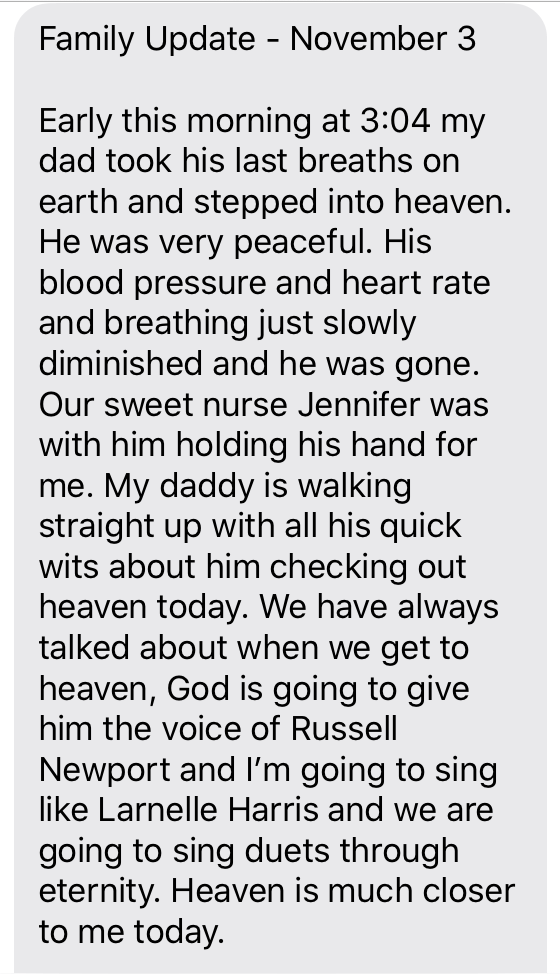
On Nov. 3, at 3:04 AM, my grandfather died.
On the same day, my grandmother was still slowly declining and Dan holding stable and sedated. This pattern would continue for a few days.
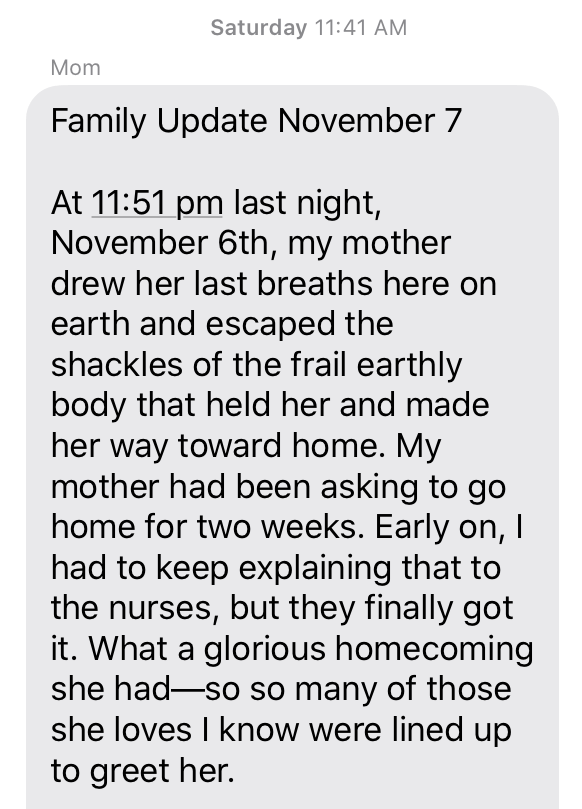
On Nov. 7th, at 11:51 PM, my grandmother died.
Dan is still sedated on ECMO as I write this post.
I hope to come back and give updates when I have something else to share. I won’t write another post (unless people tell me they want another post), I will just edit this page with any additional information.
We have been fortunate in that our community has taken notice of our hard times and rallied around us.
Some newspapers and TV stations have already covered the story:
Three restaurants have agreed to have charity events to support Dan’s care, and dozens of people have already given money to help us cover all of the medical expenses from the past month.
If you would like to help us cover Dan’s medical expenses, please use our GoFundMe Page.
Update on January 1, 2020:
I have not had the strength to update this page until now. A month ago today, Dan also passed away from COVID-19.
It is easy to understand the death of my grandparents, even if it is difficult to deal with their loss. They were older, they already had several health issues.
The loss of my uncle is crushing and inexplicable. My sister-in-law- said it best when she said that it is “unfair”.
It hurts because he was so young, he was 49. It hurts because he leaves behind so many people who he was still in the process of helping, like his daughter who is in college. It hurts because what killed him was a pandemic that took advantage of his desire to care for his sick parents.
Please protect your loved ones. With this pandemic, that means care for the people in your bubble, and do not visit with other friends and family. I know it is hard, it is so hard. All we want is to be with the people we care about. This virus feeds on our desire for community and interaction. Yes, this distance has many negative consequences, but the sacrifices are so worth it to keep your friends and family alive.
I will end this post with the obituaries of my grandparents and my uncle. I will also end it with a plea to please wear your mask, please wash your hands frequently, and please avoid indoor social gatherings. I do not want any more families to suffer what so many already have.
This is one in a series of posts where the content is provided by a guest who has graciously answered five questions about their experience as a Tolkien reader. I am very humbled that anyone volunteers to spend time in this busy world to answer questions for my blog, and so I give my sincerest thanks to Dom and the other participants for this.
To see the idea behind this project, check out this page
I want to thank Donato Giancola for allowing me to use his stunning portrait of J.R.R Tolkien as the featured image for this project. If you would like to purchase a print of this painting, they are available on his website!
If you would like to contribute your own experience, you can do so by using the form on the contact page, or by emailing me directly.
Now, on to Dom Lane’s responses:
1. How were you introduced to Tolkien’s work?
My mother had loved The Lord of the Rings when it came out in the 50s. I was an avid reader from a young age and she bought me a copy of The Hobbit when I was eight. This would have been in 1971. I moved on to The Lord of the Rings as an 11 year old in 1974.
2. What is your favorite part of Tolkien’s work?
What a tough question! The richness of the work probably, the vast creative backstory.
3. What is your fondest experience of Tolkien’s work?
Reading his letters for the gaps they fill in, and the insight into the man.
4. Has the way you approach Tolkien’s work changed over time?
Most definitely. We’ve been together now for nearly 50 years, and what started out as a bringing to life legendary elements I was familiar with from Norse and Celtic myths, has become a many faceted engagement, as I played D&D from the early 70s, then Runequest, then studied literature at university, lived in Wellington as Jackson started and finished his work, joined the TS – I find now I can dip in and out of his work, and works about him, savouring them with the wisdom (if I can be so bold) – or at least insight – of years.
5. Would you ever recommend Tolkien’s work? Why/Why not?
I have done so on many, many occasions, to family and friends, young and old.
This is one in a series of posts where the content is provided by a guest who has graciously answered five questions about their experience as a Tolkien reader. I am very humbled that anyone volunteers to spend time in this busy world to answer questions for my blog, and so I give my sincerest thanks to Maureen and the other participants for this.
To see the idea behind this project, check out this page
I want to thank Donato Giancola for allowing me to use his stunning portrait of J.R.R Tolkien as the featured image for this project. If you would like to purchase a print of this painting, they are available on his website!
If you would like to contribute your own experience, you can do so by using the form on the contact page, or by emailing me directly.
Now, on to Maureen Smiley’s responses:
1. How were you introduced to Tolkien’s work?
I was 12 when my brother recommended The Lord of the Rings. This was in 1967. He was in his first year at Stanford University, California.
2. What is your favorite part of Tolkien’s work?
Reading The Fellowship the first time it seemed really slow to take off, but the second and subsequent readings (there have been too many to count) have made the journey to Bree my favorite part of the entire book.
3. What is your fondest experience of Tolkien’s work?
Meeting with other readers of Tolkien was always wonderful, and the exercise of memorizing the journey bit by bit so I could image it in my mind was excellent.
Also when out in the mountains hiking I could imagine the long walk of Frodo and companions easily.
I find the creative journey of great art always fascinating.
As a musician, I really enjoy listening to the music of the films, though I don’t like the films themselves. Also the music of Morning in Rivendell by the Tolkien Ensemble is very inspiring
4. Has the way you approach Tolkien’s work changed over time?
The last 20 years I have been gathering up all the Tolkien Literature I can find. But now I am more interested in early Tolkien and the fresh inspiration those works have. I am a non-religious person and it is difficult sometimes to overlook the overtly religious contingent of Tolkien fandom and also the militaristic interpretation of some of the fandom. I realize this is inevitable but it does make for a less inspiring outreach than I am comfortable with. Thus, I am reading more in a bubble than I used, ie. isolating from societies and fandom.
5. Would you ever recommend Tolkien’s work? Why/Why not?
I always recommend Tolkien to people who are interested in Trees and wilderness and walking on long adventures.
It is so important to me to write about Tolkien’s use of language and his masterful storytelling skill. But also to say that LOTR and the Silmarillion are masterpieces of literature, and that is why I am careful to recommend the books to others. It is intense reading that involves so many layers of study in its secondary world structure and meaning. I owe a great deal of my inner imagination, as an artist and a musician, to the influence of these works. The study of the power of language and the musical sound of the words has been a big influence on me as well.
I feel that reading Tolkien for fifty odd years has made me a much smarter person!
In this special episode of the Tolkien Experience Podcast, Luke and Sara wrap up the first season!
They reflect on some of their favorite interviews, share some of their own Tolkien Experiences, and give a special thank you to our faithful listeners!
We hope you enjoy it. Remember, there will be more TEP coming your way after the holidays!
Please consider supporting the Podcast on Patreon!
This is one in a series of posts where the content is provided by a guest who has graciously answered five questions about their experience as a Tolkien reader. I am very humbled that anyone volunteers to spend time in this busy world to answer questions for my blog, and so I give my sincerest thanks to Raphael and the other participants for this.
To see the idea behind this project, check out this page
I want to thank Donato Giancola for allowing me to use his stunning portrait of J.R.R Tolkien as the featured image for this project. If you would like to purchase a print of this painting, they are available on his website!
If you would like to contribute your own experience, you can do so by using the form on the contact page, or by emailing me directly.
Now, on to Raphael’s responses:
1. How were you introduced to Tolkien’s work?
Via my father.
He is a big fan of mostly Science Fiction with the occasional forays into Fantasy, and as avid a reader and book collector as they come. When I was little, he used to drop mysterious names like Bilbo and Frodo the hobbits, Gimli the dwarf, Boromir the man, Gandalf the wizard, Legolas the elf, and hint at their epic exploits. I remember those names already sounding like adventure to me, and being immensely frustrated when he wouldn’t tell me their entire story right then and there. (I have since forgiven him.)
Eventually, he gave me a German edition of The Hobbit to read (the small format dtv junior paperback edition with Klaus Ensikat’s magnificent butterfly-winged Smaug on the cover!), and that was it for me. If my memory serves me right, it would be a bit before he gave me The Lord of the Rings to read (that characteristic green German paperback edition), and then The Silmarillion. We’d then have the occasional re-reads of it all, the release of the new German translation, and then I’d ‘graduate’ to English editions.
In retrospect, that last step happened surprisingly late – I must have been in my early to mid-twenties when a then-girlfriend gave me a paperback box set after snooping out that I hadn’t read Tolkien in English yet, despite my reading having pivoted to original texts instead of translations for English/American literature years before.
2. What is your favorite part of Tolkien’s work?
Just one?
If I have to narrow it down that much, I’d choose that the legendarium is not ‘just’ literary text, but text that has in-universe authors written into it, as well as different variants of a fictional manuscript tradition explaining in-universe how these books ended up in our hands. That makes the texts into something much more like ‘fictional artefacts,’ with their double layer of ‘literariness.’ To me, this makes for the most interesting and rewarding way of reading them because it gives the text’s narration a perspective of its own – a hobbit’s perspective on matters of the world outside the Shire, an elf-affine perspective on who is who in the universe, a cumulative scribes’ perspective on a personal account, or if we accept Aelfwine as a middle-man for The Silmarillion, a 10th century man’s perspective that explains how through millenia of history and highest craft, warriors remained clad in coats of mail.
All in all, I wish Tolkien’s transformative influence on the genre included a bit more of that, the artificial myth aspect, rather than just the high fantasy trappings of elves, dwarves, halflings, and orcs.
Beyond this aspect, there are many motifs or parts I like a lot. How Thorin acknowledges to Bilbo the value of the apparently unheroic hobbit way of life on his deathbed, and it being that same hobbit way of life that makes the Ring’s sway over Sam so weak – weaker than even over wise Gandalf! The big tragedy of Húrin’s family also speaks a lot to my old goth heart. And everything dwarves is an instant win in my book. (The fact that we get so little of them and their status in creation being that of a step-child ties in neatly with reading the texts as coming from a perspective dominated by elven lore, doesn’t it?)
3. What is your fondest experience of Tolkien’s work?
Overall, I guess it is whenever I get to discuss the hell out of a random facet of a Tolkien work with a fellow fan. For one, there is always something new to learn from listening to how somebody else read those same passages, especially someone looking at them from a completely different perspective and lived experience.
And I just love digging deep and comparing notes on what exactly we think it means that Tom Bombadil speaks in verse in a world created as music made real. Or where we stand on and arrange ourselves with the themes of Noldorian colonialism, the hobbit classism exhibited in Frodo’s and Sam’s relationship, the many racist descriptions of nonwhite ethnicities, and so on. Or whether or not to stan Boromir and why.
4. Has the way you approach Tolkien’s work changed over time?
Oh, definitely! You can’t step in the same river twice, after all.
Reading the texts for the first time when I was young, I was reading enjoyable fantasy adventure stories. Then I got really into the worldbuilding, trying to suss out all the details. Somewhere in between these two, I was a young lad reading them for their clout in the genre. (That turned out to be not very rewarding. 1/10 do not recommend.) Eventually, I came upon that notion of how much fictional perspective is in the texts, and it uprooted much of how I read them previously.
As an amateur artist, reading the texts for inspiration is a recurring thing. As an enthusiast of bowyery and archery, I started a complete read-through gathering all mentions of bow and arrow, descriptions of their use, armour worn against them, and so on. And finally, during my studies in Digital Humanities at uni, Tolkien’s work often featured either as a test bed for methods or an inspiration for term papers.
These are just the bigger currents that come to mind – but every re-read makes something subtly different stand out, or a well-known turn of phrase reveal something new, and therefore constitutes something like a new mini-approach.
5. Would you ever recommend Tolkien’s work? Why/Why not?
Overall, yes, because I believe there is something there for most people who are at least a little receptive to Fantasy. But it is important to remain aware that things can not click for all kinds of reasons.
Being able to share something I feel deeply about with somebody else is too good an experience to abstain from recommending just because it might not appeal, though. That we now have not only the books, but also Peter Jackson’s high-profile films and soon Amazon’s series as a gateway is a big boon.
For fans of the genre, I’d consider Tolkien essential reading at the very least because he was such a defining influence on Fantasy that we now have to make explicit when we are talking about the pre-Tolkien flavour of it. It’s like Blade Runner for fans of cyberpunk-y Science Fiction films – there are plenty reasons it might not end up a personal favourite, but it’s worth watching at least once to see what became the DNA that’s now woven through the entire field of things you enjoy. And what of it didn’t.
For more about Tolkien and other literature from Raphael, visit Twiter!








 Luke Shelton PhD