Michaela Hausmann’s Experience–Tolkien Experience Project (68)

This is one in a series of posts where the content is provided by a guest who has graciously answered five questions about their experience as a Tolkien reader. I am very humbled that anyone volunteers to spend time in this busy world to answer questions for my blog, and so I give my sincerest thanks to Michaela and the other participants for this.

To see the idea behind this project, check out this page

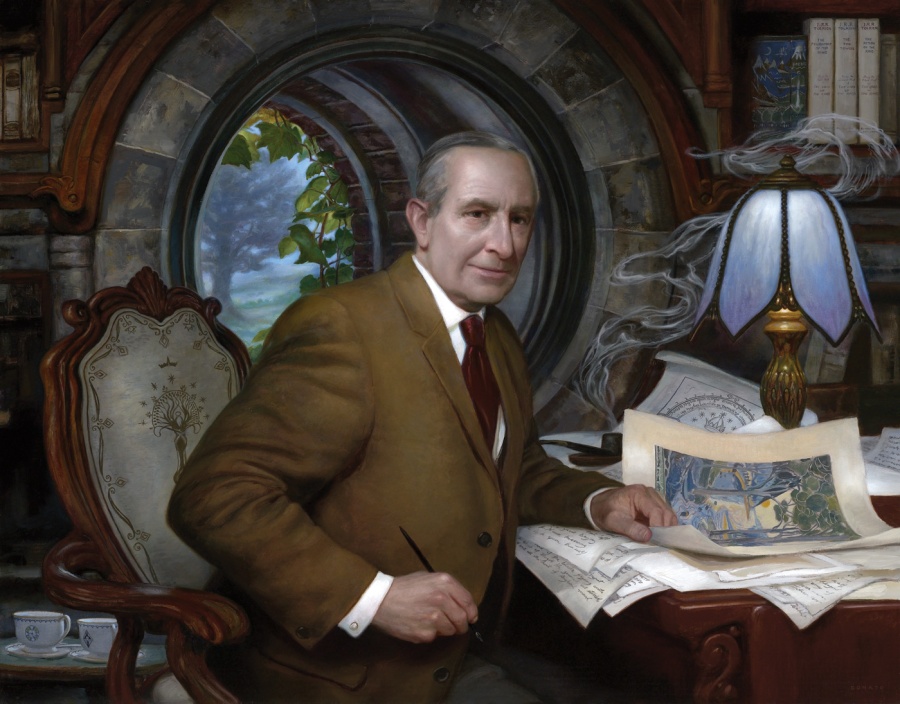
I want to thank Donato Giancola for allowing me to use his stunning portrait of J.R.R Tolkien as the featured image for this project. If you would like to purchase print of this painting, they are available on his website!

If you would like to contribute your own experience, you can do so by using the form on the contact page, or by emailing me directly.

Now, on to Michaela Hausmann’s responses:


How were you introduced to Tolkien’s work?

My sister told me about The Lord of the Rings when I was twelve years old. She promised to go and see the film with me but I wanted to read the book first. I did and became enchanted. I still am. And I shall be forever grateful to my sister.

What is your favorite part of Tolkien’s work?

My favourite chapter in LotR is the chapter “Farewell to Lórien” as it poignantly portrays the tragedy of the Elves and of Galadriel, who also happens to be my favourite character. I still think that this chapter is one of the most important passages in Tolkien’s legendarium as it makes a crucial statement about the necessity and pain of loss but also about the beauty and importance of hope.

What is your fondest experience of Tolkien’s work?

My first Tolkien Society Seminar in 2015. In German academia, fantasy literature is sometimes still not taken seriously. To meet so many like-minded Tolkien enthusiasts at the seminar made me ridiculously happy and encouraged me to continue my work.

Has the way you approach Tolkien’s work changed over time?

It has. Of course, reading The Silmarillion is an altogether different experience than reading LotR. For many years, I preferred The Silmarillion with its creation myth, the epic wars between Morgoth and the Elves, and the touching stories of the fall of Gondolin or the love of Beren and Lúthien. The Silmarillion fascinates me because it oscillates between the bigger picture and the portrayal of individuals. However, after learning more about narrative techniques and Tolkien’s works in general, I began to appreciate the unique narrative style of LotR more than the necessarily fragmented stories of The Silmarillion. And finally, writing my PhD thesis on the poems in LotR required a more detached view and analysis of Tolkien’s works. This was an important and necessary experience. The enchantment continues but it has changed, and that is a good thing.

Would you ever recommend Tolkien’s work? Why/Why not?

YES! Because they take you to a beautifully written world full of wonder, tragedy, good & evil deeds, and fascinating stories. Yet they also take you back to “recover” your own world, as Tolkien called it, to see your own world in a new light. And, what is more, Tolkien’s hopes came true. His works indeed left “scope for other minds and hands, wielding paint and music and drama” (Letters, 145). Even people who are not voracious readers can take the road to Tolkien’s Faërie – through music, pictures, films, games, cosplay, etc. Tolkien’s works have, in many ways, become a shared experience.


For more from Michaela, you can follow her on Twitter!

Lo’s Experience–Tolkien Experience Project (67)

This is one in a series of posts where the content is provided by a guest who has graciously answered five questions about their experience as a Tolkien reader. I am very humbled that anyone volunteers to spend time in this busy world to answer questions for my blog, and so I give my sincerest thanks to Lo and the other participants for this.

To see the idea behind this project, check out this page

I want to thank Donato Giancola for allowing me to use his stunning portrait of J.R.R Tolkien as the featured image for this project. If you would like to purchase print of this painting, they are available on his website!

If you would like to contribute your own experience, you can do so by using the form on the contact page, or by emailing me directly.

Now, on to Lo’s responses:


1. How were you introduced to Tolkien’s work?

I was, sadly, introduced to Tolkien through Peter Jackson’s movies. I tried reading The Hobbit when I was younger, around 11, but I admit to not having made it past the tedious beginning with the genealogy and things. At that time, I stuck mostly to nonfiction. I had discovered paganism after starting middle school, and devoured any book on nature religions and the occult that I could find. Of course, when I did finally see the movie a year later, I was VERY ready to absorb the values, characters, and story given to me by the saga. I read the trilogy, The Hobbit, The Silmarillion, as well the Lost and Unfinished Tales, and even part of Lays not long after.

2. What is your favorite part of Tolkien’s work?

My favorite part of Tolkien’s work is his philosophy. Of crafting “sub-creations”, of myth-making, of living fully and peacefully, of his skepticism of industry and money, and, even though I am still pagan, of his religious devotion. He endeared me in a most profound way to the art of slowness, deep listening, and conviviality. He shaped my deep interest in environmental matters, and my respect for honest labor of the soil. He helped to form the basis of my understanding of the world and of the importance of story. Small things no longer elude me, and I know that wonder is often found in the humblest of places.

3. What is your fondest experience of Tolkien’s work?

If I ignore the fun times I had with friends in high school who would get together to watch all 3 films in one day every year, or dress up with them as characters for Halloween, my fondest moments were probably over the course of reading The Silmarillion. Certain scenes, lines of dialogue, images, would stick out to me, and I would have to put down the book to process what had happened. Invariably I would sit for a while, or here and there over several days, and ponder things like Feanor burning the ships, or the men and elves arguing about the pain of death and the pain of immortality, or the sinking of Beleriand and the idea that a world could truly be changed for ever.

I was also wholly enamored with the act of “sub-creating” itself, and dove head-first into designing otherworldly alphabetic ciphers when I was younger. My affinity for writing and storytelling eventually combined with alphabets to pull me towards hobbyist language creation in high school, which I didn’t have much of a gift for in the end. Fortunately, my artistic talents prevailed, and in college I started a graphic novel that owes a great deal of its narrative, philosophical, and world-building sensibilities to Tolkien’s influence. And though I’ve since shifted focus away from linguistics and genealogies, I hope that I’ve successfully conveyed in my own work the same sense of deep history as well as the wonder and vastness of nature that so moved me when reading about Middle-earth.

4. Has the way you approach Tolkien’s work changed over time?

Absolutely. When I was younger, I was drawn to the idealism underpinning the stories of many of Middle-earth’s heroes. From Aragorn to Glorfindel, I was most receptive to scenes of bravery and beauty, as well as the aesthetics of a world that values such things highly. But in the past 5 years or so, I’ve since come to better understand the plight of our own world, and that it will, in my lifetime, also be changed forever. I’ve since come to see many of Tolkien’s tales to be tales of collapse, of peoples navigating a shrinking, increasingly hostile world, and the end of days in a most literal way. But maybe the most valuable lesson to be had with that reading is that the years will always march on, no matter how old you feel, no matter the tragedies you’ve witnessed, and that the best thing to do is to surround yourself with good food, good pipe-weed, and good company. And to remember that all things will pass.

5. Would you ever recommend Tolkien’s work? Why/Why not?

I have and I do recommend Tolkien’s work for the simple reason that it is one of the bedrocks of my life and that knowing at least part of his corpus is one of the quickest ways to understand me, as well as the kind of humility and values I strive to represent.


To see Lo’s work, you can visit aquapunk.co!

Thoughts on Post-Conference Feelings and Imposter Syndrome

Hello everyone, I posted this thread on my social media sites, and it received some attention, so I thought it might be worth sharing here, and I will also elaborate a little more because I can do that in a blog!

It started as just thinking aloud, so I began with “Important post-conference reminder (mostly for myself, but I though it might help someone else):” but it has evolved and many people seemed to find it helpful. I hope you do too!


It is wonderful to be engaged in a field where I am able to meet others and get excited about their projects and ideas for the future! I am privileged to have such opportunities, so I want to get everything I can out of them. Importantly, then, I want to concentrate on keeping the joy that comes from these events and not let it feed imposter syndrome!

It is easy, especially when I am feeling melancholy after a wonderful conference ends, to make a harmful transition from “these people are remarkable and I am fortunate to meet them” to “I’m not as remarkable and I don’t know if my project is worth doing”. Ideally, I want to sit with the first thought, and avoid the second.

This is difficult, though, especially for introverts. It is okay to feel sad and even a little depressed after “being up” for several days. It is normal, and many people experience the same feeling. Allow yourself to be sad, this is part of life. The trick is to allow yourself the time you need to recover without allowing this sadness to combine with the thoughts that are harmful.

These times of recovery are often the times when doubts are most likely to come up. I struggle with this a lot! I will give you some things that I have learned to help myself, though I still struggle, and maybe they will help you!

Things to remember:

  1. Forgive yourself: it is okay to be sad. This just means that you have enjoyed the past several days and the people you have met!
  2. Thoughts like this are something that a lot of people struggle with. Remember that rebounding will happen, these thoughts are temporary!
  3. Most importantly, reaching out to others is the best way to help imposter syndrome!

Talking about imposter syndrome doesn’t make the feelings go away entirely, but knowing that you are not alone eases a lot of the stress and anxiety associated with it.

If you don’t have anyone to reach out to, message me!

Thomas G’s Experience–Tolkien Experience Project (66)

This is one in a series of posts where the content is provided by a guest who has graciously answered five questions about their experience as a Tolkien reader. I am very humbled that anyone volunteers to spend time in this busy world to answer questions for my blog, and so I give my sincerest thanks to Thomas G. and the other participants for this.

To see the idea behind this project, check out this page

I want to thank Donato Giancola for allowing me to use his stunning portrait of J.R.R Tolkien as the featured image for this project. If you would like to purchase print of this painting, they are available on his website!

If you would like to contribute your own experience, you can do so by using the form on the contact page, or by emailing me directly.

Now, on to Thomas G’s responses:


How were you introduced to Tolkien’s work?

My dad read The Hobbit and The Lord of the Rings to me as bedtime stories when I was a child. I was introduced to The Silmarillion when I was looking for an audiobook to listen to on a family road trip and saw an audio version of a Tolkien book I hadn’t read.

2. What is your favorite part of Tolkien’s work?

The world building. That was what inspired me to become a writer. My earliest attempts at original fiction were very focused on the world building as a result. I have sought out all of The History of Middle Earth, because seeing how Tolkien progressed through various iterations of his stories is something I find incredibly fascinating. The (relatively) newly released Fall of Gondolin is a particular favorite of mine.

I have also really loved the characters, especially the elves (Legolas was an early favorite). I realized recently that the reason that I got so attached to the elves was that my ideal gender presentation very easily falls into they way elves are depicted. The long haired, beautiful masculinity, particularly of the Noldorin elves of The Silmarillion, is something that I find very appealing. Jenny Dolfen’s depictions of Fingon are absolutely gorgeous.

3. What is your fondest experience of Tolkien’s work?

Being able to create my own meaning from a huge body of work. There are so many ways that working with HoME and the various iterations of the stories that can make for a number of incredible and varied interpretations of the work, both academic and fannish.

There is also something I find quite special about sitting down to watch the extended cuts of the LotR films. They are among a very small number of movies that I can just get completely lost in watching.

4. Has the way you approach Tolkien’s work changed over time?

Tolkien was my first foray into fanfiction before I knew what fanfiction even was. I was eight or nine and I’d just seen the Fellowship of the Ring movie for the first time, and I decided, “I like these characters, I’m going to write a story with them,” and I’ve been writing Tolkien based fanfiction pretty much ever since.

My early interaction with Tolkien’s work was primarily with the LoTR and The Hobbit, however, the more I got into The Silmarillion, they more I wanted to learn about all the specifics and the differences that emerged in the earlier drafts that make up HoME (Such as the scrapped LotR storyline where Legolas and Gimli get captured by Saruman). As I’ve gotten older and fallen in love with academic research, my interest in Tolkien has gotten more academic as well.

5. Would you ever recommend Tolkien’s work? Why/Why not?

Yes. Not to everyone of course, but if someone is interested in the high fantasy genre, but hasn’t read The Hobbit or LotR, I think suggesting those as future reading would be fitting. I’d feel the same way for someone maybe just trying to dip their toes into that genre for the first time.

If someone already likes Tolkien and is interested in reading more, I would absolutely recommend The Silmarillion. I find it’s a more challenging read than The Hobbit or LotR so I probably would not recommend The Silmarillion to someone who hasn’t read any Tolkien before and the same would apply to HoME.


For more Tolkien talk from Thomas G, you can follow him on Twitter or his blog!

Elyanna C’s Experience–Tolkien Experience Project (65)

This is one in a series of posts where the content is provided by a guest who has graciously answered five questions about their experience as a Tolkien reader. I am very humbled that anyone volunteers to spend time in this busy world to answer questions for my blog, and so I give my sincerest thanks to Elyanna C. and the other participants for this.

To see the idea behind this project, check out this page

I want to thank Donato Giancola for allowing me to use his stunning portrait of J.R.R Tolkien as the featured image for this project. If you would like to purchase print of this painting, they are available on his website!

If you would like to contribute your own experience, you can do so by using the form on the contact page, or by emailing me directly.

Now, on to Elyanna C’s responses:


How were you introduced to Tolkien’s work?

I was first introduced when I was about 9/10 to the LOTR movies via my dad, but I don’t remember having any lasting impressions from that first exposure. The real moment I got thoroughly invested was when I was studying The Hobbit as a part of my ELA (English Language Arts) class in Hong Kong in 2012 when The Hobbit films were coming out. That’s when I really started to participate in a “fandom” like setting online on Tumblr and joined a Tolkien roleplay community where I was introduced to The Silmarillion in around 2014. From there I began to branch out to The Histories of Middle-earth. I then moved back to the UK in 2015 when I started being exposed to the Tolkien Society, and after attending a few events I’ve recently joined as a member and am due to present at Tolkien 2019 in August. I am currently 19 so I’ve only just fallen out of the young readers category.

2. What is your favorite part of Tolkien’s work?

Probably the nuances and dualities of pretty much everything in his work. There’s always the theme of hope and triumph, but also cynicism and price of victory in Frodo’s success. There’s the equal capability for all races in Tolkien’s works to both enrich and destroy cultures and one another, but there’s also the moral grey and the debates that can be made about the nature of evil in Tolkien’s world — if the orcs are considered by Tolkien to be entirely irredeemably evil and so separate from the sentient “good” races, then how are they capable of creating and speaking language in the form of Black Speech? (Personally, I’m a big fan of the “it’s a perversion of the Valarin language spoken by the Valar and Maia” theory due to their similar sounding harsh consonants, and how perfectly it fits into the whole evil is a perversion of good idea in Tolkien).

3. What is your fondest experience of Tolkien’s work?

Probably my discovery of The Silmarillion and its special place in my life — it felt like I had picked up an anthology of myths and histories from a world I didn’t feel as alienated from as opposed to Ancient Greek/Roman mythologies. Those were the stories that stuck with me the most — one of the reasons why I’ve applied for Medical School to become a doctor in the first place is because I was so moved by Fingon’s rescue of Maedhros! Even while on work experience in A&E I was subconsciously picturing myself as a Fingon-like figure, and I really didn’t mind offering my help to the nurses and other staff present whether it was requesting photocopies of paperwork, or cleaning up bodily fluids. The other influence was Eowyn’s decision to transition to a life of healing after experiencing and fighting in war, so in that my career aspirations are very personally linked to Tolkien and the influence his works have had on my life. I’ve also made several close friends, some of whom I’ve known for the better half of a decade now through the online Tolkien fandom space who I still speak to on a regular basis.

4. Has the way you approach Tolkien’s work changed over time?

I think as a result of my first lasting impactful exposure to Tolkien’s works being in an academic setting, I’ve tended to read Tolkien in more or less an academic light from the very beginning, and analyses done by other fans online in “meta” posts have definitely influenced the way I read certain characters with a lot more nuance than I might have in my original readings of the text. Who knew the fanbase could be so divided on Fëanor? There’s also the matter of me being a POC (Chinese-British) fan in a fanbase which I would argue has few to no visible POC fan communities which has shaped my interactions within in the fanbases both online and in real life. There’s also the matter of some of the contents of Tolkien’s letters which would be considered rather ignorant today regarding his attitudes towards certain people groups which I would say actually did hurt me quite a bit as a young fan. Why should I continue enjoying a man’s work when he described the features of the only evil irredeemable race as “Mongoloid” when I instead interpreted the majority of Elves to look similar to me in that we both share a similar physical description of fair skin and dark hair? While I definitely still think there are problematic attitudes hidden within even more well-known and documented instances of real-life people groups (*cough*Easterlings*cough*) being given problematic treatment in both the films and the original texts, I’d like to think that he was more enlightened than the average person of his time and as such his particular views on race and ethnicity are a product of his time. And with that, I can safely continue enjoying and consuming Tolkien content to my heart’s desire with a sound mind so long as I take those small problematic details when they pop up with a generous sprinkling of salt.

5. Would you ever recommend Tolkien’s work? Why/Why not?

Definitely! There’s a piece of Tolkien’s work everyone can appreciate, embrace and participate in whether it’s the “not all those who wander are lost” fridge magnet quote, the Peter Jackson movies, the Hobbit and LOTR books, or The Silmarillion and other posthumous works. Personally, I’ve been able to take the most out of the Silmarillion as my go-to work which I guess warrants a label of being a little pretentious, but I don’t mind. That’s just my personal experience and everyone else is entitled to their own just as I am to mine.


For more Tolkien talk from Elyanna C., you can follow her on Twitter!