LotRFI Pt.58–The Scouring of the Shire

I was utterly unprepared for the Scouring in my first read of LotR. Almost every book I had ever read had an ultimate climax, and then a denouement to return the main characters to normalcy. I was shocked that there could be trouble after the Ring is destroyed.
sergei-lukhimov_orig
Image copyright Sergei Yukhimov

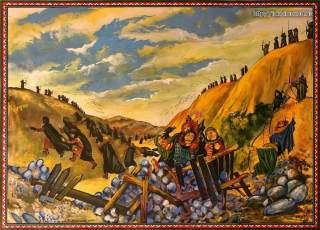
This event was pivotal to my interpretation of the hobbits in my first reading, though. This is where the hobbits display their new-found maturity. The quest has changed each of them, and those changes are displayed throughout their confrontations in the Shire. Merry, Pippin, and Sam all gained courage, confidence, and the ability to lead others.

Nowhere were these traits more apparent to me than in the preparations leading up to the Battle of Bywater. The hobbits of the Fellowship gather together disparate groups of hobbits and rally their spirits to out their oppressors.

For Sam, courage manifests itself on a personal level as he finds the strength to talk to Rosey Cotton, and ultimately marry her. Frodo, though, shows a different type of development. He has learned pity and mercy after these characteristics saved his life and all of Middle-earth. He demonstrates this several times in his interaction with Saruman and Wormtongue outside of Bag End. He offers them freedom and forgiveness several times.

As a child, I detected the changes in Pippin and Merry much more readily than those in Frodo and Sam. Their actions and outward appearance changes drastically after the quest. Even Sam was easier to understand because he seeks out more responsibility and involvement in the community. While Frodo partakes in many of these same responsibilities, this is not as noticeable a change for him.

Unlike the other hobbits, though, Frodo carries wounds that never heal. While Frodo was my least favorite hobbit, I still pitied his pain and I wondered if he would ever find healing.

Where Do We Go From Here?

To the Grey Havens, then on to the final words of the story.

What Do You Think?

How did you react to the change in the hobbits?
What did you think of Frodo’s pain?
​Did I miss anything? Let me know!

Ian L. Collier–Tolkien Experience Project (55)

This is one in a series of posts where the content is provided by a guest who has graciously answered five questions about their experience as a Tolkien reader. I am very humbled that anyone volunteers to spend time in this busy world to answer questions for my blog, and so I give my sincerest thanks to Ian and the other participants for this.

To see the idea behind this project, check out this page

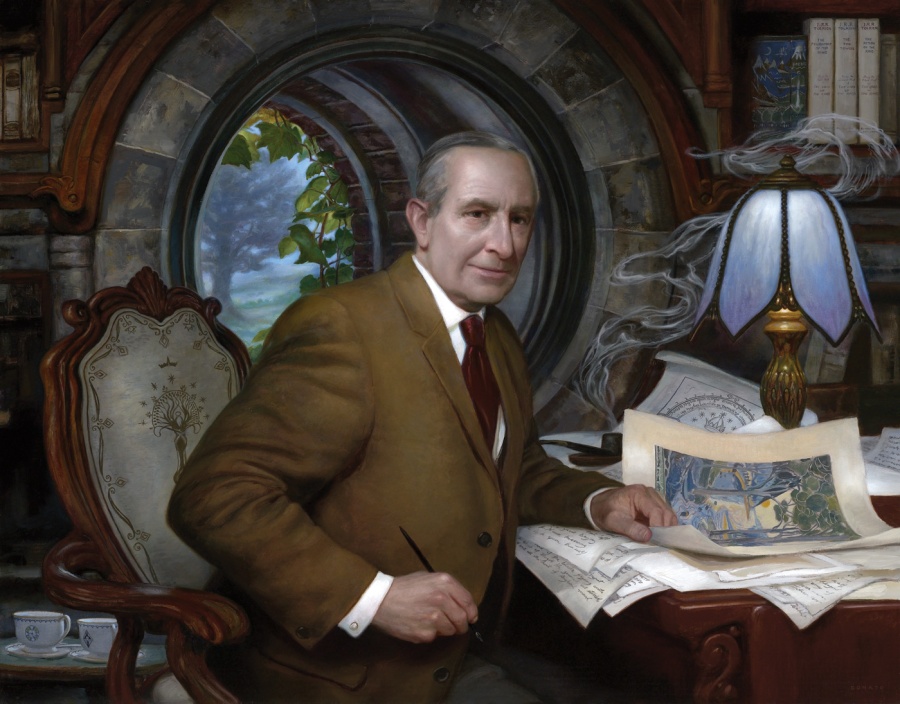
I want to thank Donato Giancola for allowing me to use his stunning portrait of J.R.R Tolkien as the featured image for this project. If you would like to purchase a print of this painting, they are available on his website!

If you would like to contribute your own experience, you can do so by using the form on the contact page, or by emailing me directly.

Now, on to Ian L. Collier’s responses:


1. How were you introduced to Tolkien’s work?

Technically at school as my class of 12 year old kids had The Hobbit as a book to read as a class reading (each taking turns to read it) but as my father died around then I didn’t finish it with the class and forgot all about it – you can guess why. 4 years later though during the summer holiday from school I saw my sister reading a book with a strange design of a ring & strange red letters and asked what it was – she told me I could read it after I’d read The Hobbit. So I read The Hobbit and then sneaked reading of The Lord of the Rings (in 3 volumes) as my sister hadn’t finished it but had to go to work at her summer job – so I could read it when she wasn’t at home – and then went to get copy of from the library to read straight away after. I’d read Catch22 in a similar fashion earlier but have only re-read that once unlike TH & LotR etc 😉

2. What is your favorite part of Tolkien’s work?

Oh now that is something I would describe as very hard to pin down beyond ‘all of it’ In TH & LotR There’s the sheer depth of the world you experience around the characters and action. TH may be a bedtime story for kids but there are all these hints at older stranger things around the edges, in LotR there are even more and then at the end you get the appendices and “Tale of Years” with all these little snippets of ‘history’. After that you find The Silmarillion with its mythology and then the wars of the elves that are hinted at in TH. Unfinished Tales is a gem as it bridges Sil & TH/LotR with background information and also new stories.
After that you can discover Farmer Giles of Ham, or Niggle and his Tree, and the Father Christmas Letters are jewels of imagination and artistry, Tolkien’s output is a deep well of wonderful tales or scholarship wrapped up in fiction.
There is also the pleasure to be found in reading them aloud to other people (kids & adults).

3. What is your fondest experience of Tolkien’s work?

Reading Farmer Giles of Ham with a group of students in Taruithorn (The Oxford Tolkien Society) who had never read it before – it was a delight.

4. Has the way you approach Tolkien’s work changed over time?

Not really, I still just pick up a book from my shelves – they are quite tame so there’s no need to sneak up on them.

5. Would you ever recommend Tolkien’s work? Why/Why not?

Of course I would, and have, before the films actually came out I was interviewed a few times for the Tolkien Society and I was asked what I would say to someone who had tried to read LotR and given up – my reply was to read it until the end of the Council of Elrond and if you weren’t hooked then not to worry about it – books are different to each readers’ taste and for some people the ebb and flow of familiarity and danger as FotR takes you from birthday parties, on to shadowy hunters etc works to draw you in but for others …


LotRFI Pt.57–Bilbo

Bilbo served as a vital link between H and LotR for me in my first reading. I loved Bilbo’s character in H and was curious to see what would happen to him in this new tale. I was surprised, then, when he quickly exited the stage and was replaced by Frodo. Nevertheless, Bilbo served a pivotal role. He was no longer the protagonist of the story; instead he was a patriarch, the figurehead at the beginning of a tradition. He preserved the Ring and passed it to Frodo. Now Frodo, and the reader by extension, must see the quest through to the end, if only for the sake of Bilbo. This was very clear to me in my first reading.

The idea of the quest of the Ring as an inheritance from Bilbo is emphasized in the Council of Elrond. Bilbo volunteers for the quest:

‘Very well, very well, Master Elrond…It is plain enough what you are pointing at. Bilbo the silly hobbit started this affair, and Bilbo had better finish it, or himself’ (FR, II, ii, 269).

He is turned down and the quest falls, instead, to his heir, Frodo.

bilbo
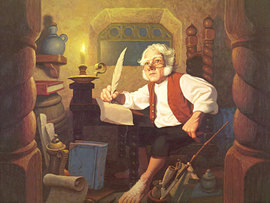
Image copyright Greg and Tim Hildebrandt

Bilbo functions to keep the reader motivated throughout LotR. I would argue that this is especially true of younger readers who were particularly invested in him in H. I know it was certainly true for me. I wanted to see what happened to this ring that Bilbo collected and that brought doom to the world. It was important to me that Bilbo was not implicated in anything so heinous.

Perhaps this post is a bit unexpected, especially here in the midst of the story’s conclusion. I have good reason for putting it here, though. Bilbo continues to serve as this important motivator for younger readers even through the end of the tale. When the hobbits revisit Rivendell, he is there to catch up on the adventure and to demonstrate how much the world has changed. Not only has the age of Men begun, but the age of children’s tales is fading, much like Bilbo himself.

Finally, this theme is enacted as Bilbo travels to the ships to sail west. Frodo finally comes to an even footing with his mentor after completing the quest which the one bequeaths the other. They part the world at the same moment, and this serves to bookend both LotR and H.

Where Do We Go From Here?

To the Shire, and then to the Grey Havens.

What Do You Think?

Did you see Bilbo as a structural element in your first reading?
Did you expect to see Bilbo as much in LotR? Did you expect to see him more?
​Did I miss anything? Let me know!

John Hancock’s Experience–Tolkien Experience (54)

This is one in a series of posts where the content is provided by a guest who has graciously answered five questions about their experience as a Tolkien reader. I am very humbled that anyone volunteers to spend time in this busy world to answer questions for my blog, and so I give my sincerest thanks to John and the other participants for this.

To see the idea behind this project, check out this page

I want to thank Donato Giancola for allowing me to use his stunning portrait of J.R.R Tolkien as the featured image for this project. If you would like to purchase a print of this painting, they are available on his website!

If you would like to contribute your own experience, you can do so by using the form on the contact page, or by emailing me directly.

Now, on to John Hancock’s responses:


How were you introduced to Tolkien’s work?

When I was at Adelaide University in the 70s there was a strong JRRT following. It appeared to have a significant cultural influence on many of my fellow students, even in the science faculty of which I was a part.

I bought a paperback copy of LOTR and once I started to read could not put it down. I was transported in a way that I never experienced previously and have not since.

I also bought another paperback The Adventures of Tom Bombadil which contains some short stories such as Leaf By Niggle and various poems. When my children were young I would often read the poems to them which they still remember.

After that I read LOTR every year until I was about forty. After that I have read it on average about every two to three years.

The original LOTR and TAOTB have long since fallen to pieces due to their constant use and have been replaced.

Once the movies were released I instantly became a fan and have watched them many times, and the commentaries and extras numerous times as well.

I also purchased The Silmarillion and have read that a number of times as well.

2. What is your favorite part of Tolkien’s work?

That is like having to choose between your children. If I had to choose I think it would be his poetry. More specifically, “Poems and Songs of Middle Earth.” Although not strictly adhering to the “Middle-earth” mythology it seems to me to encapsulate JRRT’s creative ability.

3. What is your fondest experience of Tolkien’s work?

Back in Uni a friend loaned me a record of “The Poems and Songs of Middle Earth” and I subsequently bought the four record set.

It has a song cycle of songs sung by William Elvin and music by Donald Swan (of Flanders and Swan fame), and readings of poems and extracts from the book by Tolkien himself.

I spent many hours listening to these records.

I subsequently bought the hard cover book “Poems and Songs of Middle Earth” which contained the piano score of the Swan song cycle. I am sure I drove my family mad trying to play and sing the songs.

4. Has the way you approach Tolkien’s work changed over time?

I cannot say that it has really. Well, that is not strictly true.

When I first read his work I was captivated and amazed at the complexity and sheer imagination. As I discovered more about the world that Tolkien created I become more and more engrossed in his legendarium.

Having discovered so much scholarly work, particularly The Tolkien Professor, it has given me a greater appreciation of the literary merits of JTTR’s work.

5. Would you ever recommend Tolkien’s work? Why/Why not?

Short answer yes. Long answer maybe. I have found that many people have no desire for or appreciation of fantasy. That is not to say that they would not appreciate JRRT’s writings but I have found that it just leaves many people cold.

To be blunt he is not for everyone. However it has not stopped me recommending his work and never will but I rarely recommend others of his works such as The Silmarillian.


For more from John Hancock, check out his Twitter or his Facebook!

LotRFI Pt.56–Many Departures

Since I can remember, I have been prone to melancholy when significant events or phases of my life conclude. I do not know if this was caused by LotR or if I already had this tendency. What I know for certain, though, is that the protracted series of departures in Book VI were cruel and unusual punishment to me as a child.

peter-caras_orig
Image copyright Peter Caras

Each character that broke away and said goodbye would sting a little bit more. This started as early as the departure of the Fellowship from Gondor. I knew that everyone would have to return home, but I did not like saying goodbye to the likes of Faramir and Éowyn. As the Rohirrim leave for their land, another wave of sadness struck as the brave Eorlingas left. As Gimli and Legolas bade farewell to the Fellowship and turned toward their various ends, I was greatly saddened. Oddly enough, Treebeard saying goodbye to Merry and Pippin was one of the hardest farewells for me to read. This emotion finally reached its pinnacle with the departure of Aragorn. I remember sobbing as he vanished in the glimmer of the Elfstone, thankfully I was at home.

This extended leave-taking is still hard for me to read without welling up with emotion. I do not know what inspired Tolkien to write the departures in such a prolonged manner, but it certainly struck home in this reader in the first reading.

A couple of side-notes:

The way that the three bearers of the Elven Rings talked back and forth was interesting to me, though I did not wholly understand that they were actually conversing with one another. I just assumed this was some long exchange of meaningful glances.

I thought that the interaction with Saruman on the side of the road was the last I would see of him. I thought it served to show his declined state and how he was prone to making idle threats. I did not know that it foreshadowed his part in the Scouring of the Shire, but more on that later.

Where Do We Go From Here?

A special mystery post about an undisclosed character, then on to the Shire!

What Do You Think?

Do you like how Tolkien organized the departures?
Did they change your estimation of the book?
​Did I miss anything? Let me know!

Cristina Montes’s Experience–Tolkien Experience Project (53)

This is one in a series of posts where the content is provided by a guest who has graciously answered five questions about their experience as a Tolkien reader. I am very humbled that anyone volunteers to spend time in this busy world to answer questions for my blog, and so I give my sincerest thanks to Cristina and the other participants for this.

To see the idea behind this project, check out this page

I want to thank Donato Giancola for allowing me to use his stunning portrait of J.R.R Tolkien as the featured image for this project. If you would like to purchase a print of this painting, they are available on his website!

If you would like to contribute your own experience, you can do so by using the form on the contact page, or by emailing me directly.

Now, on to Cristina Montes’s responses:


How were you introduced to Tolkien’s work?

A philosophy professor in college (sometime between 1993-1997) recommended that I read Tolkien. It was only many years later, however, that I actually got around to doing so. That was when the LOTR movies were about to come out. I wanted to read the books before watching the movies.

2. What is your favorite part of Tolkien’s work?

I love the LOTR trilogy. It’s an annual ritual for me to re-read it. I simply love the story, the themes, the world Tolkien created, his characters, and the word-craft.

3. What is your fondest experience of Tolkien’s work?

When I went to Spain to study for a year, I discovered that my Spanish landlady also has a passion for Tolkien. From that instant, the two of us became very good friends. She even lent me the Spanish edition of LOTR when she found out I read the trilogy once a year.

4. Has the way you approach Tolkien’s work changed over time?

Yes. Every time I read the LOTR trilogy, different parts of it resonate depending on the personal issues I’m dealing with at the moment I’m reading the trilogy. Also, through time, I have read Tolkien biographies and commentaries and studies on his works; these have enriched my understanding and appreciation of Tolkien’s works and have given me new ways of viewing his works. Because of this, each re-reading of the LOTR trilogy is a unique experience.

5. Would you ever recommend Tolkien’s work? Why/Why not?

Of course! Tolkien’s work has enriched my world and has made me a better person in more ways than one.

LotRFI Pt.55–Aragorn King, Aragorn King

When Aragorn finally acknowledges his title, beginning with the ride out to the Black Gate, he changes dramatically. He becomes an archetype of the ‘good king.’ This is a motif that I was familiar with from reading Arthurian fiction, and Aragorn fits the role pretty well. Like my response to Frodo, I appreciated how Aragorn took on the responsibility of kingship but I did not like him as a person in this role as much.

returnking3
Cover art copyright Michael Herring

I cannot overstate how much I loved Strider in my first reading. He was cool but responsible, mysterious but stately. He was like the gruff uncle or something. He was very likable and I felt this likability diminish as he ascended to his throne. In short: I liked Strider better than Aragorn, and I think I still do. As a character, Aragorn becomes more distant and aloof to the hobbits. This is only natural because he has so much more responsibility, but it felt like a ‘growing apart’ in a way. Aragorn was moving on with his life, and the hobbits and I were still the same.

We were changed by the quest, of course, but not by status or class. For the hobbits and the reader, the change is internal, a maturing or growing up, but for Aragorn it is largely external. I felt this keenly in my first reading. While I still loved Aragorn, because he was still partly Strider, I lamented his change in status. Since I did not read the appendices, I did not know that the hobbits ever saw Aragorn again. I thought that he basically forgot them once he went back to Gondor: a melancholy ending to the relationship.

As a side-note: since I did not read the appendices or pick up on the hints throughout the text, Arwen was a mystery to me when she showed up to be his queen. I did not know who she was, or why she should have such an immediate claim on Aragorn. I essentially had to judge her based on her actions once she is Aragorn’s queen. I decided that I liked her enough, because she gave Frodo a present, but that I still did not know her very well. Keep in mind that I did not realize what she actually gave Frodo. I thought that she basically gave him a token, and that she was simply describing how he is destined to go West (something that I promptly forgot before the end of the book).

Where Do We Go From Here?

To talk about the many departures, then a special mystery post!

What Do You Think?

How did you feel when Aragorn became king and started taking on those responsibilities?
Did you feel a shift in his relationships to other characters?
Did I miss anything? Let me know!

Michael Flowers–Tolkien Experience Project (52)

This is one in a series of posts where the content is provided by a guest who has graciously answered five questions about their experience as a Tolkien reader. I am very humbled that anyone volunteers to spend time in this busy world to answer questions for my blog, and so I give my sincerest thanks to Michael and the other participants for this.

To see the idea behind this project, check out this page

I want to thank Donato Giancola for allowing me to use his stunning portrait of J.R.R Tolkien as the featured image for this project. If you would like to purchase a print of this painting, they are available on his website!

If you would like to contribute your own experience, you can do so by using the form on the contact page, or by emailing me directly.

Now, on to Michael Flowers’s responses:


How were you introduced to Tolkien’s work?

At Junior High School an English teacher retired, and we were given a science teacher for one hour a week. He obviously didn’t know how to conduct an English class. His solution was to get us to read in turn out loud The Hobbit to the rest of the class. I can remember personally reciting the bit about the dwarves approaching the fires of the Elvenking. I even had time to look up and see the whole class was spellbound. At the end of the academic year we hadn’t even finished the book, so I got it that Christmas, and read it all through myself.

A few years later on a school prize-giving day someone in another class got this strange thick green paperback book with a yellow spine – myself and others were receiving chunky hardback history books, or atlases. On investigation this green book was Pauline Baynes’ cover of The Lord of the Rings. I got it the following Christmas and read it through several times. I remember the first time I wondered who Arwen was at the end (I missed her earlier entrance in Rivendell, or forgot all about her). I was also surprised that Strider became the King.

A couple of years later I remember going into W.H. Smiths and coming across a desk absolutely covered with piles of a strange book with a floral design on the cover – this was the launch of The Silmarillion. I got the paperback for Christmas once it became available, but it took at least 3 attempts before I could get past the first two “chapters”.

What is your favorite part of Tolkien’s work?

Without question The Lord of the Rings. I prefer his mature style with a detailed attention to landscape and nature. I also like his building of suspense, and contrast between safe havens and places of danger. My favourite chapters of all are “The Shadow of the Past” and “The Council of Elrond.”

What is your fondest experience of Tolkien’s work?

I didn’t enjoy my senior school very much, but I remember once reading The Lord of the Ringswalking between classes, waiting outside classes in every spare moment. Then reading it at home once I got back from school. I think I managed to read it using every spare moment in 11 days. I remember finding the 3 volumes in Hull’s central library in the reference section for the first time, and being amazed by the appendices. My paperback copy only had the Aragorn and Arwen appendix. I was still at school, but spend lots of 2p pieces photocopying the appendices I wanted to read at home. I don’t know why it never occurred to me to buy the third volume in hardback, but pocket money was tight then – only 20p a week. I loved the 1981 BBC radio adaptation, and that helped with the pronunciation of words like Celeborn and Isengard – the pronunciation appendices meant nothing to me at the time!

Has the way you approach Tolkien’s work changed over time?

Yes, when I first read it as a teenager my favourite chapters were “The Uruk-Hai” and “Shelob’s Lair”, but as an adult I definitely prefer “The King of the Golden Hall” and “Treebeard”. After I studied English literature at university were Tolkien wasn’t even mentioned, and I got the impression he was despised, I feared I would find the books childish. However, I found that the narrative had added depth, especially the sections dealing with the Riders of Rohan – after studying Old English. The first teenage readings were made at breakneck speed as the excitement mounted. Now, I like to take my time and savour all the words. However, I do find the Frodo, Sam & Gollum less interesting once one knows what happens next.

Would you ever recommend Tolkien’s work? Why/Why not?

When I first read it, it was a secret vice. You weren’t supposed to mention liking it, a bit like you couldn’t mention if you enjoyed Abba. The films have made Tolkien more acceptable and mainstream. However, I probably wouldn’t recommend Tolkien to a stranger. You need to know a person’s taste before recommending Tolkien. There are still some diehard realists who don’t like fiction in which there is an element of fantasy. I’ve heard several people gave up on the TV series “Game of Thrones” as soon as the dragons appeared!


If you want more of Michael’s thoughts on Tolkien and other topics, visit his blog at http://www.eybirdwatching.blogspot.com/

LotRFI Pt.54–Sauron and Evil

Disclaimer: the nature of evil and the way we interpret it is inherently combined with the worldview of the reader. That means that I cannot effectively discuss the depiction of evil in LotR without addressing how my religious upbringing interacted with my ideas of evil in the world. I try to avoid such religious criticism when I can, but it is essential in this post. Feel free to skip to the next post if you are uninterested in this type of commentary.

tn-the-tower-of-barad-dur_orig
Image copyright Ted Nasmith

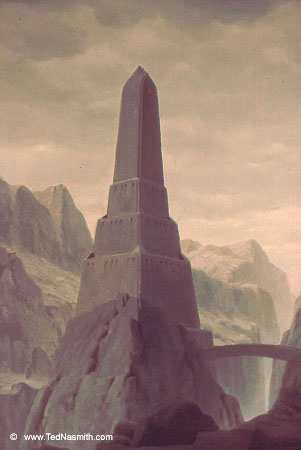
Since I read LotR as a kid, Sauron was a very effective depiction of evil to me. He was a disembodied, vague figurehead who inspired malice in his followers and crushed or corrupted his enemies. He was able to achieve all of this without ever being seen.

This type of pervasiveness made Sauron seem very complex to me as a child. I had a hard time understanding critiques of evil in LotR as being simplistic or naive. How could it be simplistic if it is able to be so pervasive and influential? To me, raised as a Sothern Baptist, Sauron was an accurate depiction of Satan (not the figure, but the figurehead). I did not understand that what people took issue with was the monolithic appearance of evil. As I think back, my lack of understanding is not very surprising to me.

Now we get to things hard to express in writing, especially plain writing without metaphor: As a child, evil was simple to me. Satan was simple to me. It was anything or anyone who caused pain or disagreed with someone I loved. This included those little thoughts of rebellion inside my own mind. Those things which were labeled as evil were to be avoided instantly. As a child, I did not wait to make distinctions or to problematize the character of evil, I fled it. Therefore, Sauron appeared as complex to me as any other evil, because all evil was monolithic.

To contradict myself, channeling my inner Walt Whitman, just because evil seemed simple does not mean that it was easy to defeat or avoid. The way that Tolkien portrays the Ring made sense to me as a Christian. I saw it as an embodiment of temptation. This is how Boromir was corrupted by it, and why each new character was to be mistrusted. Anyone at any time could feel the pull of the Ring and become ‘evil.’

To try to sum up what I have meant to express here: as a child evil was easy to identify, but impossible to avoid entirely. Sauron was a perfect embodiment of this kind of evil, which overlapped with my understanding of Satan from the Christian tradition. This meant that Sauron was, to me, the most effective antagonist I had ever encountered.

Where Do We Go From Here?

To examine Aragorn as a king, and then to start the homeward journey!

What Do You Think?

How did Tolkien’s depiction of Sauron interact with your view of evil?
How did you understand the Ring’s pull on other characters?
​Did I miss anything? Let me know!