
LotRFI Pt.46–​Éomer

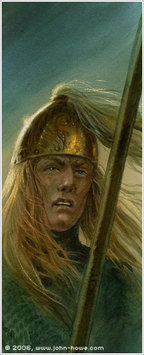
I mentioned Éomer’s first encounter with the protagonists in Pt. 22. Like many other characters, I mistrusted him at first, but then came to respect his demeanor and his bravery. The reader is reintroduced to Éomer at Edoras. Here he is reinstated as one of Théoden’s top commanders. From this point on, Éomer plays the part of a stout warrior, and steadfast advisor on military matters. He is impressive in this role, and takes after his uncle with his tenacious spirit.
wotr-eomer-port
Image copyright John Howe

As I read through LotR for the first time, I really liked Éomer. He struck me as a kind of balance between Strider as he appears in the beginning of the book and Aragorn as he is revealed as king in the end. He was unapologetically of high birth in his society, but was unpolished and even plain in his manner. This allowed him to be very likable, but to command respect, similar to what I saw in Théoden.

A large distinction that I made between Éomer and Théoden is that Théoden becomes close to the Fellowship through being an equal in stature to Gandalf and a fatherly figure to the hobbits. Éomer, on the other hand, seemed to establish a brotherly relationship with Aragorn and a playful rivalry with Gimli. While both of these relationships elevated the characters above the hobbits, and therefore above the reader, they were different in that Théoden seemed much more interested in the hobbits than did Éomer.

Shifting focus, this elevated stature of Éomer allowed him to be a heroic figure to me. His cares and worries seemed to be larger than those of the hobbits. Where the halflings are often concerned with a sense of belonging, Éomer knows his place, and is concerned more with how to lead his people correctly.

His position of authority makes his valiant stand on the battlefield even more impactful. While I am presenting my current thoughts on Éomer’s alliterative exclamations at a conference in 2018, I do want to cover my initial reaction to his heroic feats during the Battle of the Pelennor Fields.

Just as Théoden’s call to charge gave rise to some mad fire inside my little eleven-year-old frame, so too did Éomer’s despair at seeing his uncle and sister dead on the battlefield. At the time of my first reading, I was fortunate enough to have never lost someone close to me. Even still, I could find a sense of pain and loss something similar to what Éomer must have felt. His heartrending cry chilled me to the bones:

“‘Éowyn, Éowyn!’ he cried at last. ‘Éowyn, how come you here? What madness or devilry is this? Death, death, death! Death take us all’” (RK, V, vi, 844).

It was through these passages that I learned what it meant to be fey. Éomer’s complete abandonment of strategy in favor of making his death meaningful was utterly beyond my experience. His laughter in the face of battle was terrible and terrific. He was awe-inspiring in two ways: one of the most courageous and stupid things I had ever read. I was so grateful when Aragorn swooped in and saved Éomer, because I had given up hope that this courageous man would ever see another day.

Where Do We Go From Here?

To take a look at Denethor and see what his problem is.

What Do You Think?

How did you react to Eomer’s reckless abandon in battle?
What did you think of his relationship to the fellowship?
Did I miss anything? Let me know!

Becky Dillon’s Experience–Tolkien Experience Project (43)

This is one in a series of posts where the content is provided by a guest who has graciously answered five questions about their experience as a Tolkien reader. I am very humbled that anyone volunteers to spend time in this busy world to answer questions for my blog, and so I give my sincerest thanks to Becky and the other participants for this.

To see the idea behind this project, check out this page

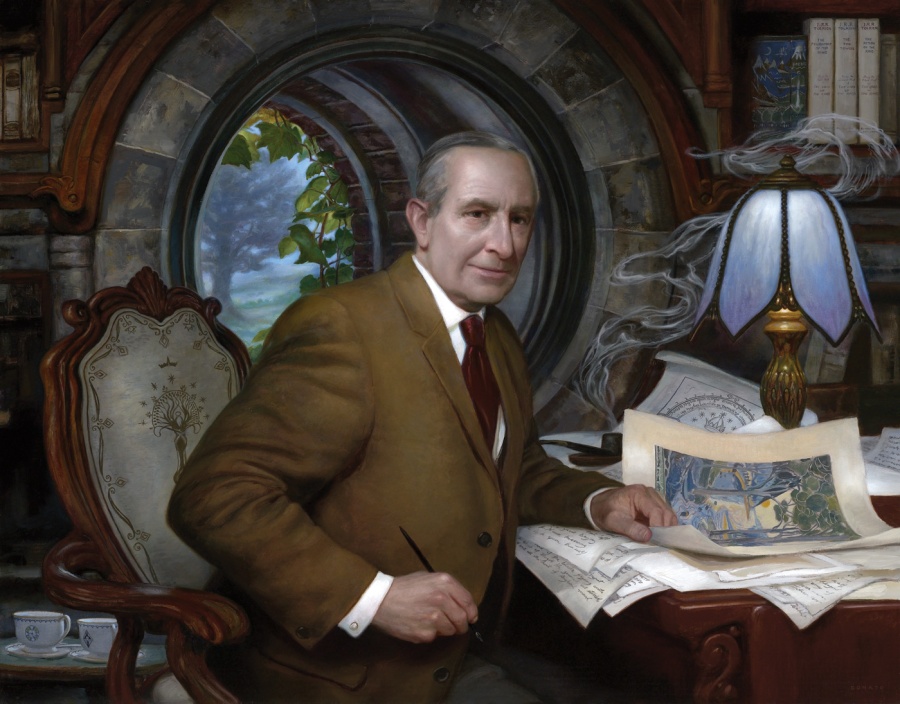
I want to thank Donato Giancola for allowing me to use his stunning portrait of J.R.R Tolkien as the featured image for this project. If you would like to purchase a print of this painting, they are available on his website!

If you would like to contribute your own experience, you can do so by using the form on the contact page, or by emailing me directly.

Now, on to Becky Dillon’s responses:


1. How were you introduced to Tolkien’s work?

“Read this,” she said as we brushed shoulder-to-shoulder in the exchange of classes back in 1965, and she pushed a strangely covered book under my nose.
“What? More unicorns and dragons and fairies? Please, Kathy, no!”
“This is different. Trust me!” I was sceptical, but I took the book from her anyway as she turned on her heel and sped away to her next class.
“Hmmm. The Two Towers. It doesn’t sound promising; more like Rapunzel…”

Of course, I was wrong.

It seemed that Kathy’s boyfriend had stumbled on this series of three books that he thought were cool and insisted that Kathy read them so they could discuss them. Kathy, in her need for support, was sharing the set with others, including me, and I got the second book because the first one was already lent out to a mutual friend who was keen to read this ‘new’ view of fantasy. Kathy, herself, was finishing the third.

Yes, I eventually got to read them in the correct order, and have been doing so every couple of years since then – albeit in one volume!

2. What is your favorite part of Tolkien’s work?

 My favourite part of Tolkien’s work is the imaginative children’s works; specifically Smith of Wootton Major, with Roverandom a close second. Tolkien’s love of story for the sake of story shows in his attention to detail and great sense of humour. Who else but Tolkien would invest so much time in the creation of the ‘Father Christmas Letters’ or the Girabbit in Mr Bliss’ garden? And, all of it is tied together with his own artwork. Although much of the published titles use the work of others (ie.:Pauline Baynes), Tolkien still had his own sense of art communicating the story as much as the words, and for a children’s book, pictures were a necessity.

3. What is your fondest experience of Tolkien’s work?

As existential as it may sound, the first time I got off the train in Oxford and walked up the street to the Magdalen Martyr’s Memorial and onto St. Giles and the Eagle and Child. I knew then that I would never have a better experience with Tolkien as my reference; almost as if I was ‘reading’ Oxford for the first time.

4. Has the way you approach Tolkien’s work changed over time?

Absolutely. Even after some 20+ reads of ‘Lord of the Rings,’ I have found that the more I read and discuss the more depth I find.
I am a member of an on-line reader’s group called the Grey Havens Palantír, and we are again reading LotR; being on Chapter VII, ‘In the House of Tom Bombadil.’ The previous chapter has opened up new insights, as re-reads always do, and I am always excited about new finds and new perceptions. The Story, for sake of the Story, will always intrigue me, but finding new details and new direction in the well-read text is always exciting.

5. Would you ever recommend Tolkien’s work? Why/Why not?

It would depend on the person involved. There are some who would not enjoy/appreciate Tolkien, and I would like to think that I should be able to discern those characters. I have found that it takes a special character to enjoy the work and the ideals put forth, and it is that which I would need to consider before any recommendation.


For more Tolkien, follow the page that Becky Dillon contributes to on Facebook: International Tolkien Fellowship-News & Publications!