
In my discussions of Aragorn, Bombadil, and Maggot I have established that my general approach to new characters during my first reading of LotR was skepticism and mistrust. The only new characters that this mistrust did not touch were the elves. This is a little ironic, given that I read H shortly before starting LotR. It would make sense, given the background of the Elf King of Mirkwood, that I would mistrust the elves, especially those wandering in the woods. It seems, however, that the impression left by Elrond had more of an influence on me as a reader of LotR.

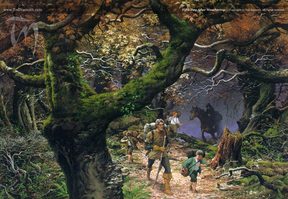
I was very quick to trust the elves. Once the Black Rider fled from Gildor Inglorion and his company, I essentially trusted elves from then on. I do not remember a single instance when I questioned this trust throughout LotR. Even when the Fellowship confronted elves in Lothlórien, I felt the tension between two factions on the same side but did not assume that the Galadhrim were evil. To rewrite the Frodo line from the meeting with Strider, I deemed that elves seemed fair and felt fairer. Even if this perspective is unique to me or is not entirely based on the published text, it has proved very significant in my understanding of Middle-earth. From the beginning of my experience, the elves were truly Good People. The evil loose in Middle-earth could not tarnish their spirits. They were the bright light in dark places, even among the trees of the Shire.
My interpretation of the elves owes a lot to the fact that Gildor’s people are aware of Bilbo’s farewell from the Shire, they call Bilbo a “good master” and they laugh in their dealings with the hobbits (FR, I, III, 80-1). The familiarity and kindness of the elves, along with their opposition to the Rider make them likable. I found myself, like the hobbits, cheered by their presence.
This feeling of wholesomeness extends to Glorfindel, although he meets the company under more dire conditions. While the group is struggling to get to Rivendell when they meet the elf, Glorfindel acts as a catalyst for action. He spurs Frodo on across the Ford and he helps the others confront the Riders. More significantly than this, however, is that Frodo glimpses Glorfindel “as he is upon the other side” (FR, II, I, 223). This cements the association between the elves and the ethereal, making explicit the goodness of the Good People.
The other-worldly view of Glorfindel not only reasserted the allegiance of the elves, but it prepared me to experience Rivendell as a place removed from the world. We will talk about Rivendell more in the next post, but for now I just wanted to link Glorfindel’s ability to be both in the world and yet detached from it as foreshadowing one of the essential qualities of Rivendell and Lothlórien.








 Luke Shelton PhD